There’s something far, far away about the name itself. Cambodia is a country of 17 million people, 90% are Buddhist (but with a strong Hindu history and a lot of hybridization). The balance are a few Muslims from Java, and a few Christians – mostly Korean ex-pats, or refugees from oppression in China.
Cambodia is a democracy on paper. But the same family has been on the throne or leading the parliament for 40 years. Voting is universal. But it’s largely a symbolic support for the family, and a protest recognizing the end of Pol Pot’s murderous communist regime. Free speech or criticism of the royal family is not a thing.
The country is a bowl, ringed by high mountains. The result is near complete protection from annual Typhoons. The climate is warm and water is plentiful due to a 5 month rainy season from March to August. There is a deep lake at the center (the deepest in South Asia) that serves as a drainage basin and prevents flooding. No flooding, no typhoons – so two full rice harvests, and lots of surviving ancient architecture.
Travel here is about Temples. Angkor Wat is the largest and most famous (by law, no building in Siem Reap can be built taller). But there are 1,900 ancient and significant temples in Cambodia.
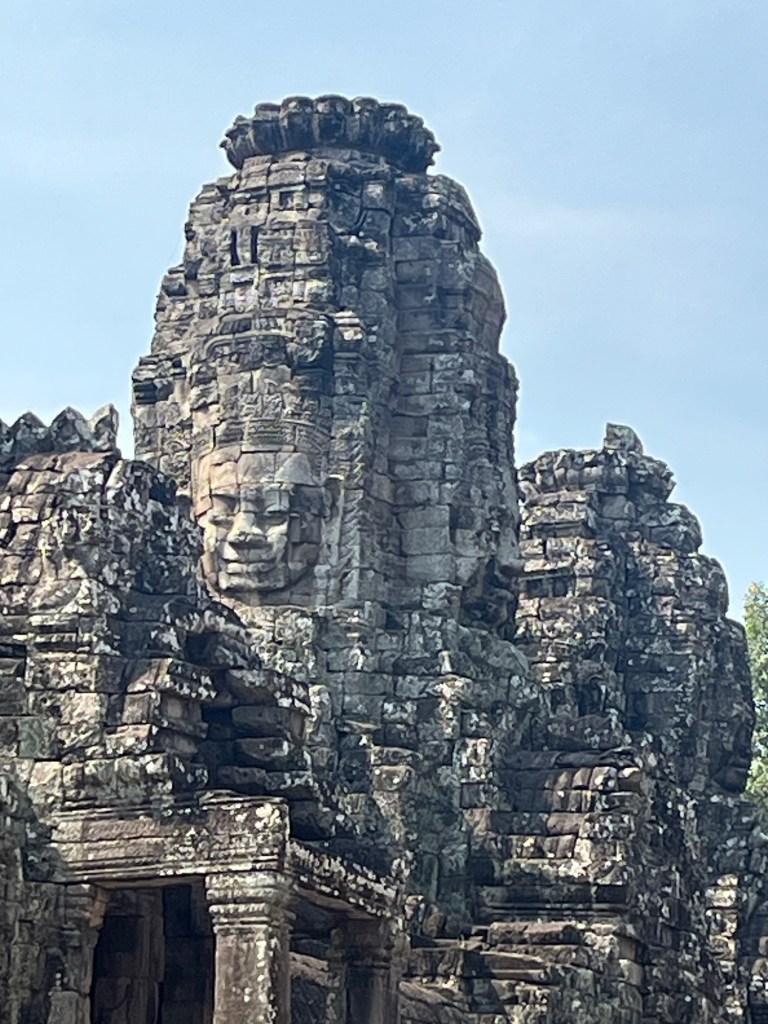
The Cambodia’s Golden Age was 1200-1300, and particularly the reign of Jayavarman VII (or Jaya 7), the strongest leader of the Angkor Empire.
Cambodia’s Dark Ages were only 40 years ago when the Khmer Rouge under Pol Pot murdered over 2 million people (25% of the population at that time) in a Communist purge from 1975-79.
They killed all students and professors, doctors and professionals, and drove the citizens out of the city enslaving, starving and massacring them whole cloth. This oppression and death continued for 4 years and is a psychic scar on everyone we meet.
Everything in Cambodia seems to revolve around one of these two histories. The current generation still includes victims of Pot. But the pride and zeitgeist (and business) spans back to Jaya 7.
We started our day at the temple of Sras Srang, watching the sun rise over a gigantic 8×12 kilometer hand dug reservoir. Constructed under Jaya 7, the reservoir served the entire community with drinking water, communal swimming, rice irrigation and worship.
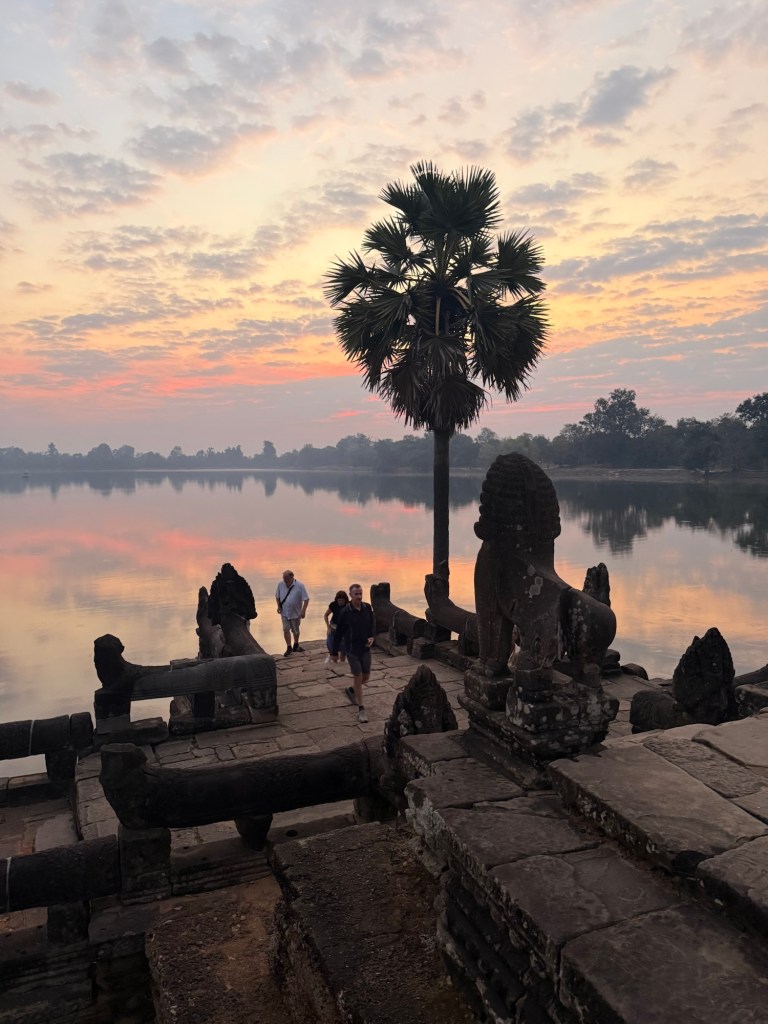
Sun up, we made visits to two other temples Ta Prohm, and Takeo.
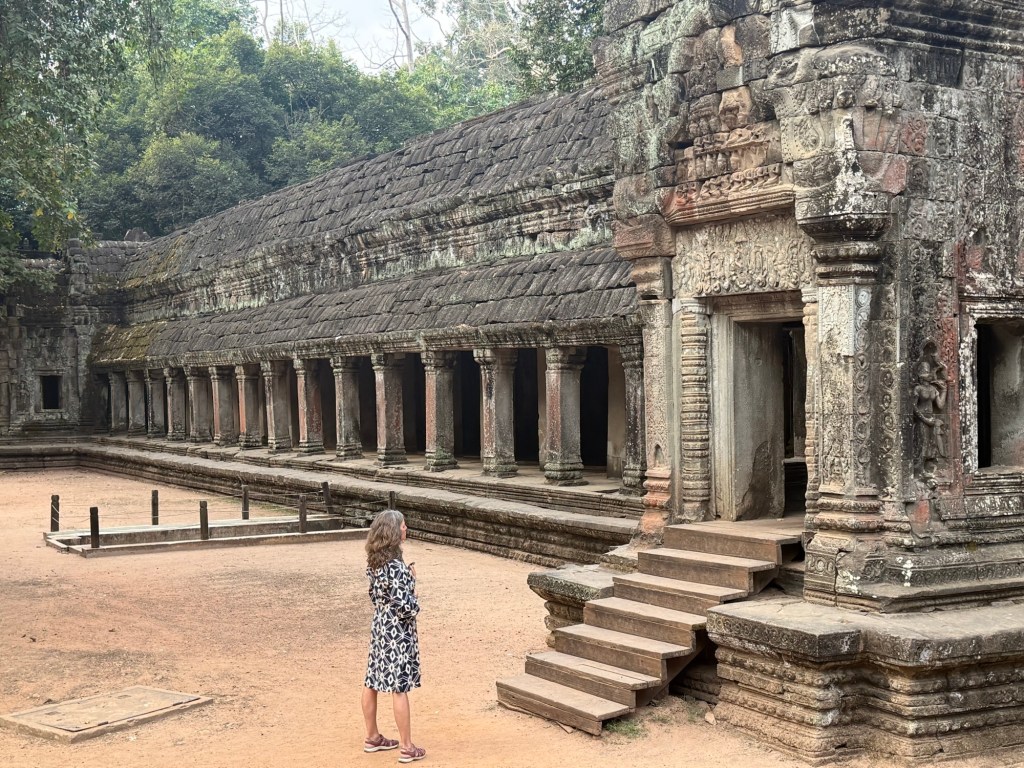
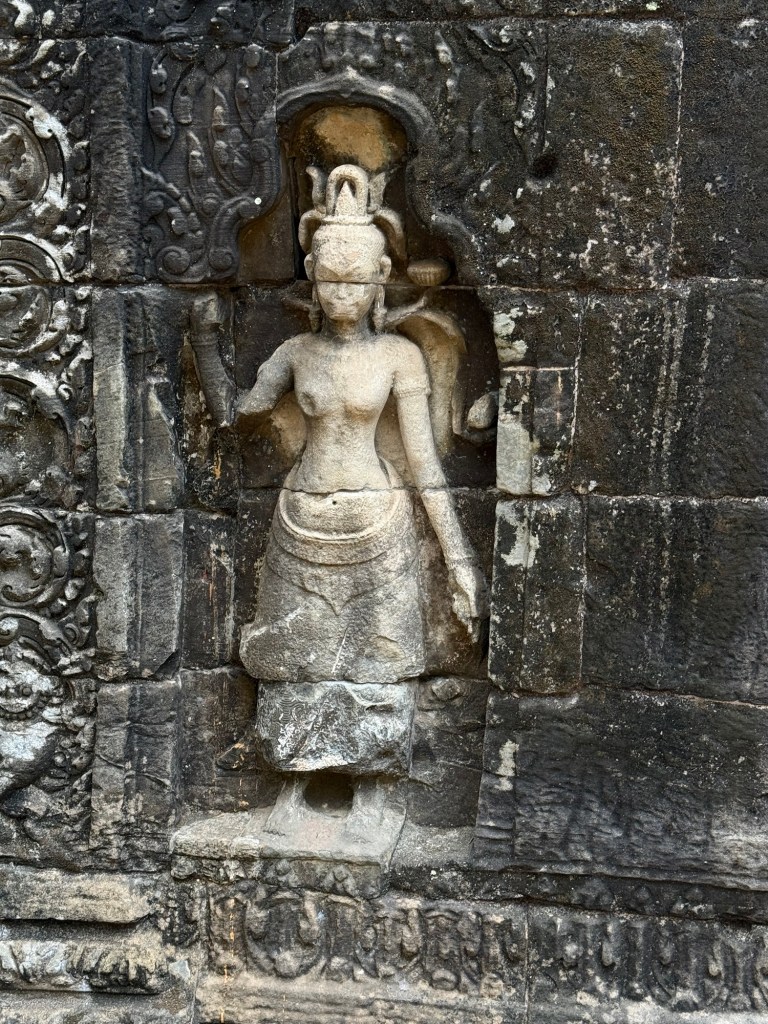
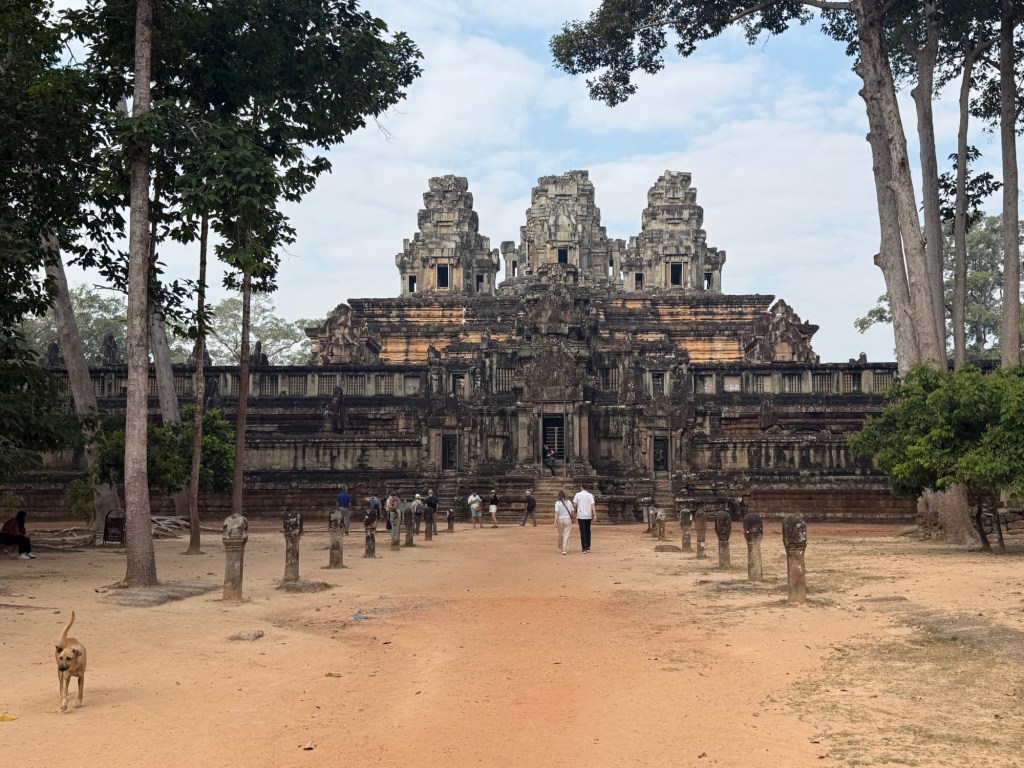
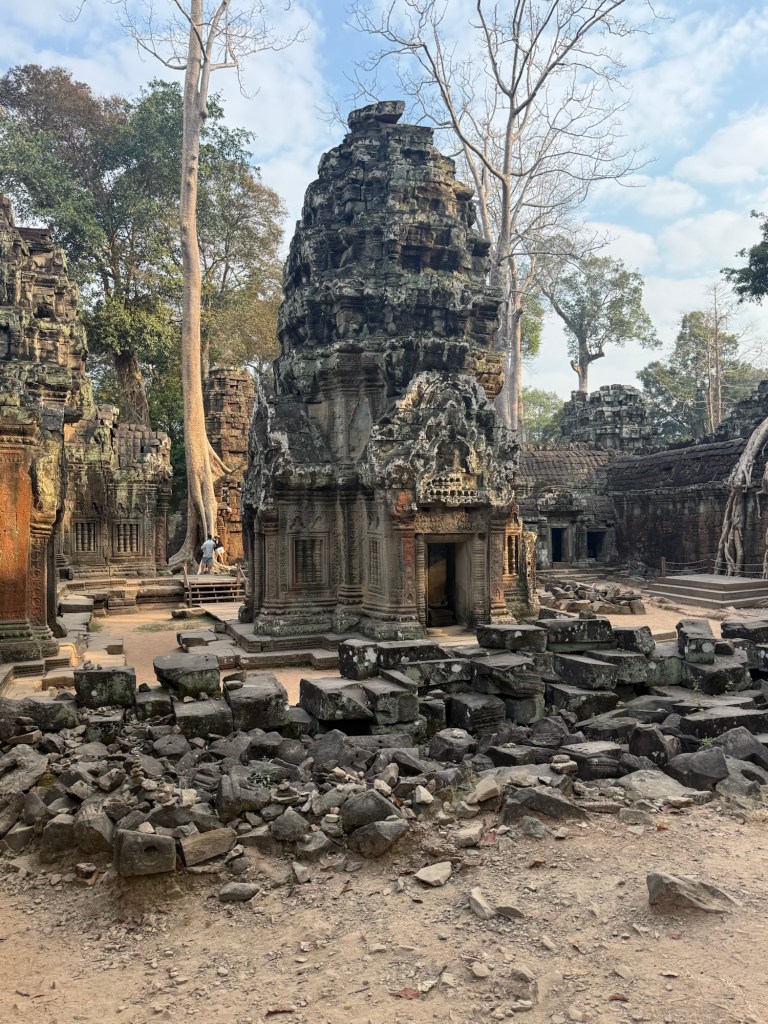
The temples are fascinating. Generally built communally as acts of worship, the bases are laterite – a form of quartz. The tops are sandstone, allowing the most intricate carving imaginable. The temple structure is built from the bottom up. A second set of craftsmen does the carving – from the top down!
The temples often structurally represent Meru, the home of the Gods. Meru is sounded by rings of 7 seas and 7 mountains. And the gates and moats that surround the temples are representative.
Some of the largest and most ornate temples are also Stupa, burial places for the Kings
Like Mayan, Aztec and Egyptian sites the temples are built on exact NSEW axis and frame Cellestial events (like the sunrise, spring equinox, etc) with mathematical precision. A mystery best explained by Aliens I think.
Many of the temples were destroyed during an invasion by Siam (historic Thailand) in the 14th century. They were literally pulled down by elephants!
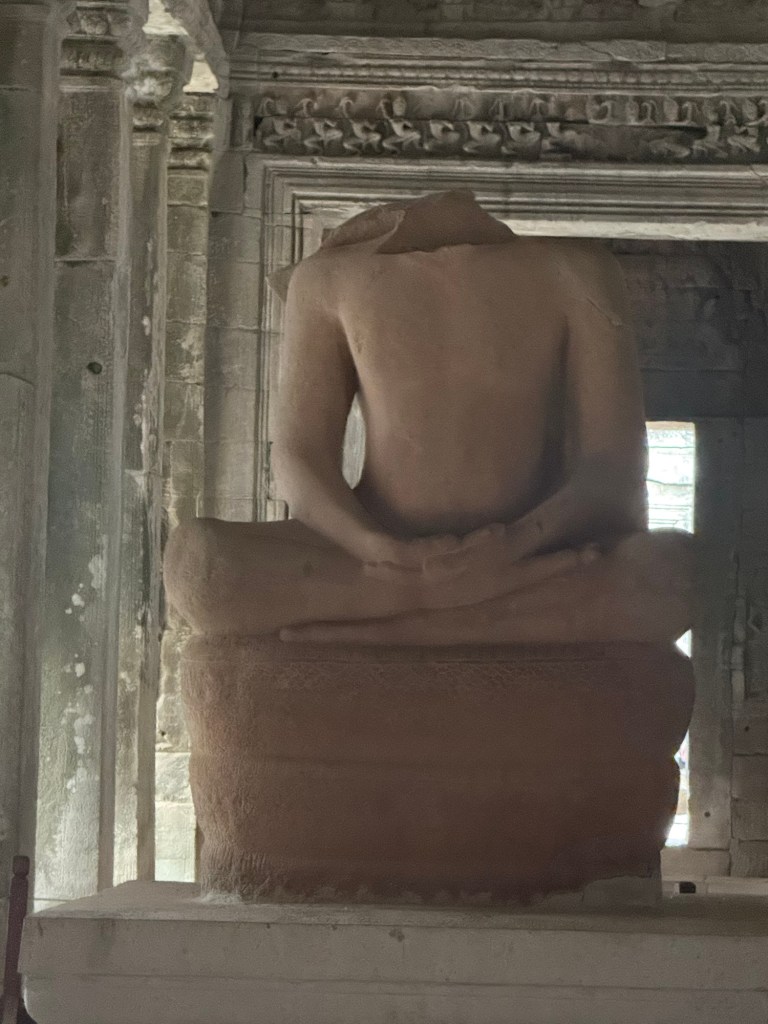
Many others were defaced as a backlash against the transition away from Hinduism under Jaya 7. Most of the Buddhas have been chiseled out. Others have been changed to include a Hindu third eye, or recarved into Hindu deities or lotus flowers.
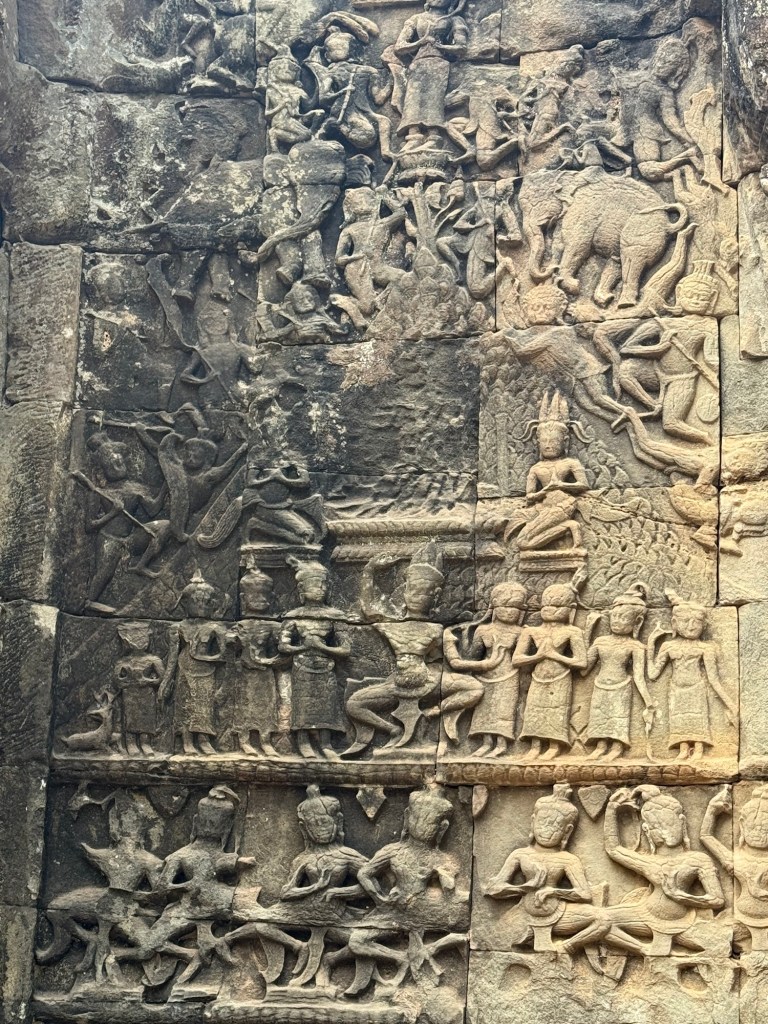
In the 16th through 20th centuries Western treasure hunters stole many of the gold artifacts and jewels. Each hole in the shot below was a large, rough cut precious gem (typically rubies, emeralds or sapphires). These were chiseled out in the early 20th century ala Indiana Jones. If you own a ruby today it’s as likely to have been stolen from a Cambodian temple as mined for you anywhere else.
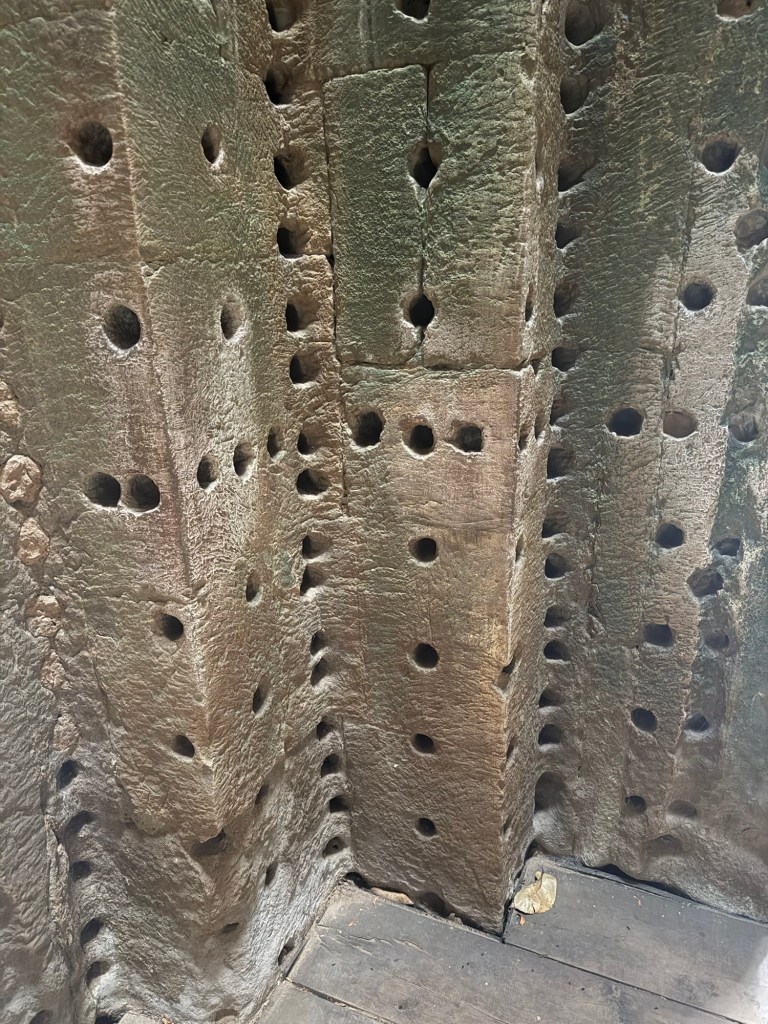
From 1975-85, the Kmer Rouge shelled and mined temples in their manic quest to purge all religion and history. More damage.
Even today the jungle itself is pulling sections apart as gigantic (protected) trees grow through and over the stones.
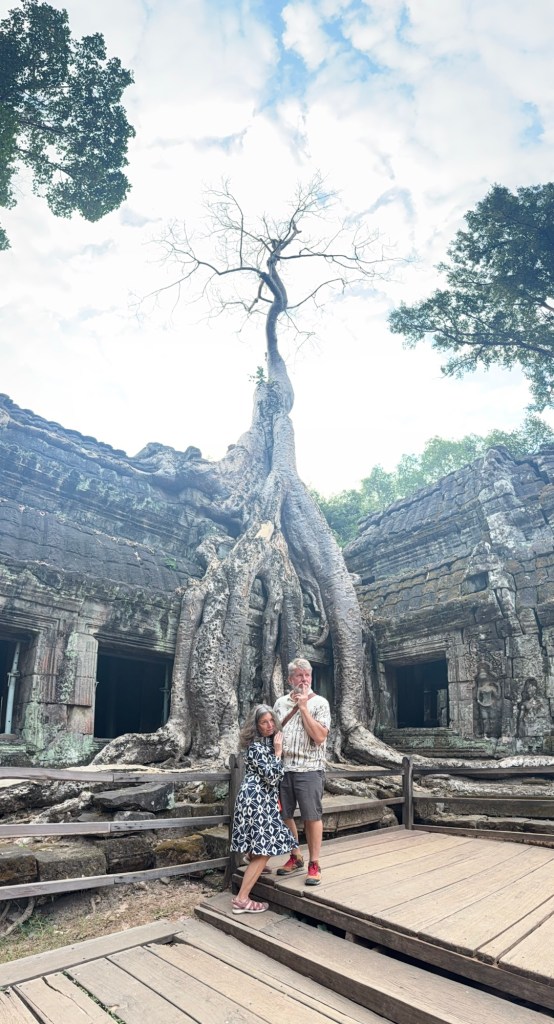
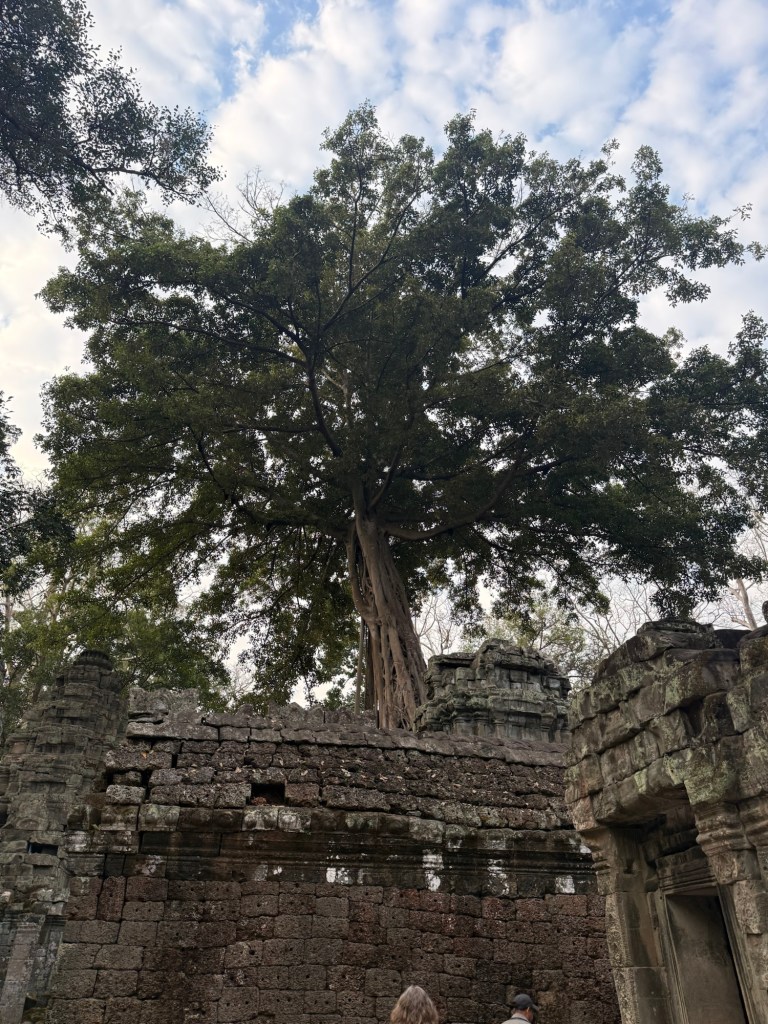
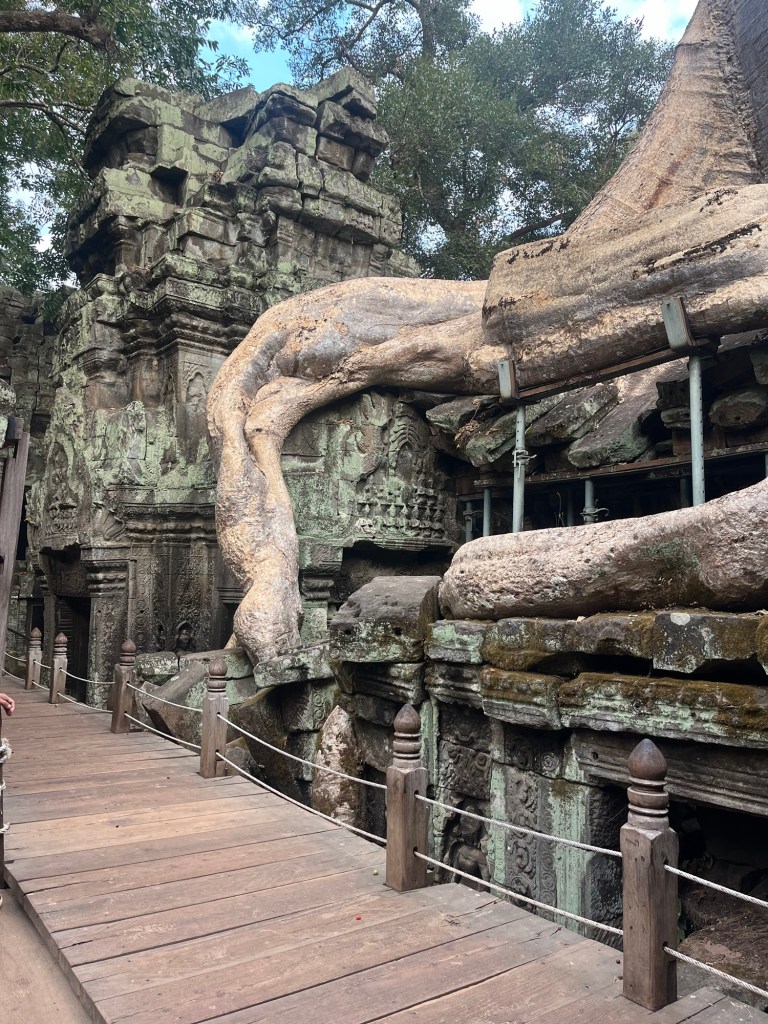
85% of the damage and loss is man-made. From the Hindu desecrations of Buddha to the destruction by Siam to the Khmer Rouge – noone knows how many temples were fully destroyed and scattered – fully gone.
What’s most amazing is what’s standing today. UNESCO has 90 temples under restoration. USAID had another 20 (we’re really sorry Cambodia). Many other global agencies and many Chinese NGOs have done or are doing miraculous restorations. Later temples and current restorations were often built from stone scattered by the Siam invaders. Each temple is a story of what was, what happened, what’s restored, and what they’re working on.
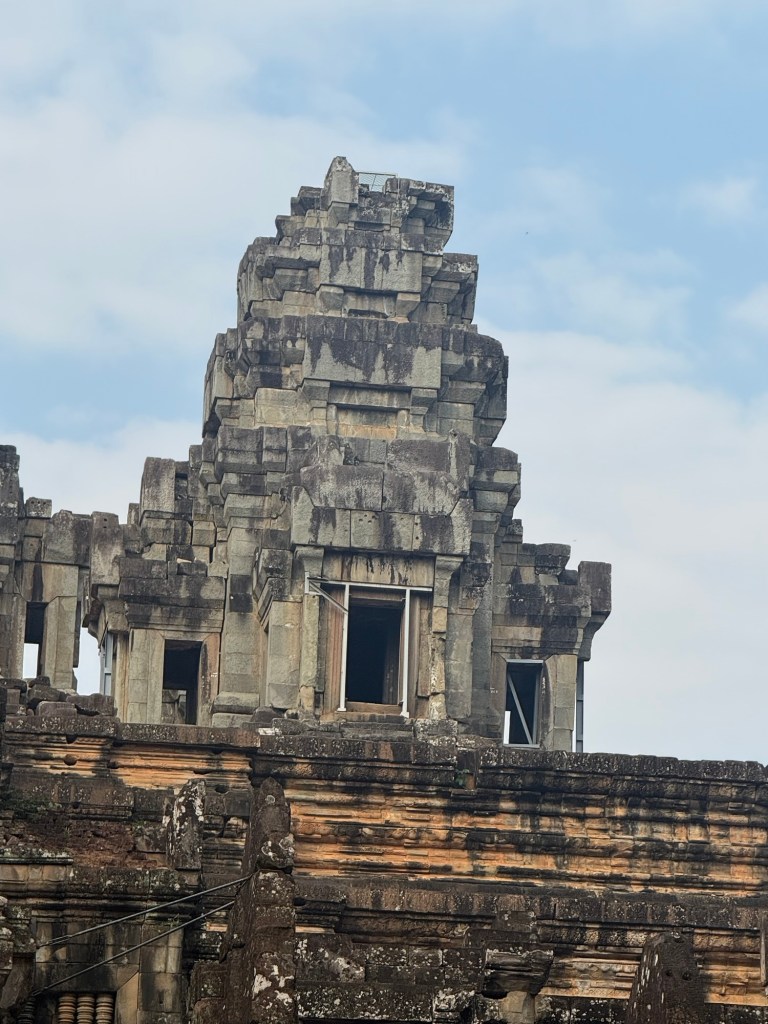
Rom points out each spot where a Tomb Raider scene was filmed. We also learned that both Vietnamese and Cambodians are a little Angelina Jolie obsessed.
Describing each temple and the detail Rom shared would be almost impossible here. The dude is encyclopedic. I’ll try and describe some common themes and features of the temples below. And I won’t try and describe where Hinduism and Buddhism start and stop.
The hybrid Buddha/Hindu traditions spin out a variety of characters that are featured in the temples
The Buddha – Before the Hindu and Siam defacements many towers had 4 Buddha faces pointing North, South, East and West. In Cambodian the four faces represent equanimity, compassion, loving-kindness, and appreciative-joy. These features are the goal of each real Buddhist as he seeks enlightenment. It seems like there are a hundred paths. But both Juju and I see it every moment in the culture, and friendliness of the people.
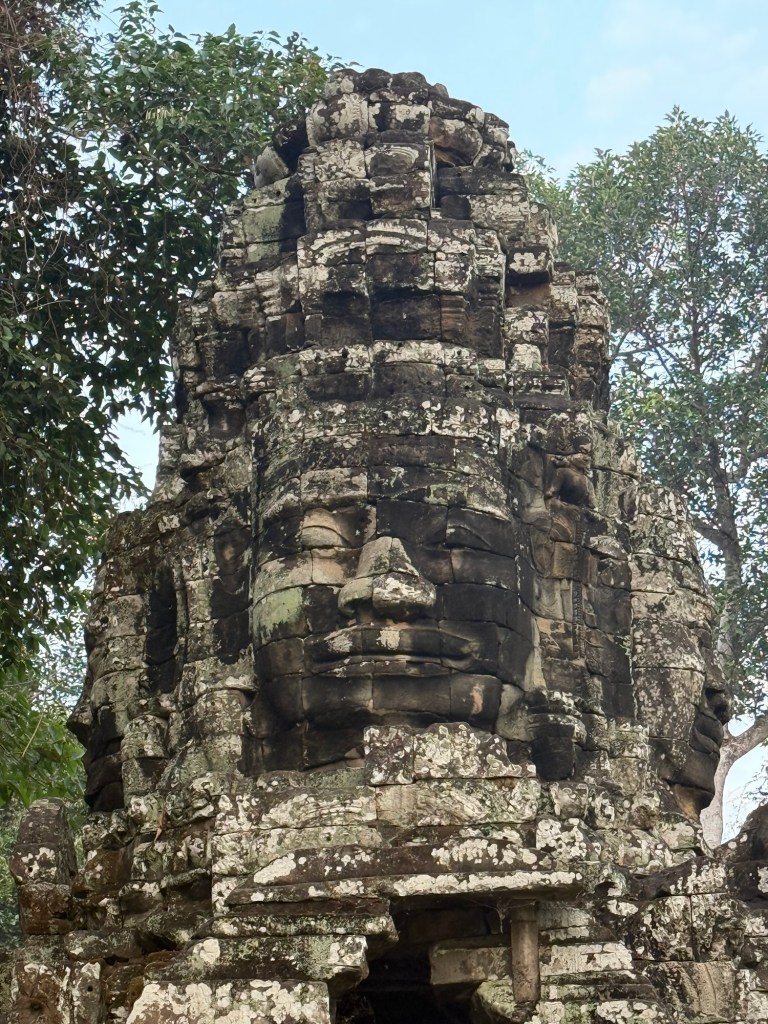
Jaya 7 – Jayavarma VII, also known as Mahaparamasaugata (1122–1218),
This guy! During his 50 year reign he built 189 temples, an entire royal city, 102 hospitals, 120 rest homes for pilgrims, public universities, extensive reservoirs, and 170 miles of moats.
He conquered a couple of neighboring countries, and established a governing system of 12 regional kings. As a side gig he basically started a new hybrid Hindu-Buddhist set of governance, ceremonial practices and architecture that stopped a millennia or so of blood shed.
Naga and Nagini, Demons and Gods – Vishnu (the God of Men) negotiated a truce between Gods and Demons so their warfare would not destroy the earth. It involved two huge snakes wrapped around an island and pulled back and forth by the two armies. This spun the island, churning the sea and producing the nectar Anrita which gave the gods immortality.
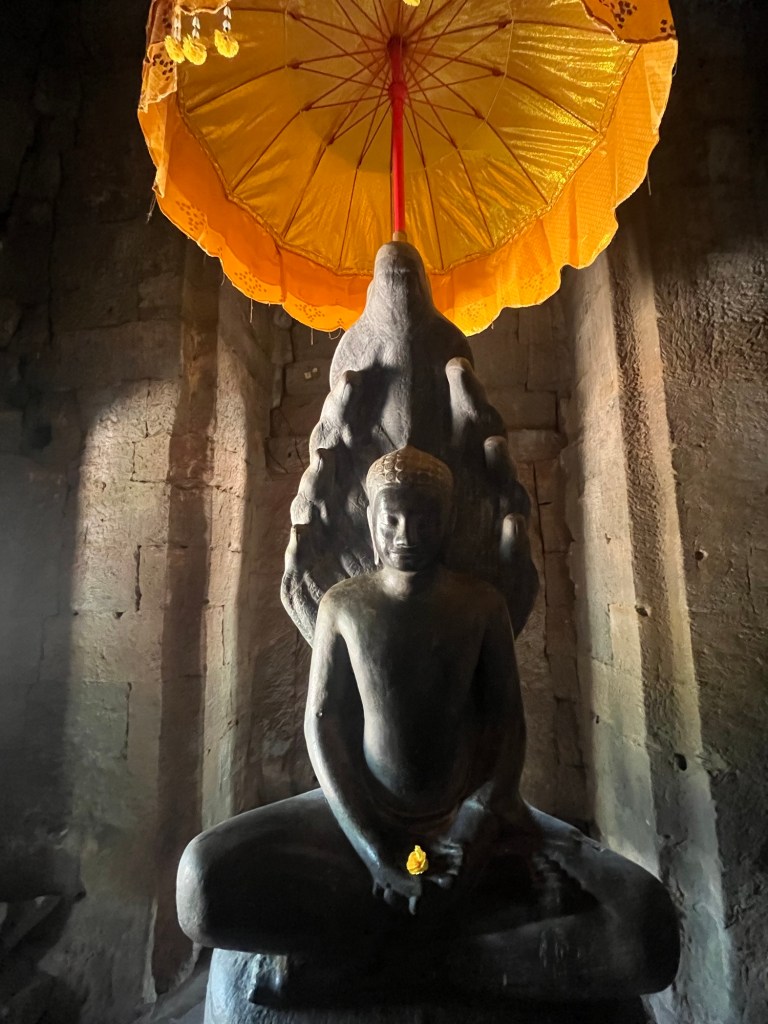
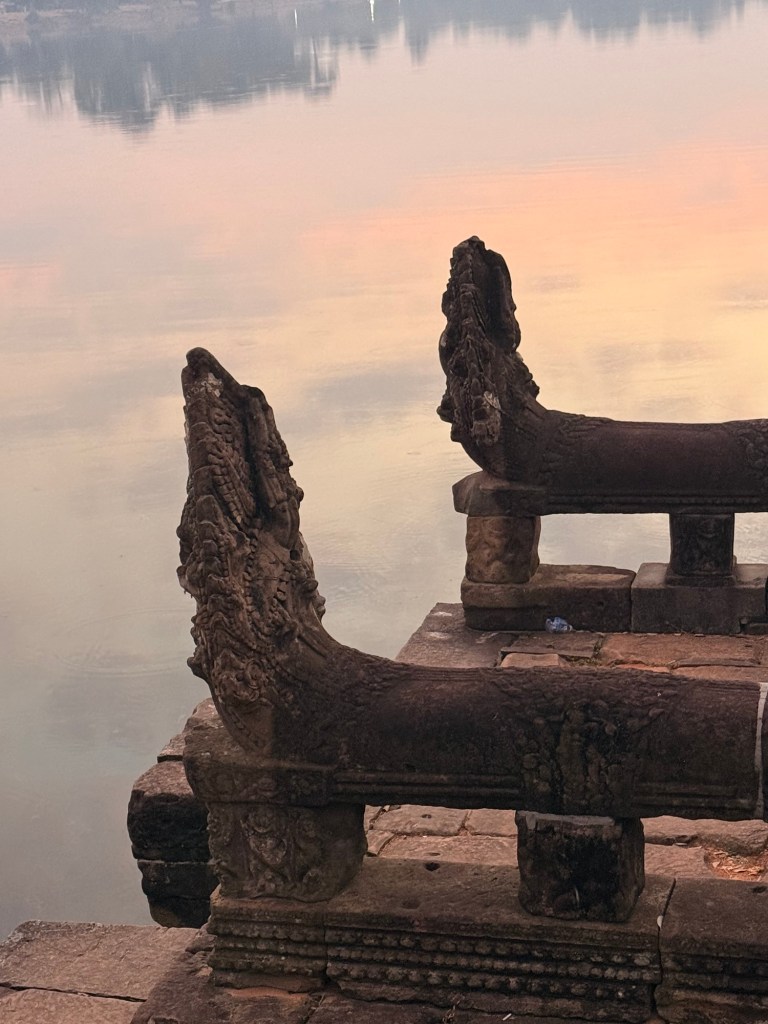
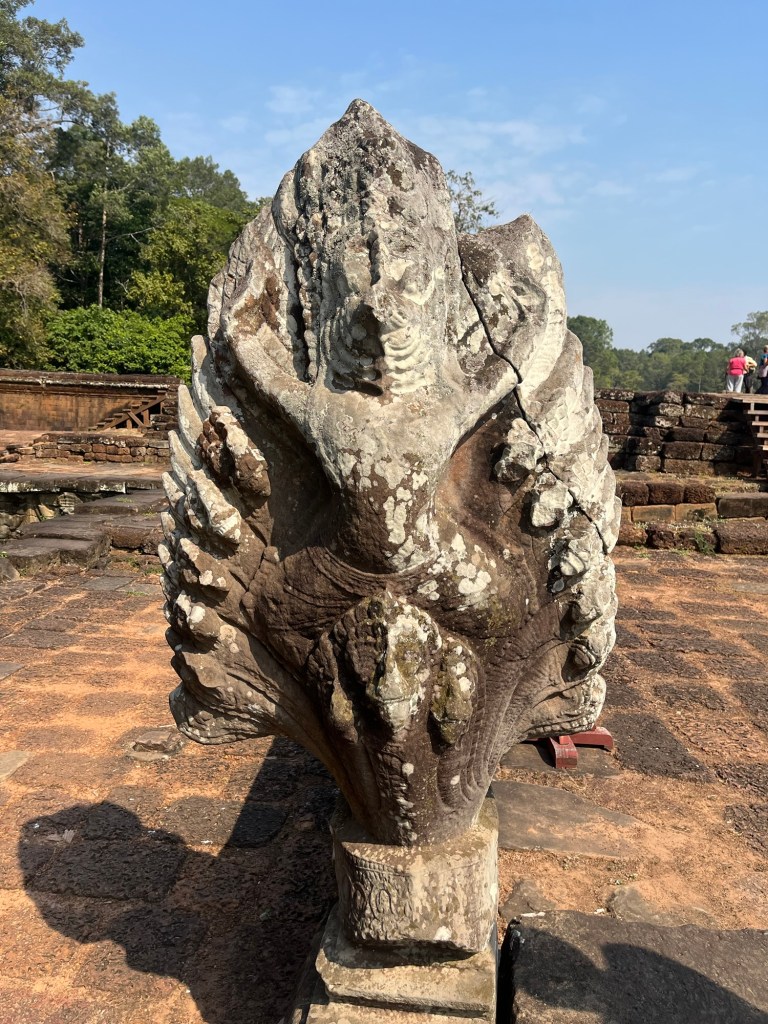
It also spawned a variety of new characters. The huge snakes, Nag and Nagini are featured as rails, roofs, and head covering for the Buddha in every temple. Kipling, of course, used them as primary character names in Riki Tiki Tavi.
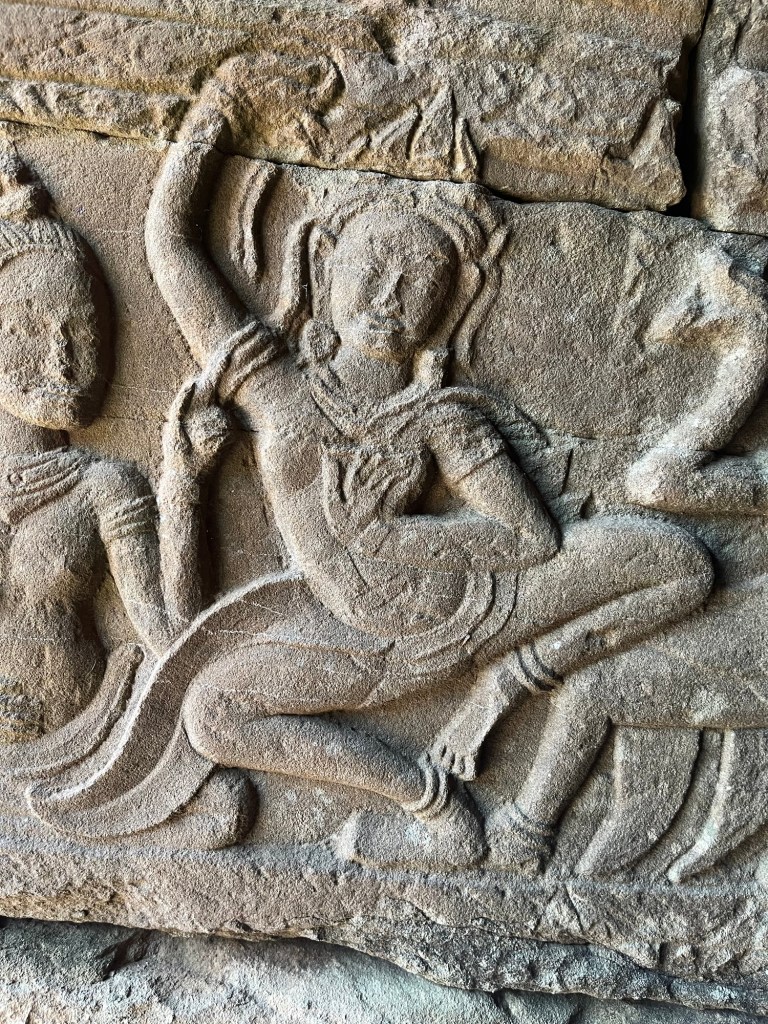
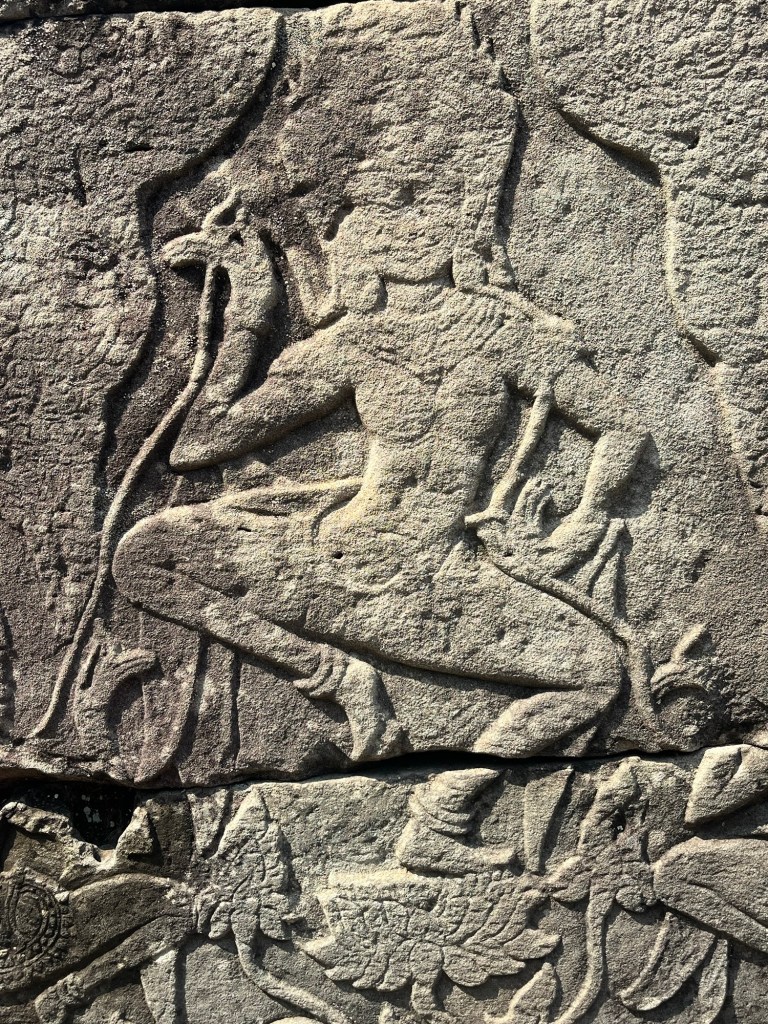
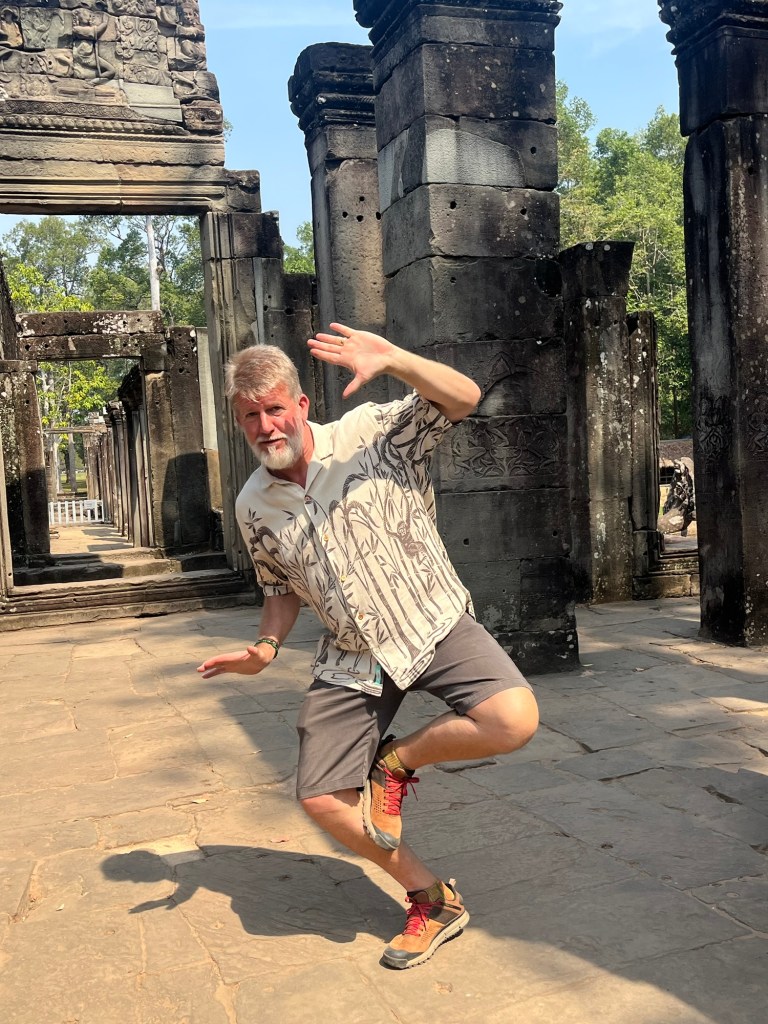
Absara Dancers – The iconic Cambodian image and a dance tradition still practiced today, the Absara are featured everywhere. Their dance, performed for the King is meant to represent the spinning and churning described above.
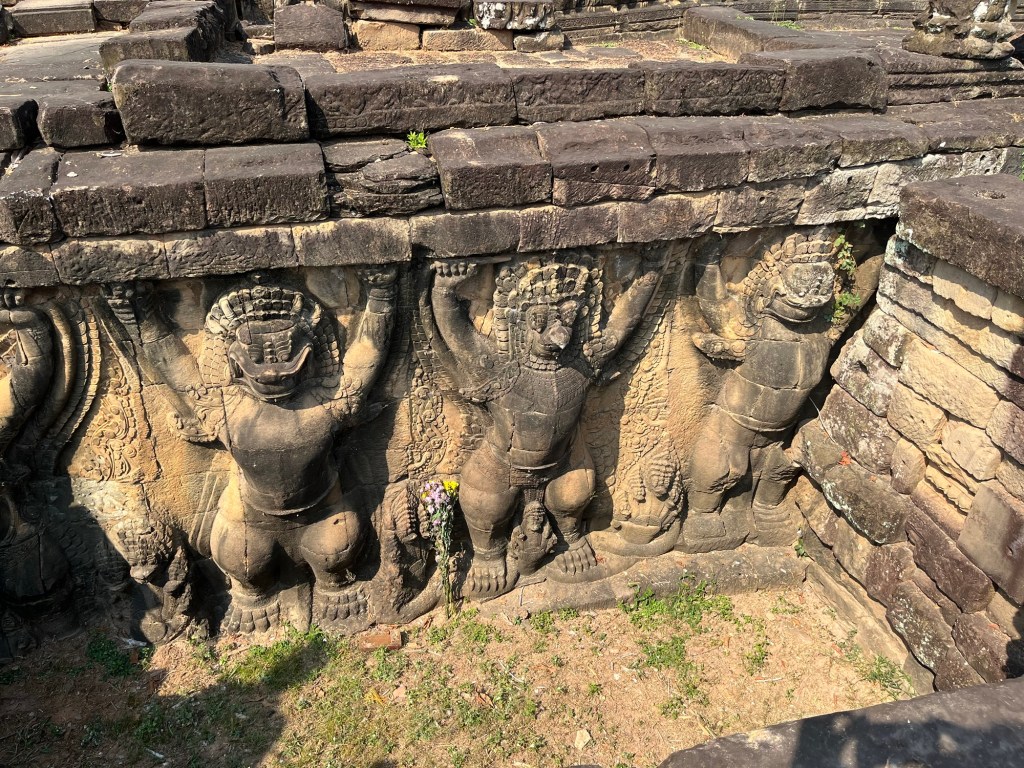
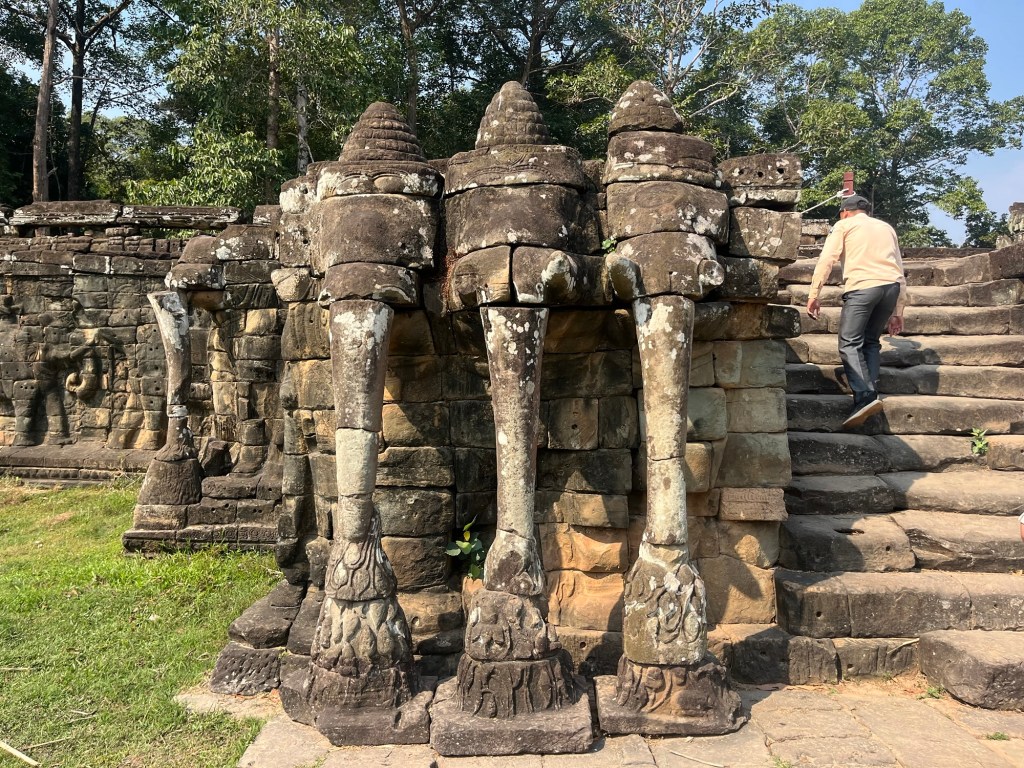
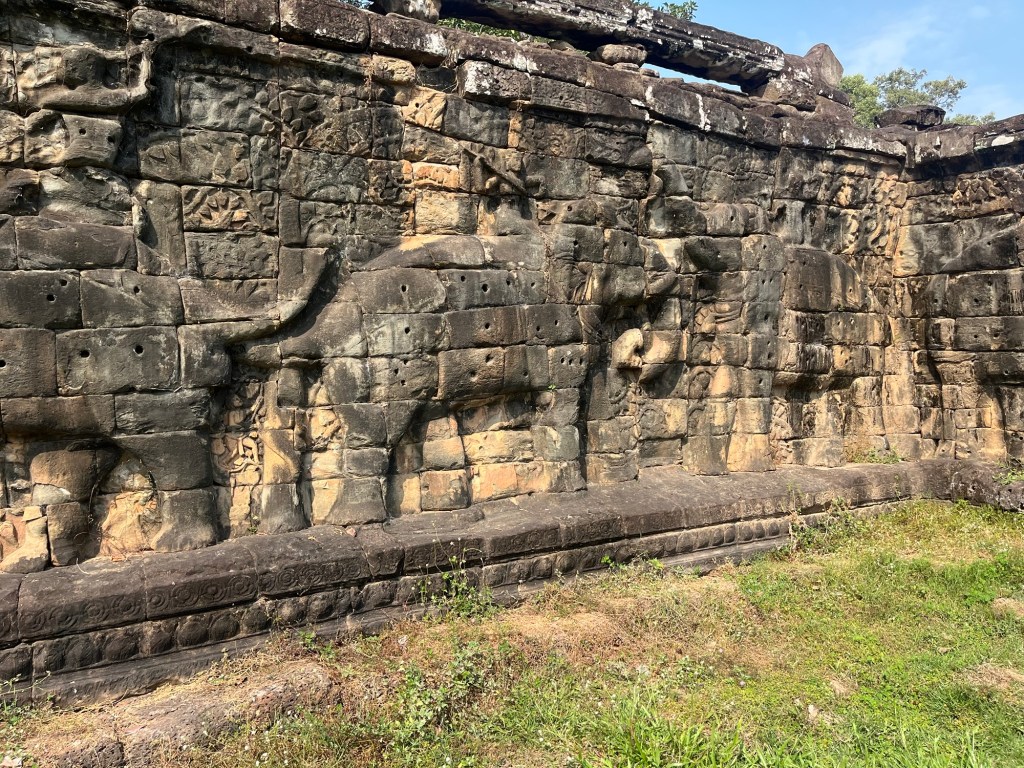
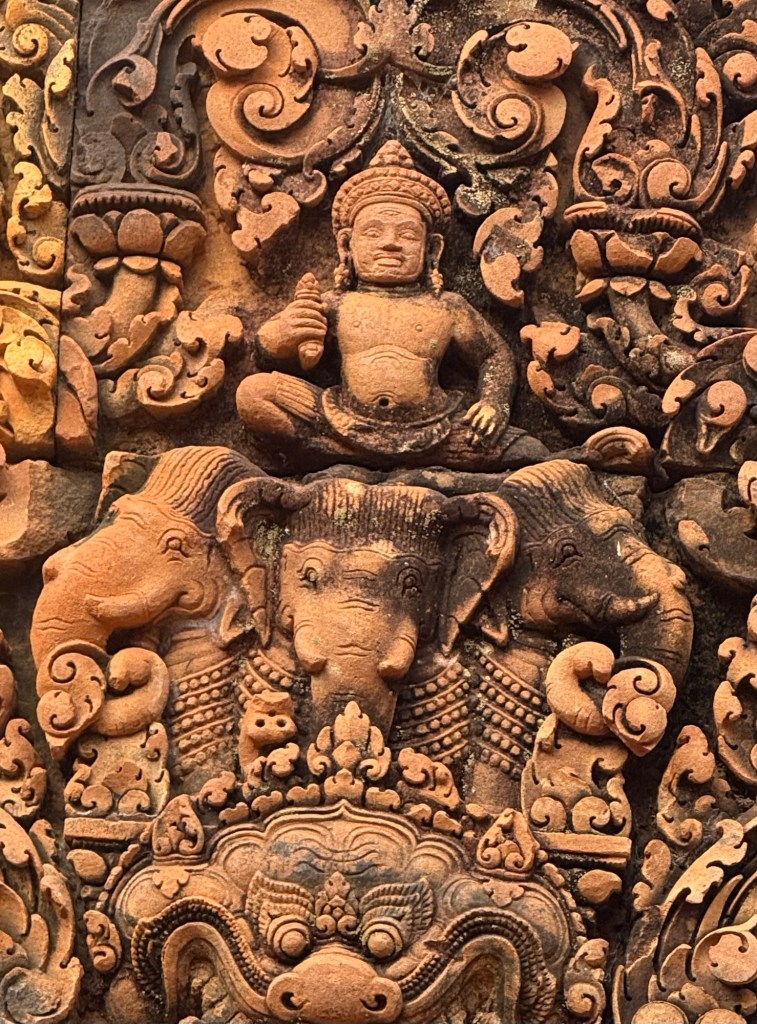
Giant Birds and Three Headed Elephants – Garuda (birds or phoenix) were spun from the froth, as were elephants including the 3 headed Iravanta. These entities serve as foundations and supports in most temples.
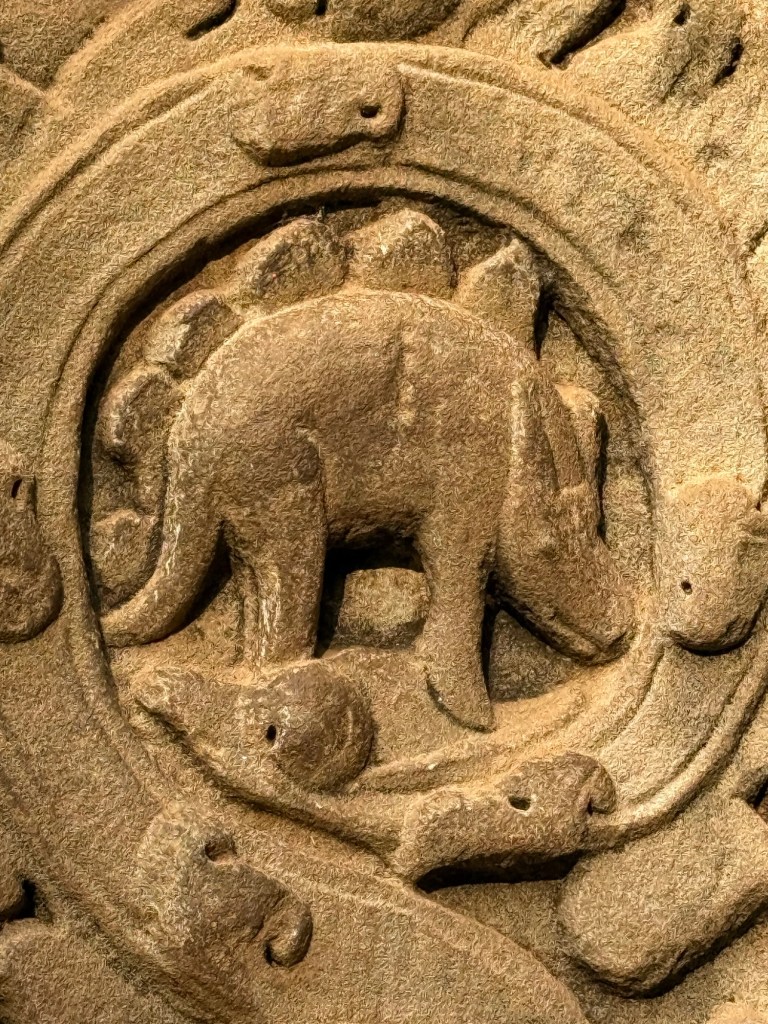
Animals and a Dinosaur (maybe) – Natural motifs, plants and native animals are featured in many carvings. One repeating figure raises a lot of questions among archaeologists. Were there dinosaurs surviving into the 13th century?
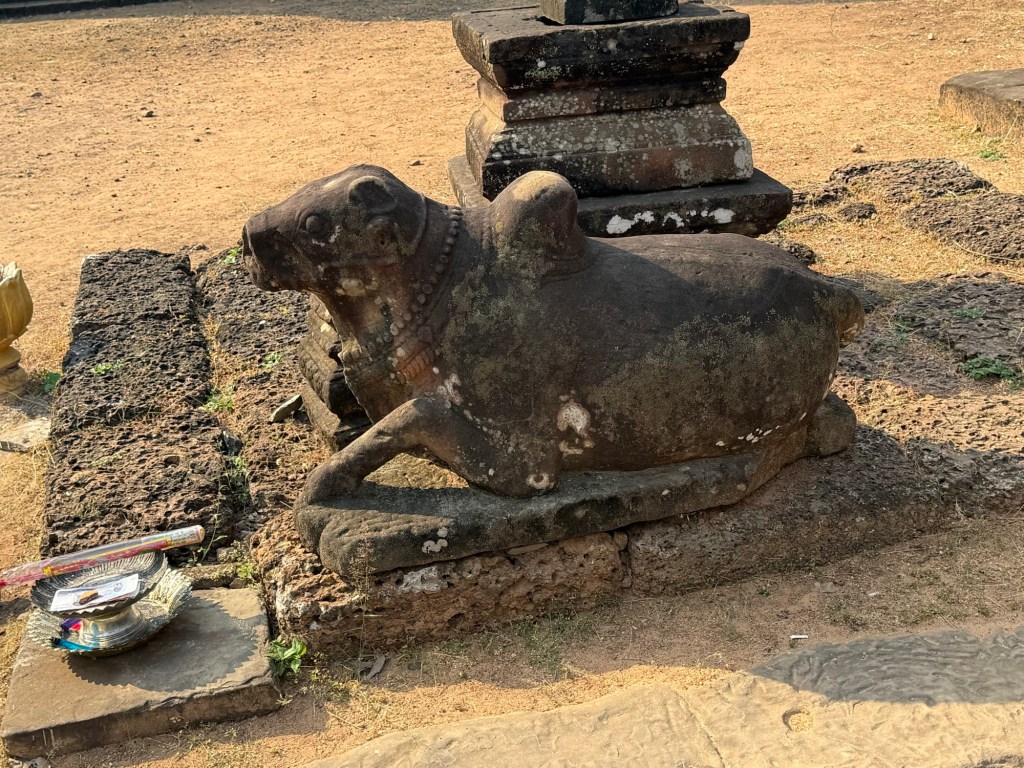
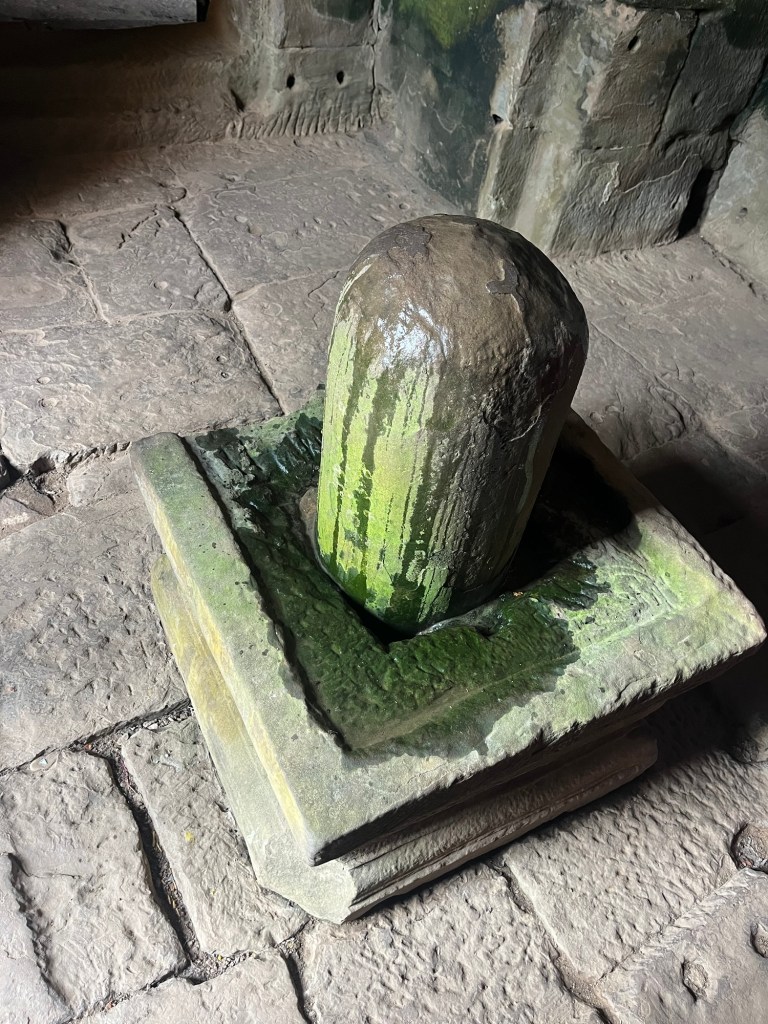
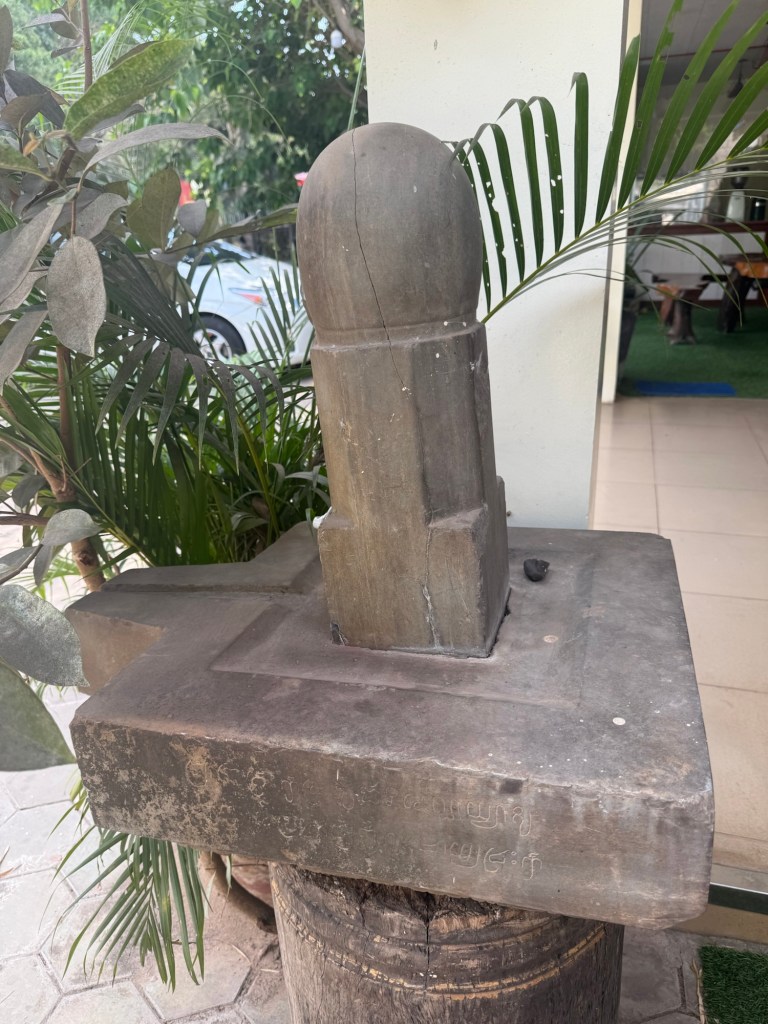
Phallic Symbols – Common in most temples are vertical phallic symbols representing lingam (the shaft) and yoni (the base). These are ancient, sacred, Hindu symbols representing the union of masculine and feminine energies. Visitors to the temple poured grain, died water or coconut milk over the sculptures to entreat the Gods (specifically Lord Shiva and Goddess Shakti) for favor.
BirdSnake – Jaya 7 introduced a new character found in most later temples combining two natural enemies, the bird and snake. This character places Hindu Garuda inside the mouth of Buddhist Naga and represented the final hybridization of the faiths, and a peace lasting essentially today.
There were many more features and characters but this is getting long.
Later in the day we drove between two huge Naga and Nagiana supported by a dozen Demons and a dozen Gods and through the “Victory Gate” and into Angkor Thom.
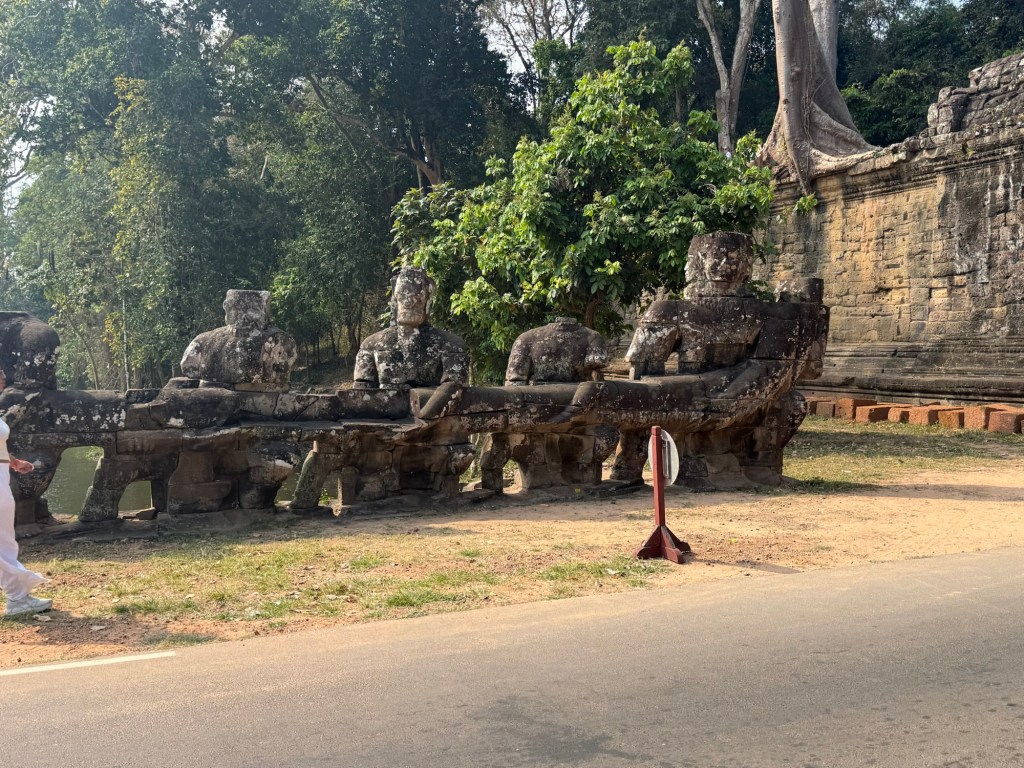
Suryavarman II built the royal city 200 years after the reign of Jaya 7. Angkor Thom is surrounded by a huge moat and 40 foot walls. The 4 square mile city includes 12 (relatively) small temples for his 12 kings – each with its own Buddha or guardian God, 4 large royal temples, and 4 small temples for various family members.
The Terrace of the Elephants, a huge platform 1/4 mile wide and 15 foot high was the royal receiving area from which kings would review their elephant armies, hold sporting events, or receive delegations from subordinate kings.
Several huge temples including Bayoun, Baphon and the kings own Phimeanakas Temple were within the city walls. Giant man made pools, separated by male and female, were dotted across the ground. Ponds for fish and ceremonial water offerings were near each temple.
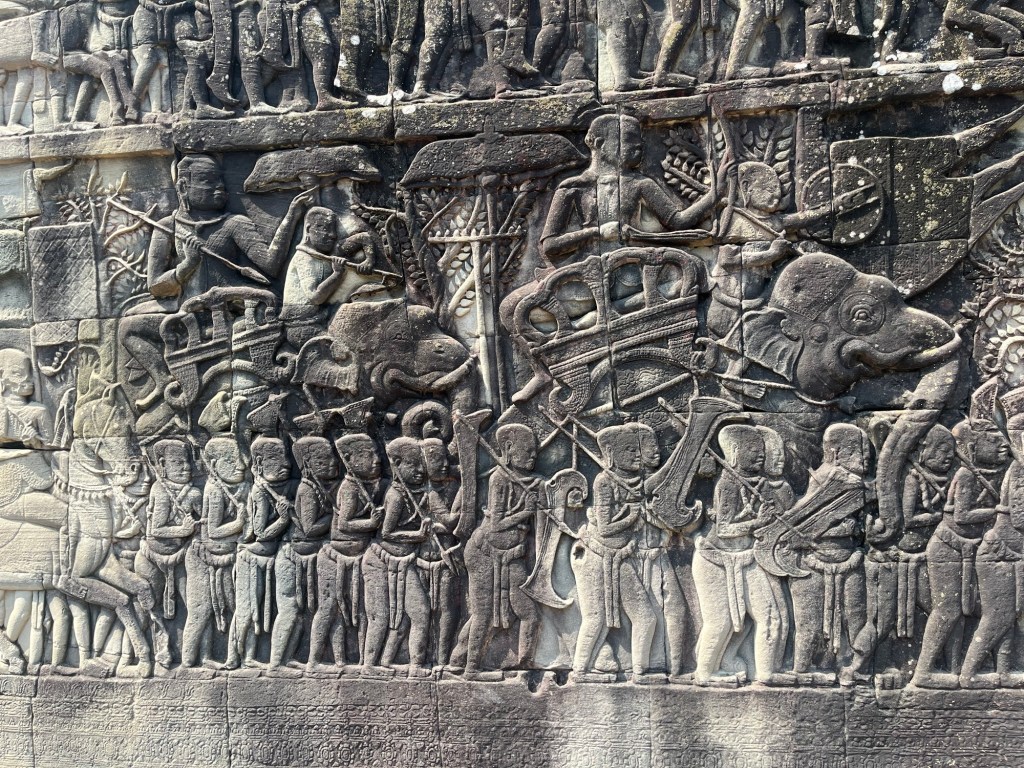
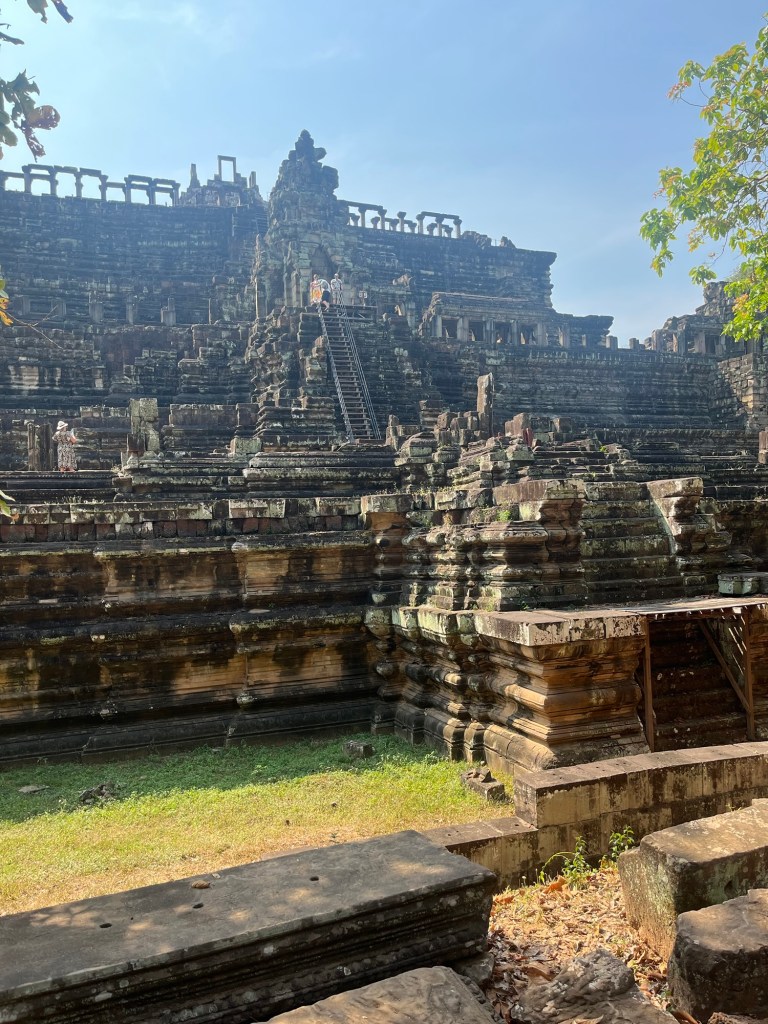
The grounds today feel like a verdant jungle broken up my massive royal structures. But recent LIDAR imaging shows that the city was densely packed with wooden homes. The King’s own palace (wooden) surrounded his temple on all four sides, but only the foundation and broken clay shards from the roof are there today.
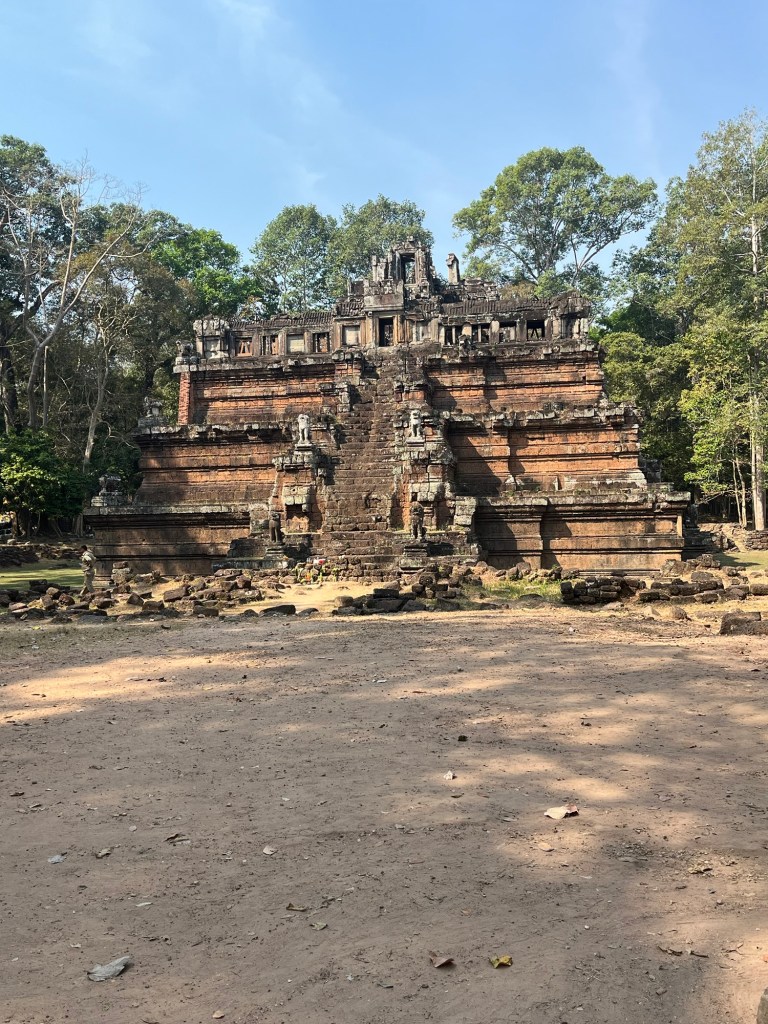
So there you go (and we haven’t even made it to Angkor Wat!)
 Mac and Juju explore Southeast Asia