We keep running into other fellow travelers from Vietnam as we progress. Hello Bev and Jackie, Bruce and Laurie, Simon and your beautiful bride (?? sorry).
And now a random list of Cambodian commentary, events, and experience that aren’t history and aren’t temples…
The Sinta Mani Hotel is a western focused hotel. Lots of loud Americans, and missing our Asian breakfast buffet. But a smash burger by the pool? That’s alright.
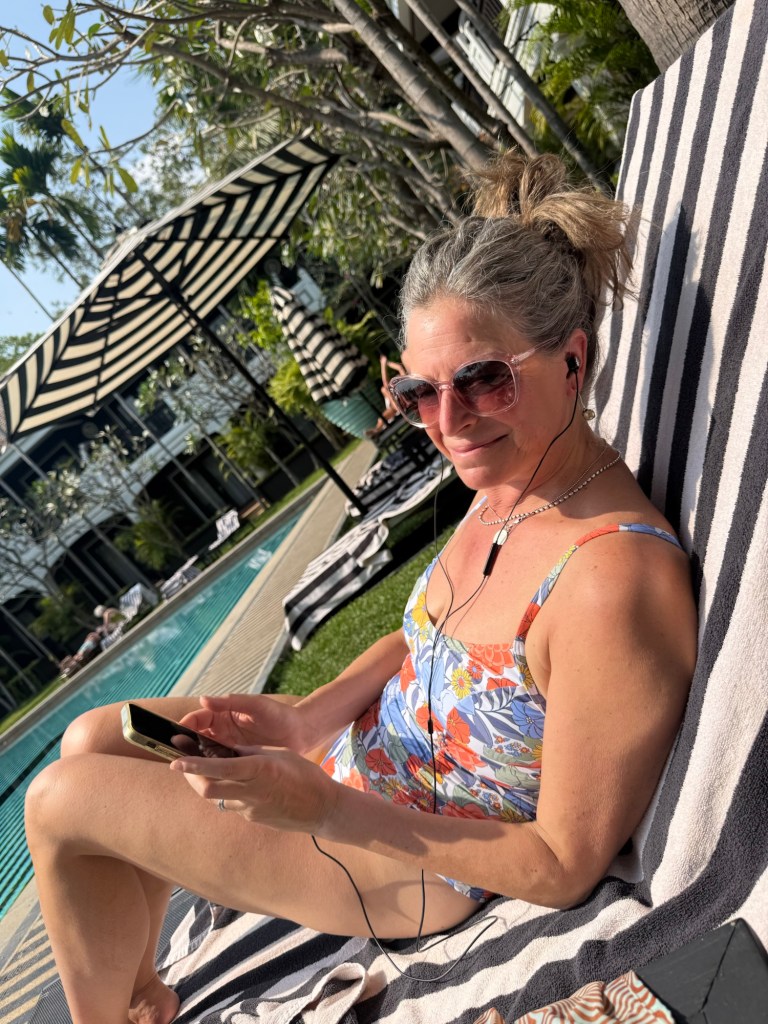
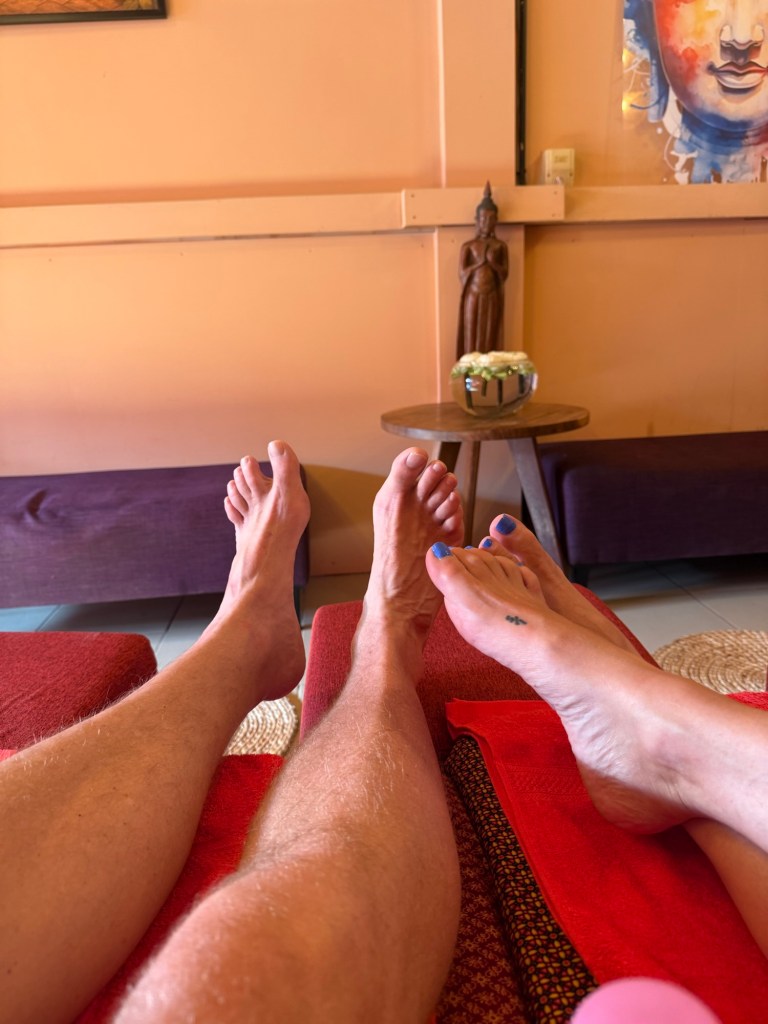
Pool Time2 Foot massages, and 2 double margaritas, $13
Another round of music lessons – Juju jamming’ for mine victims.
Juju laying it down
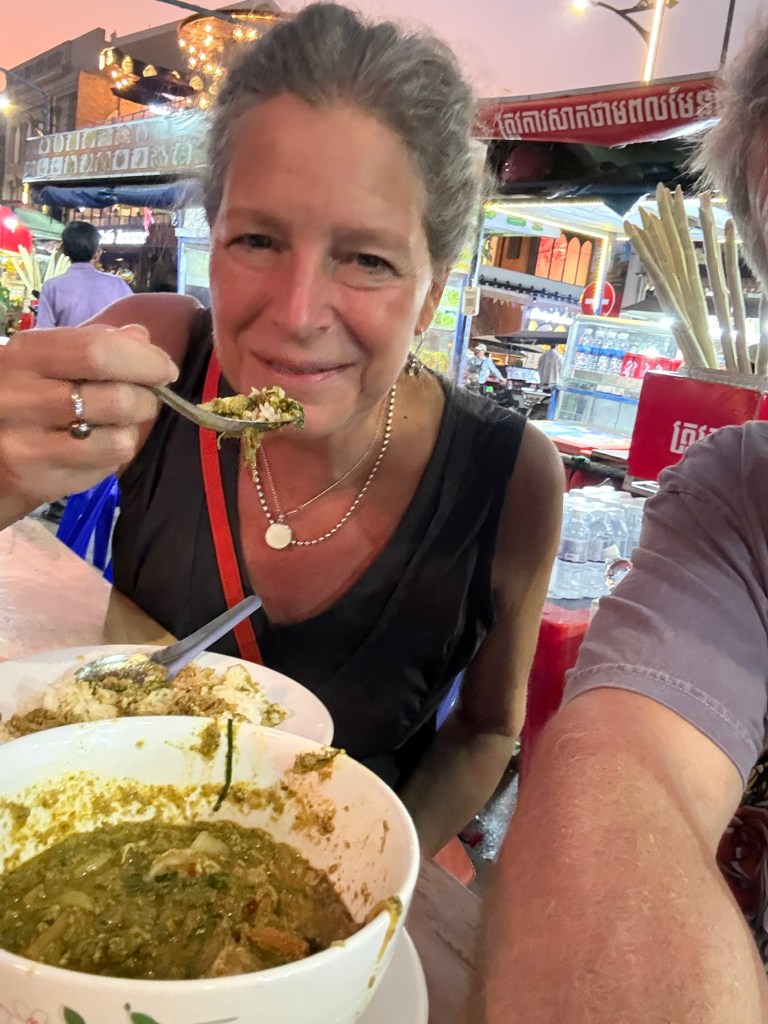
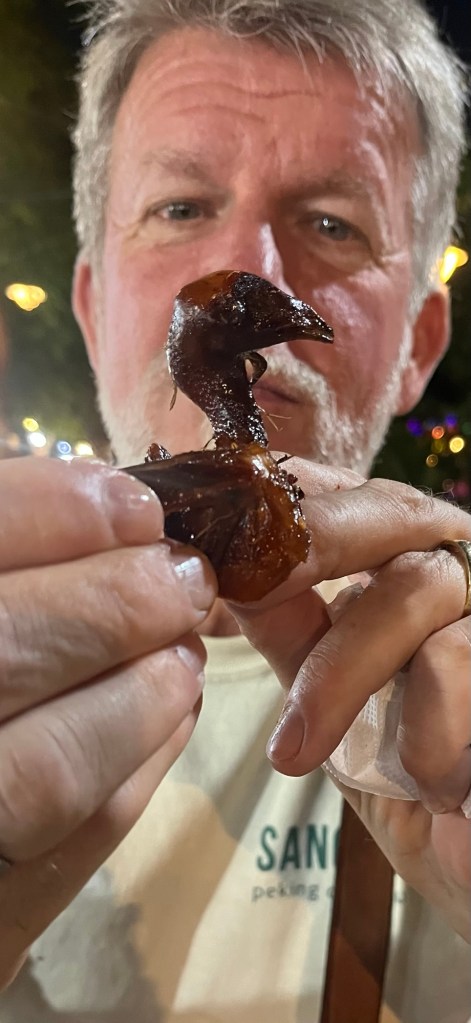
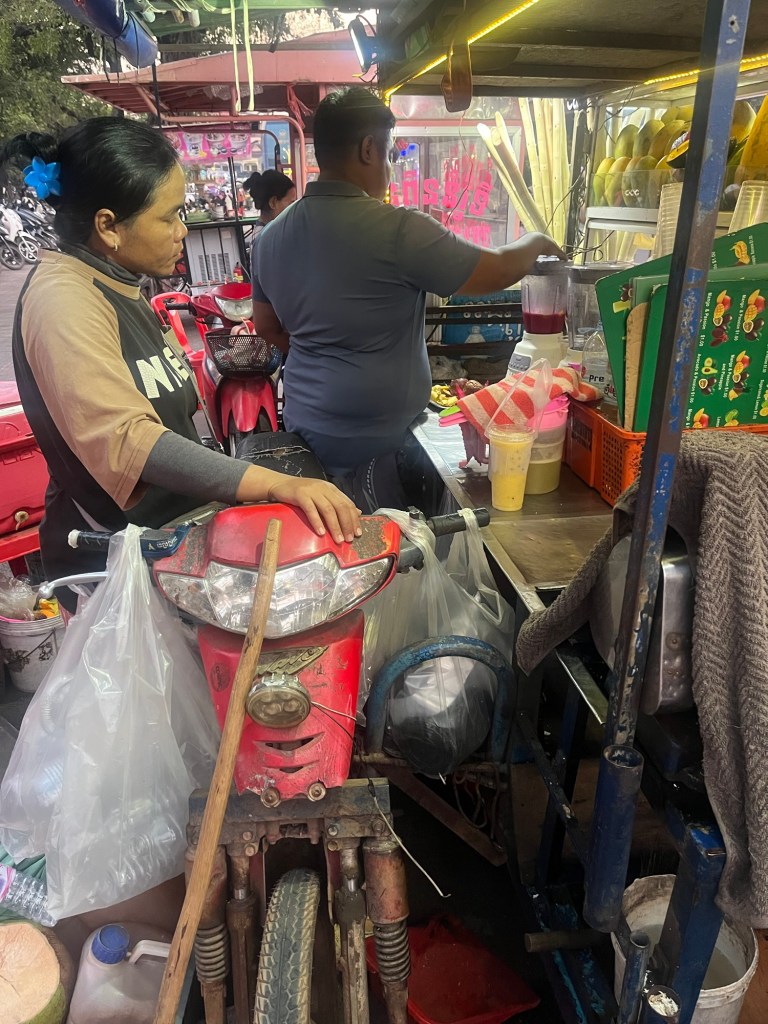
Street food: Amok (traditional Cambodian stew) and fresh fruit and rum slushies (blender powered off a motorcycle!). Grilled quail, squid, and pork belly.
AmokRum Slushies ala YamahaNot much meat on the skullGas powered slushy blender
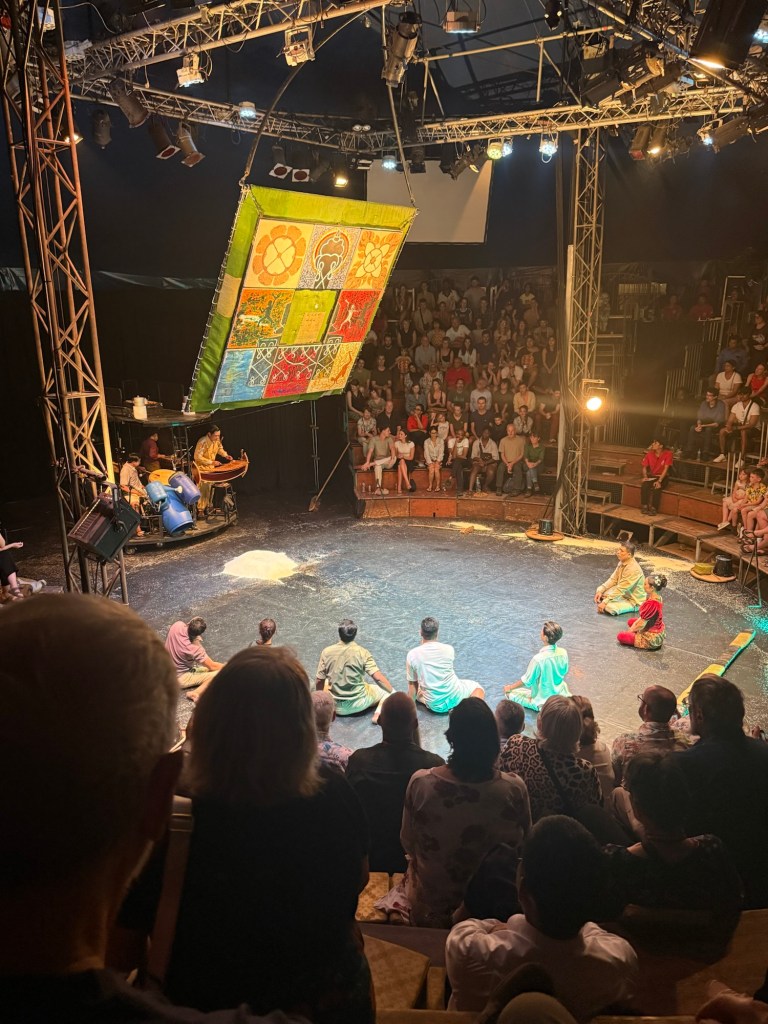
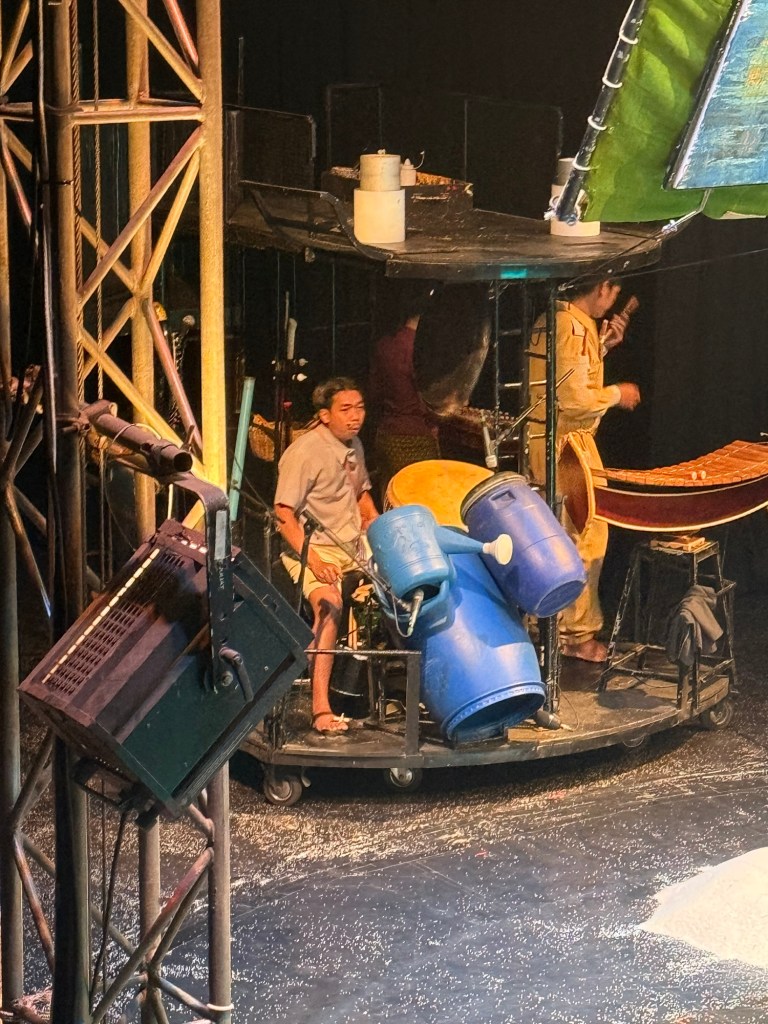
Cambodian Circus Performance – mind blown
Circus TimeThe Rhythm Section
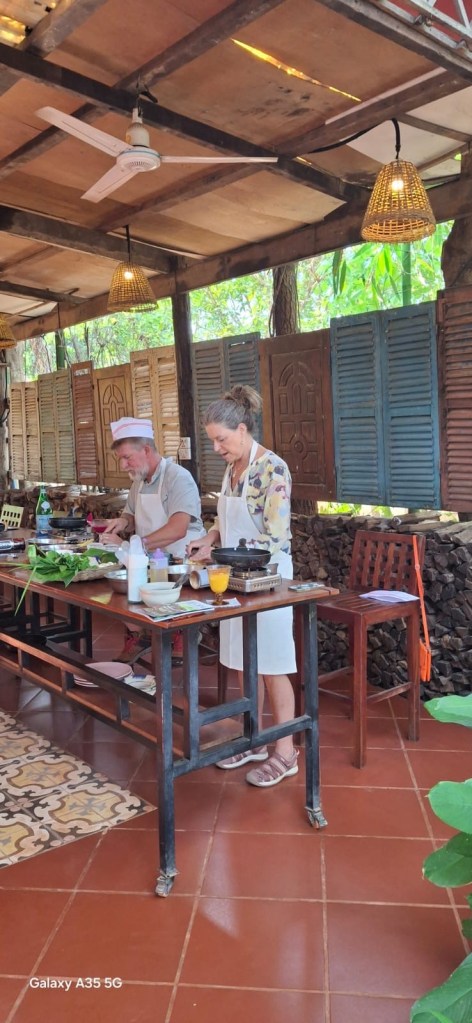
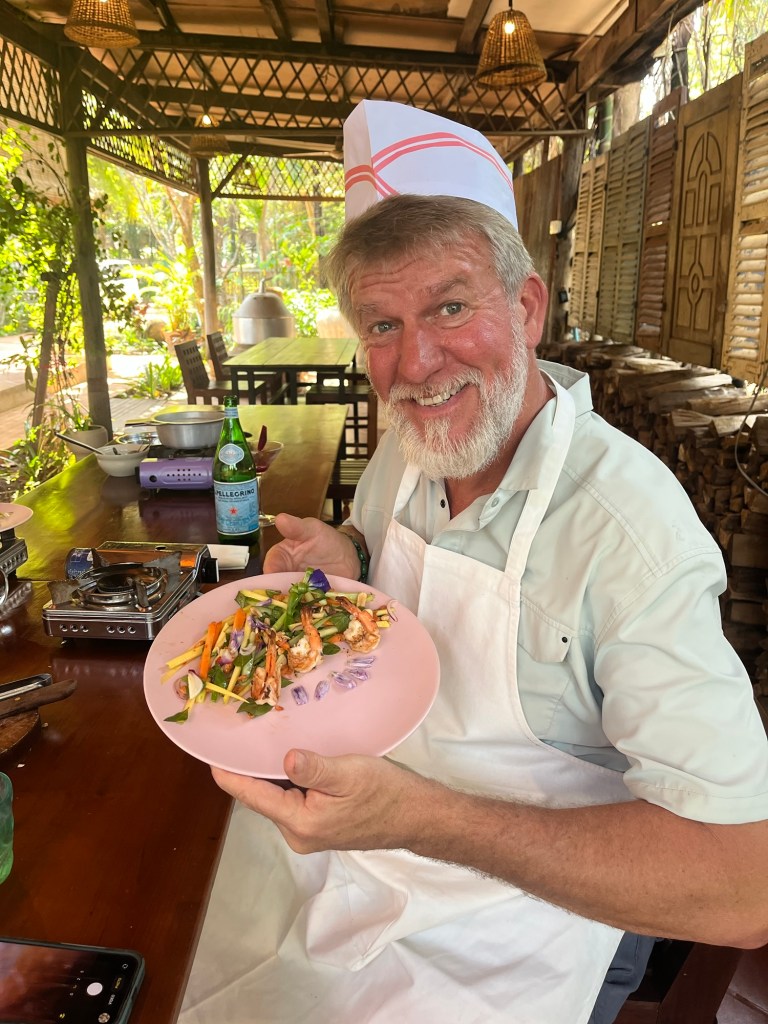
Half day market tour and Khmer cooking lessons. Just as good as the one in Hoi An – but just the two of us.
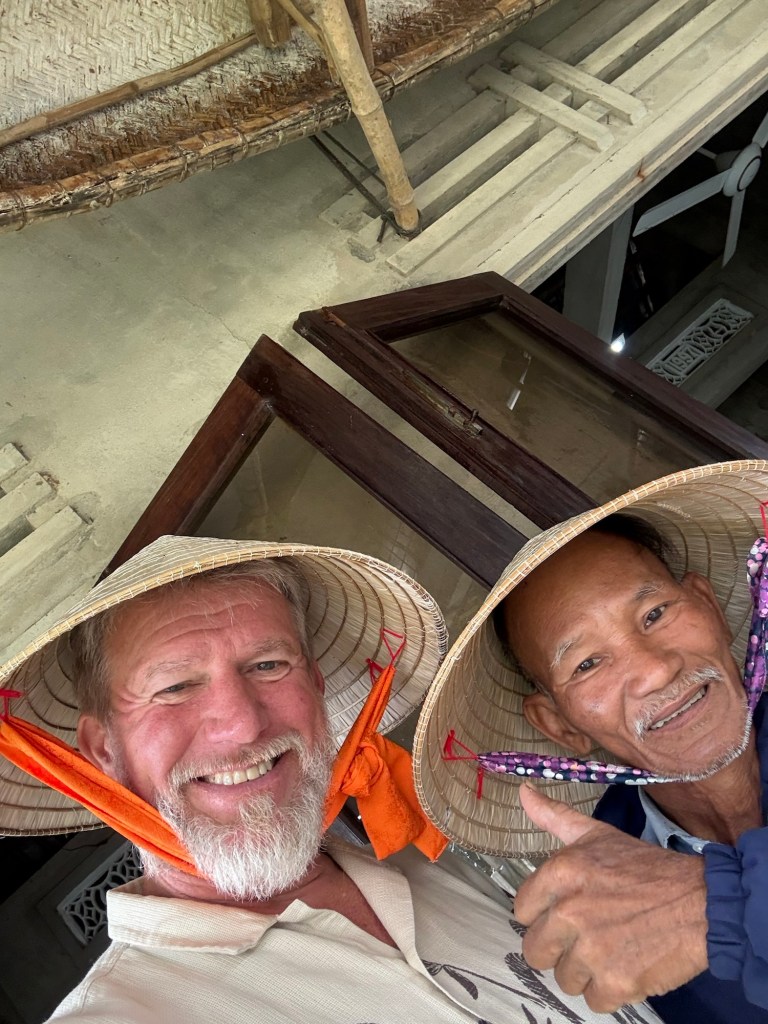
Gills still movingChef Reit “Happy to see you”Yes ChefSilly Hats
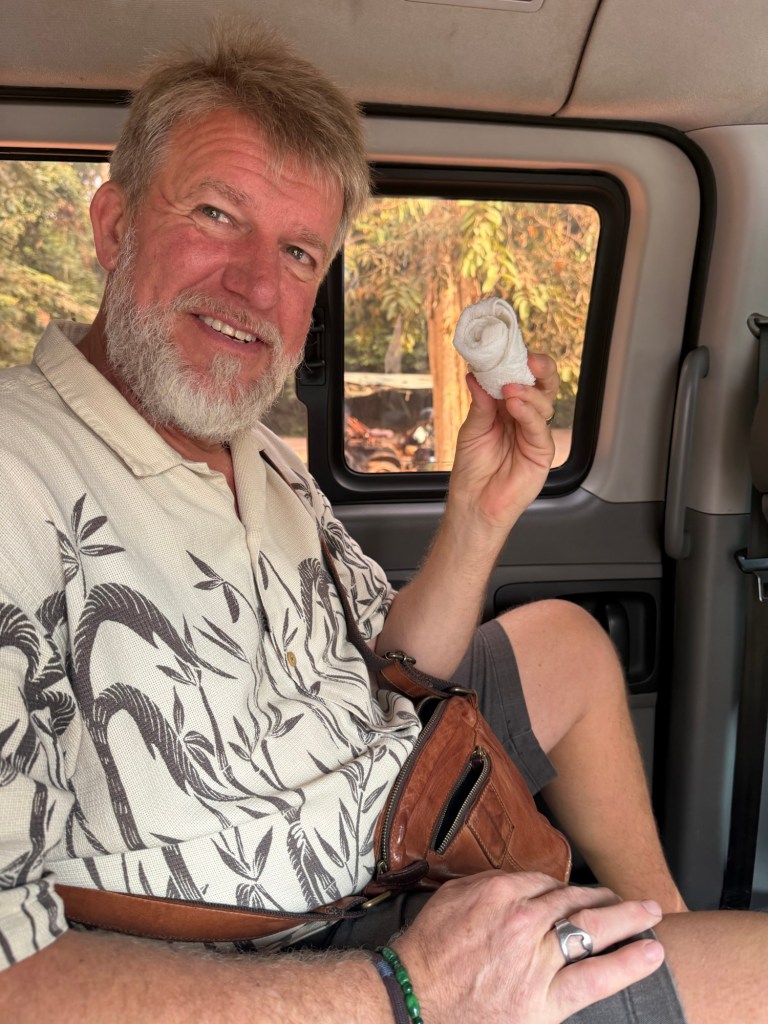
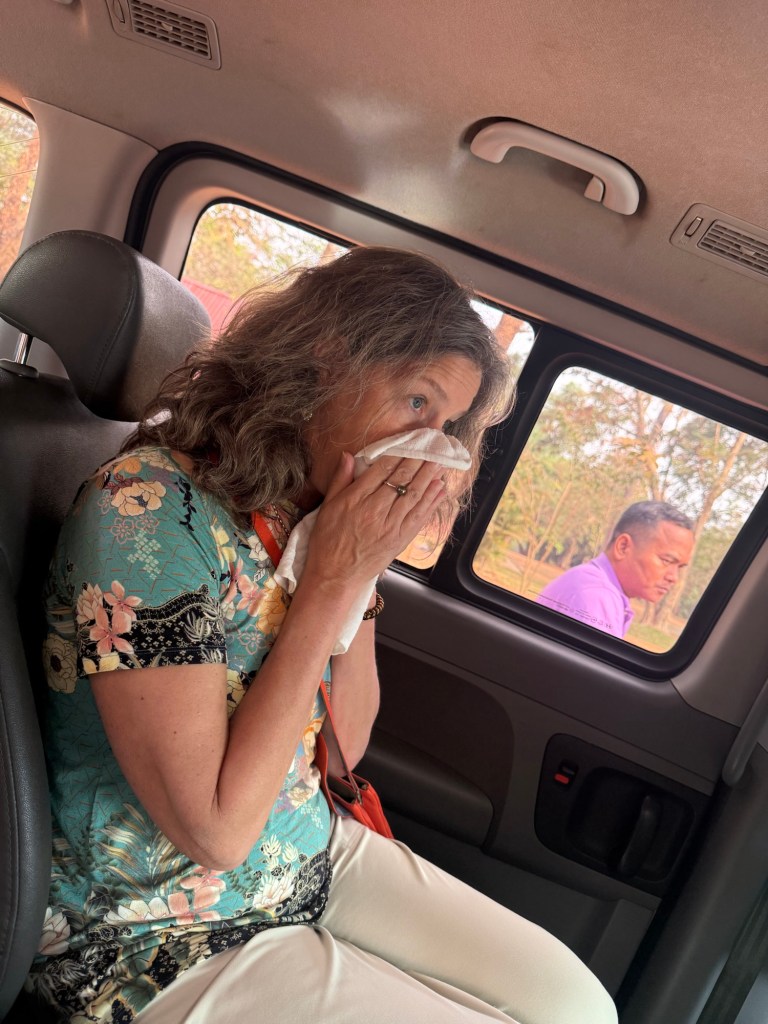
Spring Rolls – it’s hot. But every time you pause for a breath, someone hands you a tightly rolled, damp, ice cold towel – often jasmine scented. This happens 5-10 times a day and washing your hands and cooling down your face and neck with a “spring roll” is a miracle.
Spring Rolls – Better than a cup of coffeeTemple Dust Gone
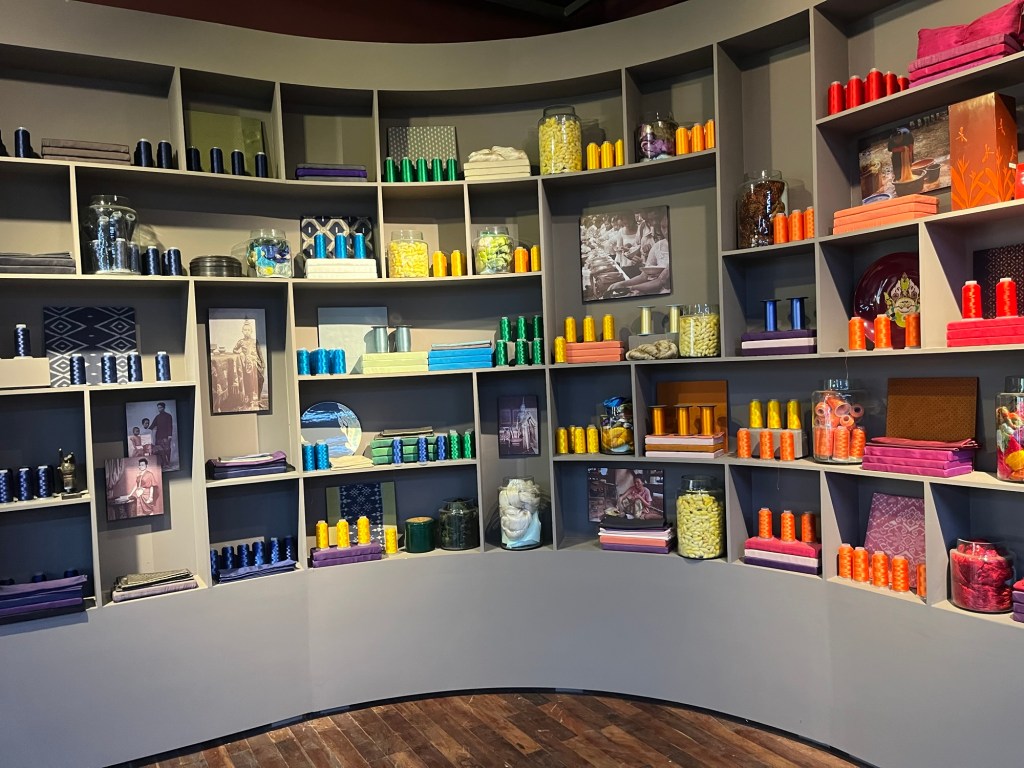
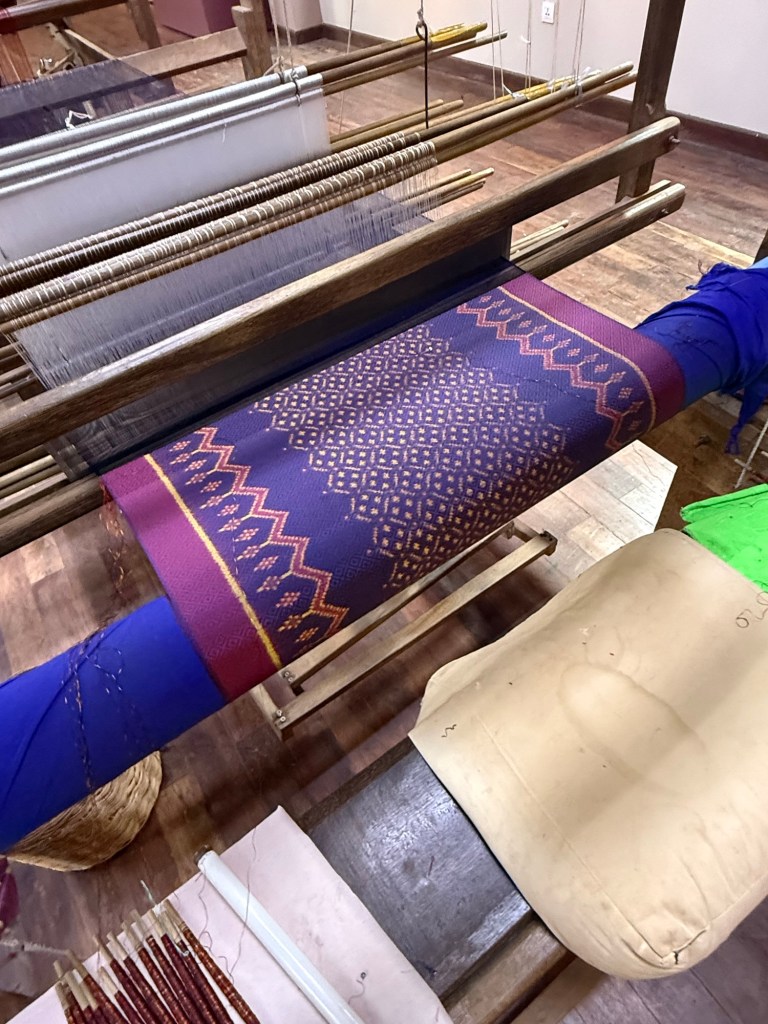
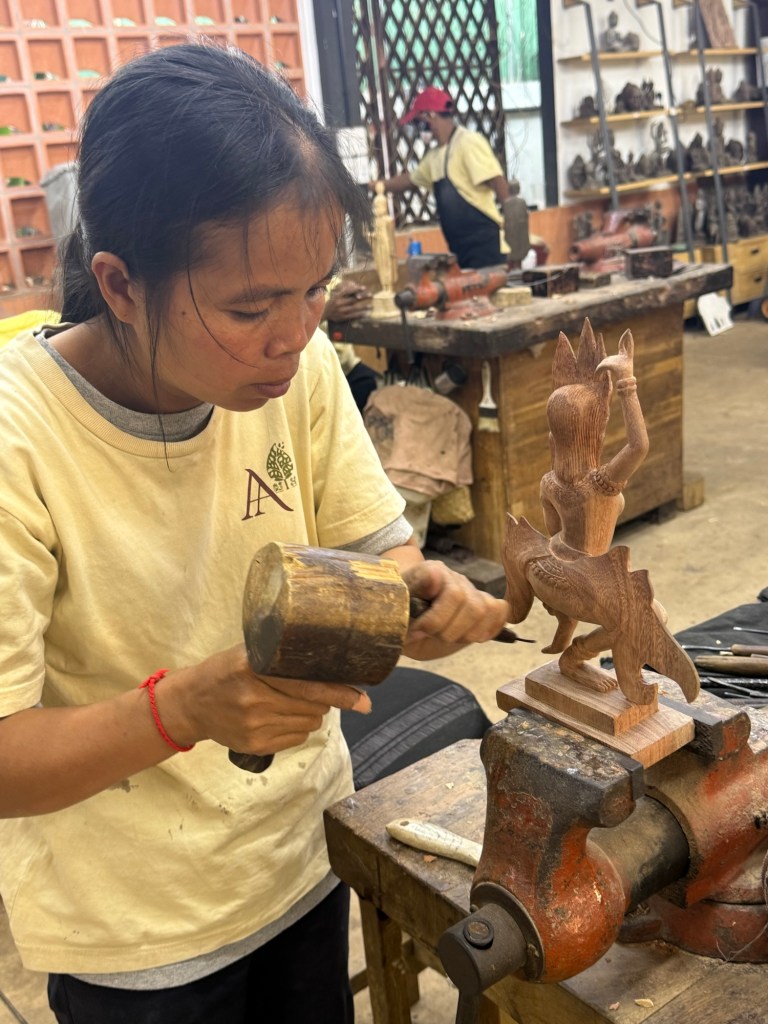
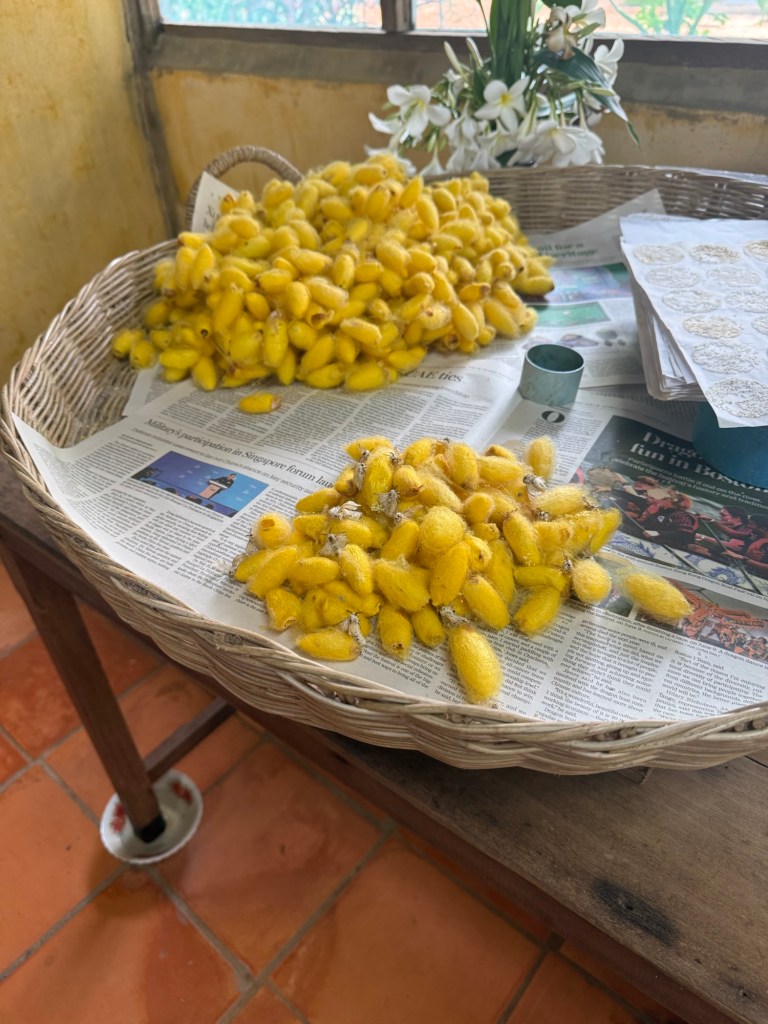
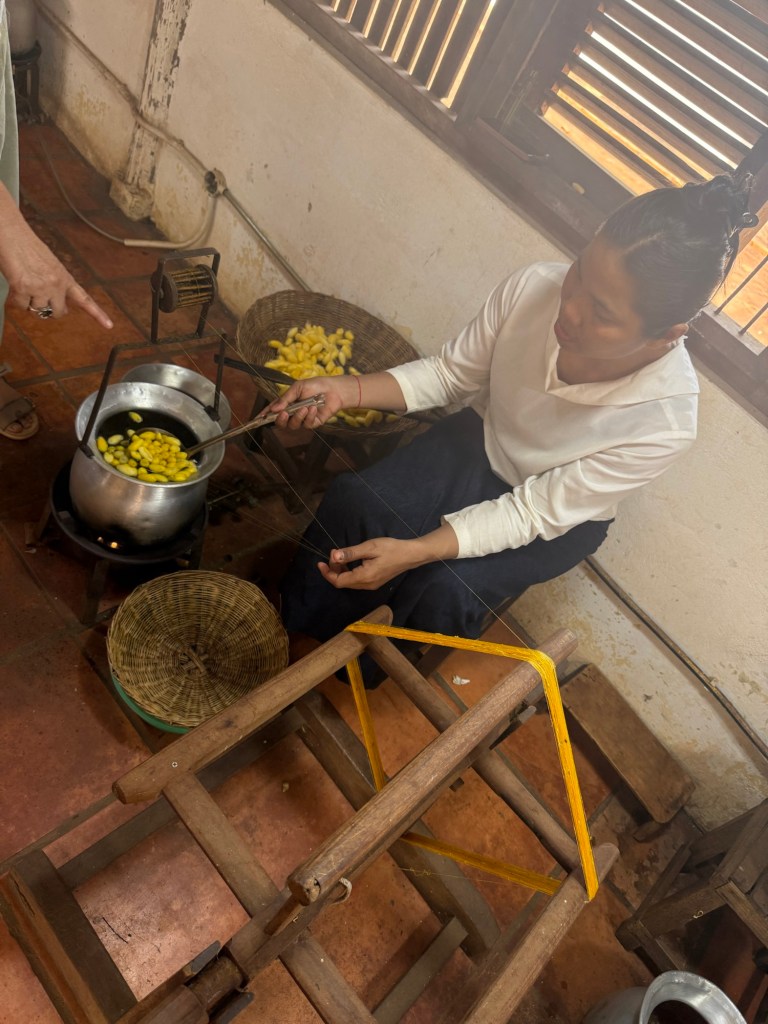
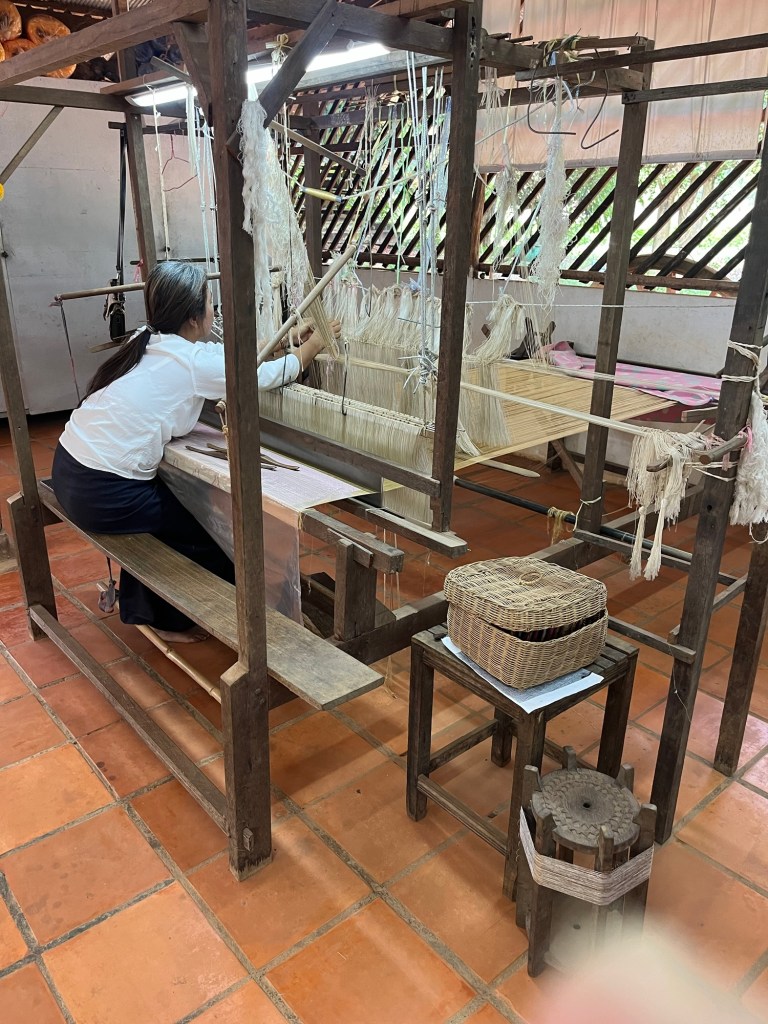
Artisan Angkor Center – We attended demonstrations of silk making, wood carving, and metal smithing. I splurged on a silk shirt. You know, for the orphans
Silk SpoolsWarp and WeftCarving an Absara
Yellow Hornbill Sighting
Wildlife
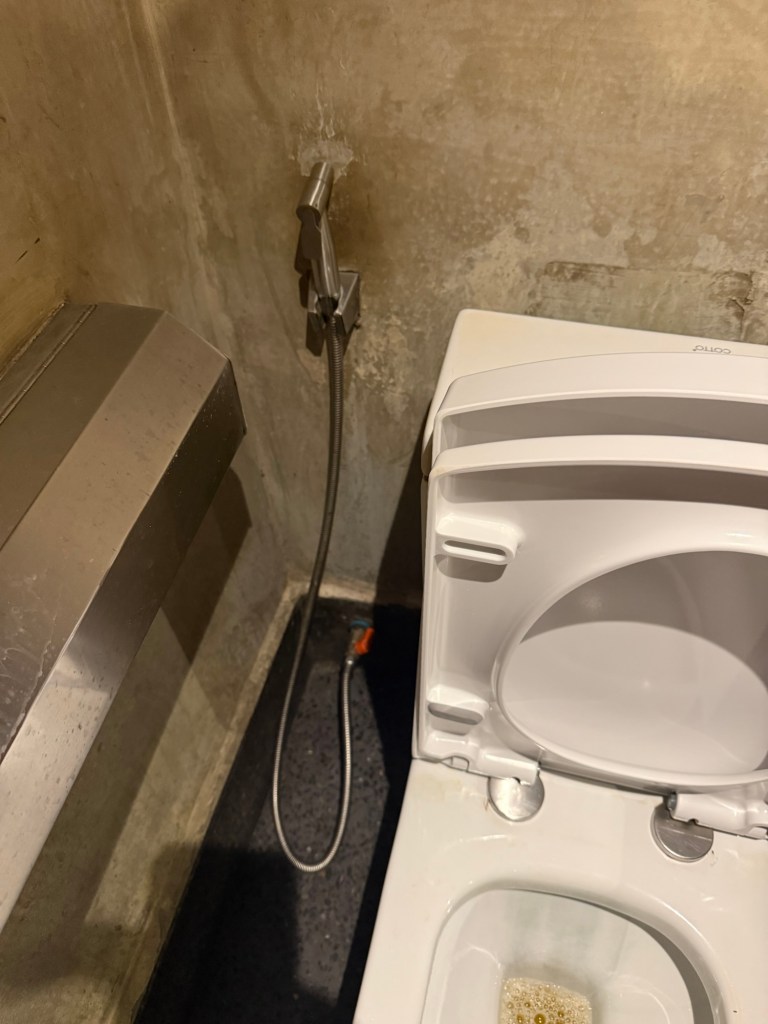
Toilets: everywhere in Vietnam and Cambodia we ran into the poor man’s bidet – a kitchen sink sprayer, mounted behind the bowl. I’m putting one in when I get home. And also – don’t squat on the seat, Chinese tourists.
A definite ToDo for the KSQ list
Monasteries are a form of social safety net. Disabled kids, delinquents and oldsters without family support take on the robe and exchange a life of piety for sustenance.
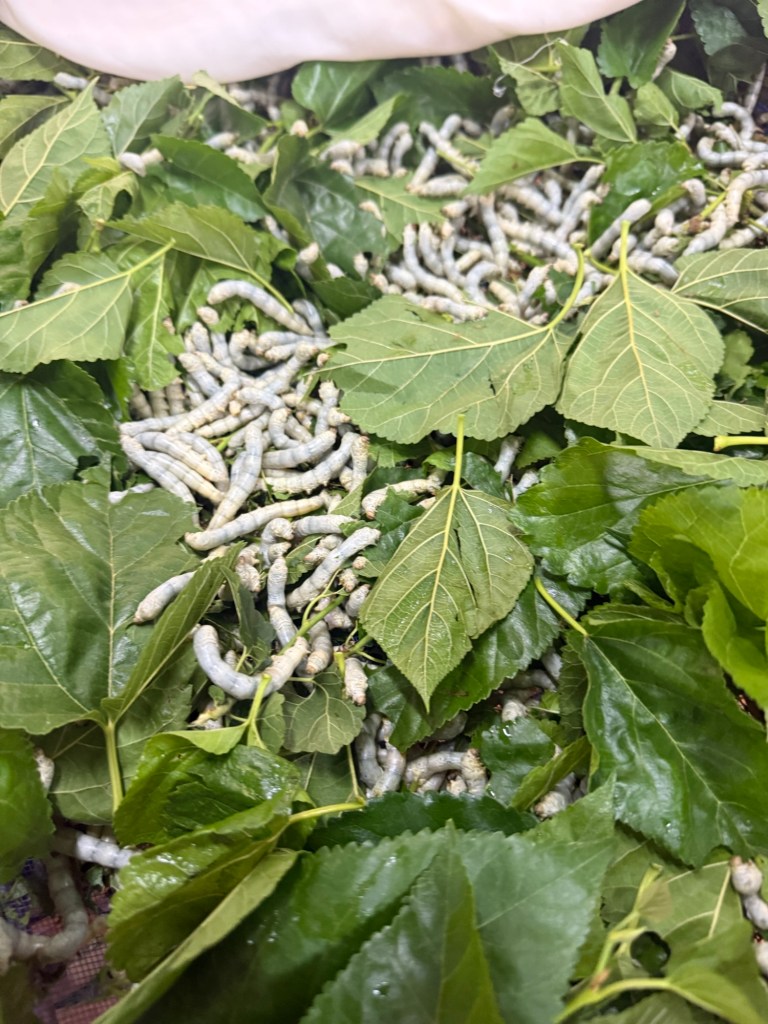
Gold Silk Farm: A Wednesday visit to a working silk farm and an education in Cambodian real-politick from the owner Pheach. The farm and factory were built to employee refugees, victims and orphans of the Khmer. Pheach’s commentary cut through the propaganda and changed our view on quite a few things.
Feeding mulberry leaves to silkwormsRaw silk in the makingDrawing from the podsWarp and Weft
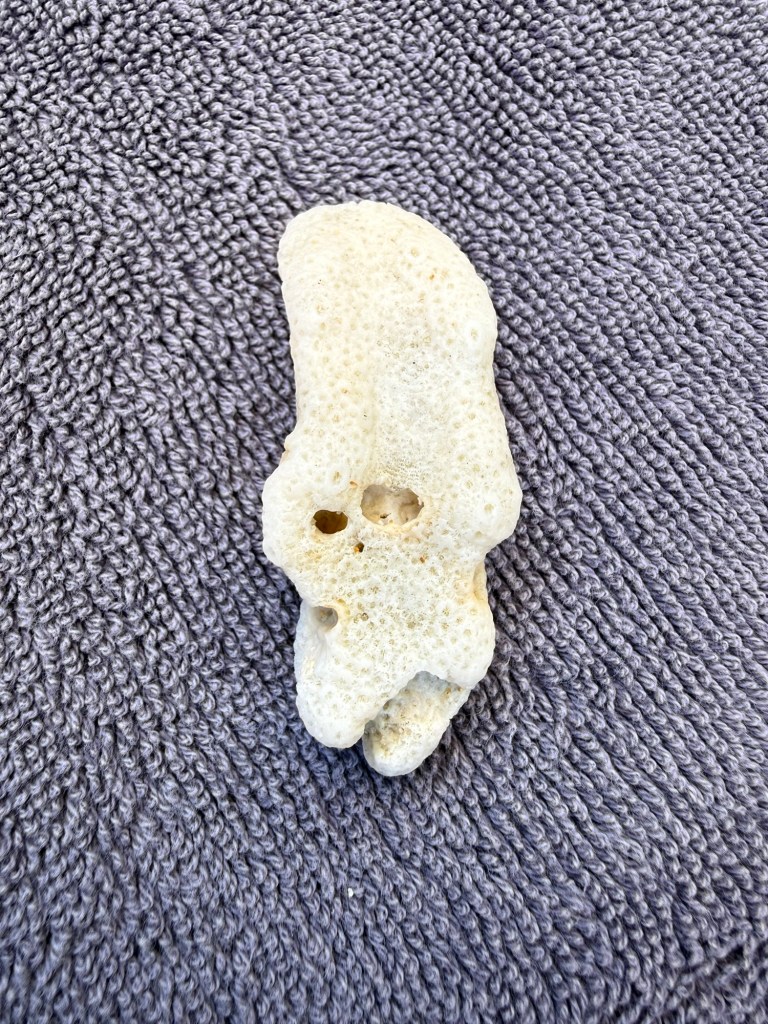
Aliens: so Mayan Temples and Cambodian Temples are way more alike than different. And both peaked at exactly the same time (900-1000 AD?) And nobody knows how they did it. And this fossil.
Just sayin’
Alien baby skull, Phuket
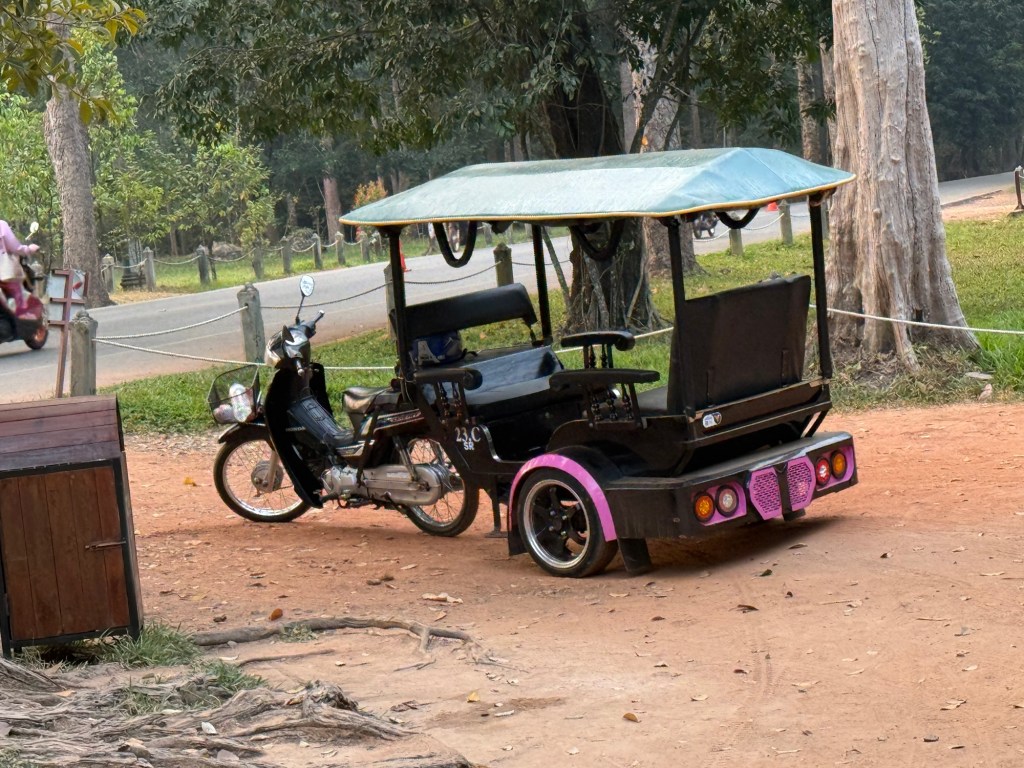
The Remok: Cambodia’s version of the Cyclo (Vietnam) or TukTuk (Bangkok)
The Remok
“A little templed out”
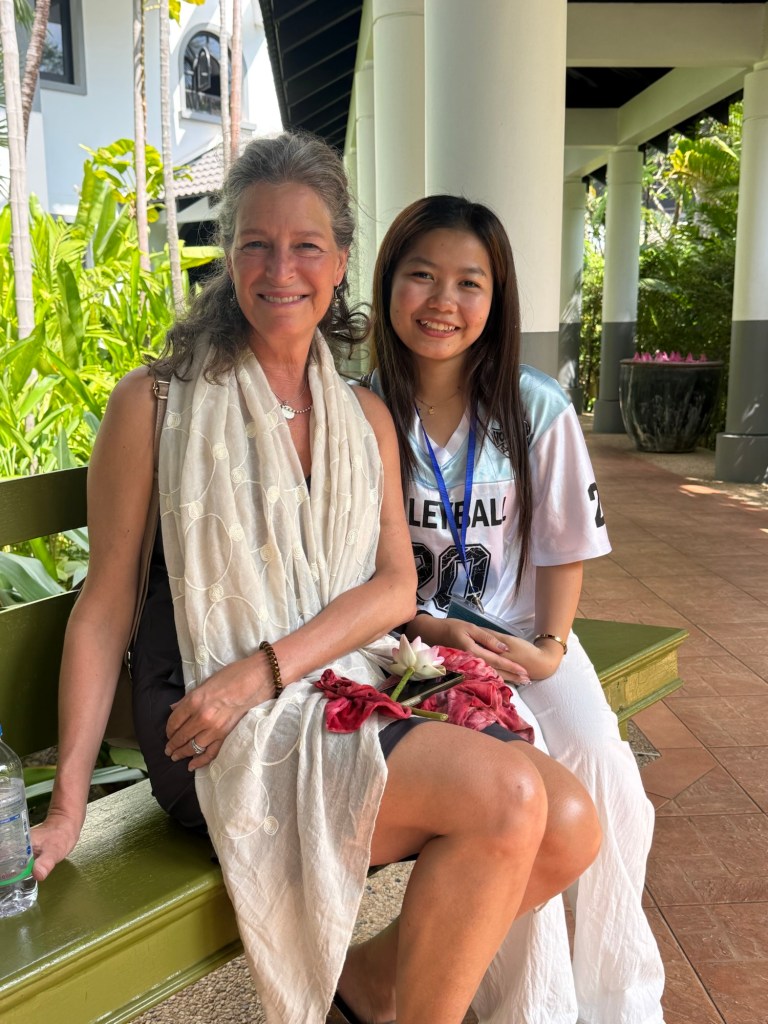
Ms. Moly. Justine met a lovely, warm and gracious young graduate of Shanta Mani hospitality training. Her role there allows her to support her entire family. They met again on our last day and committed to staying touch!
New Freinds
JuJu’s 58th: What a way to spend it! A visit to a 7th wonder of the world – Angkor Wat, a goodbye to Siem Reap, and a business class upgrade to a resort in Phuket.
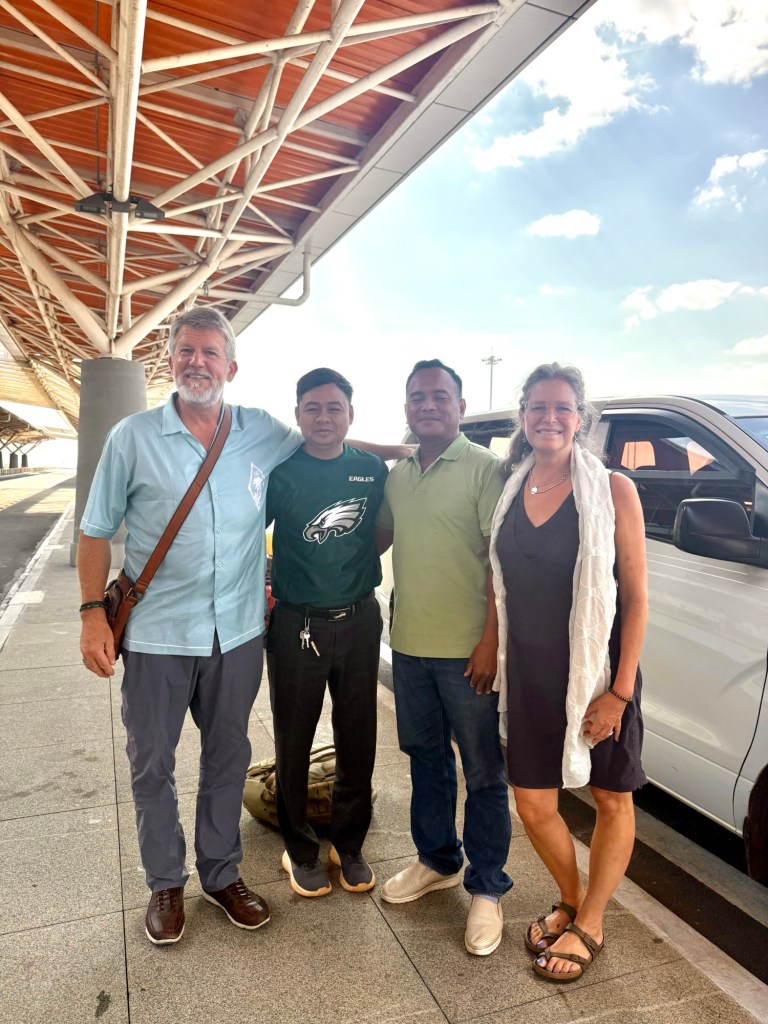
Goodbye! Thank you to our guide Rom (Seng Phearom) and our driver Ravouth. So knowledgeable, professional, and fun to travel with.
First some pre history – Animism dominated the area until the 1st century when Buddhism & Hinduism arrived at the same time from India. From the 1st to 12th century, the dominant empire, was the Angkor and Cambodia was 70% Hindu until about 400 A.D. A slow conversion to Buddhism accelerated under Java 7’s reforms and Cambodia is now 90% Buddhist. The Angkor Empire fell in the 1400’s after successive invasions by Siam (Thailand.)
The Cambodian Genocide: Pol Pot was the leader of the Kampuchea Communist party from 1963-75. He was a Maoist and believed society should retreat 400 years to be completely agrarian. He was supported by Vietnamese infiltrators, trained in Khmer, and had Chinese Communist weapons and financing.
Gaining control of Cambodia by uniting the hill tribes, he organized a new government and put his beliefs into radical action. He drove everyone out of the cities and systematically killed intellectuals, student, doctors and professionals.
But it evolved into the psychopathic and indiscriminate “killing fields” and 3 million people were murdered.
People were killed for having glasses. Feces checks identified anyone who was “over-fed” and their throats were slit. Soldiers were conscripted and their families were killed to keep them ideologically focused. Whole villages were burned alive for no apparent reason. 25-30% of the population was murdered in the name of one man’s ideology.
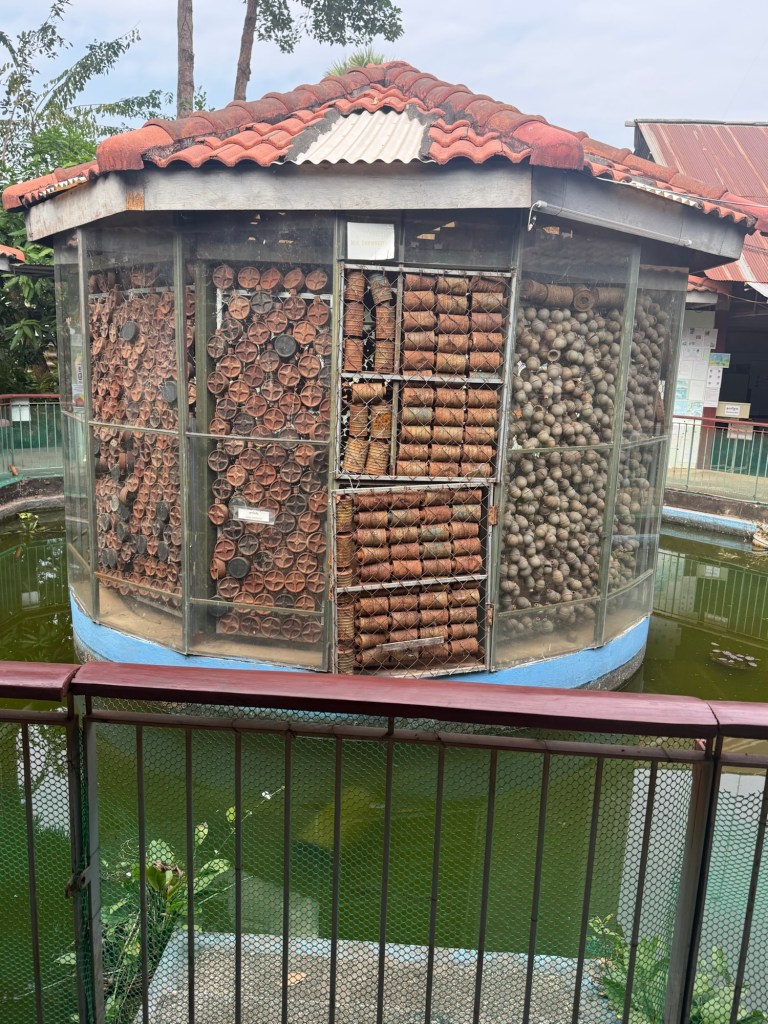
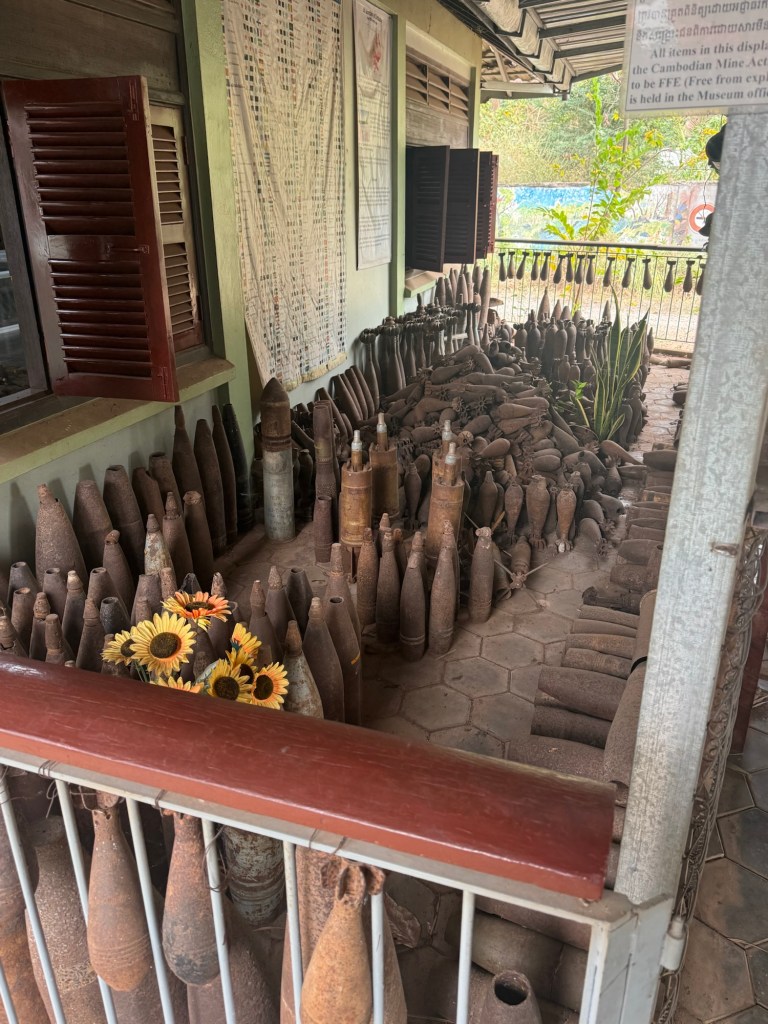
Cambodian Land Mine Museum: The visit here was harrowing. There were case after case of recovered Russian, Chinese and US mines, and also rooms full of unexploded ordinance.
27 million US bombs were dropped on Cambodia during the American War. 5 times that many mines were deployed. Millions still remain.
Mines were made to maim not kill. A dead enemy is quickly buried. An injured enemy requires evacuation, care, and resources.
Many of the staff were amputees, and we heard story after story of lives ruined and lives still being ruined on a daily basis (510 mine incidents were recorded in 2024).
Antipersonnel Mines – Designed to Maim Unexploded ordinance
Siem Reap, Killing Fields we visited a small killing field in a monastery in urban Siem Reap. We were wrecked by stories of mass execution, torture, and viewed a drinking well where hundreds were drowned and their skeletons recovered.
A Maoist social experiment of cooperative farms, the elimination of currency, forced marriage, child abduction and indoctrination started with destroying the existing structures, religion and economy. It devolved into a psychopathic killing spree.
From Pol Pot to now: Pol Pots government was defeated by the Vietnamese as Cambodian peasants joined them en masse. The VN ruled formally from 1979-89 until UN pressure for Cambodian independence (based on 1953 treaty w/ French) resulted in a Vietnam exit. Cambodians we talk to say it was a “show exit” and the Vietnamese and some Khmer still rule in the shadows today.
The first Cambodian election was in 1993 – and the Kings son won as Prime Minister. Later under an impending revolution the King made the guy who came in second (Hun Sun), a dual prime minister. Hun Sun ruled until 2023 when he won again. But he appointed the current Prime Minister in his place – his own son Hun Manet.
Both families are incredibly wealthy, and are heavily inter married. And both are rumored to have Vietnamese or Khmer Rouge roots and connections. There is zero tolerance for public or press criticism and even the stories above were delivered in a whisper.
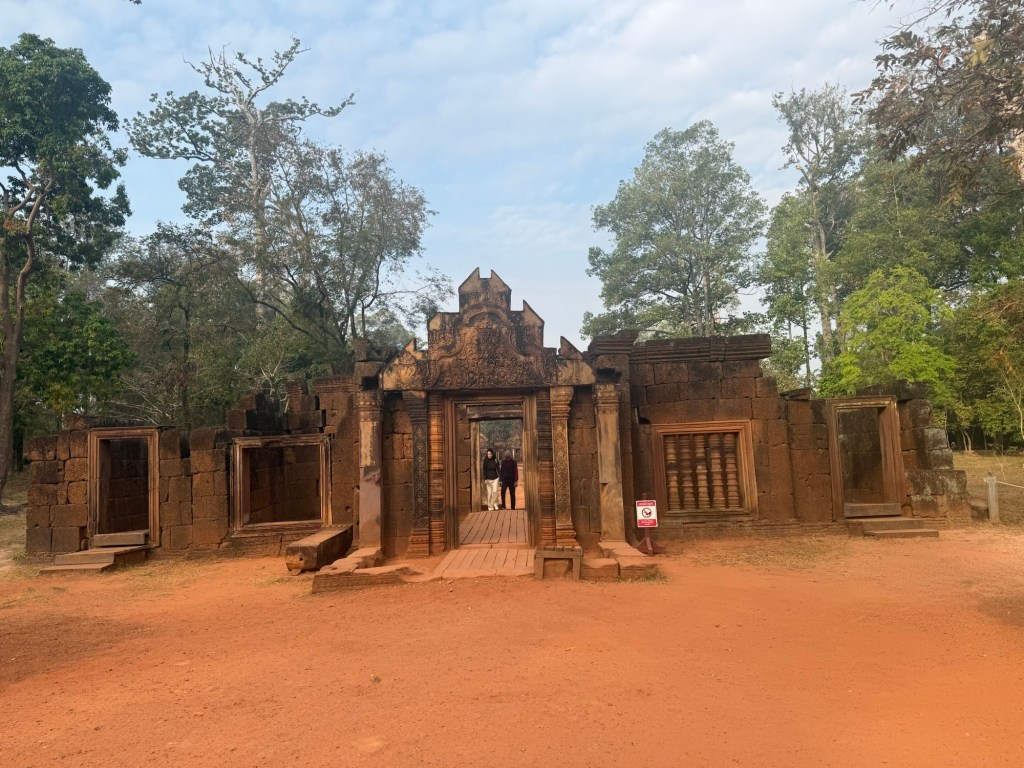
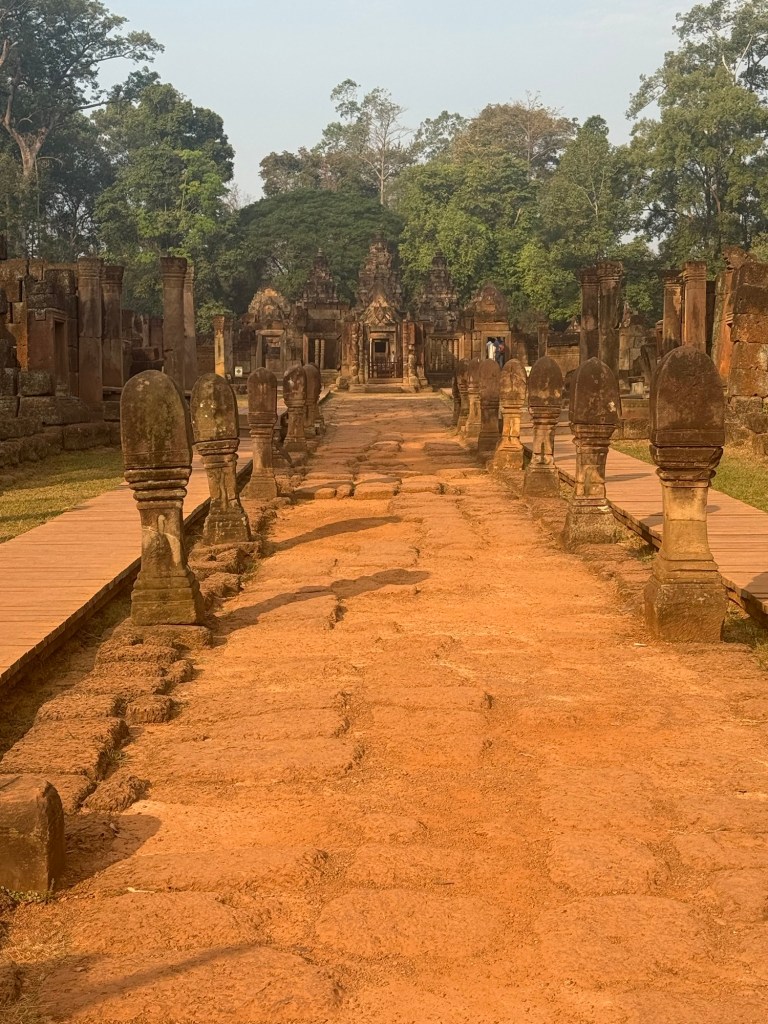
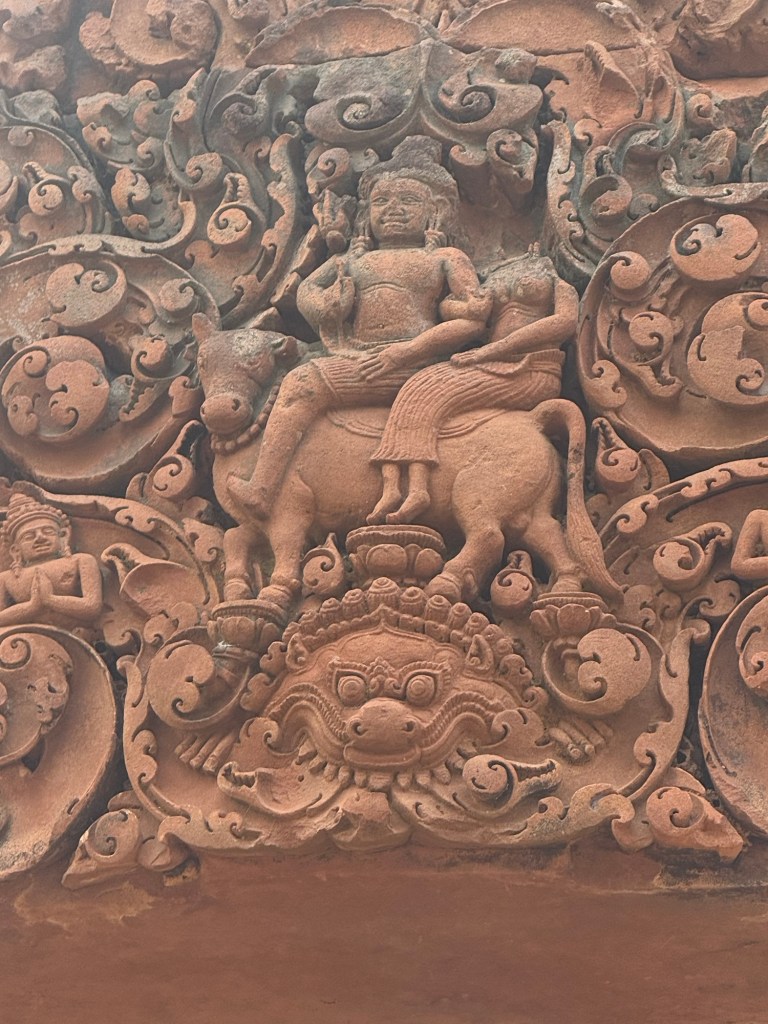
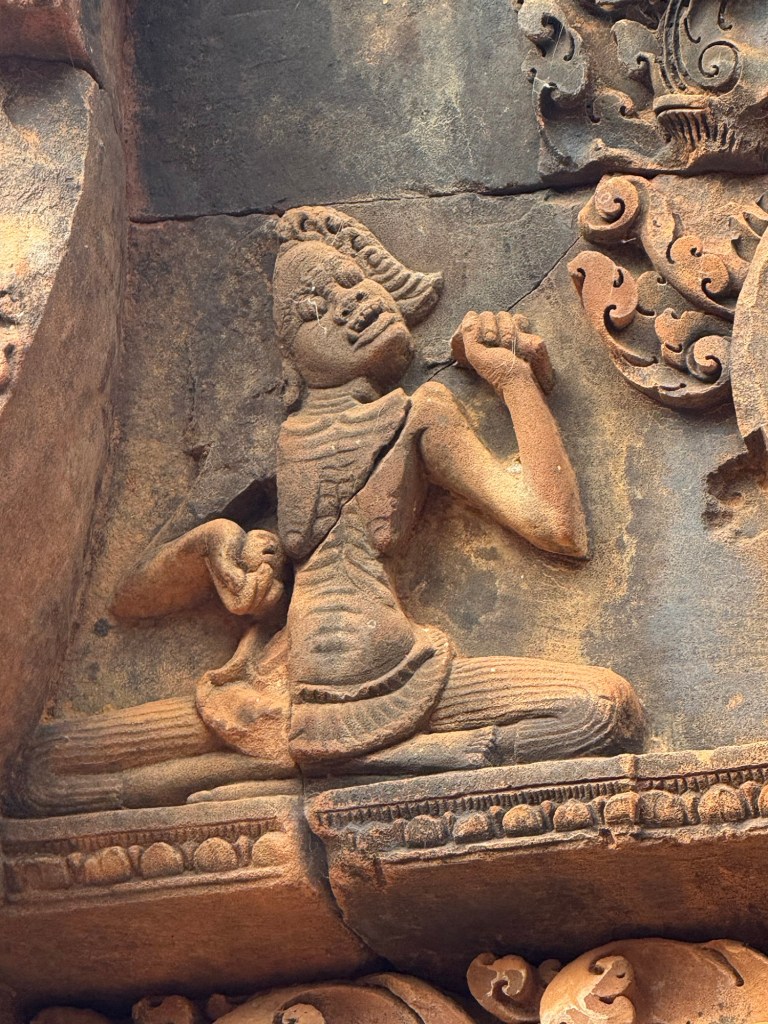
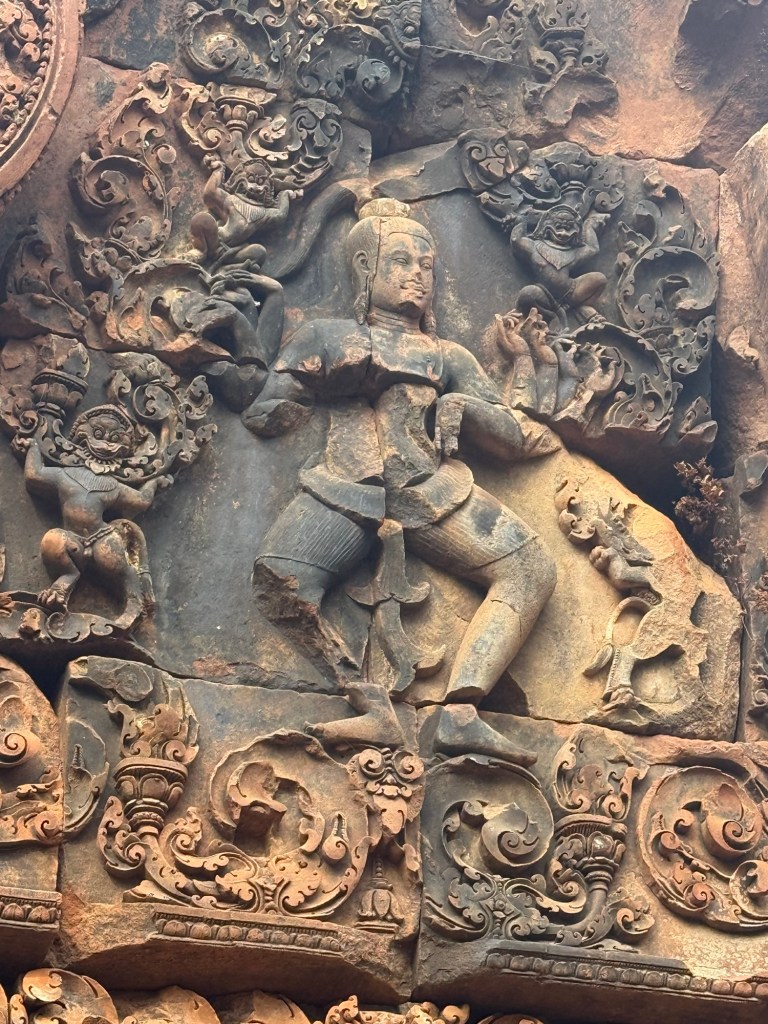
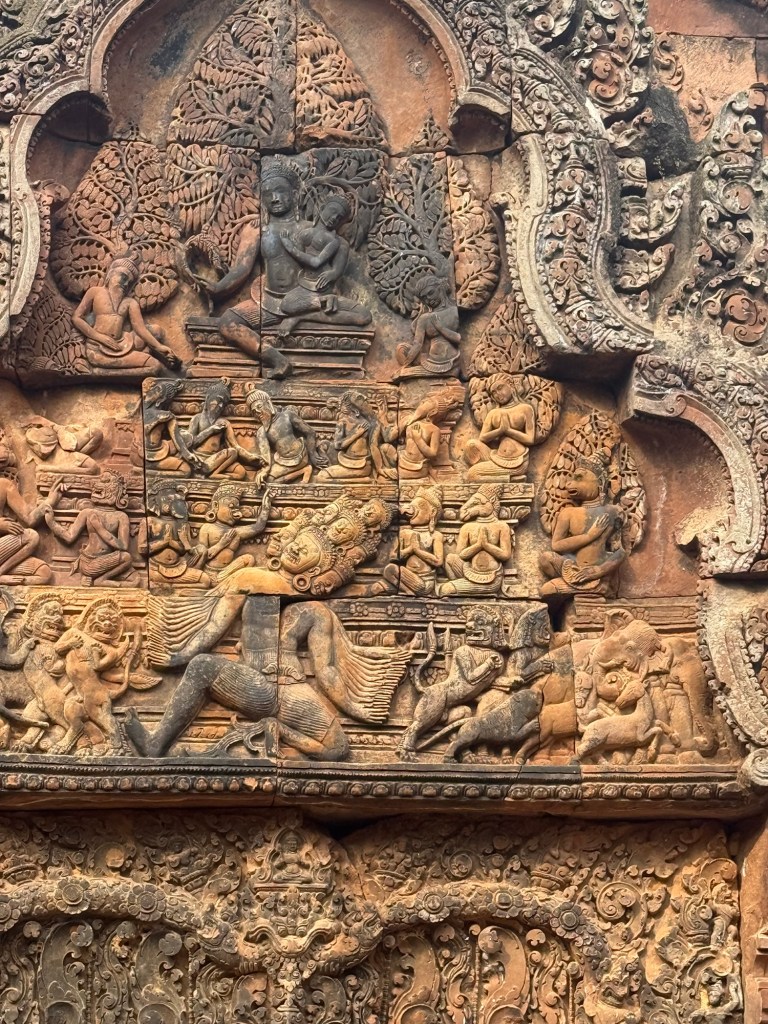
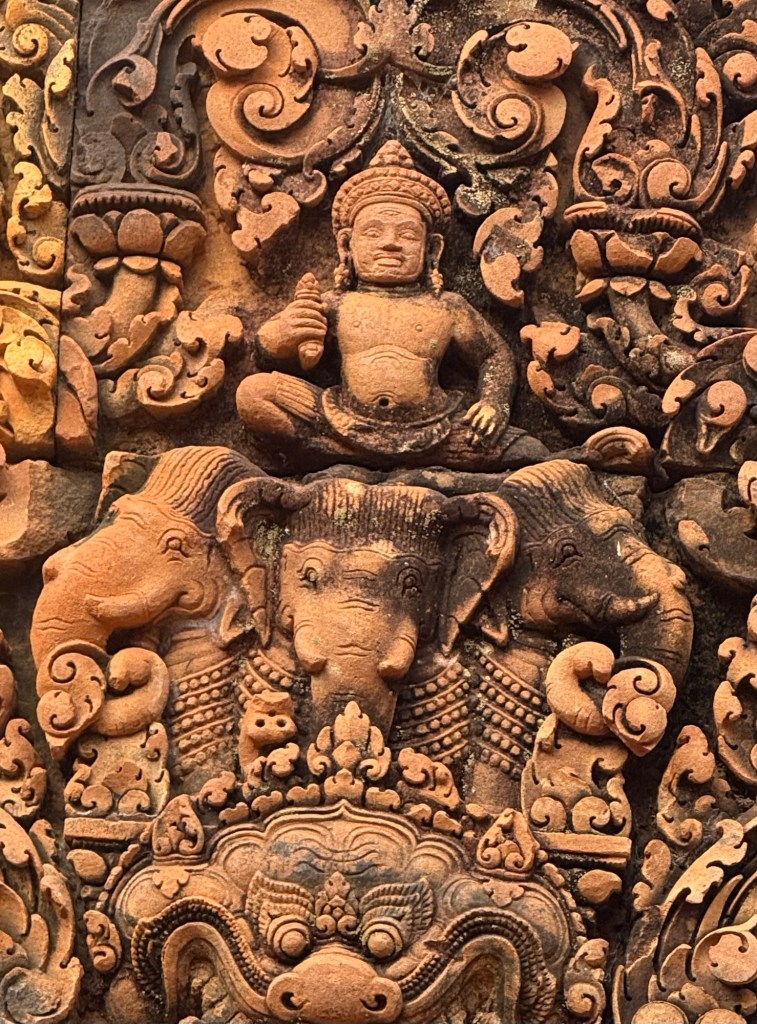
Wednesday 7 AM, we travel to Banteay Srei, a 10th century Hindu temple that predated everything we’ve seen. Much more ornate and preserved, it’s called the Lady Temple because of the carefulness of the work.
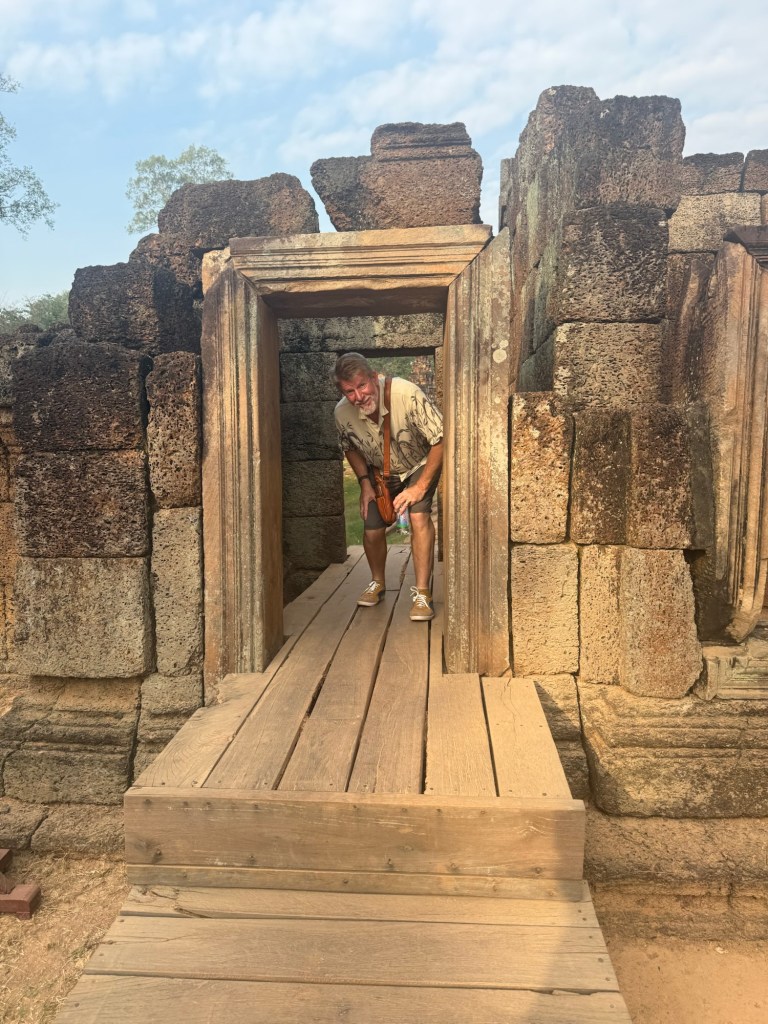
Banteay Srei TempleCausewayLow entrances force you to bow on entering Vishnu – God of Earth on the Sacred Bull Nandi.Nani – aged by Vishnu to prevent war over her beautyMany Armed Shiva the DestroyerDemon King (10 faces, 20 arms), shaking the mountain to interrupt Shivas meditation
Some how I missed Darma, the Creator. But she, Shiva and Vishnu are the theee most important entities. There are hundreds, and many have reincarnated 5-10-20 times with a new manifestation each time. Gonna leave it there.
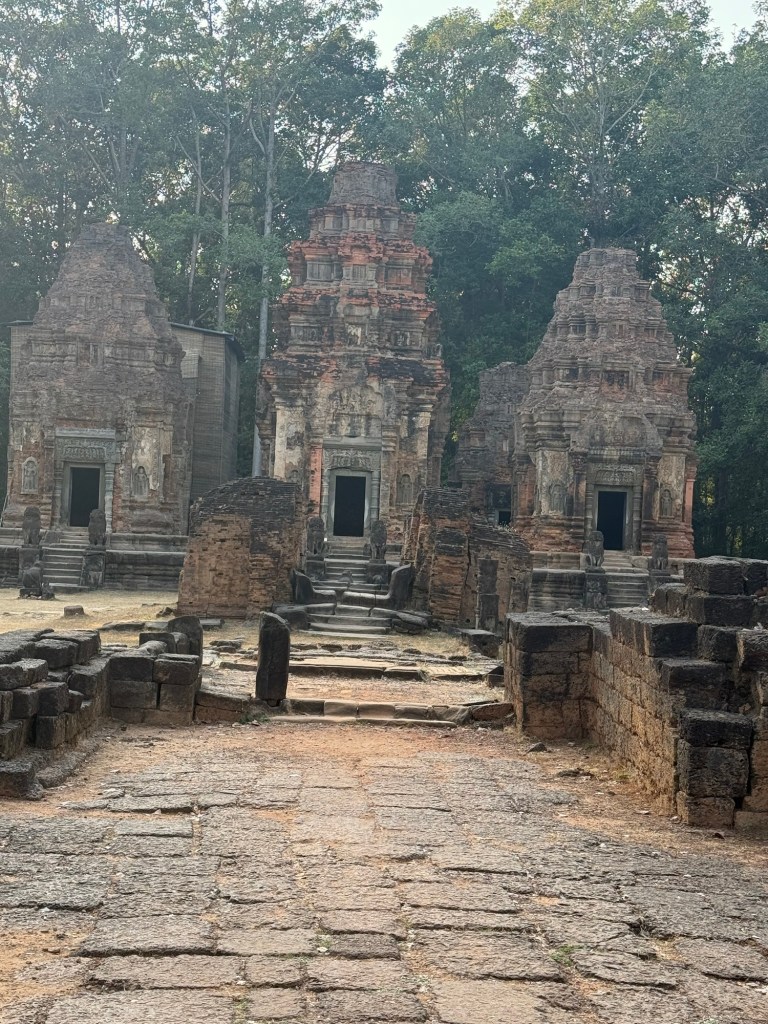
In the afternoon we toured the Rouluos Group, current name of Hari Haralya, the capitol city of Cambodia in the late 9th Century
The emperor Rouluos, like Jaya 7 sought to make space for both Hindu and Buddhist – placing Buddhist monasteries and temples on the grounds of Hindu temples.
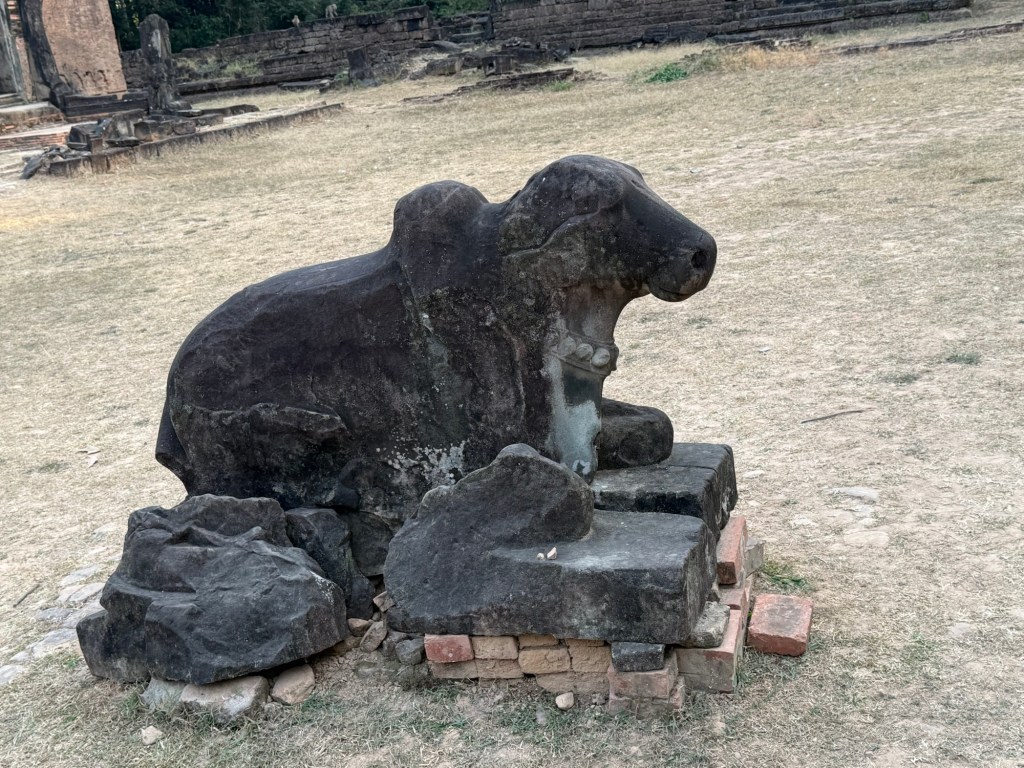
The first, Preah Ko was brick covered with Stucco and built to honor Shiva (lots of Nandi). It also included a tower, out of the way in the back, for his In-laws.
Preah KoThe Cow Nandi
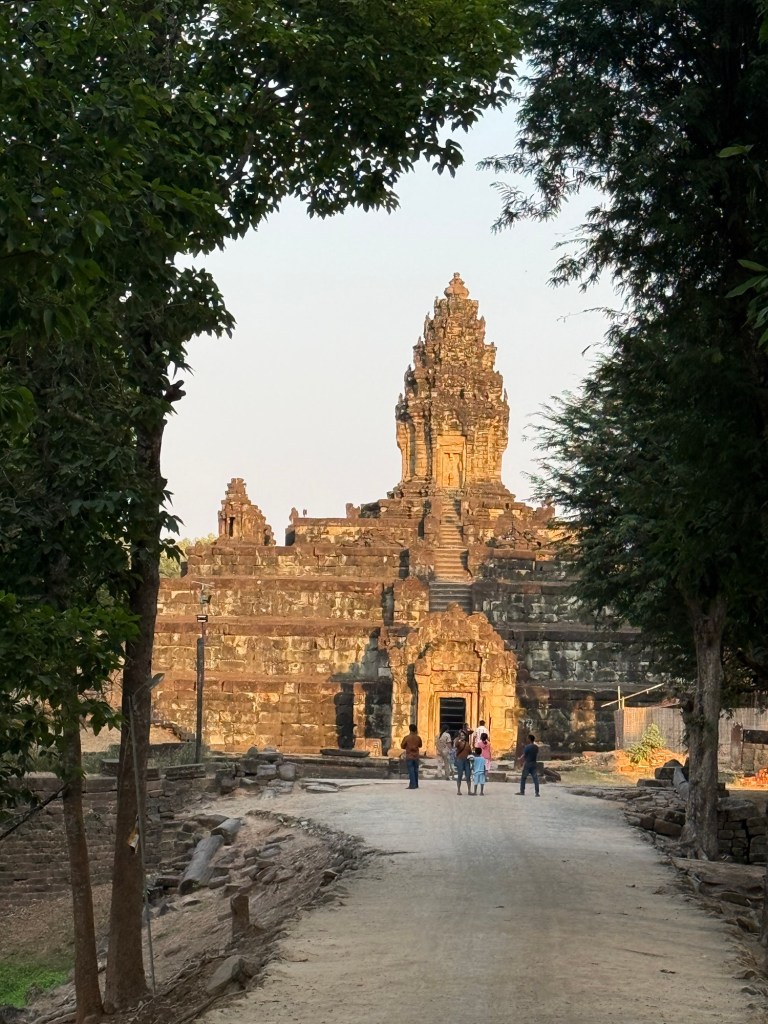
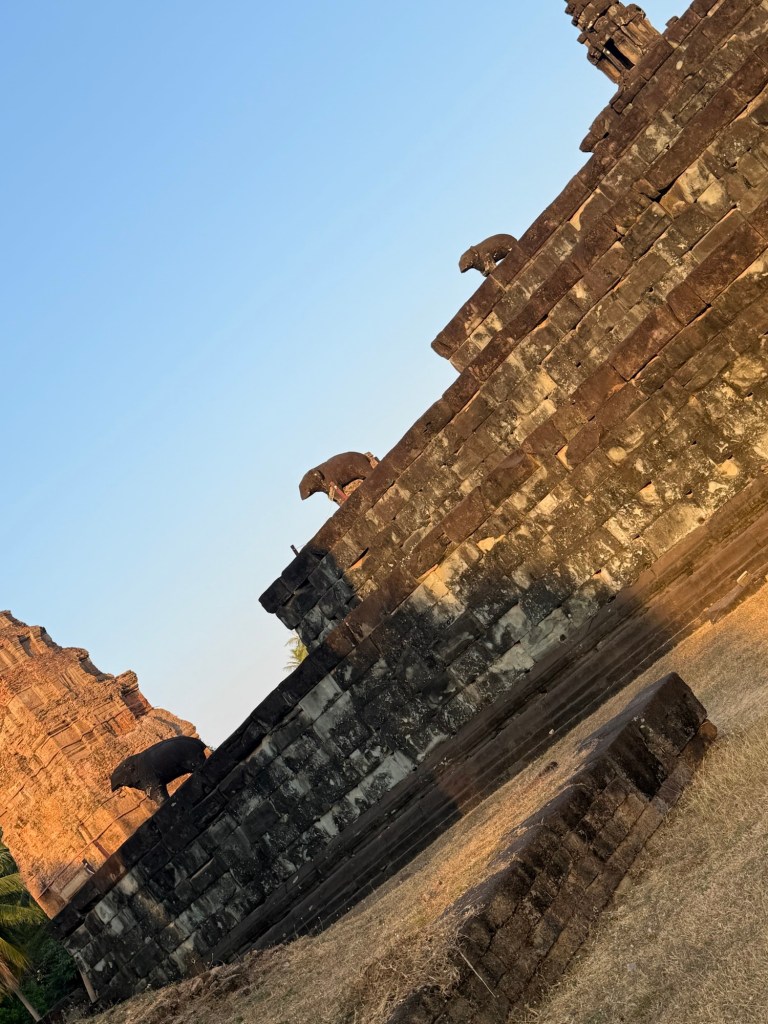
The second, Bakong Temple was also for Shiva and included the King’s stupa. . It was the first five tier temple and the first to include stand alone Naga on the causeways.
BakingElephant GaurdiansPrettying up a Trmple
The third, Lolei Temple was built in 893 AD in the center of a reservoir. It is compact but beautiful. A series of gates and Naga connected it to land and it included boat landing docks on the far side (we parked there as the reservoir is now dry.)
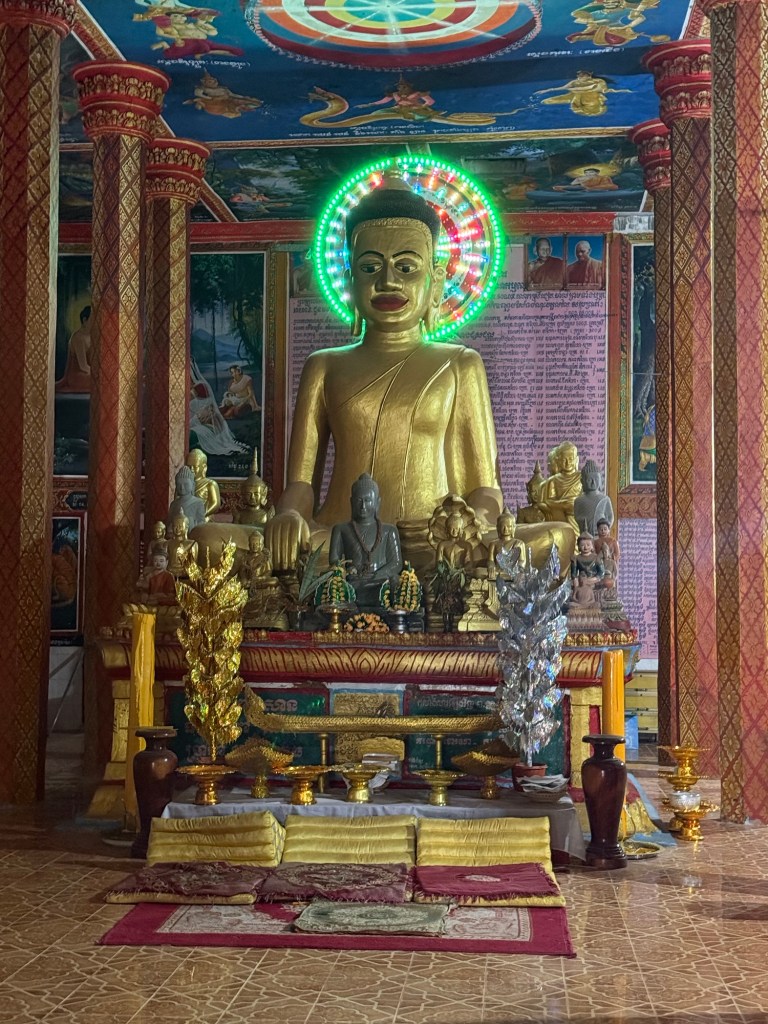
LoleiRom and JuJuNew Friends for the GarangElectric Buddha in the Monastery at Lolei
There’s something far, far away about the name itself. Cambodia is a country of 17 million people, 90% are Buddhist (but with a strong Hindu history and a lot of hybridization). The balance are a few Muslims from Java, and a few Christians – mostly Korean ex-pats, or refugees from oppression in China.
Cambodia is a democracy on paper. But the same family has been on the throne or leading the parliament for 40 years. Voting is universal. But it’s largely a symbolic support for the family, and a protest recognizing the end of Pol Pot’s murderous communist regime. Free speech or criticism of the royal family is not a thing.
The country is a bowl, ringed by high mountains. The result is near complete protection from annual Typhoons. The climate is warm and water is plentiful due to a 5 month rainy season from March to August. There is a deep lake at the center (the deepest in South Asia) that serves as a drainage basin and prevents flooding. No flooding, no typhoons – so two full rice harvests, and lots of surviving ancient architecture.
Travel here is about Temples. Angkor Wat is the largest and most famous (by law, no building in Siem Reap can be built taller). But there are 1,900 ancient and significant temples in Cambodia.
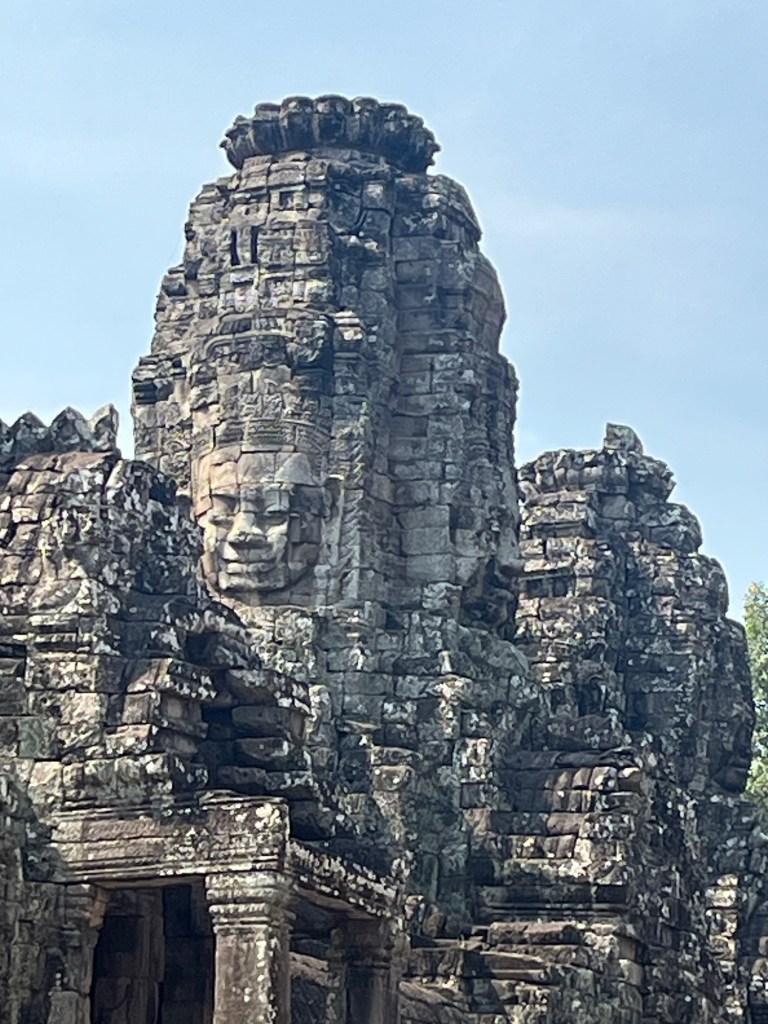
Boyan Temple
The Cambodia’s Golden Age was 1200-1300, and particularly the reign of Jayavarman VII (or Jaya 7), the strongest leader of the Angkor Empire.
Cambodia’s Dark Ages were only 40 years ago when the Khmer Rouge under Pol Pot murdered over 2 million people (25% of the population at that time) in a Communist purge from 1975-79.
They killed all students and professors, doctors and professionals, and drove the citizens out of the city enslaving, starving and massacring them whole cloth. This oppression and death continued for 4 years and is a psychic scar on everyone we meet.
Everything in Cambodia seems to revolve around one of these two histories. The current generation still includes victims of Pot. But the pride and zeitgeist (and business) spans back to Jaya 7.
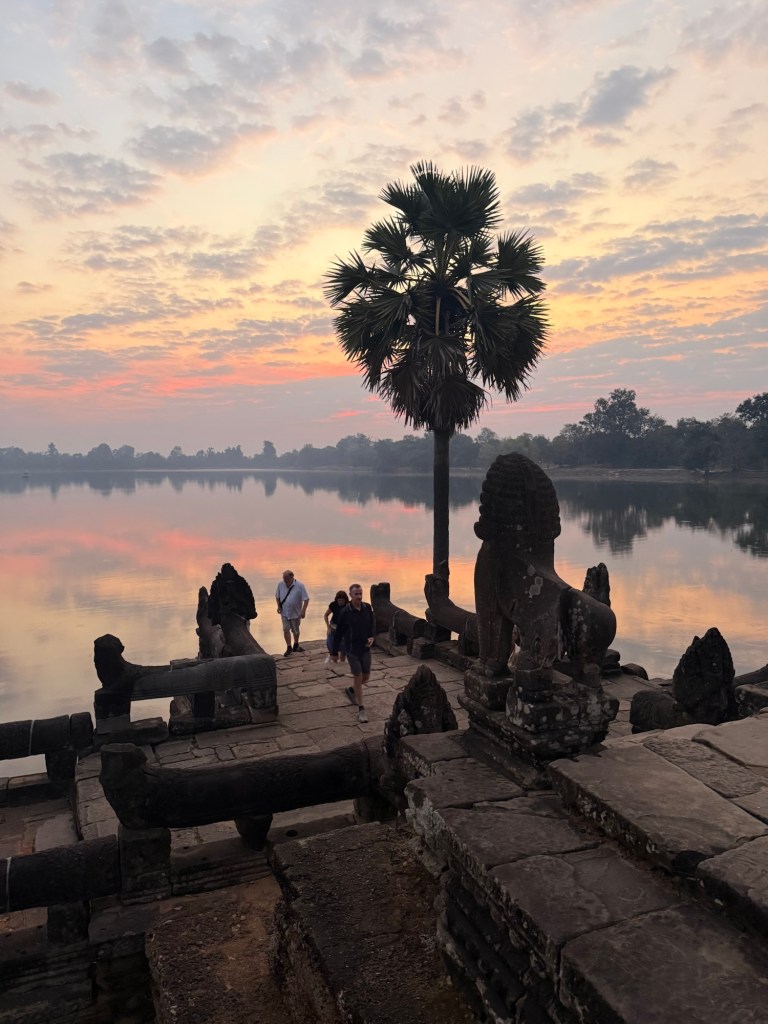
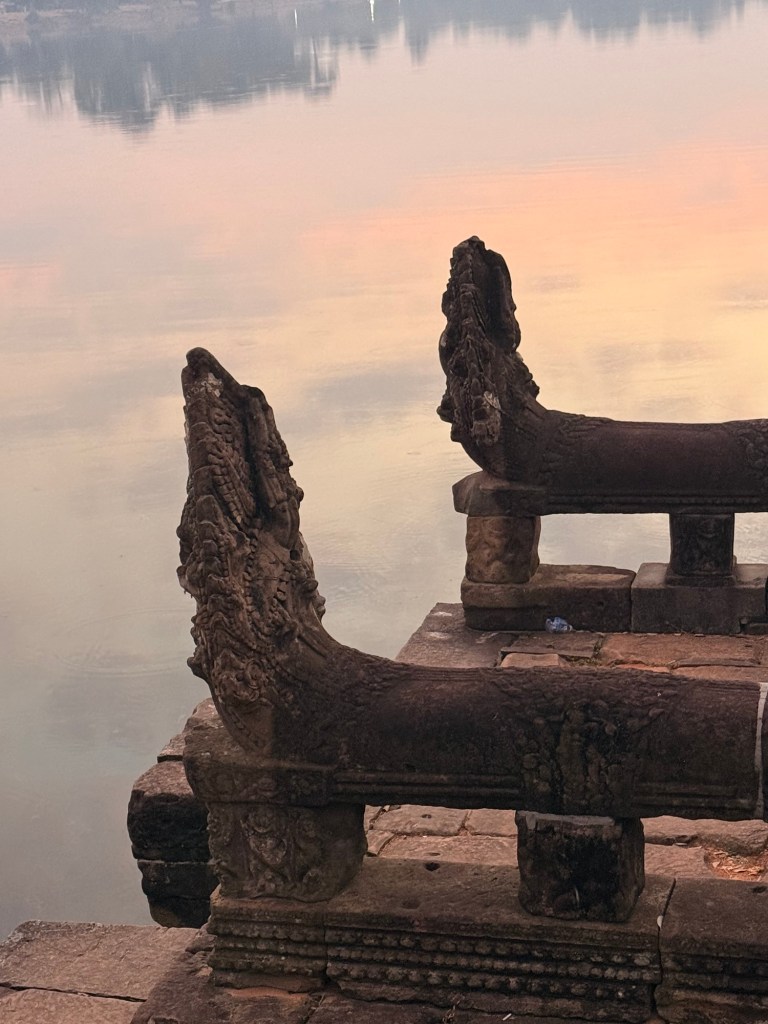
We started our day at the temple of Sras Srang, watching the sun rise over a gigantic 8×12 kilometer hand dug reservoir. Constructed under Jaya 7, the reservoir served the entire community with drinking water, communal swimming, rice irrigation and worship.
Seas Sarang Reservoir at Sunrise
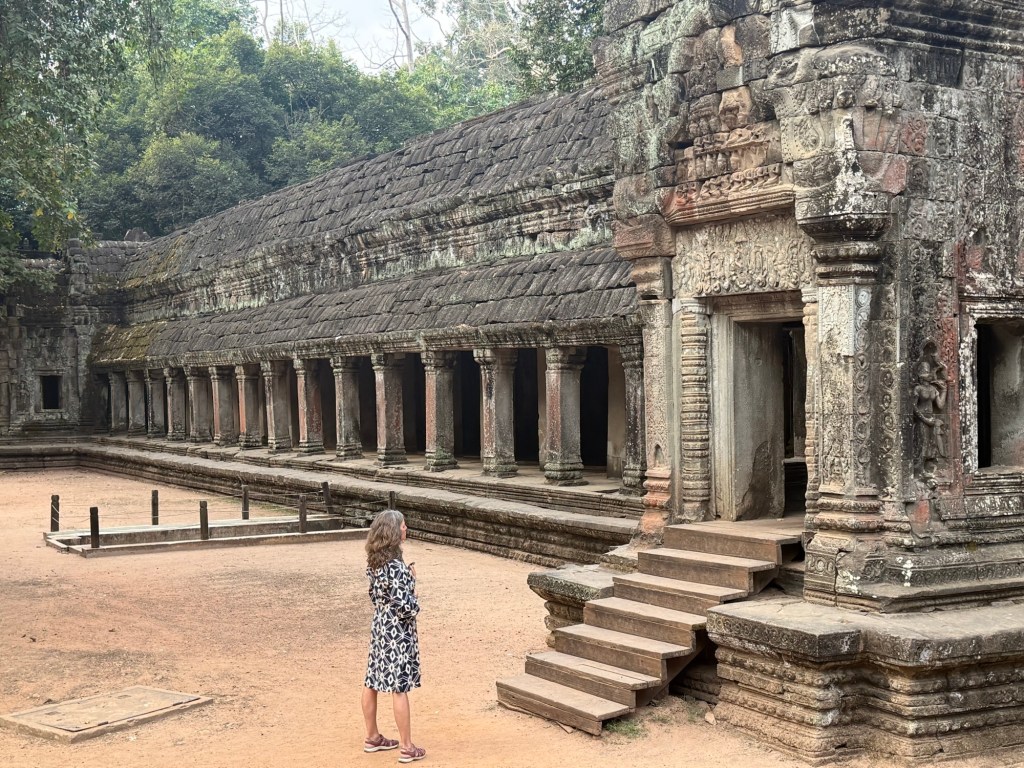
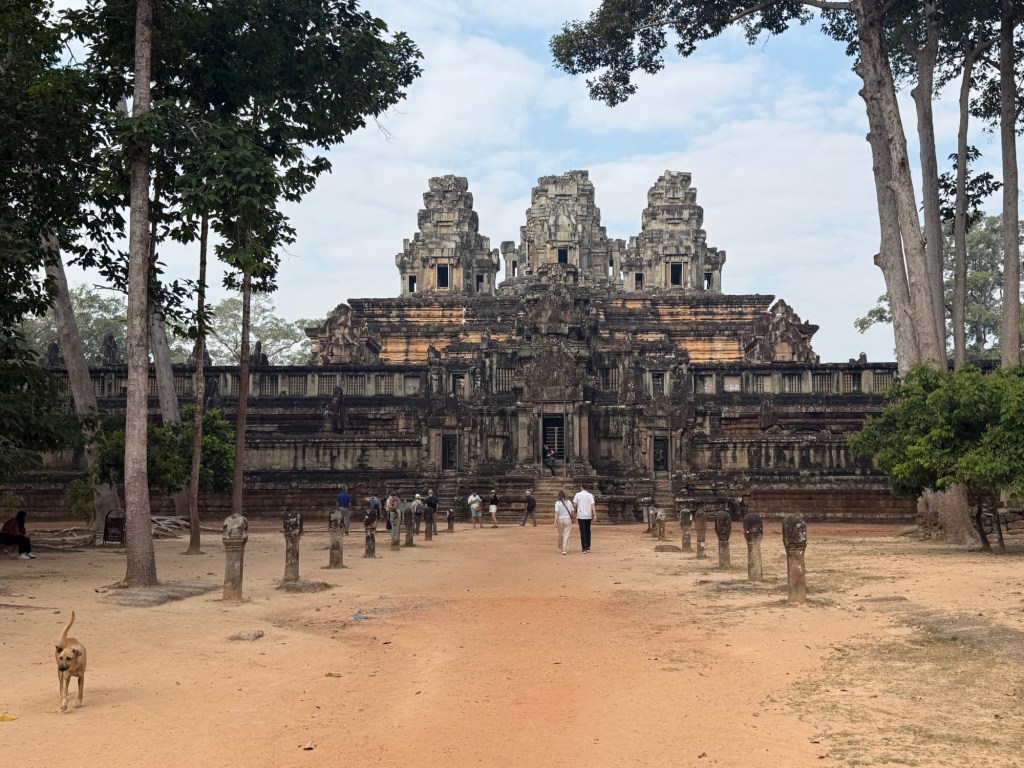
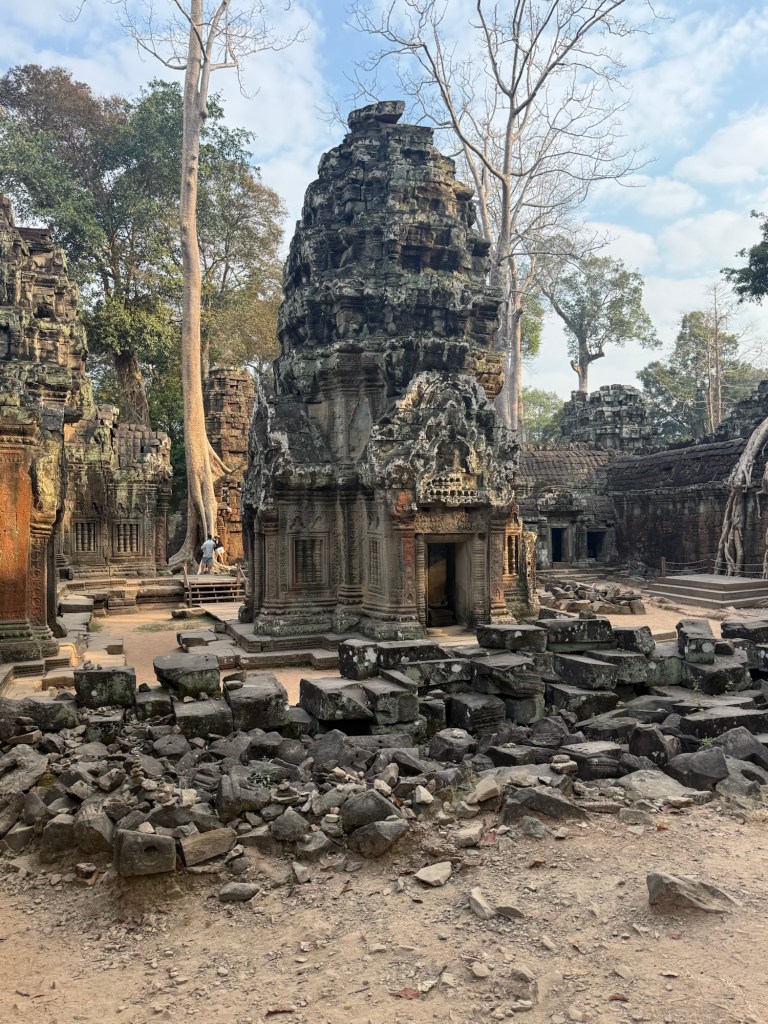
Sun up, we made visits to two other temples Ta Prohm, and Takeo.
Ta Pram Ta PramTa KeoTa Keo
The temples are fascinating. Generally built communally as acts of worship, the bases are laterite – a form of quartz. The tops are sandstone, allowing the most intricate carving imaginable. The temple structure is built from the bottom up. A second set of craftsmen does the carving – from the top down!
The temples often structurally represent Meru, the home of the Gods. Meru is sounded by rings of 7 seas and 7 mountains. And the gates and moats that surround the temples are representative.
Some of the largest and most ornate temples are also Stupa, burial places for the Kings
Like Mayan, Aztec and Egyptian sites the temples are built on exact NSEW axis and frame Cellestial events (like the sunrise, spring equinox, etc) with mathematical precision. A mystery best explained by Aliens I think.
Many of the temples were destroyed during an invasion by Siam (historic Thailand) in the 14th century. They were literally pulled down by elephants!
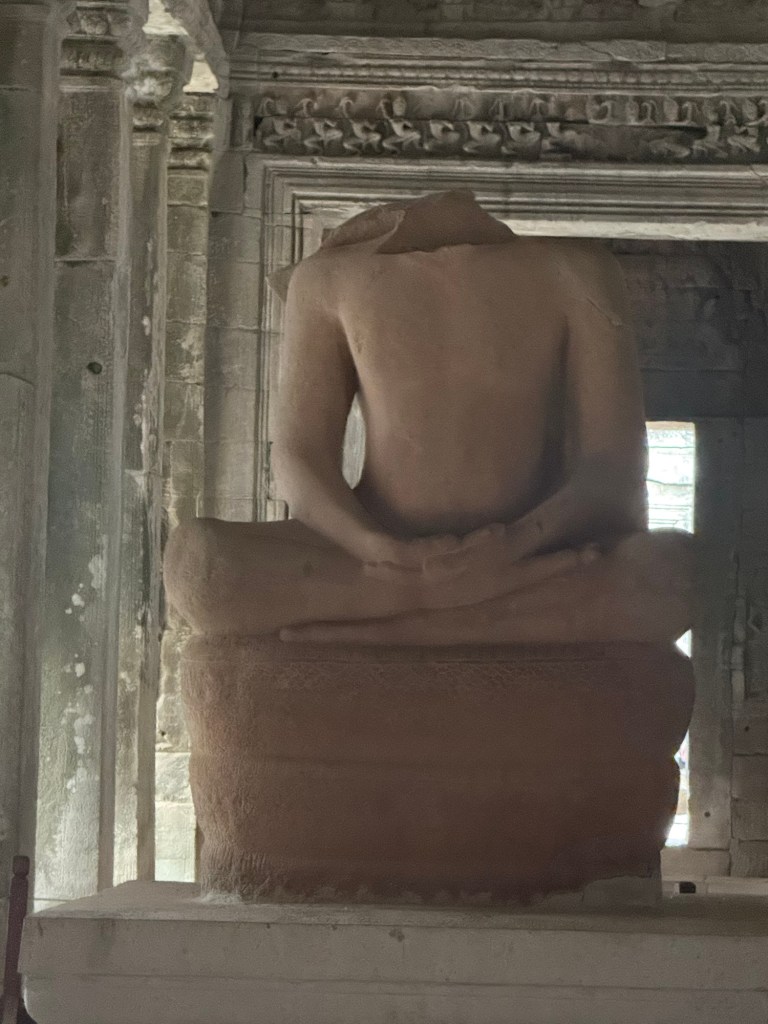
Many others were defaced as a backlash against the transition away from Hinduism under Jaya 7. Most of the Buddhas have been chiseled out. Others have been changed to include a Hindu third eye, or recarved into Hindu deities or lotus flowers.
Headless BuddhaBuddha “hole” at center
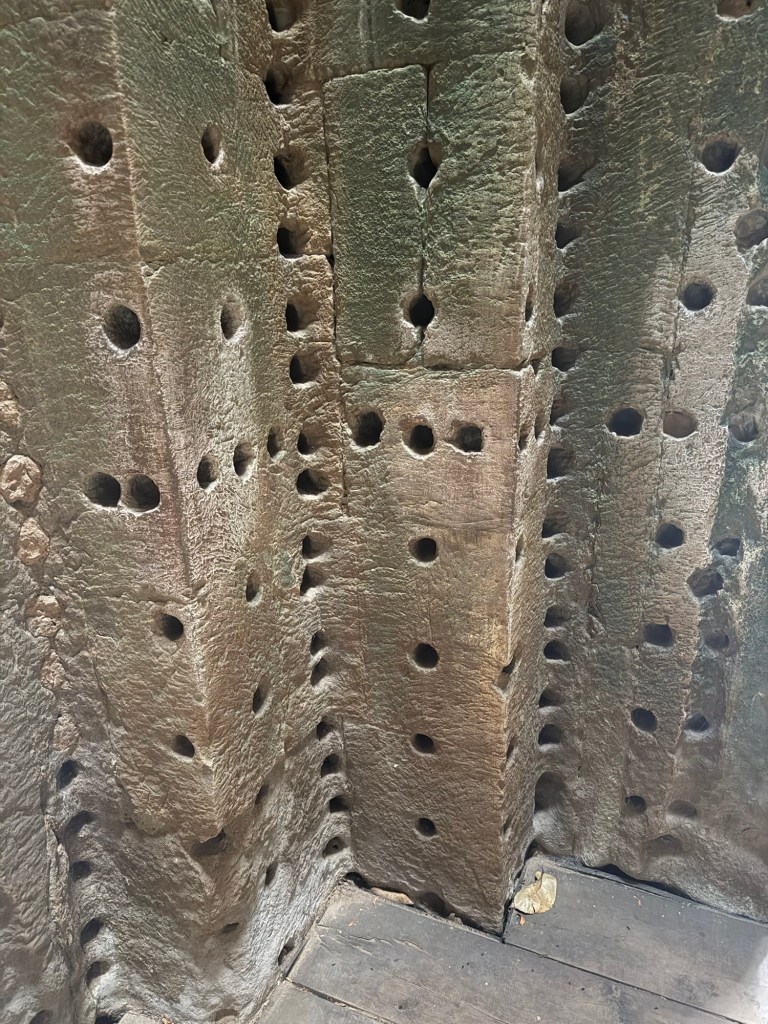
In the 16th through 20th centuries Western treasure hunters stole many of the gold artifacts and jewels. Each hole in the shot below was a large, rough cut precious gem (typically rubies, emeralds or sapphires). These were chiseled out in the early 20th century ala Indiana Jones. If you own a ruby today it’s as likely to have been stolen from a Cambodian temple as mined for you anywhere else.
Stolen gemstones
From 1975-85, the Kmer Rouge shelled and mined temples in their manic quest to purge all religion and history. More damage.
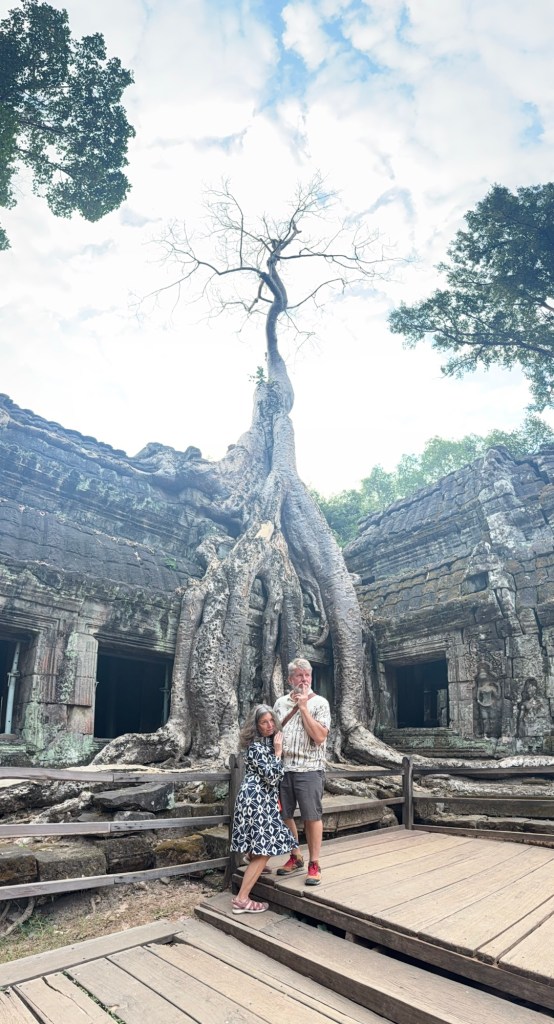
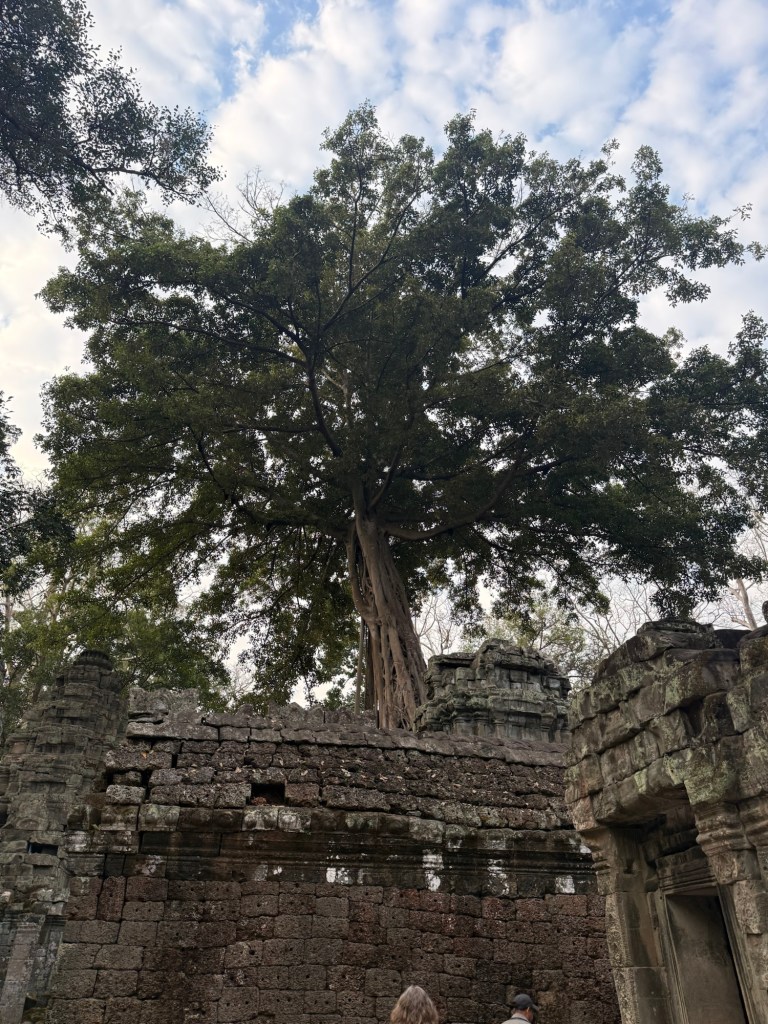
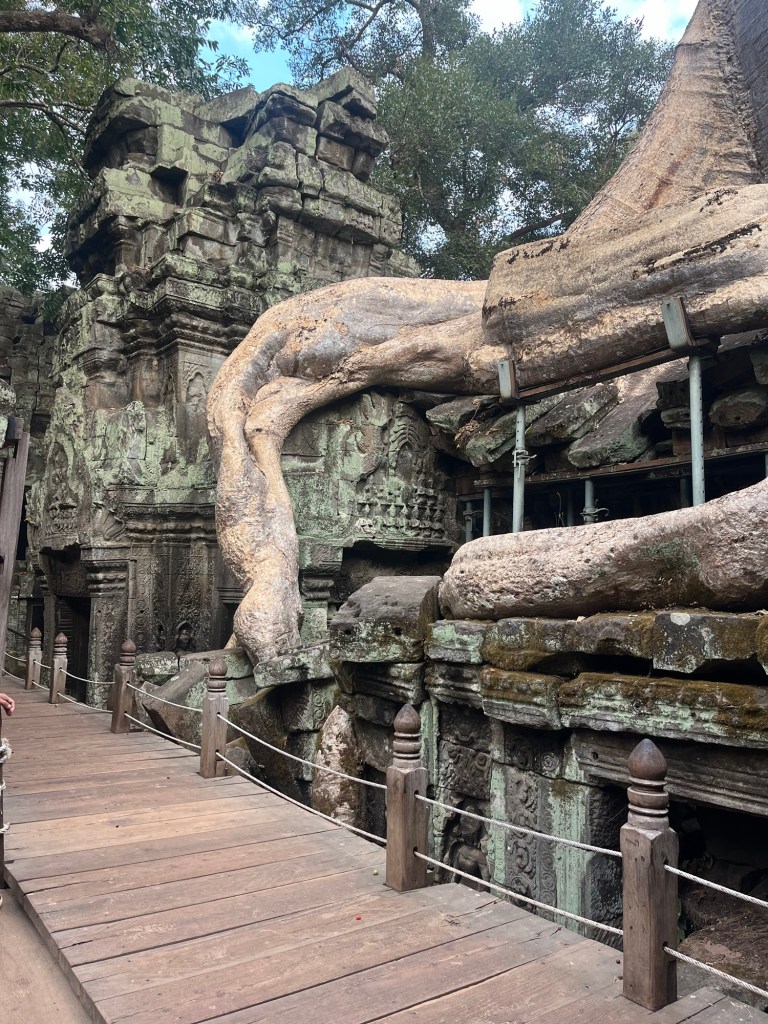
Even today the jungle itself is pulling sections apart as gigantic (protected) trees grow through and over the stones.
Ficas Invasion50 Foot Tree150 year old roots
85% of the damage and loss is man-made. From the Hindu desecrations of Buddha to the destruction by Siam to the Khmer Rouge – noone knows how many temples were fully destroyed and scattered – fully gone.
What’s most amazing is what’s standing today. UNESCO has 90 temples under restoration. USAID had another 20 (we’re really sorry Cambodia). Many other global agencies and many Chinese NGOs have done or are doing miraculous restorations. Later temples and current restorations were often built from stone scattered by the Siam invaders. Each temple is a story of what was, what happened, what’s restored, and what they’re working on.
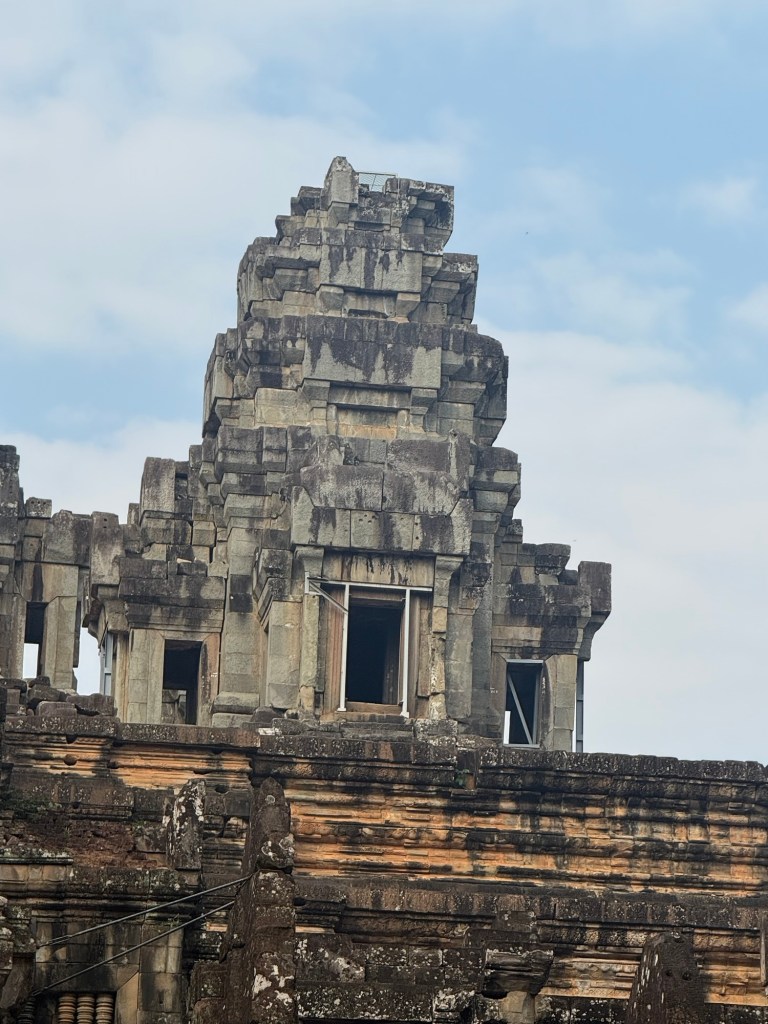
Incomplete tower at Bayoun
Rom points out each spot where a Tomb Raider scene was filmed. We also learned that both Vietnamese and Cambodians are a little Angelina Jolie obsessed.
Describing each temple and the detail Rom shared would be almost impossible here. The dude is encyclopedic. I’ll try and describe some common themes and features of the temples below. And I won’t try and describe where Hinduism and Buddhism start and stop.
The hybrid Buddha/Hindu traditions spin out a variety of characters that are featured in the temples
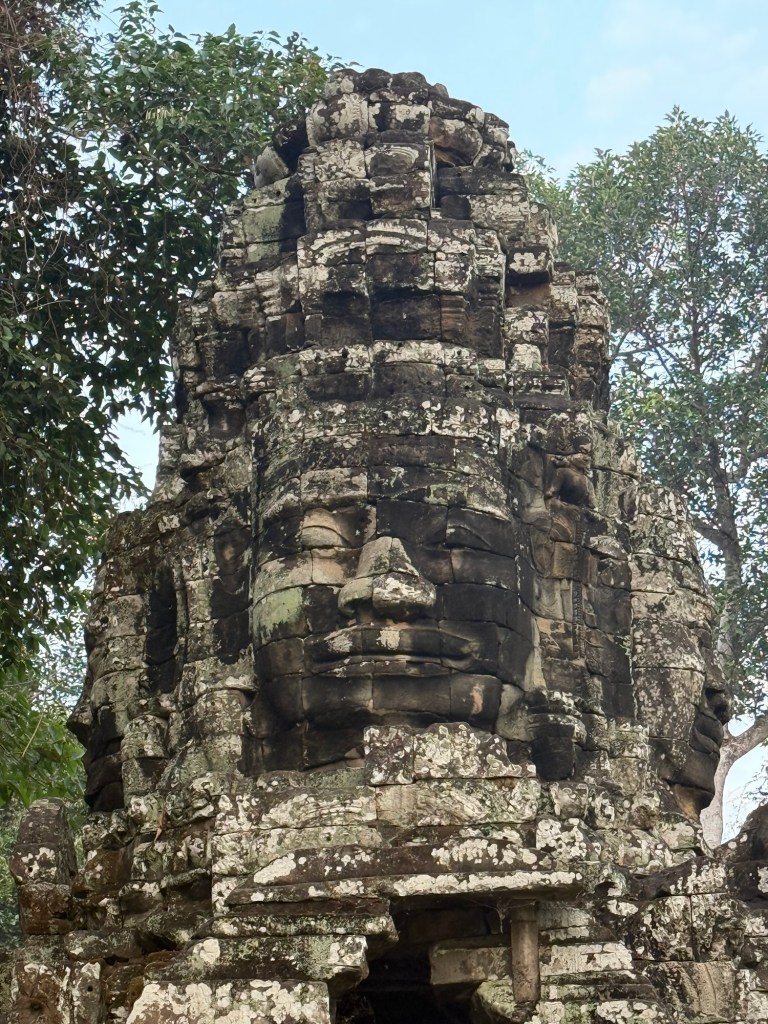
The Buddha – Before the Hindu and Siam defacements many towers had 4 Buddha faces pointing North, South, East and West. In Cambodian the four faces represent equanimity, compassion, loving-kindness, and appreciative-joy. These features are the goal of each real Buddhist as he seeks enlightenment. It seems like there are a hundred paths. But both Juju and I see it every moment in the culture, and friendliness of the people.
Buddha Tower
Jaya 7 – Jayavarma VII, also known as Mahaparamasaugata (1122–1218),
This guy! During his 50 year reign he built 189 temples, an entire royal city, 102 hospitals, 120 rest homes for pilgrims, public universities, extensive reservoirs, and 170 miles of moats.
He conquered a couple of neighboring countries, and established a governing system of 12 regional kings. As a side gig he basically started a new hybrid Hindu-Buddhist set of governance, ceremonial practices and architecture that stopped a millennia or so of blood shed.
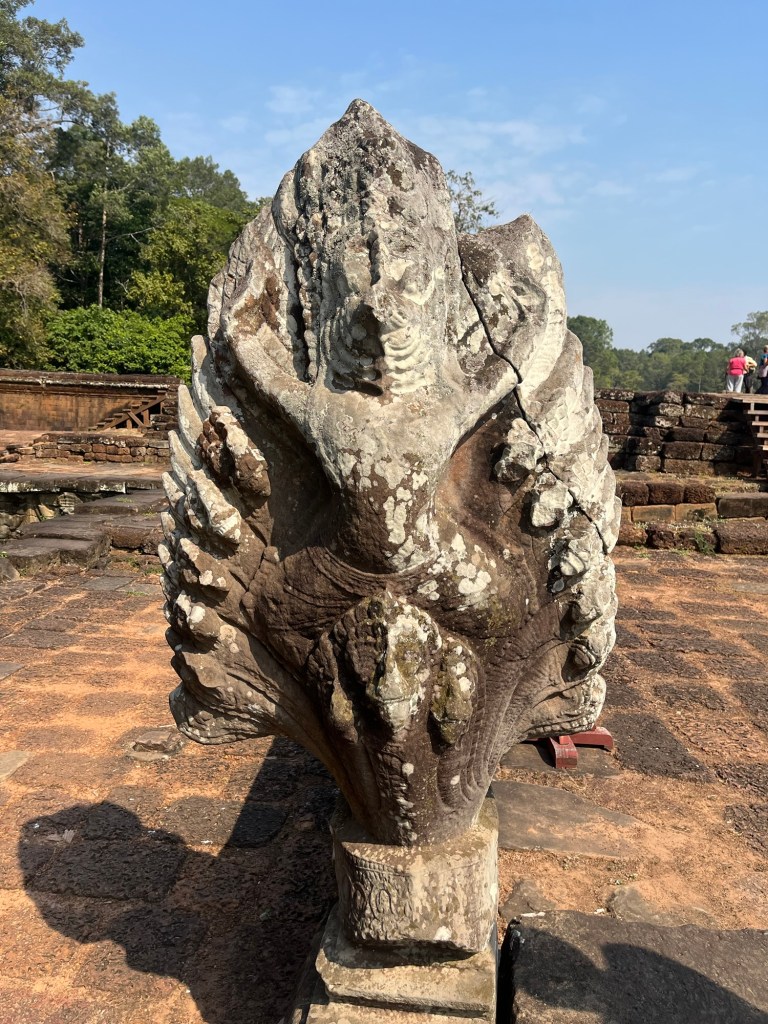
Naga and Nagini, Demons and Gods – Vishnu (the God of Men) negotiated a truce between Gods and Demons so their warfare would not destroy the earth. It involved two huge snakes wrapped around an island and pulled back and forth by the two armies. This spun the island, churning the sea and producing the nectar Anrita which gave the gods immortality.
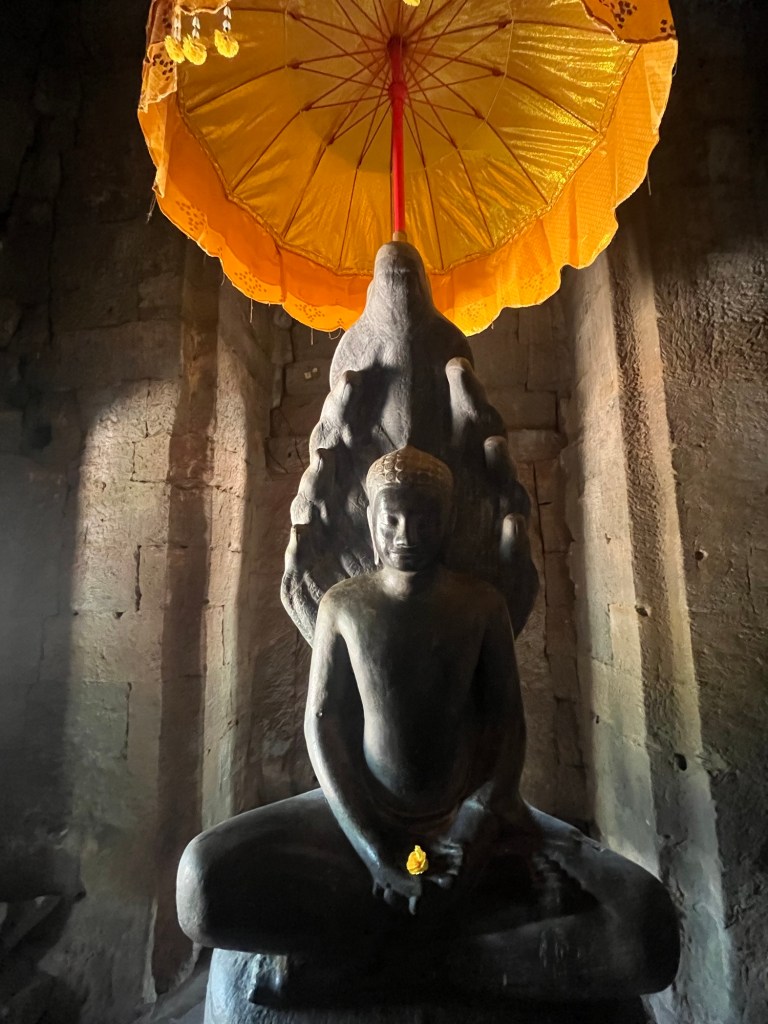
It also spawned a variety of new characters. The huge snakes, Nag and Nagini are featured as rails, roofs, and head covering for the Buddha in every temple. Kipling, of course, used them as primary character names in Riki Tiki Tavi.
Naga shading The BuddhaNaga and Nagini
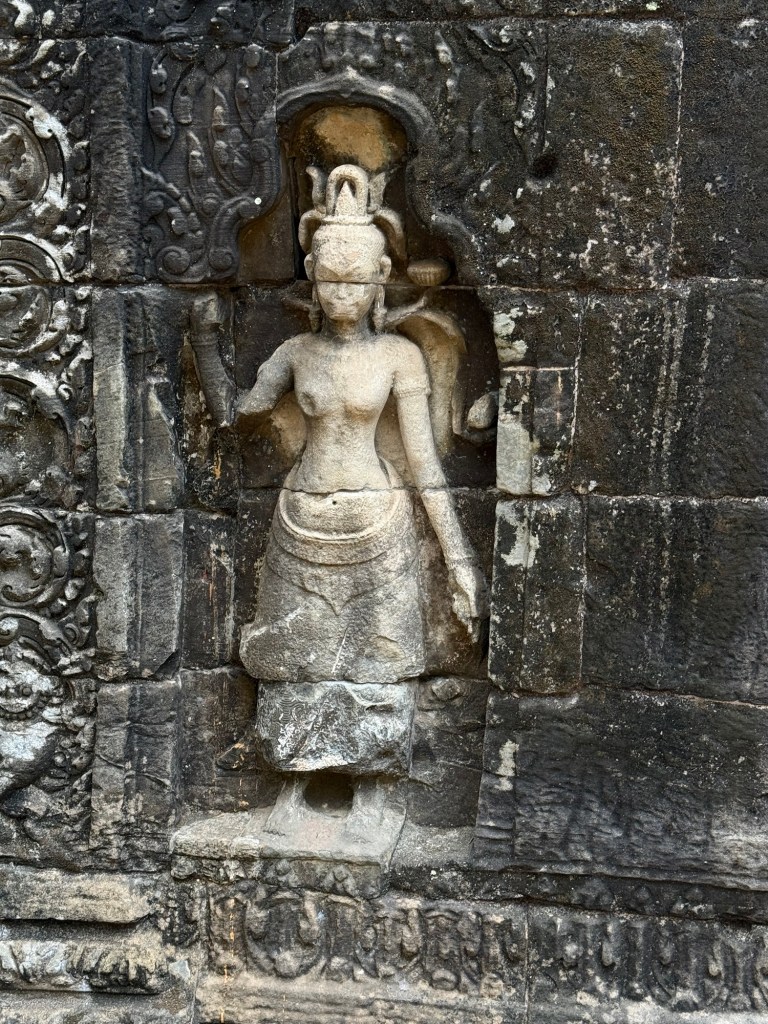
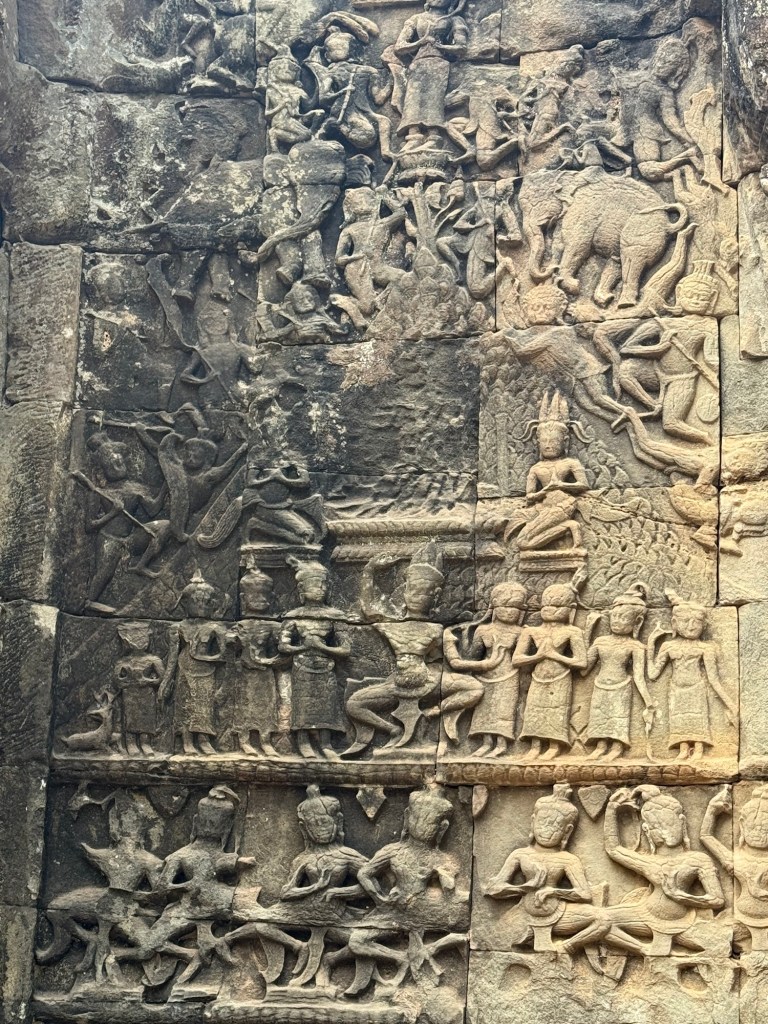
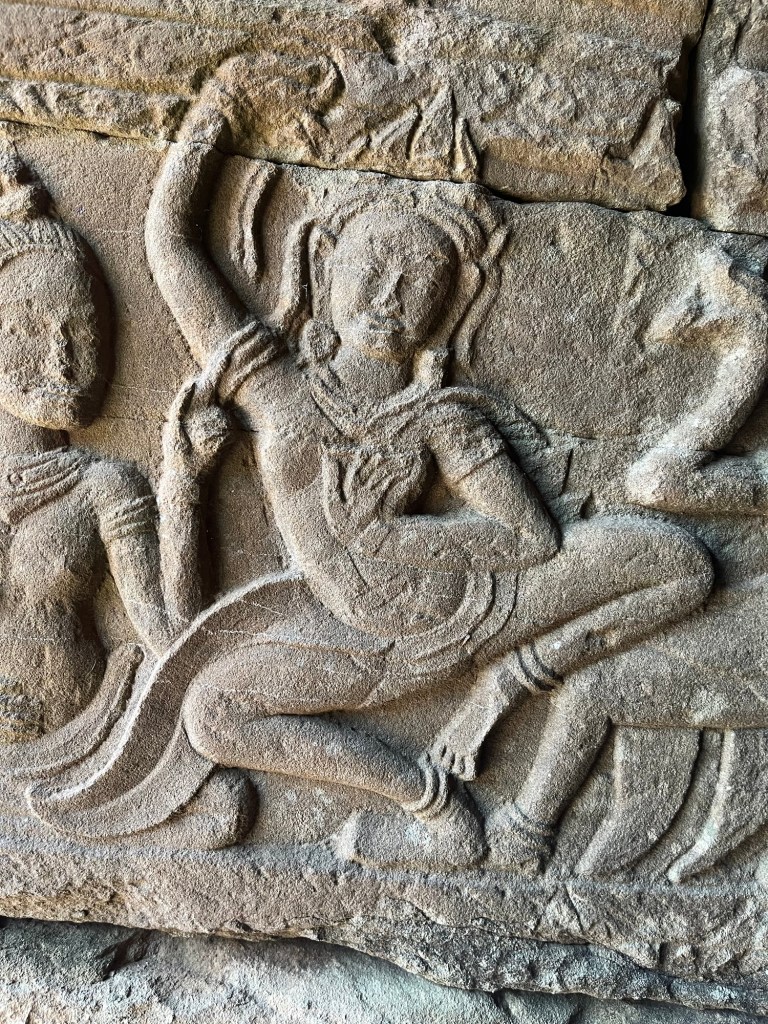
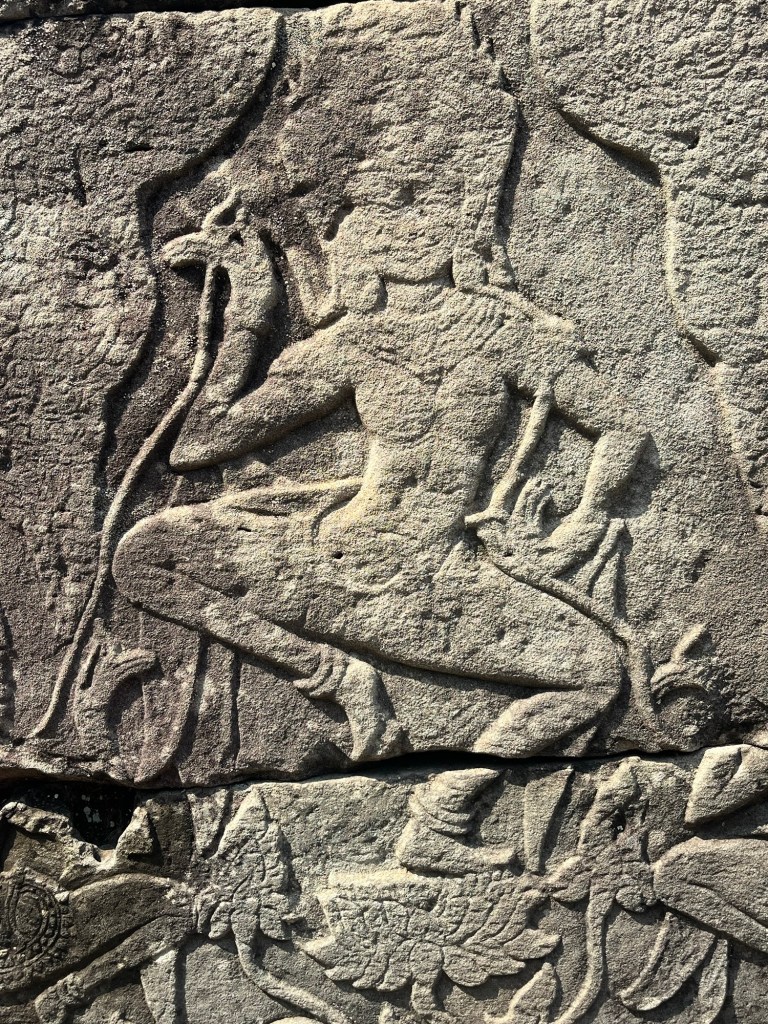
Absara Dancers – The iconic Cambodian image and a dance tradition still practiced today, the Absara are featured everywhere. Their dance, performed for the King is meant to represent the spinning and churning described above.
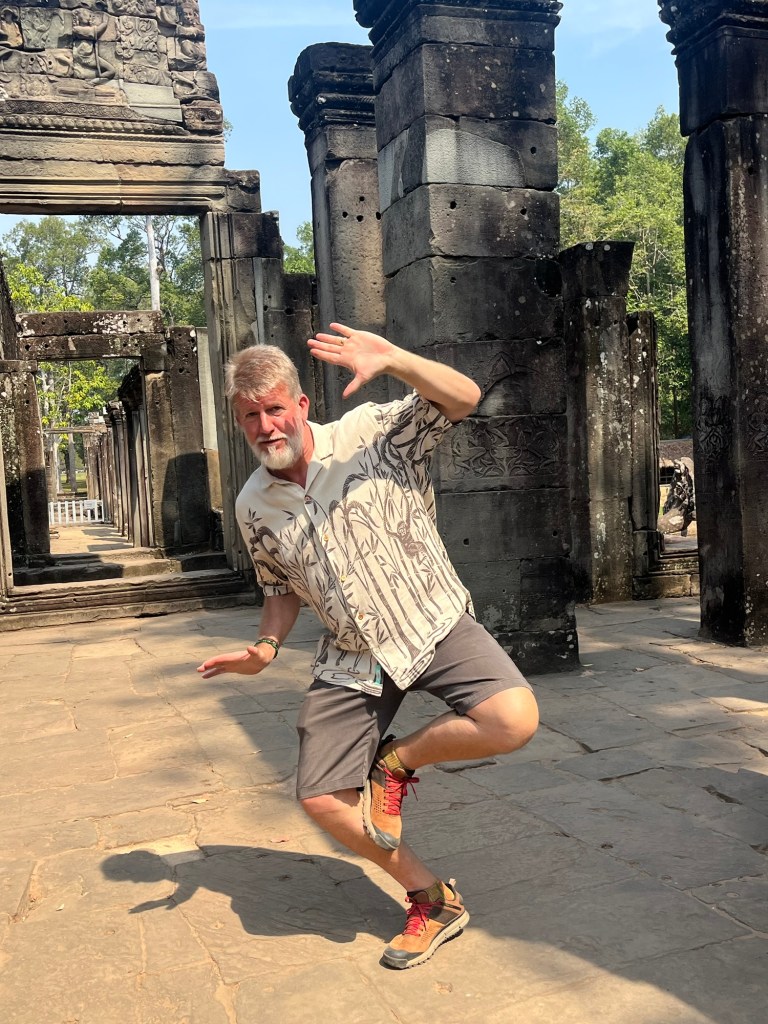
Absara at Ta KeoAbsara at Angkar WatAbsara Inflexibla
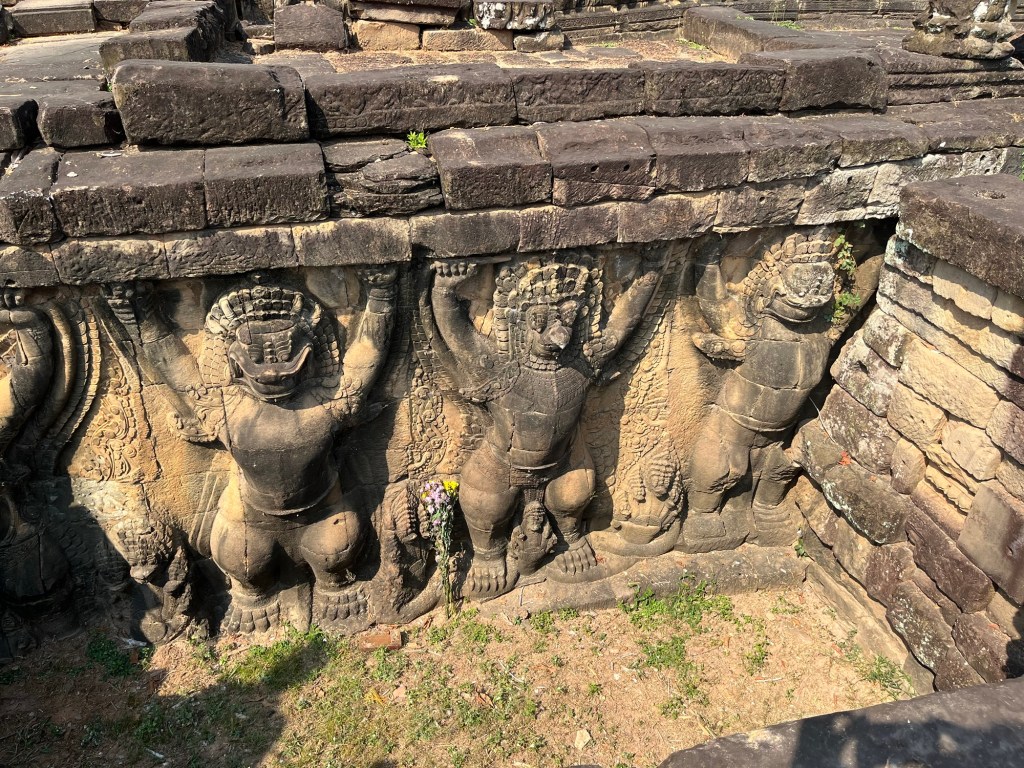
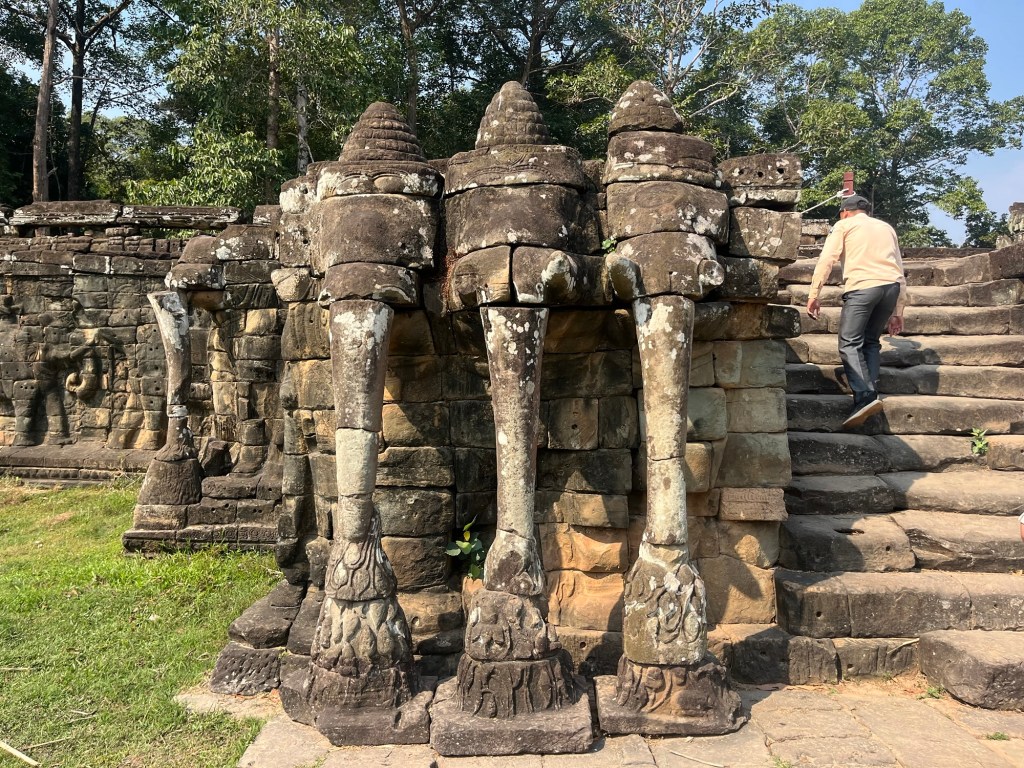
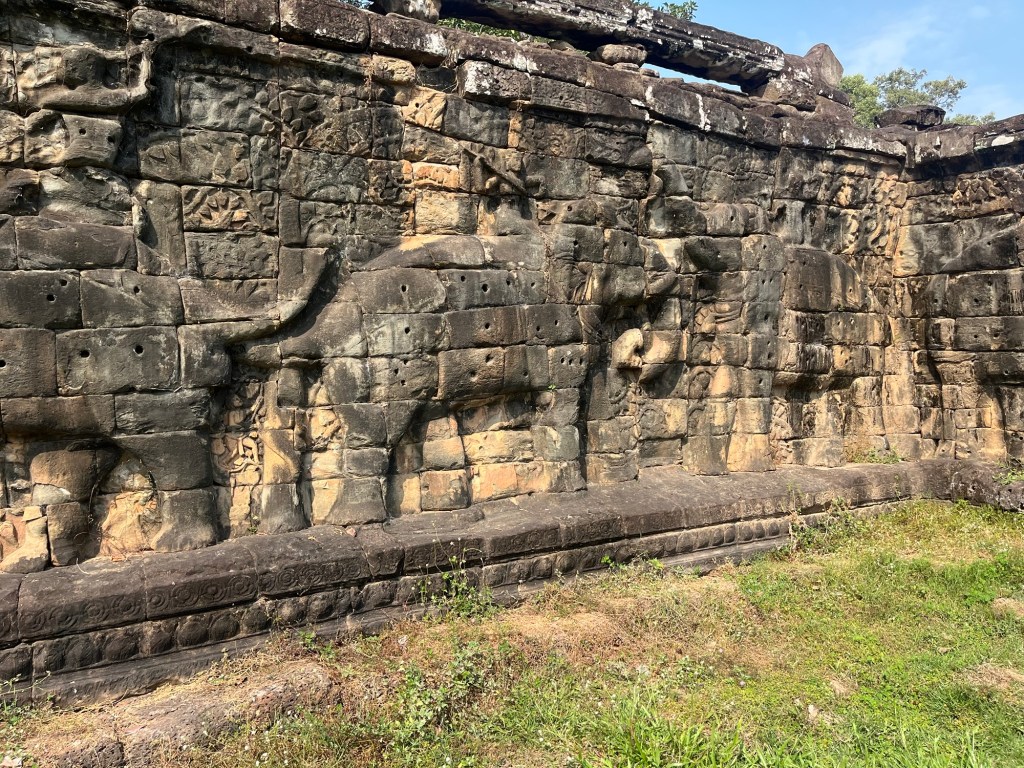
Giant Birds and Three Headed Elephants – Garuda (birds or phoenix) were spun from the froth, as were elephants including the 3 headed Iravanta. These entities serve as foundations and supports in most temples.
GarudaIravantaElephants and Mahouts10th Century Iravanta
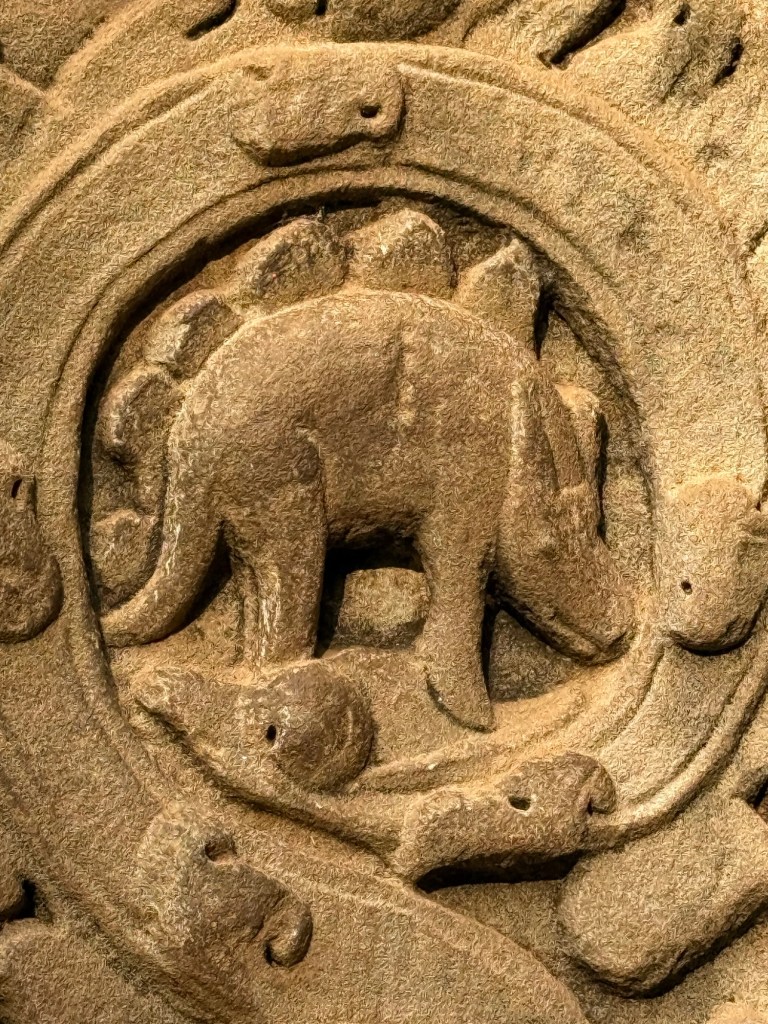
Animals and a Dinosaur (maybe) – Natural motifs, plants and native animals are featured in many carvings. One repeating figure raises a lot of questions among archaeologists. Were there dinosaurs surviving into the 13th century?
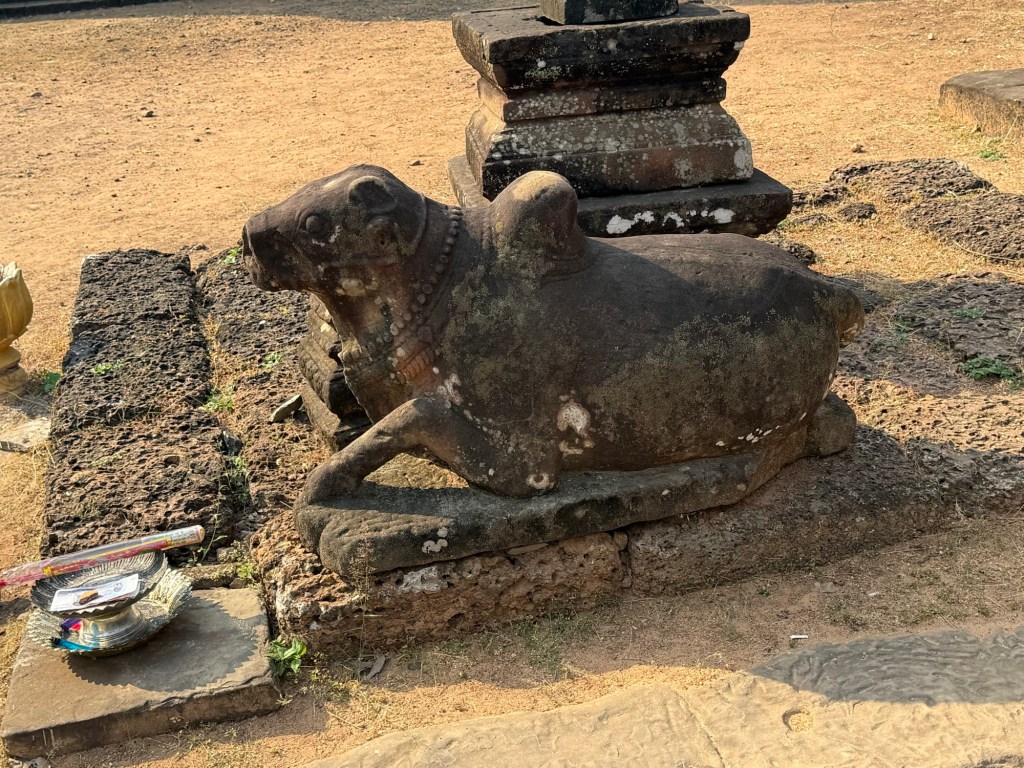
Hindu Cow, Transportation for ShivaCambodian Stegosaurus (????)
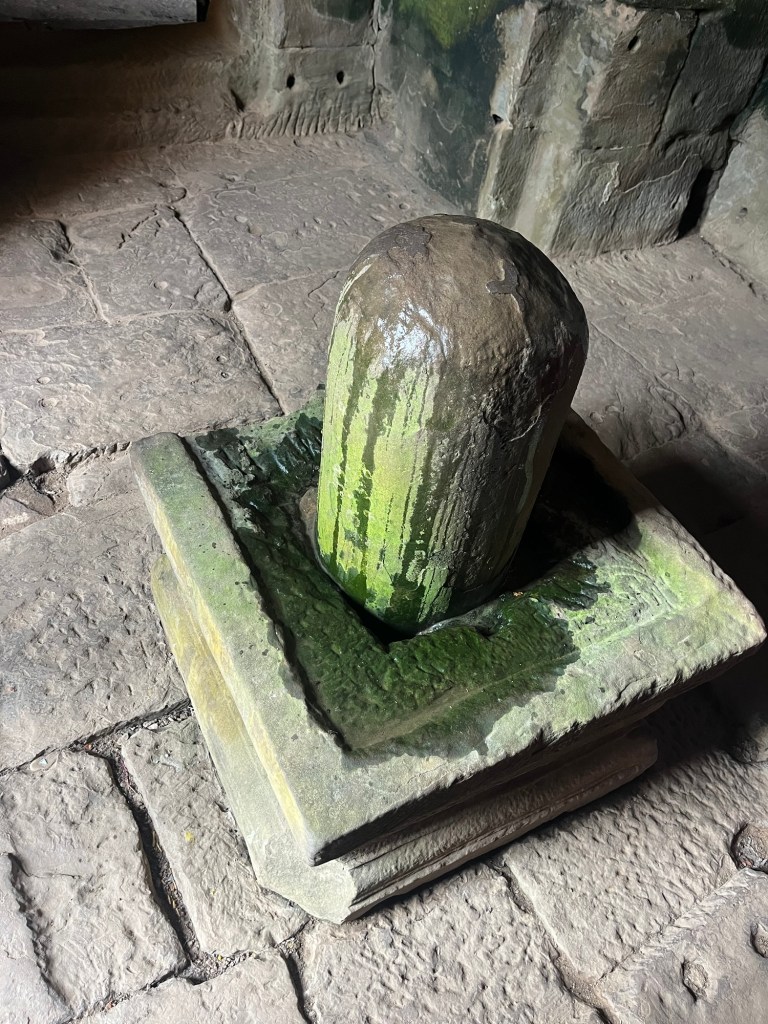
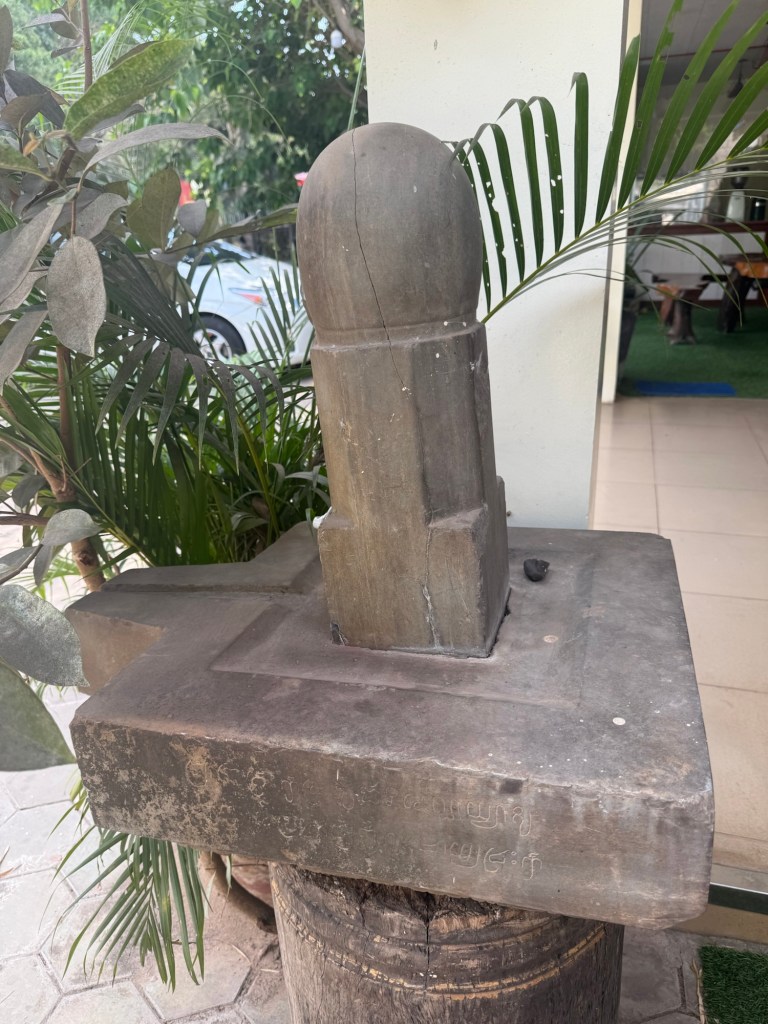
Phallic Symbols – Common in most temples are vertical phallic symbols representing lingam (the shaft) and yoni (the base). These are ancient, sacred, Hindu symbols representing the union of masculine and feminine energies. Visitors to the temple poured grain, died water or coconut milk over the sculptures to entreat the Gods (specifically Lord Shiva and Goddess Shakti) for favor.
Lingam and YoniLingam-Yoni in the hotel lobby
BirdSnake – Jaya 7 introduced a new character found in most later temples combining two natural enemies, the bird and snake. This character places Hindu Garuda inside the mouth of Buddhist Naga and represented the final hybridization of the faiths, and a peace lasting essentially today.
Garuda-Naga
There were many more features and characters but this is getting long.
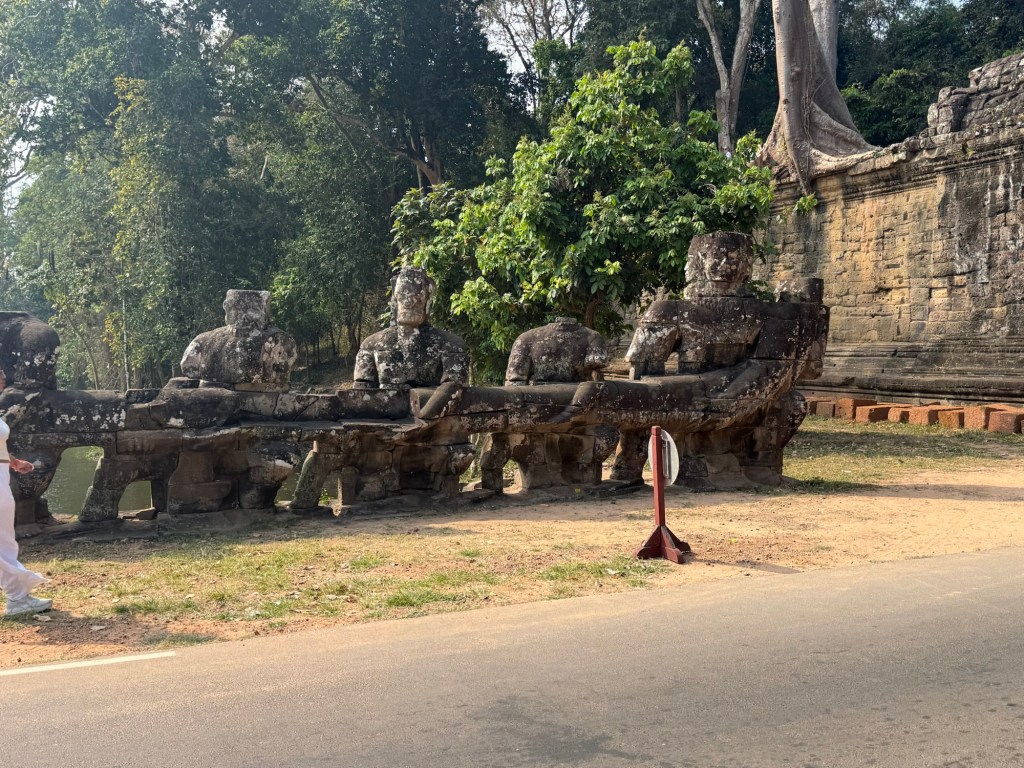
Later in the day we drove between two huge Naga and Nagiana supported by a dozen Demons and a dozen Gods and through the “Victory Gate” and into Angkor Thom.
Entrance to Angkor Thom
Suryavarman II built the royal city 200 years after the reign of Jaya 7. Angkor Thom is surrounded by a huge moat and 40 foot walls. The 4 square mile city includes 12 (relatively) small temples for his 12 kings – each with its own Buddha or guardian God, 4 large royal temples, and 4 small temples for various family members.
The Terrace of the Elephants, a huge platform 1/4 mile wide and 15 foot high was the royal receiving area from which kings would review their elephant armies, hold sporting events, or receive delegations from subordinate kings.
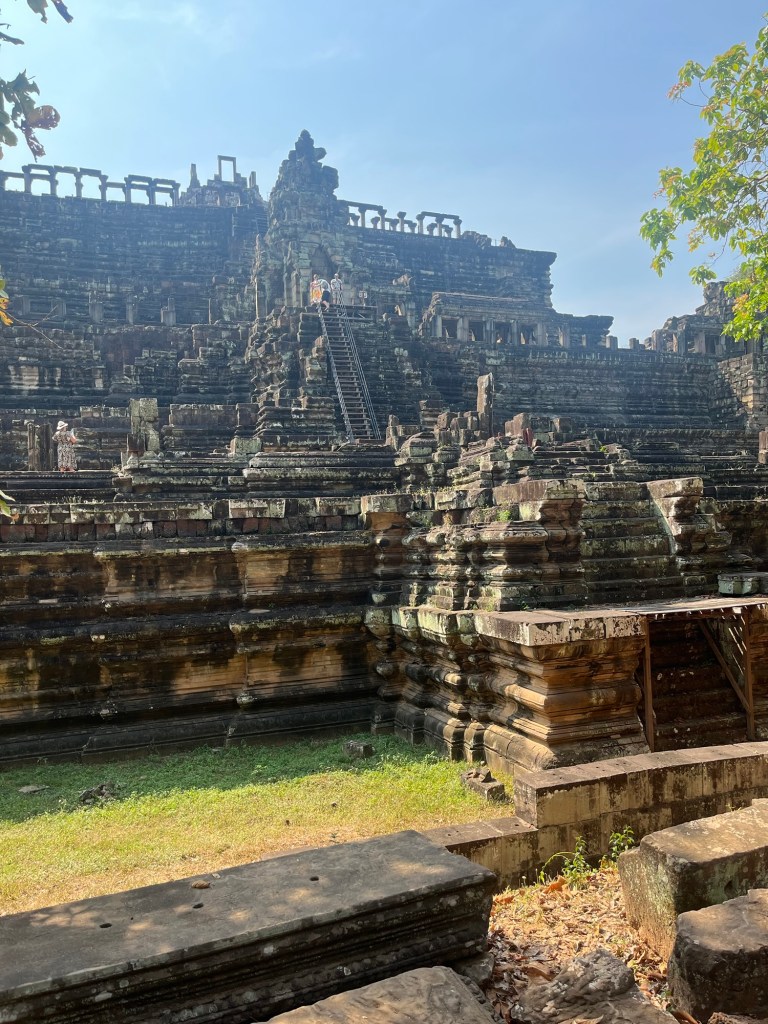
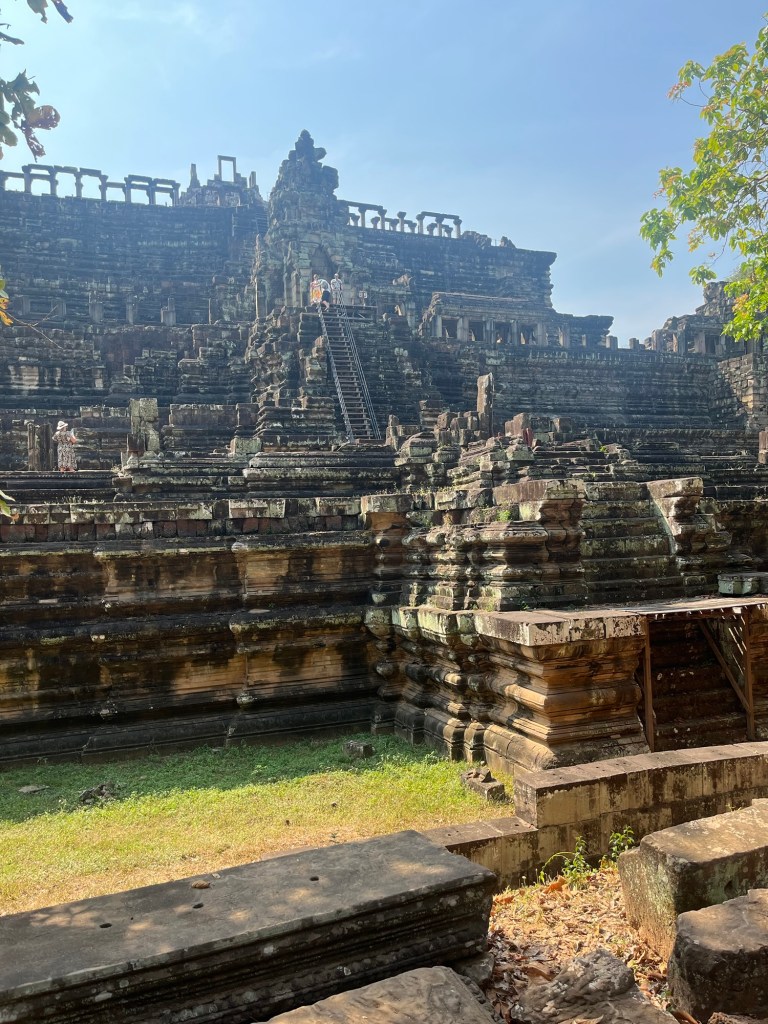
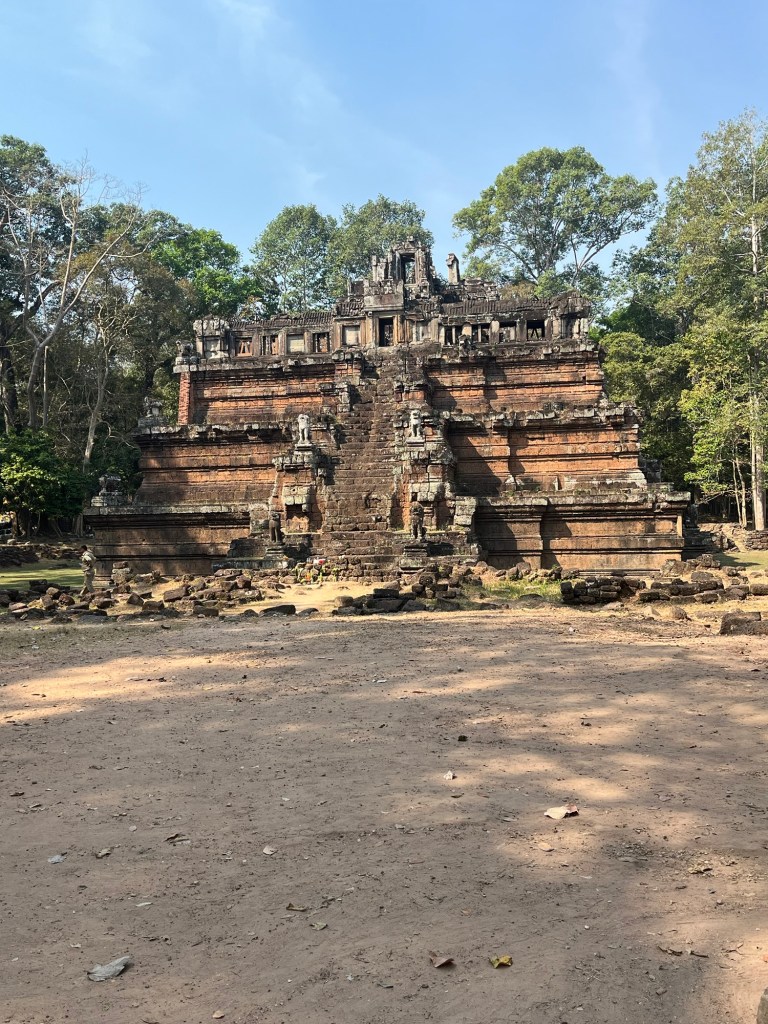
Several huge temples including Bayoun, Baphon and the kings own Phimeanakas Temple were within the city walls. Giant man made pools, separated by male and female, were dotted across the ground. Ponds for fish and ceremonial water offerings were near each temple.
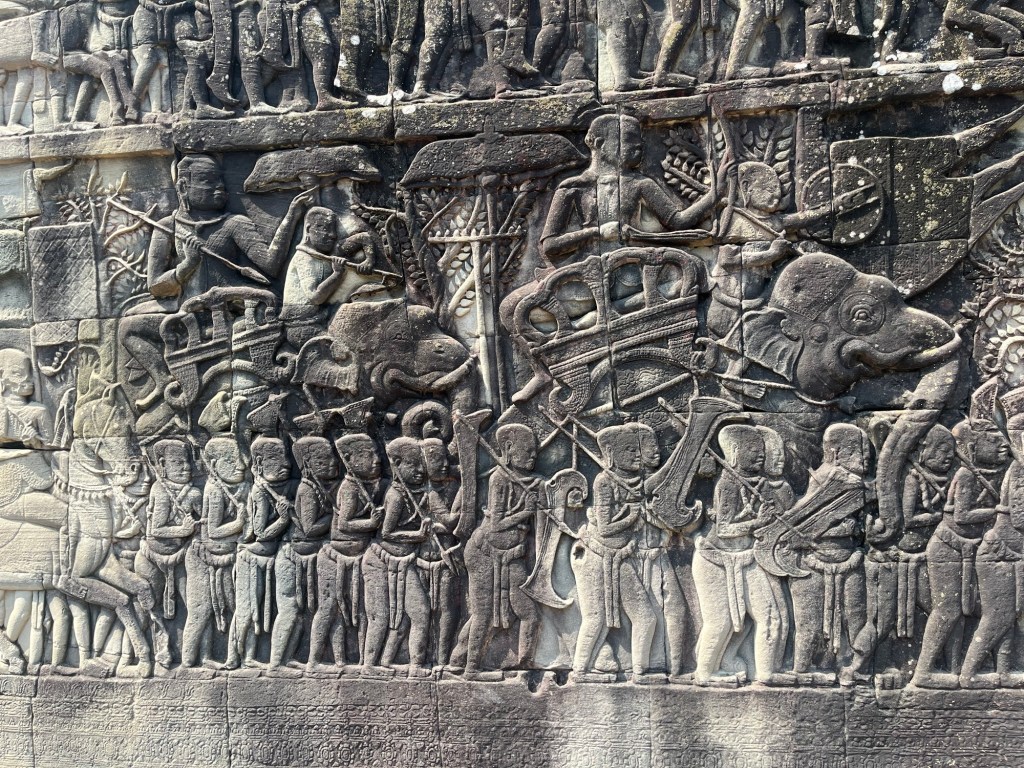
Hays’s Army from BayounThe Temple Baphon
The grounds today feel like a verdant jungle broken up my massive royal structures. But recent LIDAR imaging shows that the city was densely packed with wooden homes. The King’s own palace (wooden) surrounded his temple on all four sides, but only the foundation and broken clay shards from the roof are there today.
Temple BaphonPhimeanakis Temple and Supra
So there you go (and we haven’t even made it to Angkor Wat!)
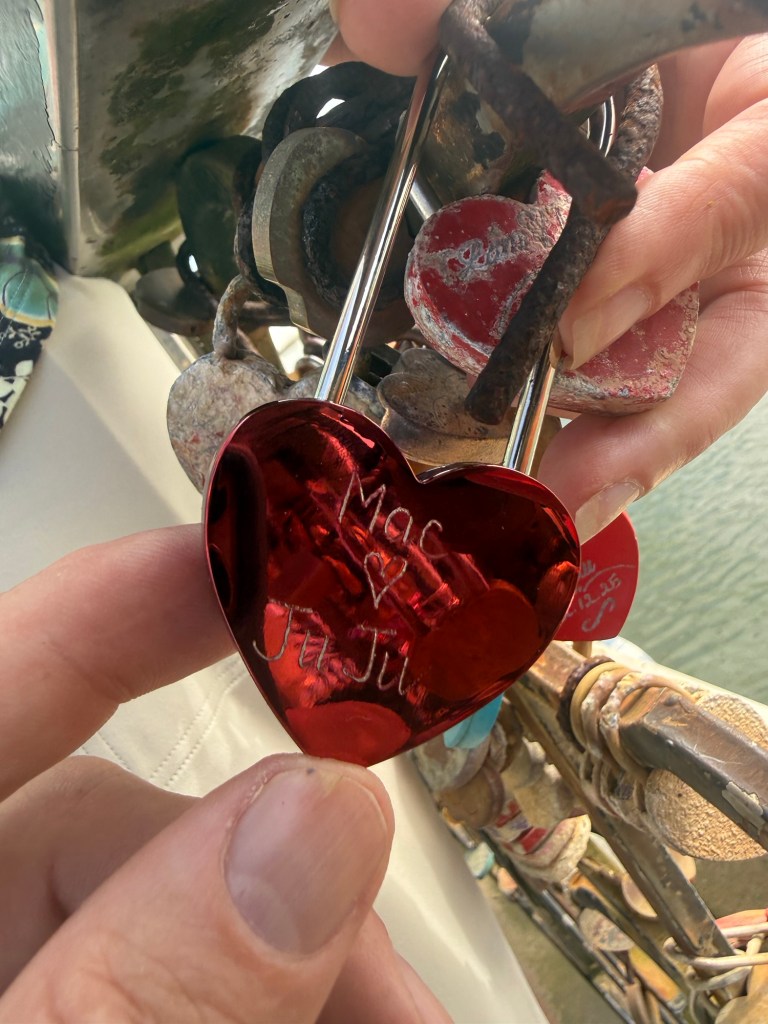
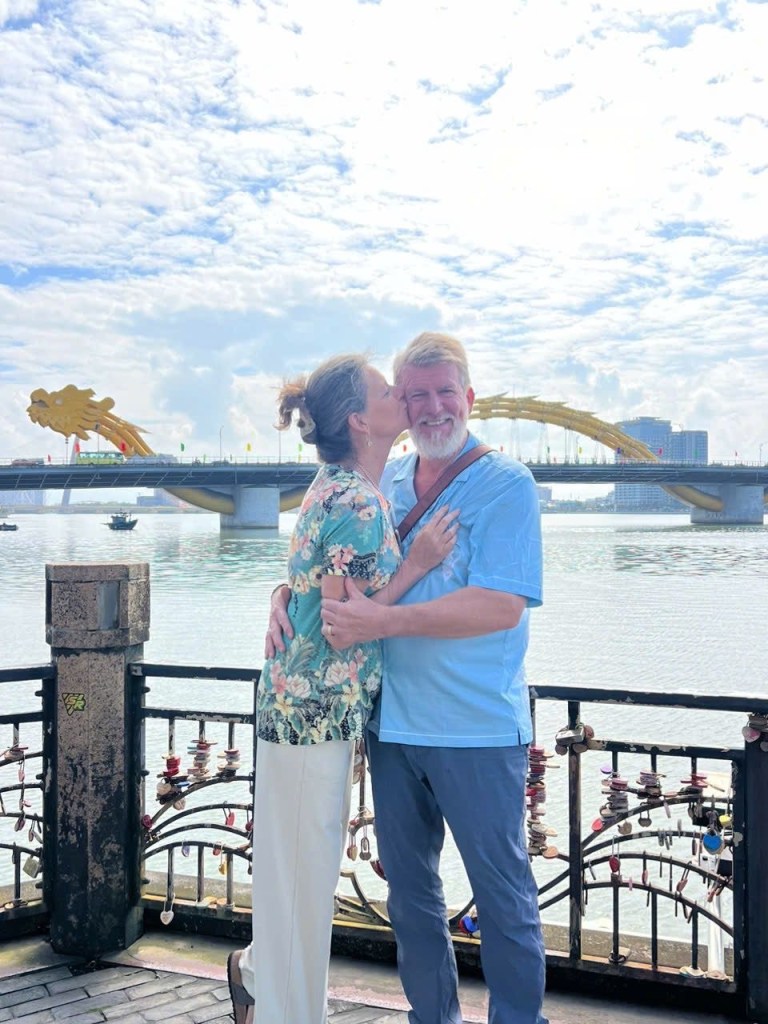
We woke up, went to breakfast, had a red-whiskered bull-bull sighting, picked up JuJu’s Ao Dai (wow!), sat by the pool, hung a love lock on the Da Nang Dragon Bridge, and then flew from Da Nang to Siem Reap, Cambodia .
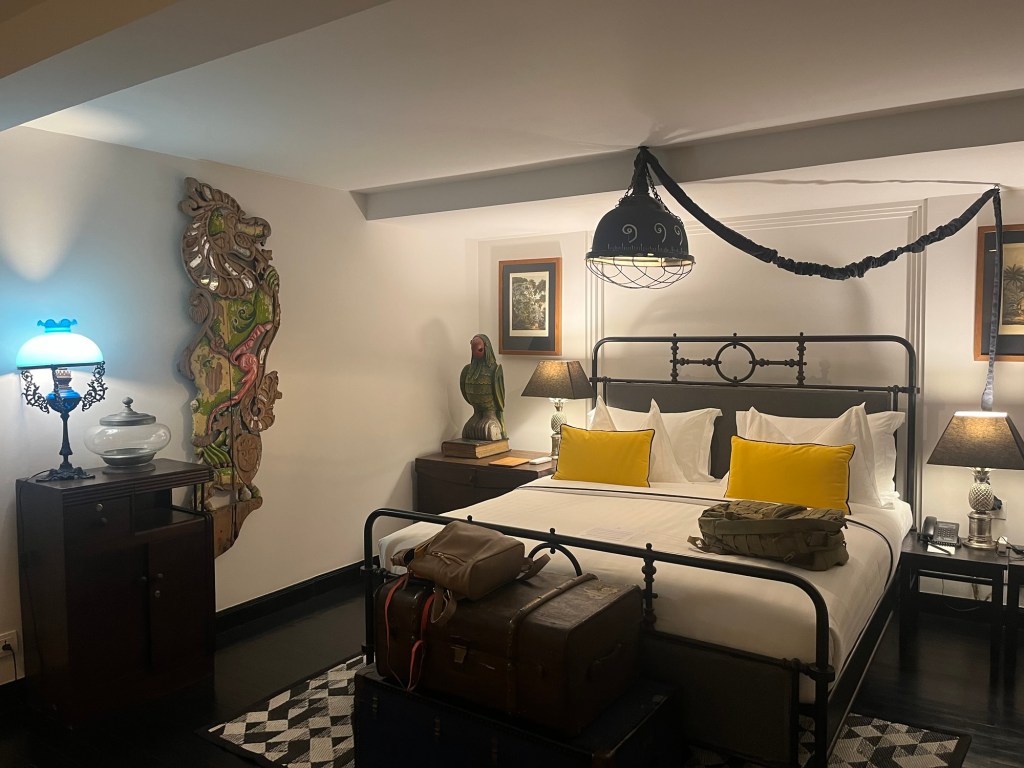
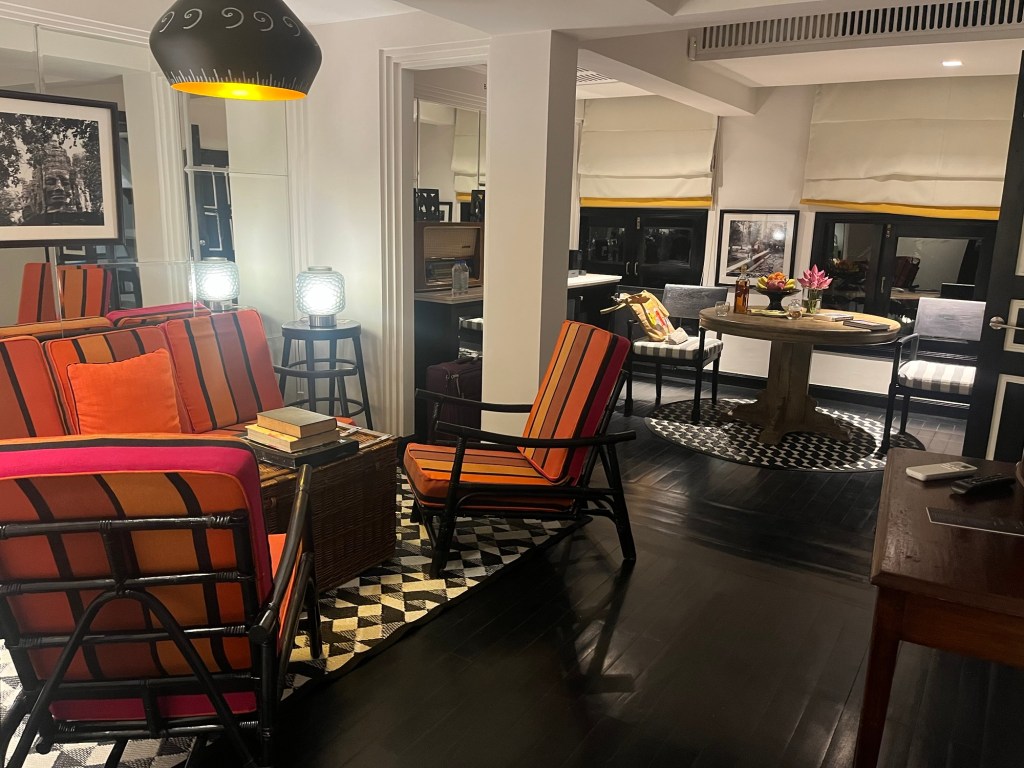
Our new guide, Rom and our new driver Ravuth expedited us through customs and took us to by far the most beautiful hotel and suite we’ve stayed in – ever, the Shinta Mani, Angkor.
Dawn at the Sara Sarong Temple tomorrow, with a 5:20 AM pick up. We had a quick snack at the hotel bar and off to bed.
Storm of the century at home in Pennsylvania. There’s 23″ of snow and single digit temperatures. I’ll just leave this here..-
Simon on the blog. CuzInternational Love Affair (lock on the Dragon Bridge)Dragon Bridge, Danang VNThe Shinta Mani Angkor, Siem ReapNice digs (again)
The tour company arranged a trip to Go Noi Village, a village outside Hoi An and central to an adjacent island. We visited with a farming family and took a biking tour to learn the trade and life of a typical Viet village.
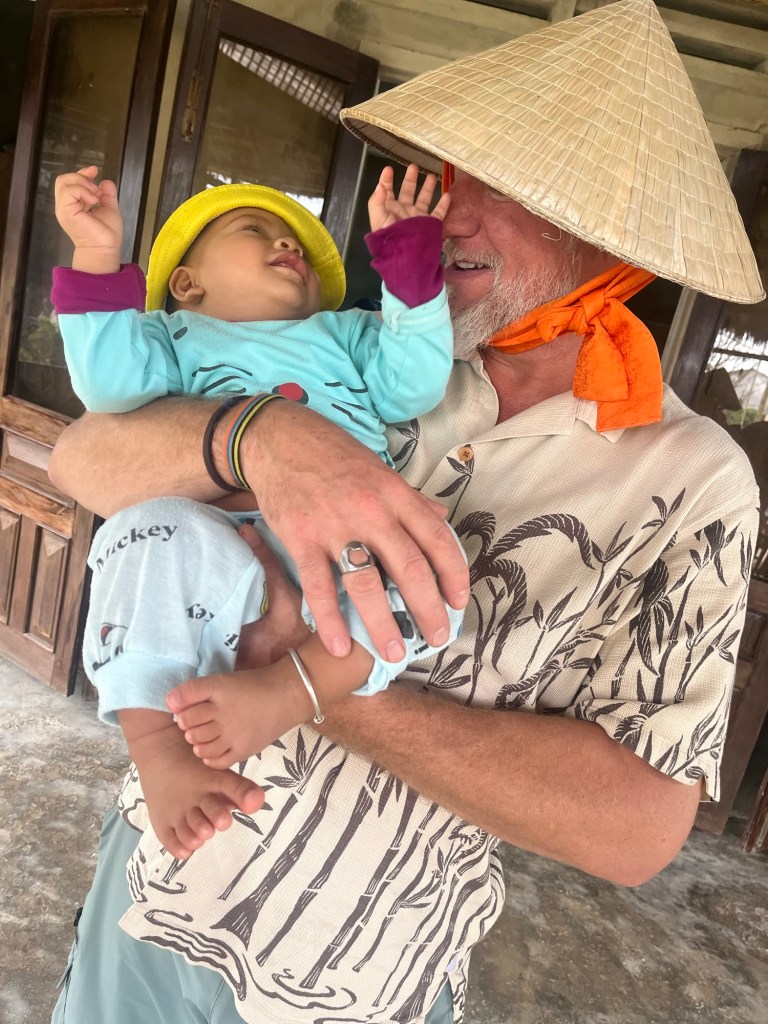
When we arrived we were introduced to the patriarch and matriarch whose names were Bay and Sau (7 and 6 in Viet).
Mac and Bay
They were ~60 , and this was a common naming approach for children born during The American War. Their 5 children were named France, America, Germany, etc.
A tour of the house, revealed some interesting features. It consisted of the two bedrooms, a main room and central shrine, and an outdoor kitchen, and dining rooms. Phap (France) the oldest son and his wife shared a room, and the sister and baby (Tintin) lived in the main room.
Rice Wine (of course)Mac and Hieu (TinTin)
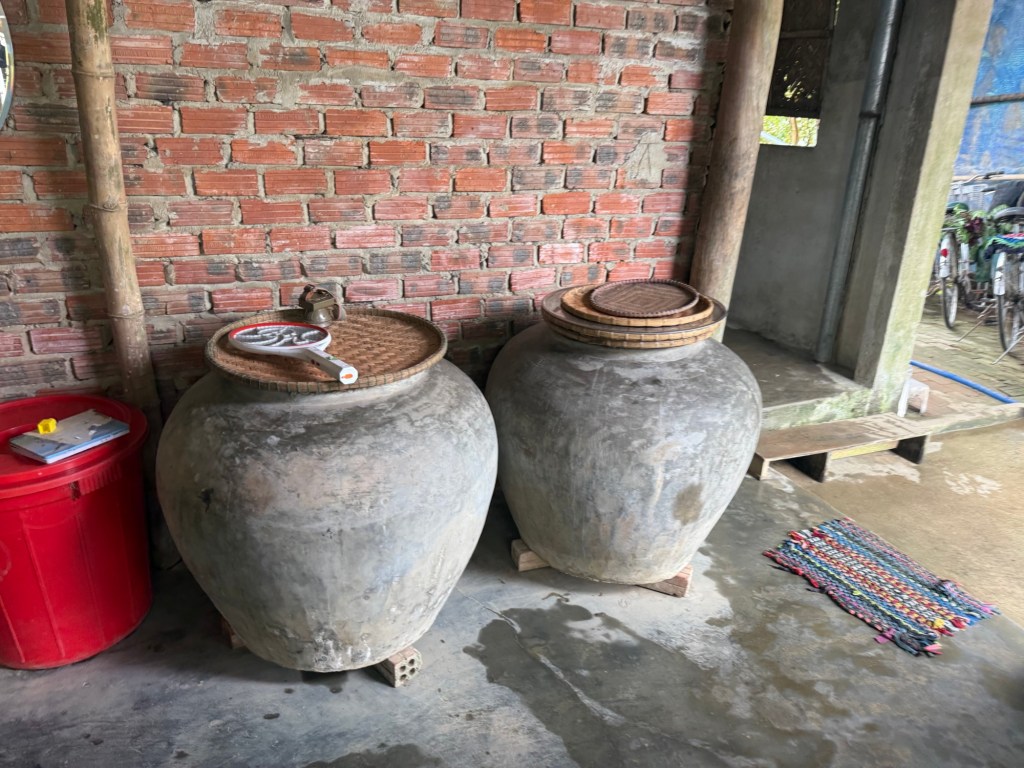
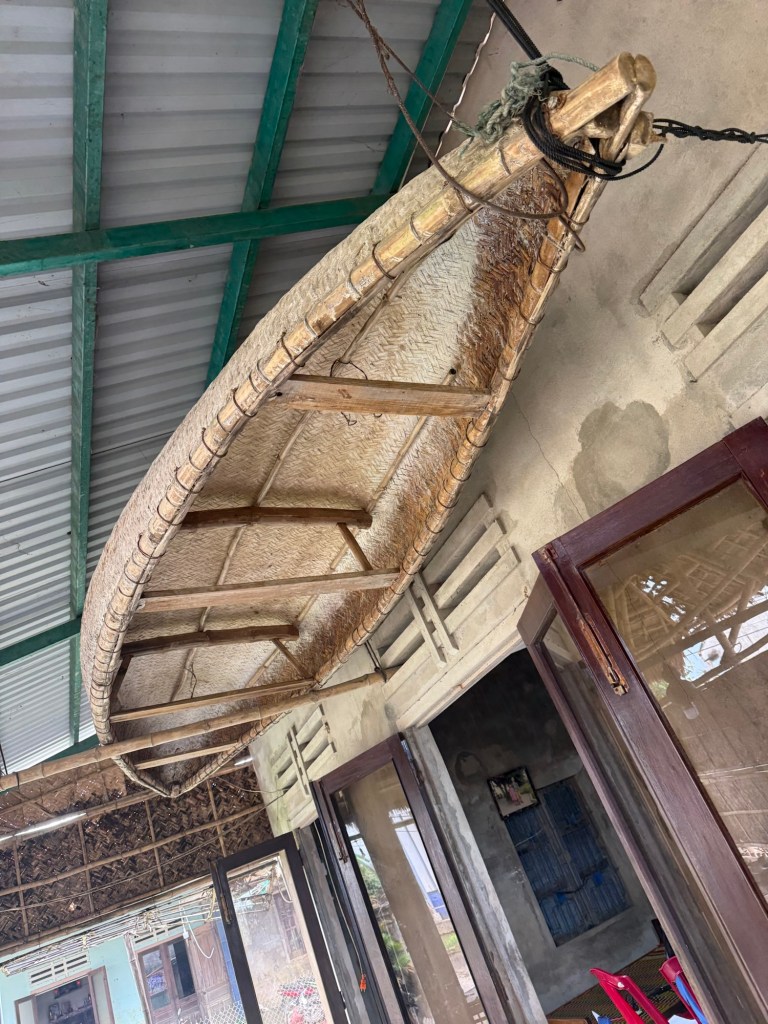
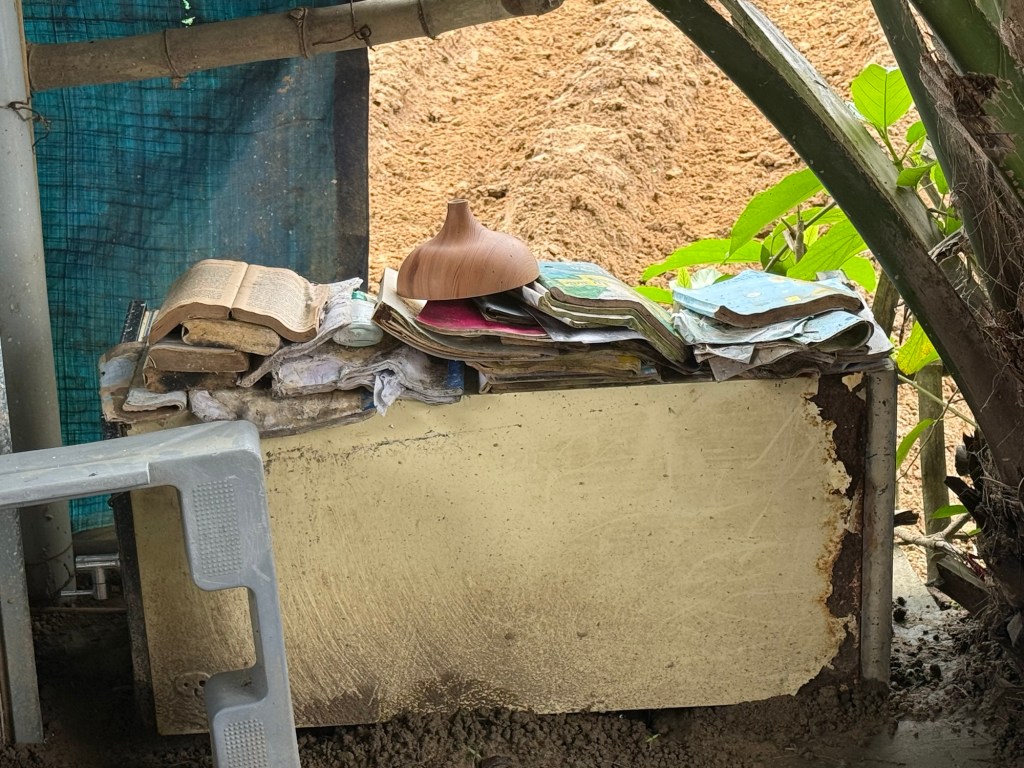
Their home and all the homes in town, included a boat mounted on the ceiling and a flood room, that the family (and the cow) moved into for two months of the year when the water was high. This particular house had a men’s and ladies room, an obvious upgrade to accommodate their tour business.
Bamboo Woven Boat (for floods)Records ruined by flood
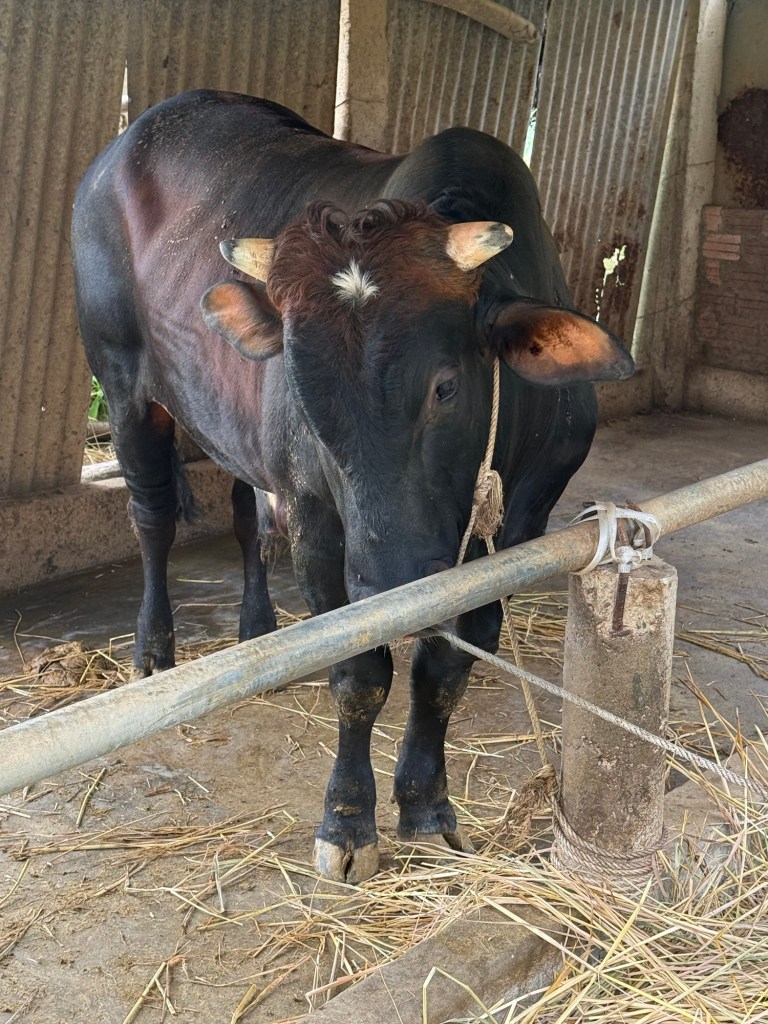
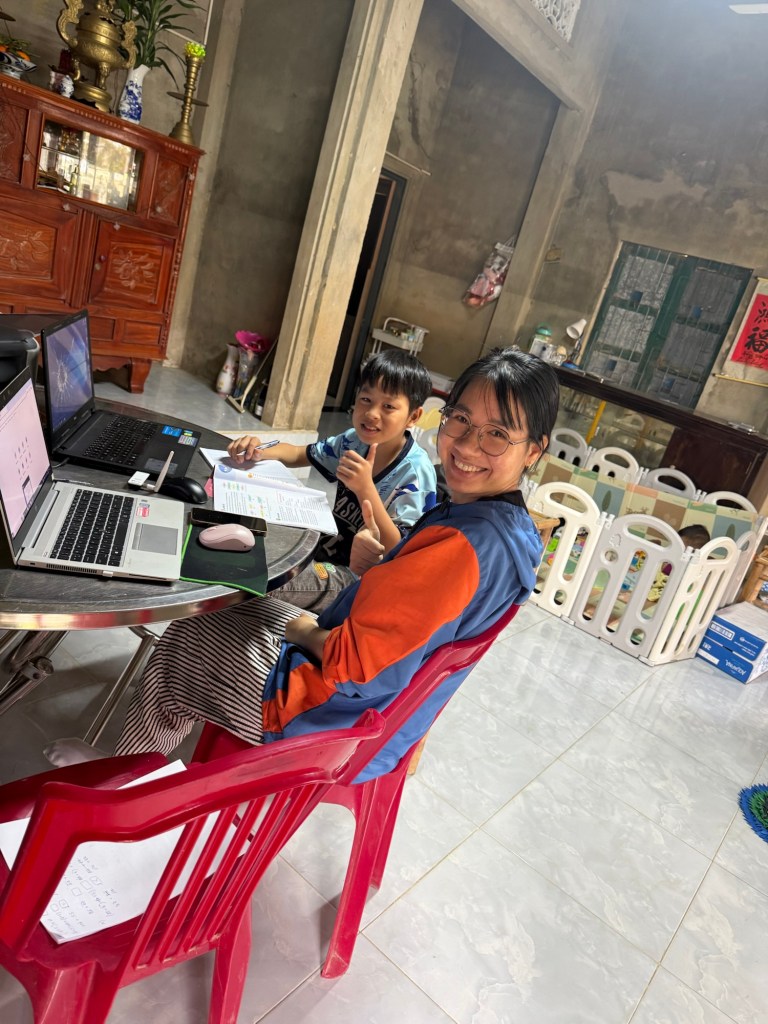
The economics of the household were basically rice farming (including a Party subsidy), a kitchen garden, and a cow. Tien let us know that the tours Phap gave to tourists was also huge part of their living as was the salary for Phap’s wife. She was a teacher, and actively tutoring on a laptop (which seemed wildly out of place) when we arrived. We learned that their other son’s university education cost one cow for two years.
One Year of CollegeSaturday Tutoring…
They treated us like family and Tien like an honored benefactor.
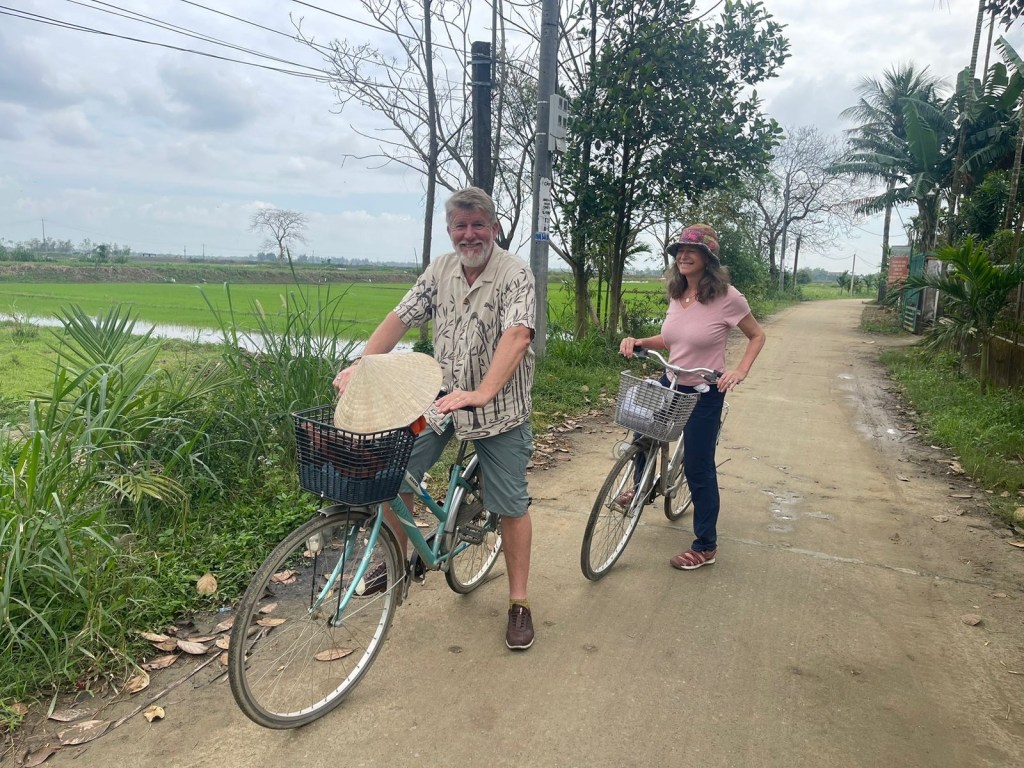
We climbed on rickety bikes and started our tour. It being Saturday, the village was filled with children, following us on their bikes, shouting hello from every house, and giggling at us. It was a pure joy.
Anybody have a wrench I can borrow?
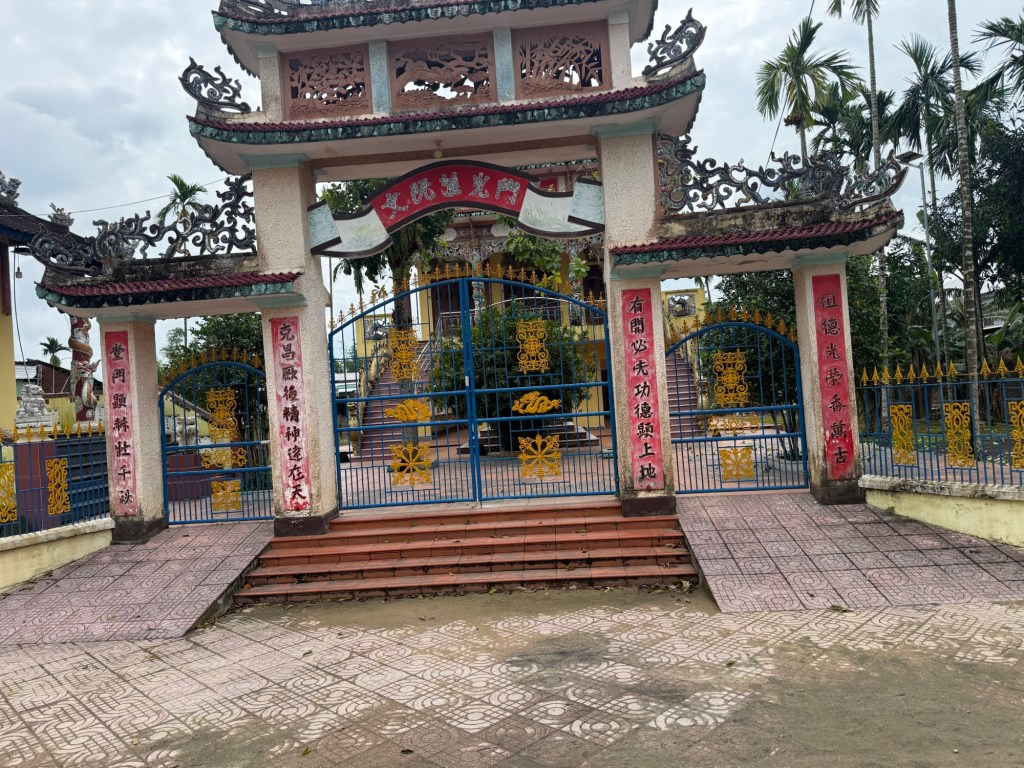
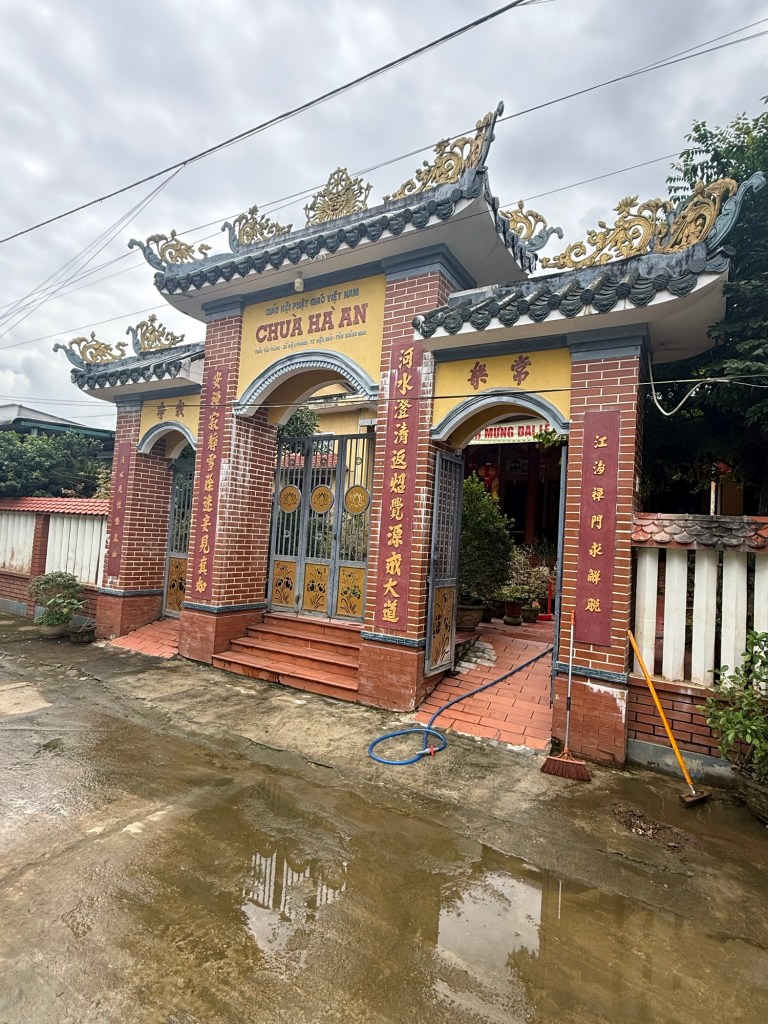
The town was deeply impoverished by western standards with mud roads, homes cobbled together from scrap wood, and trash everywhere. It was disconcerting to see three incredibly wealthy, and ornate temples and two richly appointed monasteries among the modest homes.
Temple in Go NoiBuddhist Monastery for Women Monks
We started a 2 mile ride around the town with Phap working on his English and Tien filling in the gaps. One of the funnier moments was when Tien, a Vietnamese giant at 6’1″ ran into a villager slightly taller than him. A hilarious pissing contest ensued.
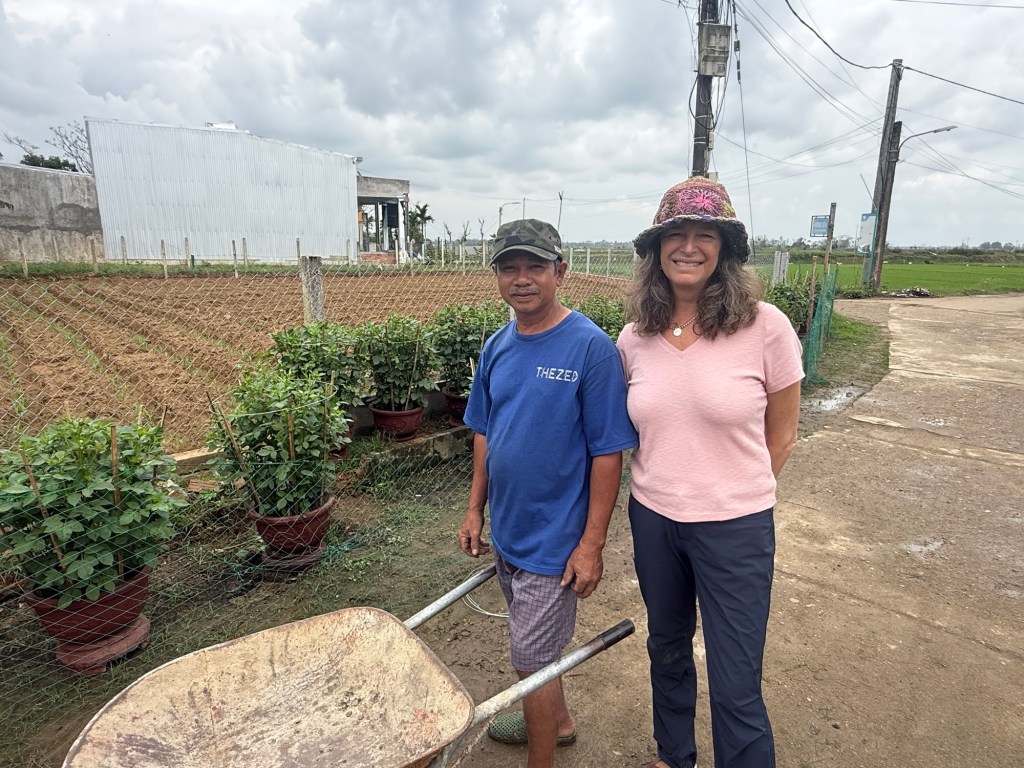
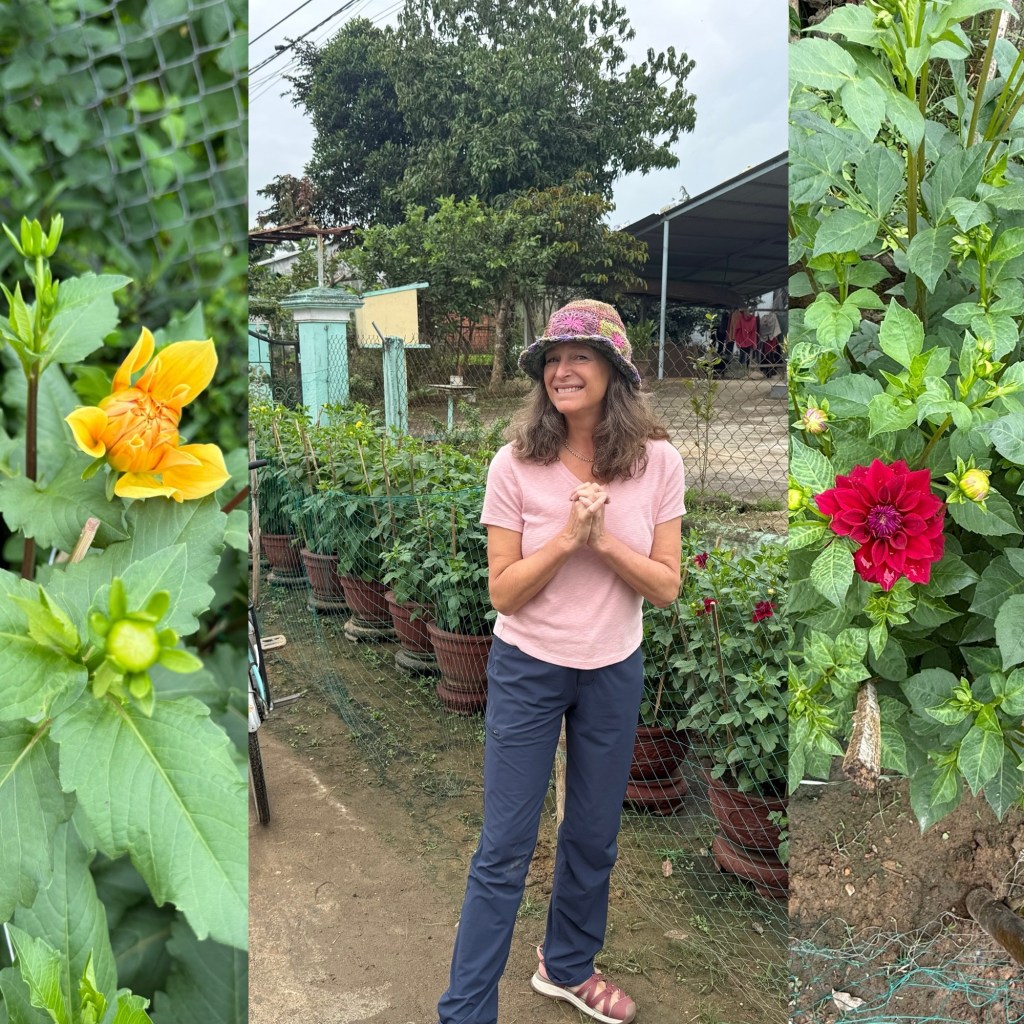
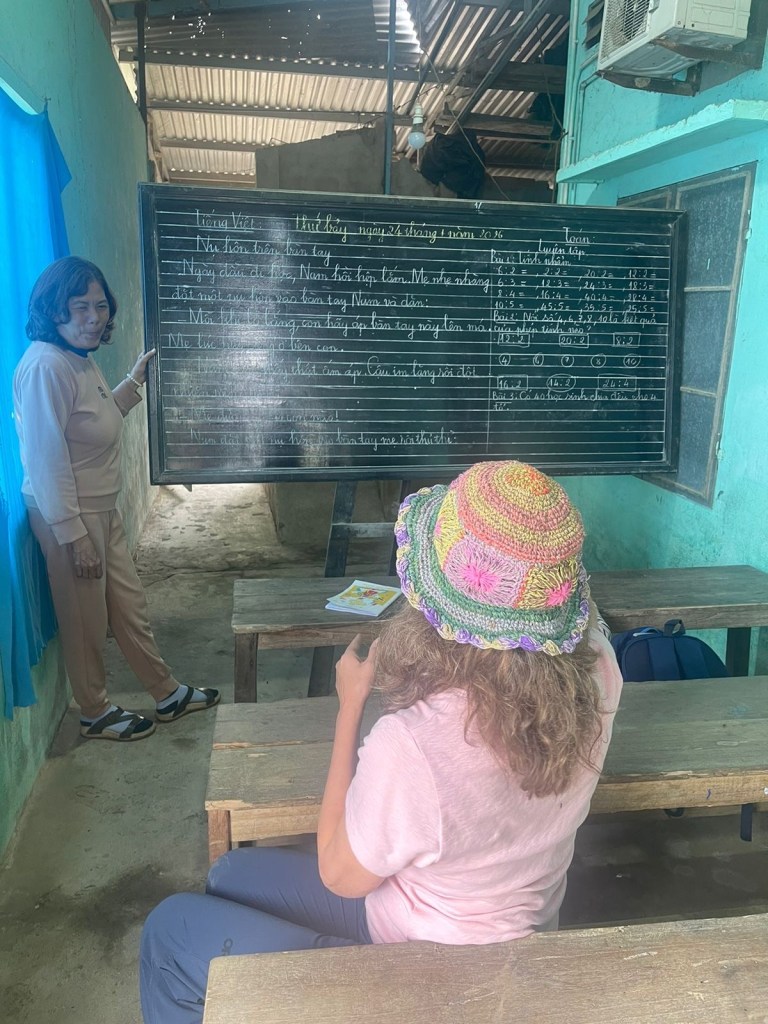
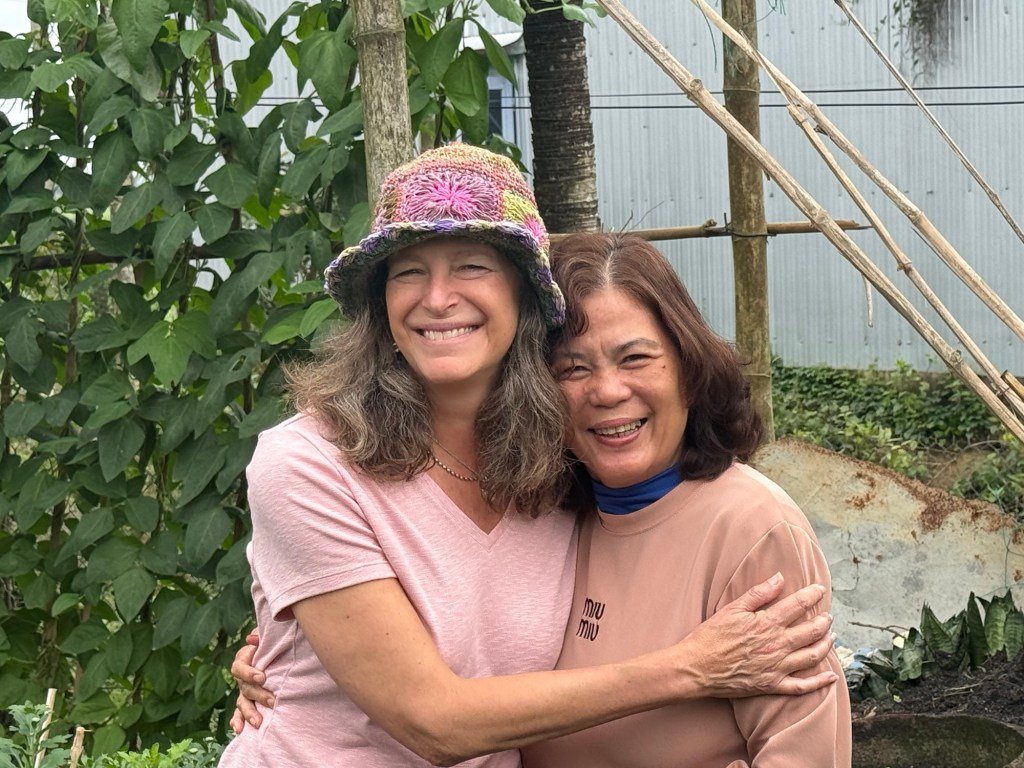
We stumbled onto a Dahlia farm (big tradition in the upcoming Lunar New Year), managed by Hoa, a retired language teacher. Juju geeked out sharing pictures of tubers, Grace’s wedding flowers and getting yet another lesson on VN vowel management.
Dahlia FarmersHating this…LessonsKindred Teachers – JuJu & Hoa (flower)
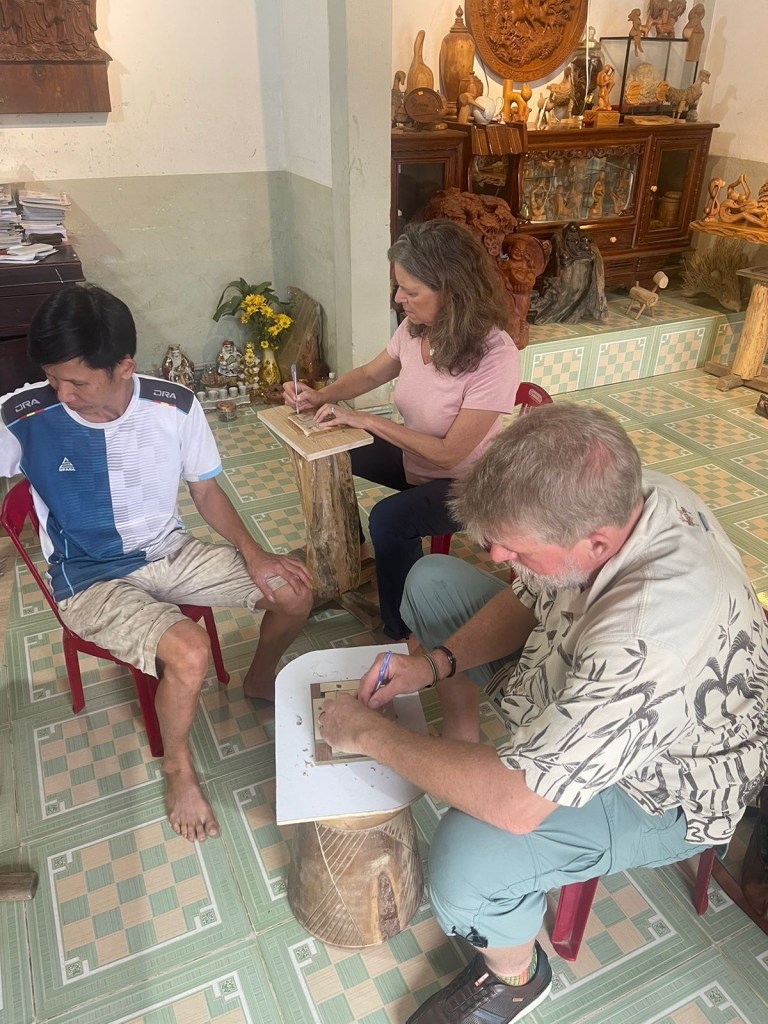
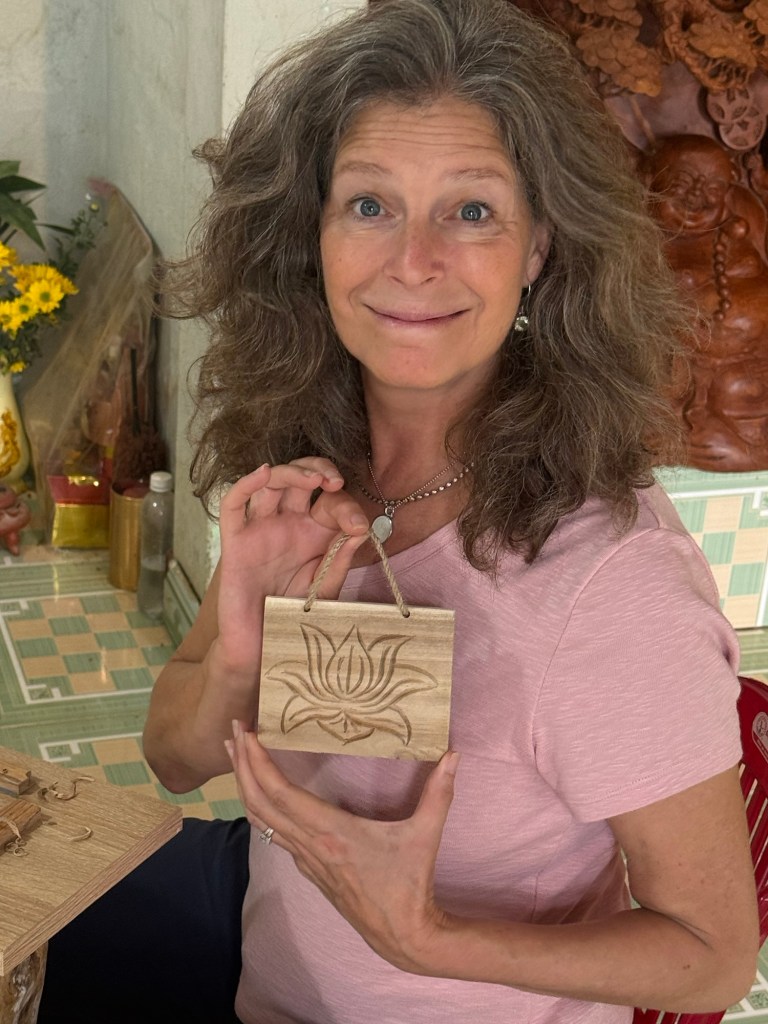
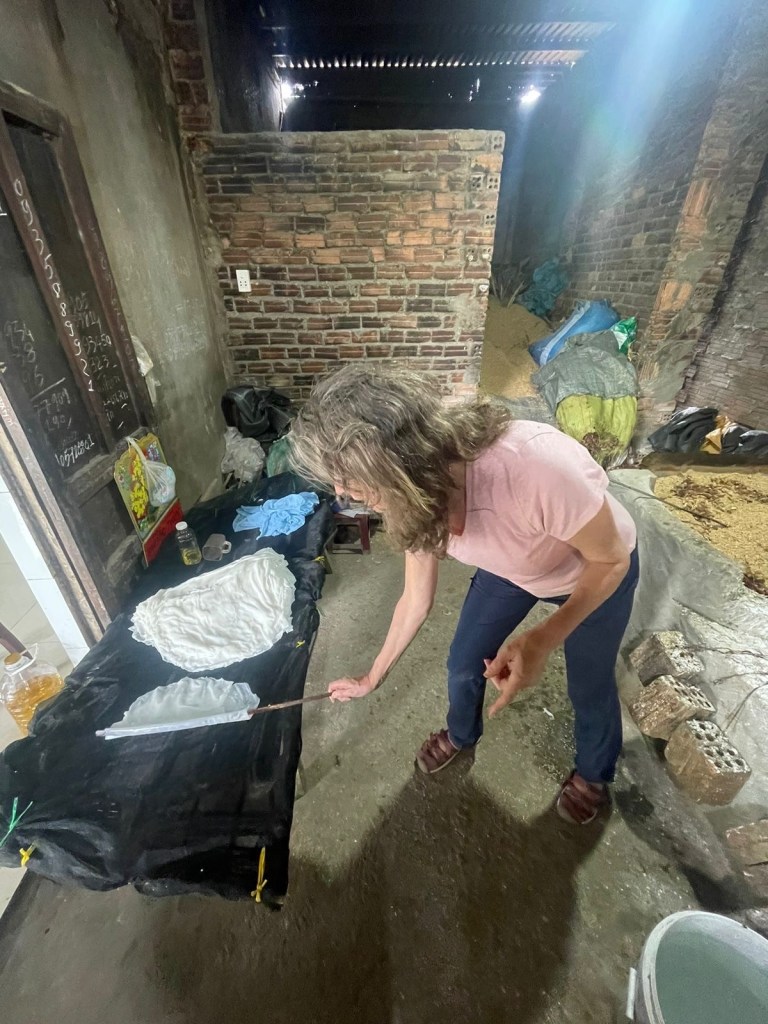
Next we had a few hands on experiences with a wood worker, and a maker of wheat paper/noodles. Really fun.
CraftsmenJuJu’s Lotus Flower
Wheat Paper NoodlesJuju Takes a Turn
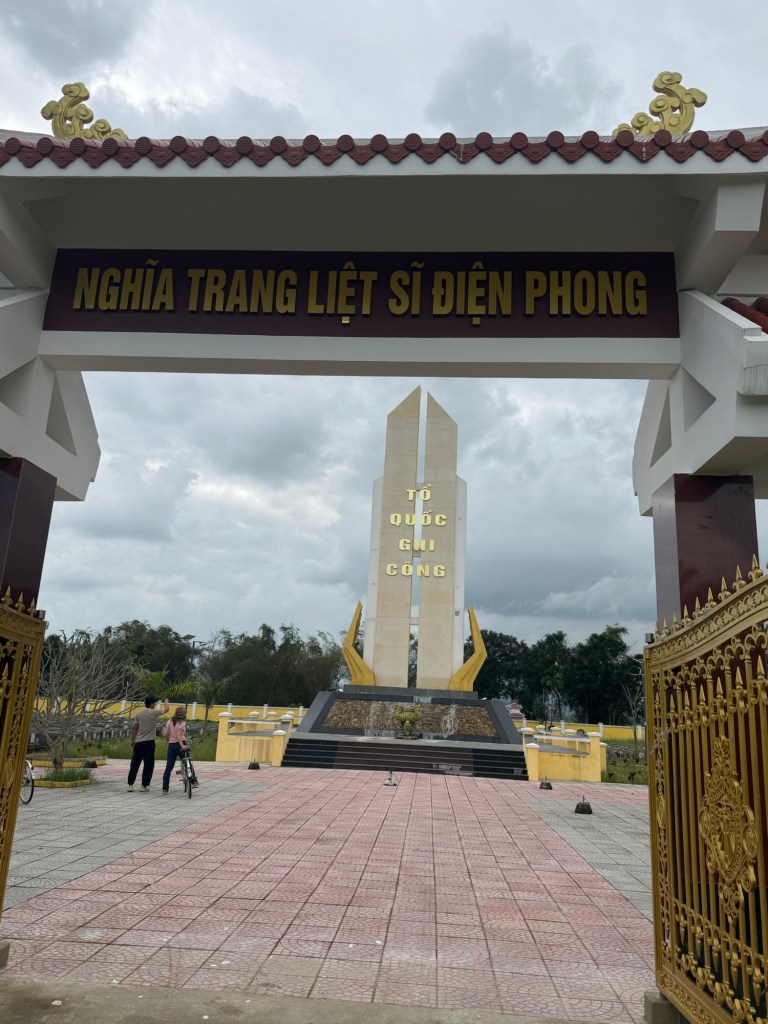
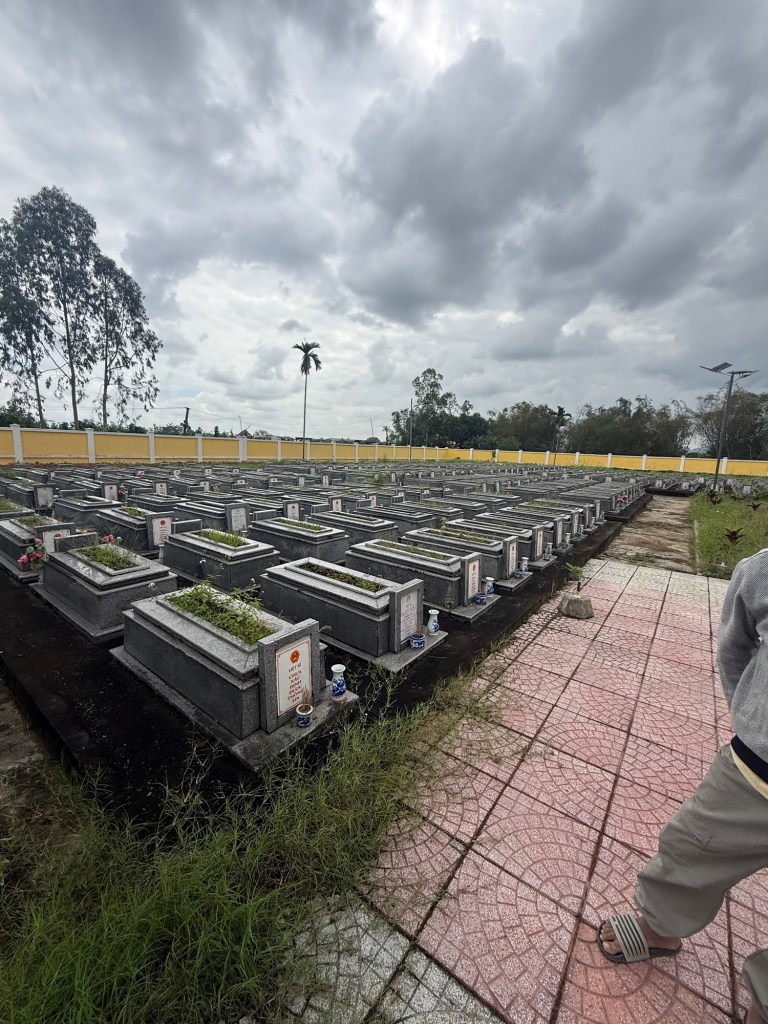
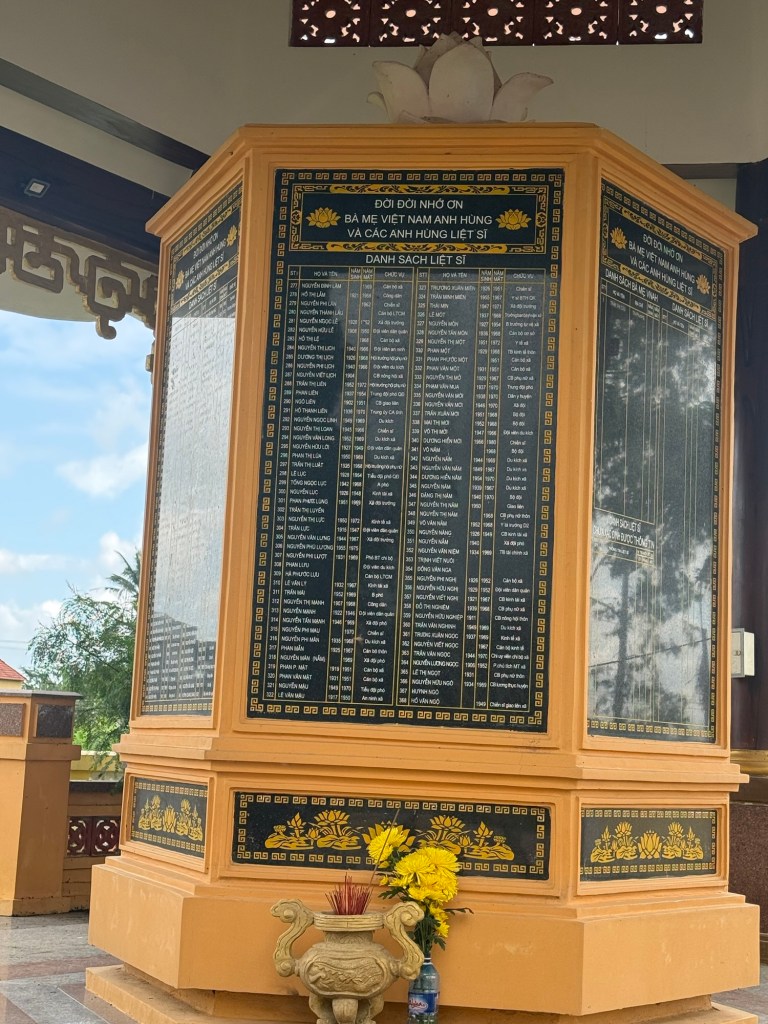
The next stop was not so fun. We visited their American War memorial. The Island was heavily bombed for over a year in 1969. The memorial recognized the 30,000 Viet Cong and citizens that died there.
I mentioned before that our Vietnam War was just one of many bloody conflicts , over a 150 year period. But here it was the one that destroyed their, villages, families and lives. Phap shared several stories about his grandparents (blessedly spared) and their friends and families who were not so fortunate.
“American War” MemorialHonored Viet Cong VeteransList of the Fallen (30,000)
It’s appropriate to remember the disproportionate impact of our war efforts. 282k American and South Vietnamese allies lost their lives. But 628k Viet Cong and over 700k non military were killed, 70% were women and children.
OK. Lunch was a team sport with Hien, our driver, contributing various vegetarian dishes, JuJu and Phap frying crispy pancakes, and Mamma Sau providing an amazing sautéed catfish. I keep saying this, but it was one of the BEST meals ever.
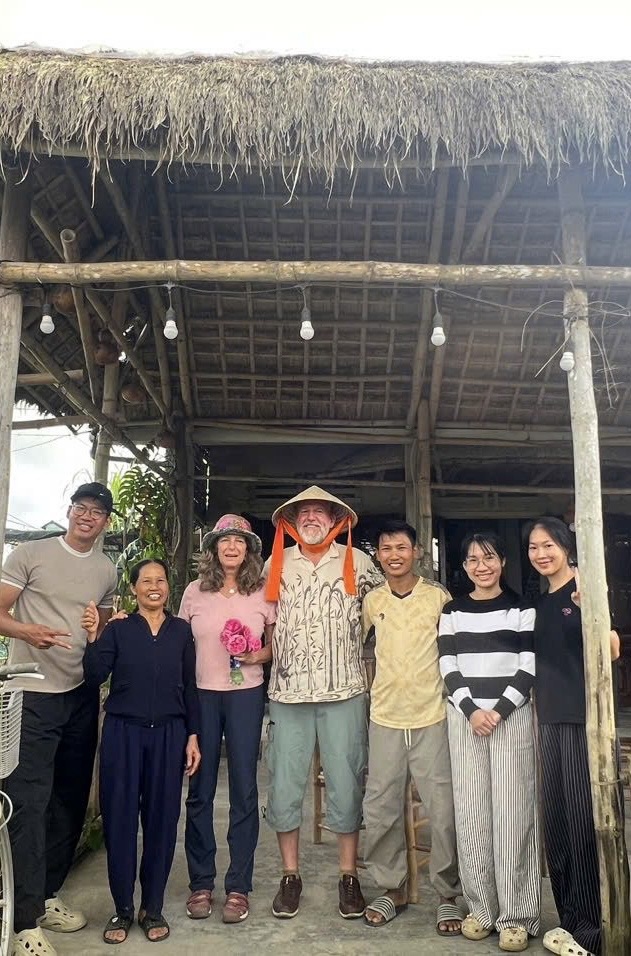
The family helped us record a birthday greeting (chúc mừng sinh nhật) for Grace to wake up to (1/24). And Sau sent JuJu off with a bouquet of roses from her garden.
Go Noi Family
Having a great guide like Tien is invaluable. But it’s also kind of exhausting in terms of activity level and content. It’s difficult to find time to shop and wander, follow your nose, talk to strangers or just chill by the pool.
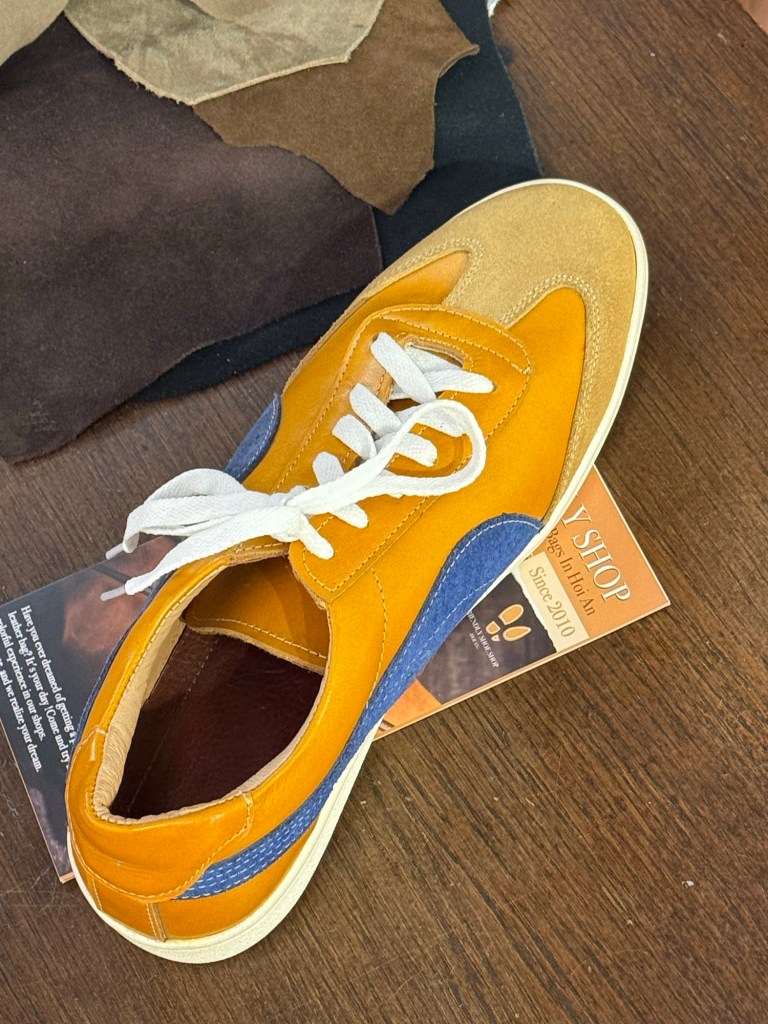
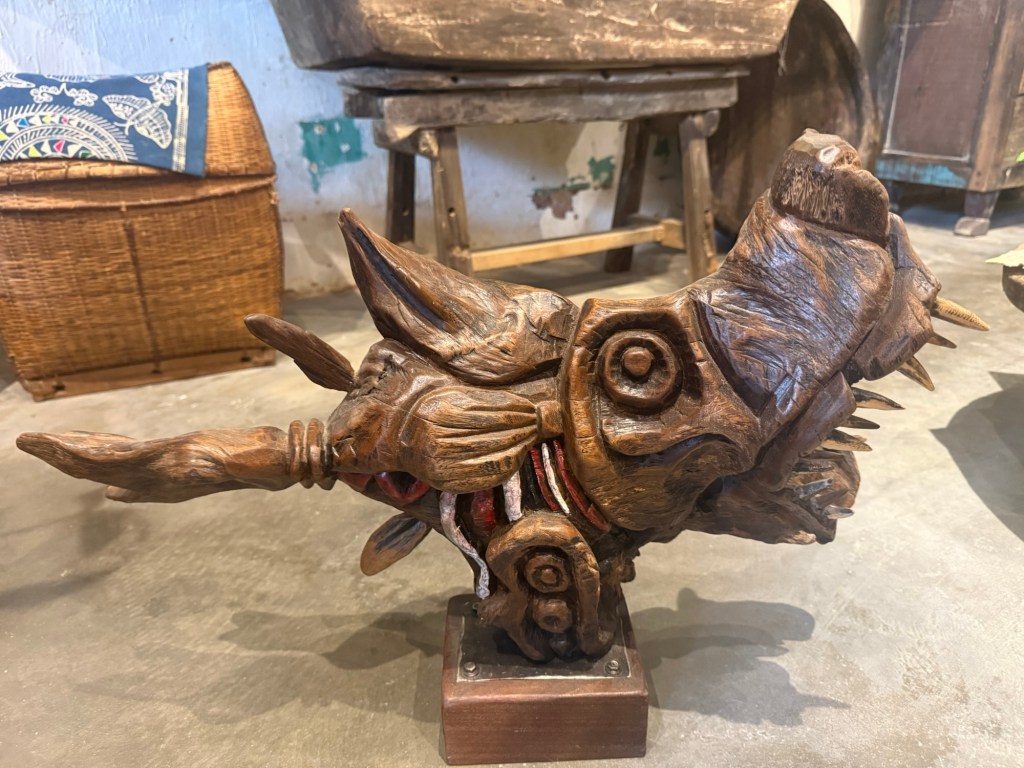
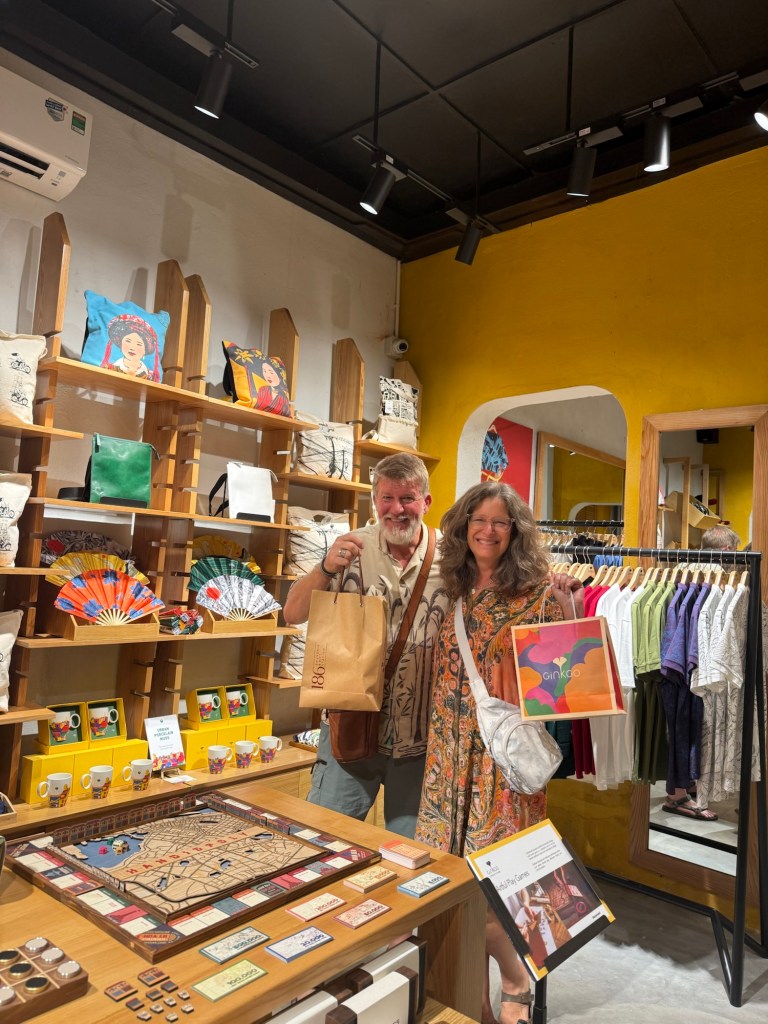
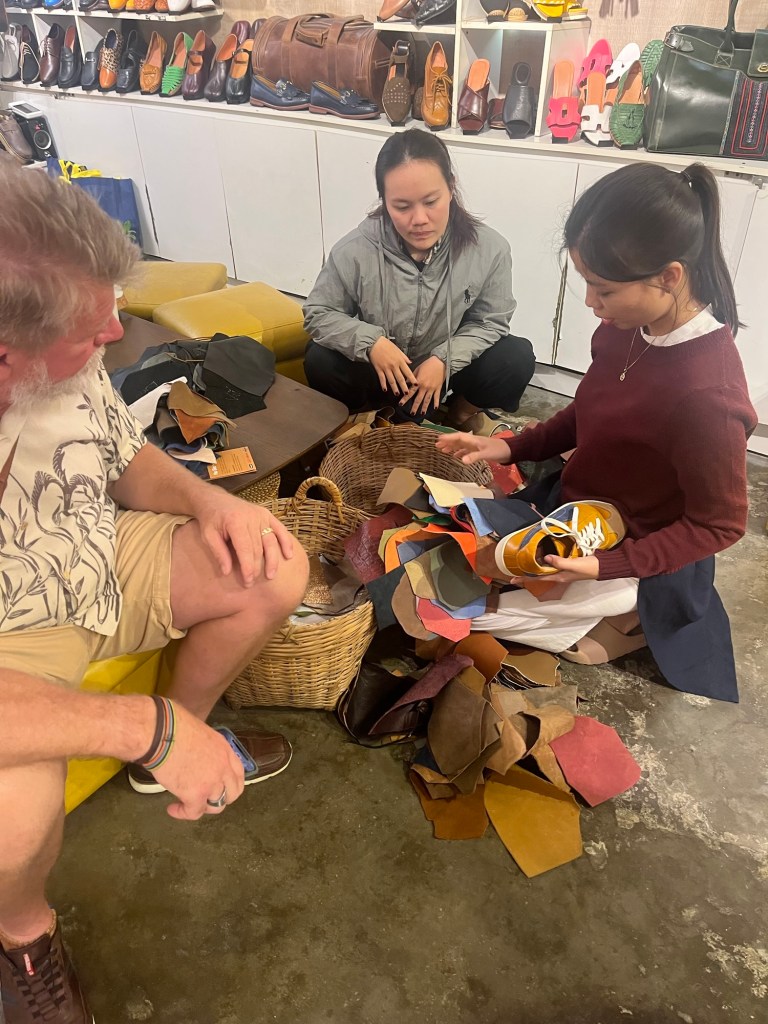
Our last afternoon in Vietnam we cut him loose so we could follow our nose. We bought some gifts for the kids. I picked up my new custom made kicks, and we splurged on some tribal art. We spent some money but I’d guess a fifth of what it would have cost at home.
Custom made knock offsIt’s a fish, really
I finally talked Justine into getting her Ao Dai (pronounced Ow Zigh). This is the traditional, formal dress and trousers of the lady-Vietnamese. Custom made with her fabrics of choice for $35 (and done in 12 hours.)
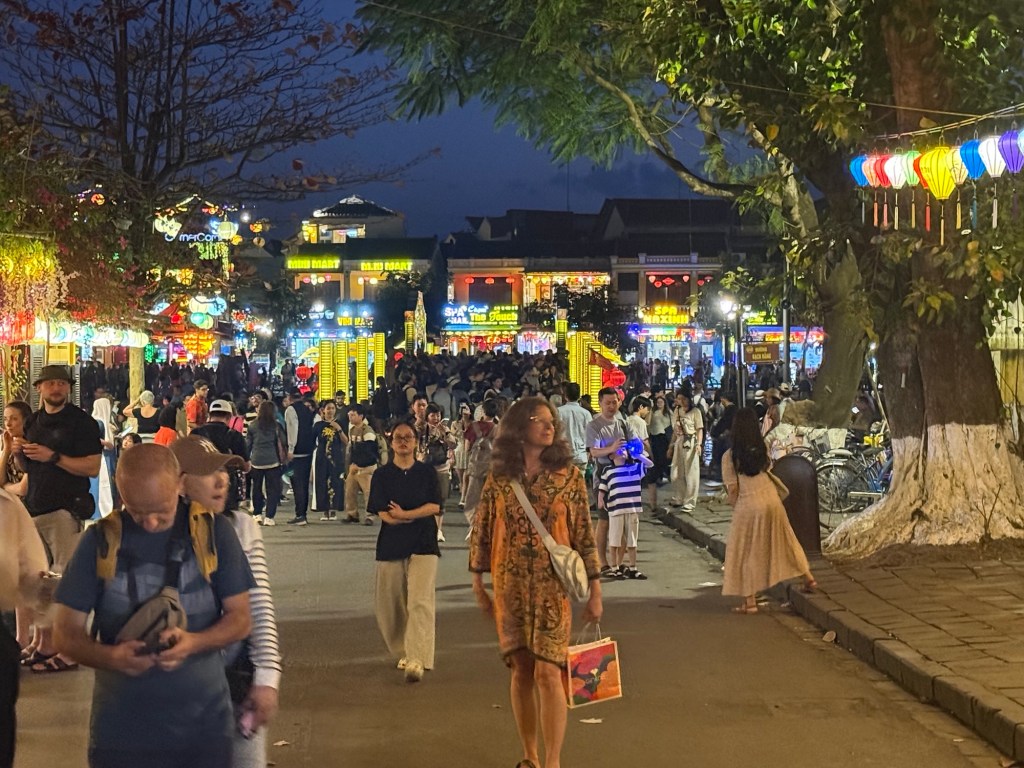
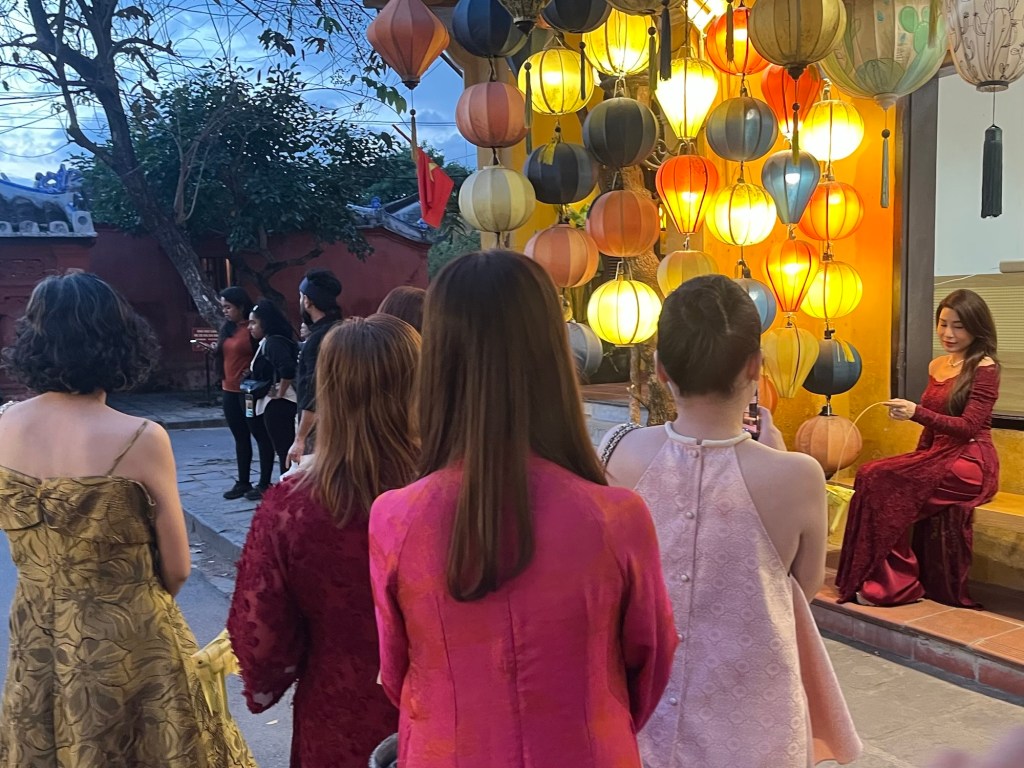
To close out our time in Vietnam we returned to Hoi An’s Old Town. It was mobbed with tourists, selfie-obsessed 20 somethings, and hard drinking Eastern Europeans.
Old TownDemure or ObnoxiousKid Stuff
We popped around the shops, grabbed a sidewalk seat, and settled in for some people watching. Just sitting still for a drink (or three) we met some wonderful people and shared some amazing life experiences.
Tomorrow we pack, pick up JuJu’s Ao Dai, chill some more, and then head to Da Nang for our flight to Siem Reap, Cambodia and the Angkor Wat temple complex.
Hoi An is a coastal city that had been the largest port in central VN until the late 1800’s. This spanned the era of the Spice Road and earlier colonization of Hong Kong, Australia etc . Sailors from Europe and all of Asia developed a thriving multicultural trade city.
Over time the Hoia River (river of memories) silted in. Ship traffic became difficult and a new peninsula formed on the north side of the river. The major trade shifted north to Danang and a new sister-city formed on the peninsula.
Today Hoi An is a thriving tourist city. The new city on the new peninsula bustles with restaurants, tailor shops, and markets. Old Town is a UNESCO site with the Japanese, Chinese and original Vietnamese enclaves protected, and a history dating back to the early 1500’s.
Our first event today is a Hoi An culinary immersion experience. Ms. Vy is an entrepreneur with 14 restaurants and ownership of a dedicated supply chain of farmers, fishing boats, and fresh markets. She also offers a 1/2 day cooking and cuisine class. That’s us!
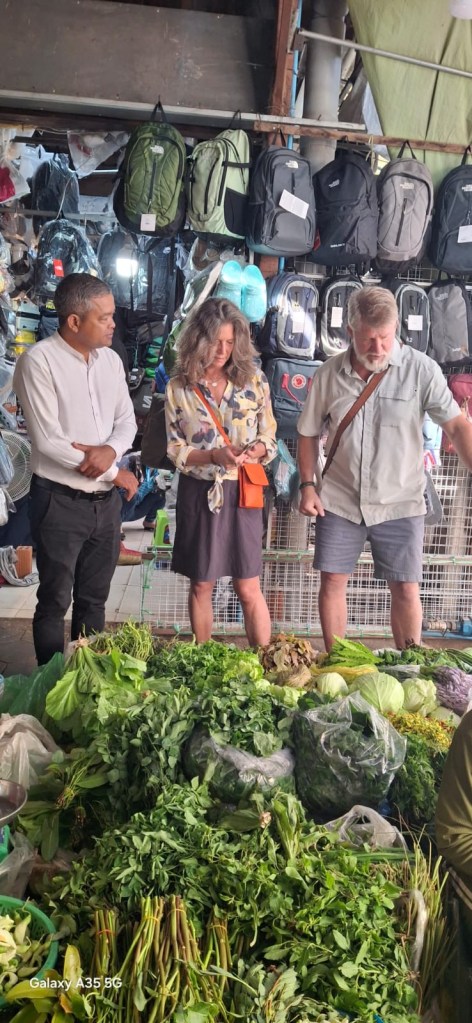
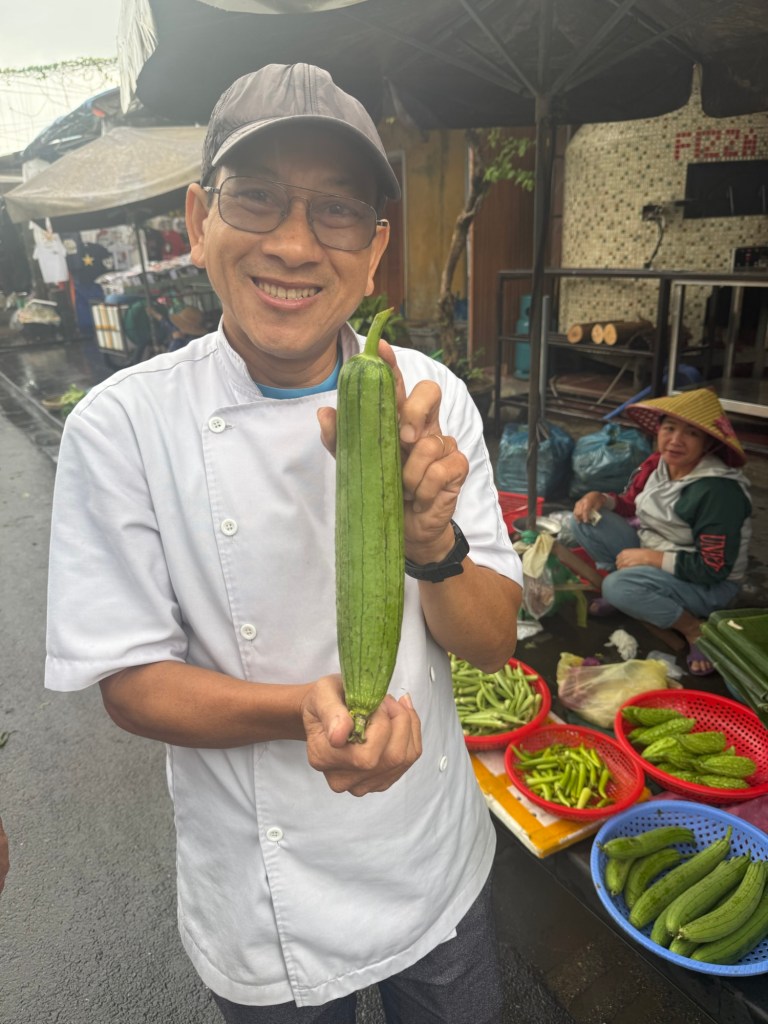
We started with a tour of the Hoi An market led by our host-chef Mr. Bon
Mr. Bon
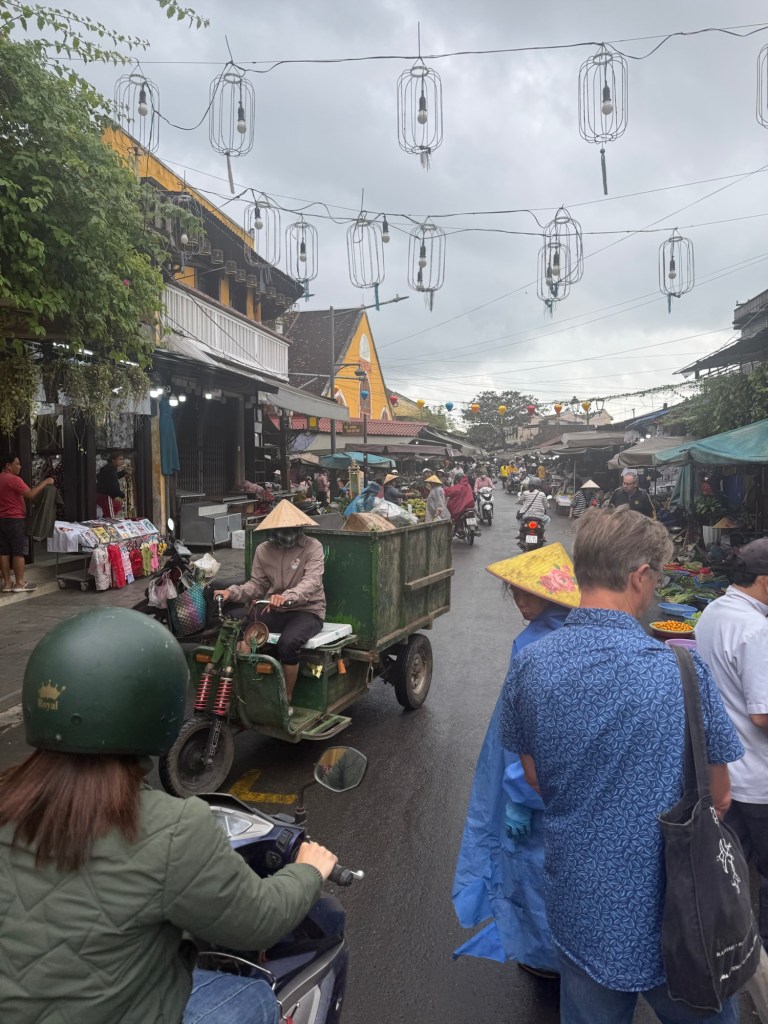
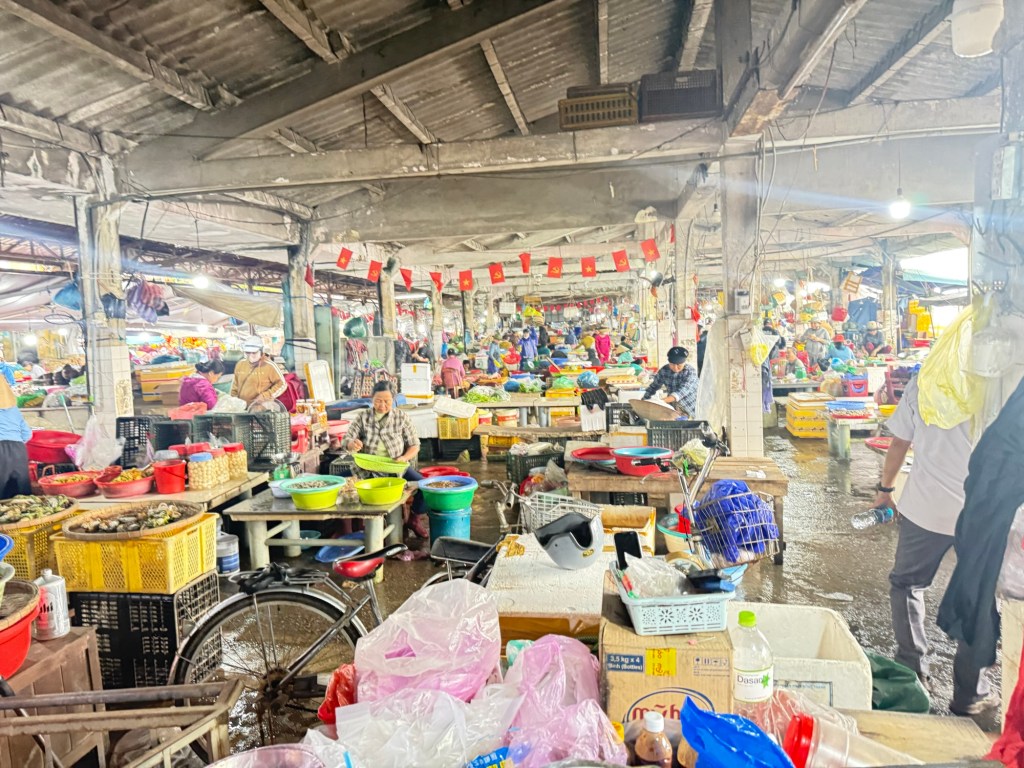
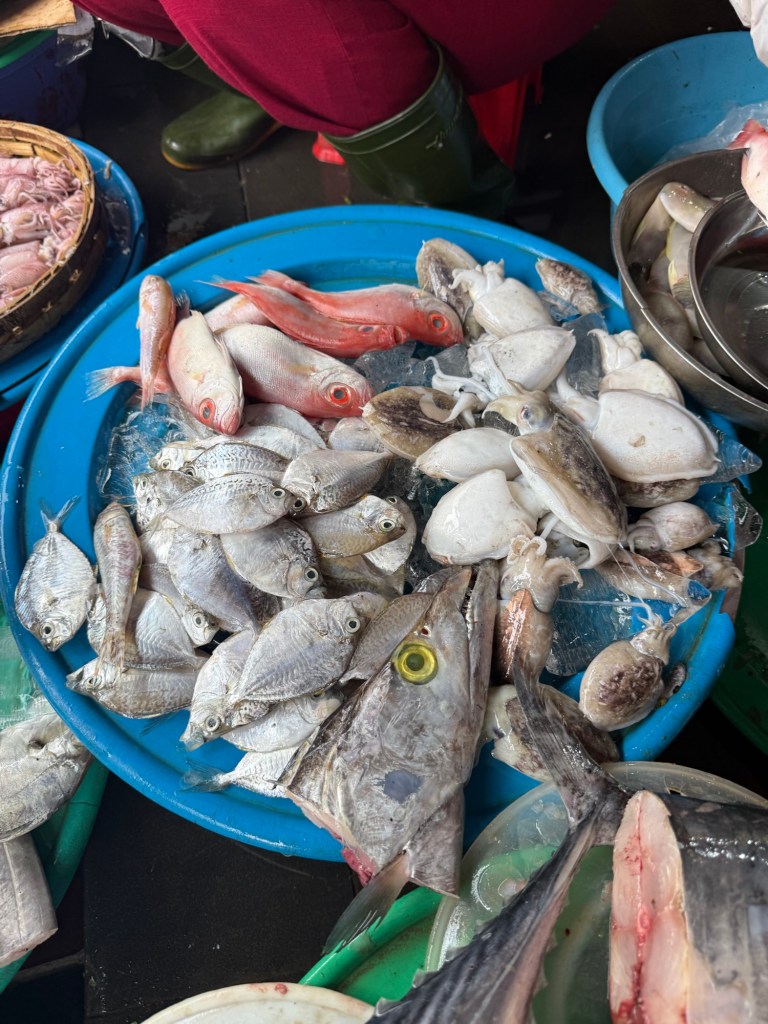
The market opens at 5 am as fishing boats offload the nights catch and farmers cart in vegetables from the surrounding farms. Housewives typically shop from 5AM to 7 to get the freshest, best options – a point of pride. The market closes at eleven but wholesalers, grocers and restaurants buy up the bulk at wholesale prices starting around 9.
Hoi An Market – 6:30 AMCovered Market
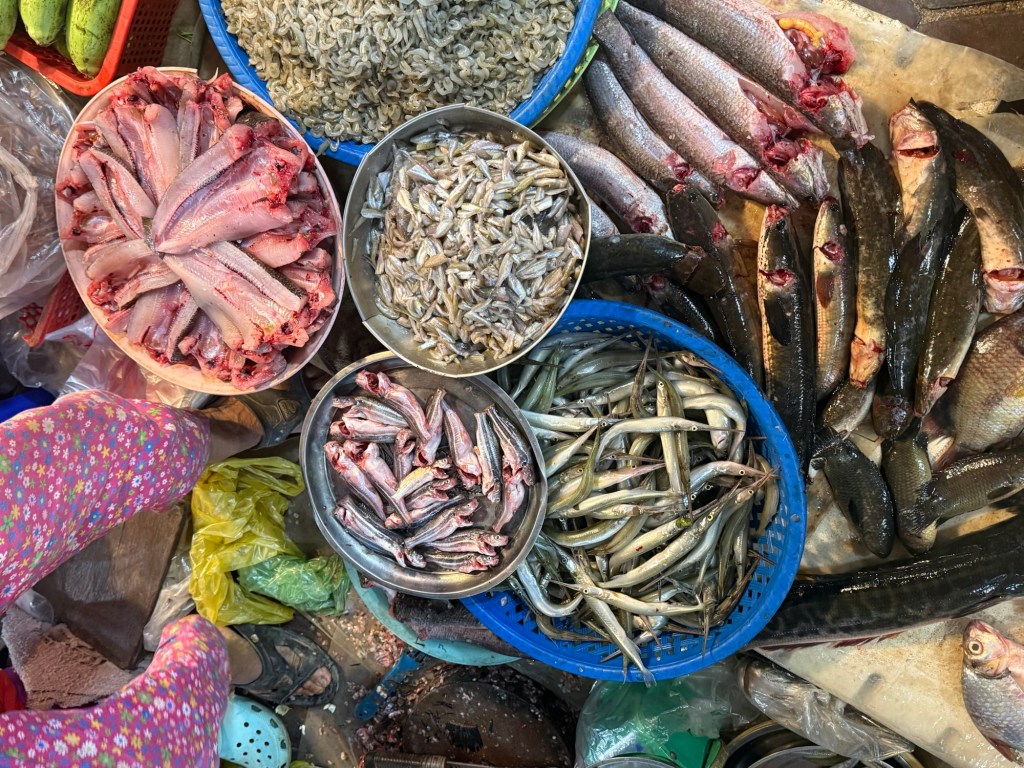
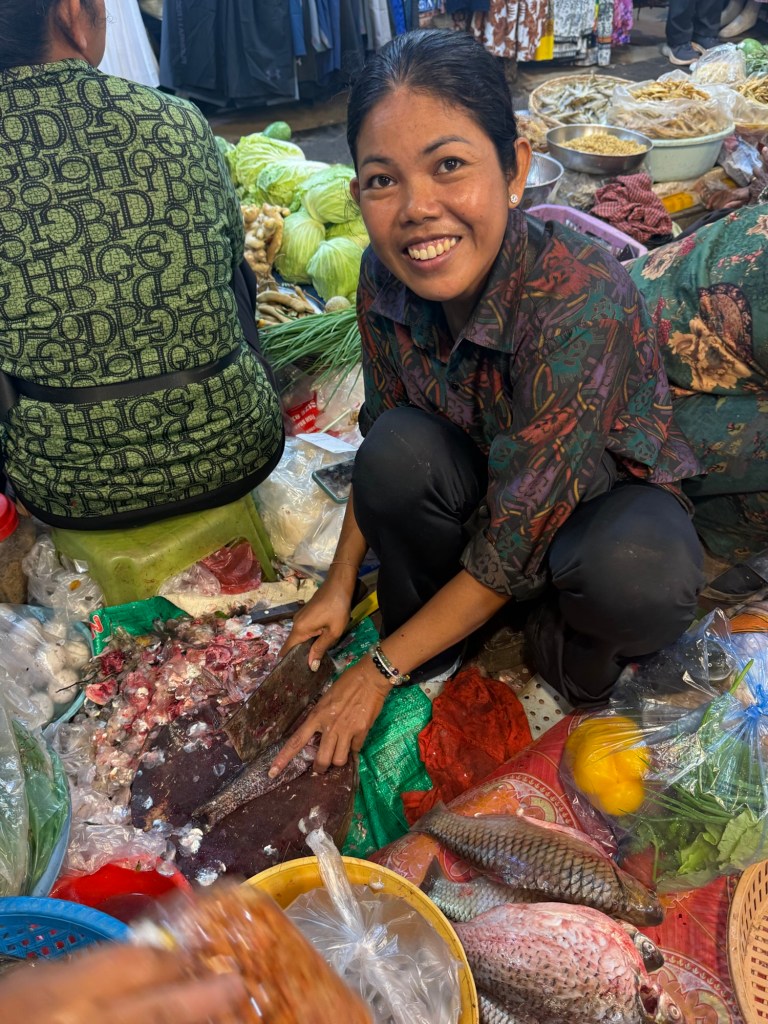
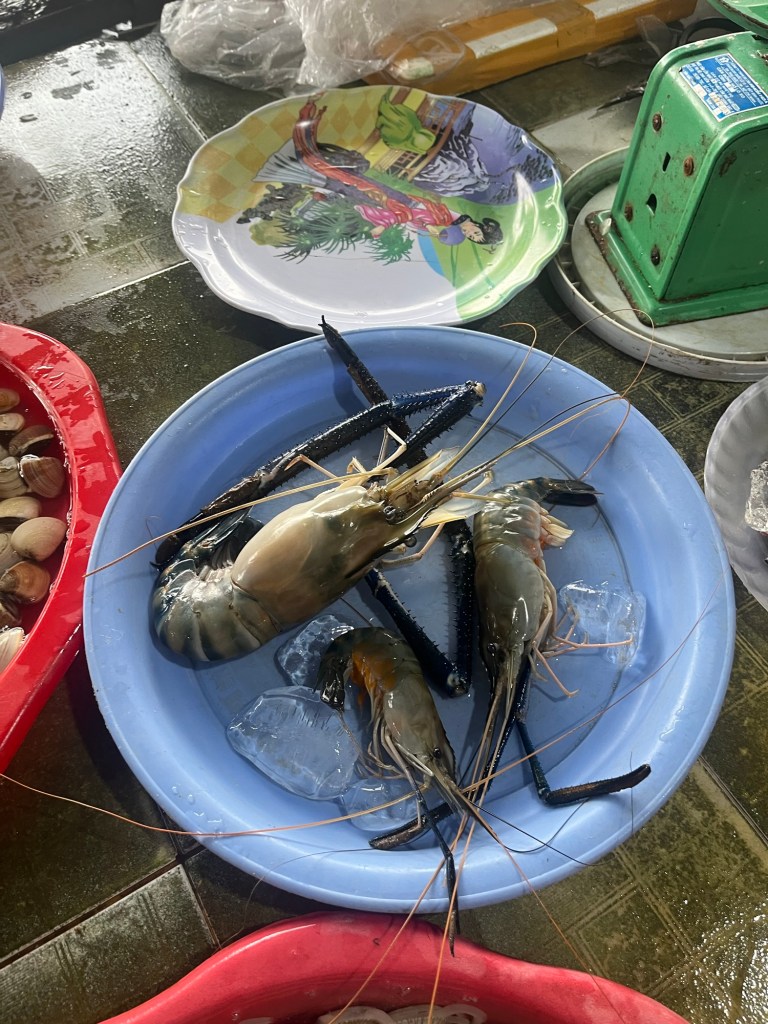
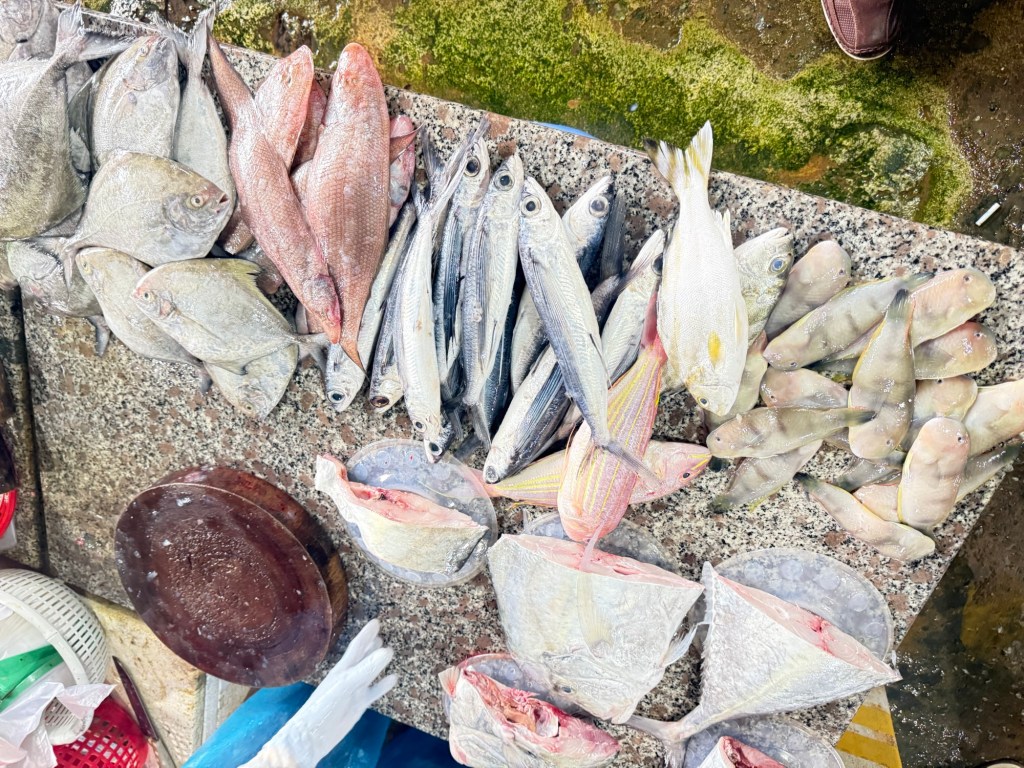
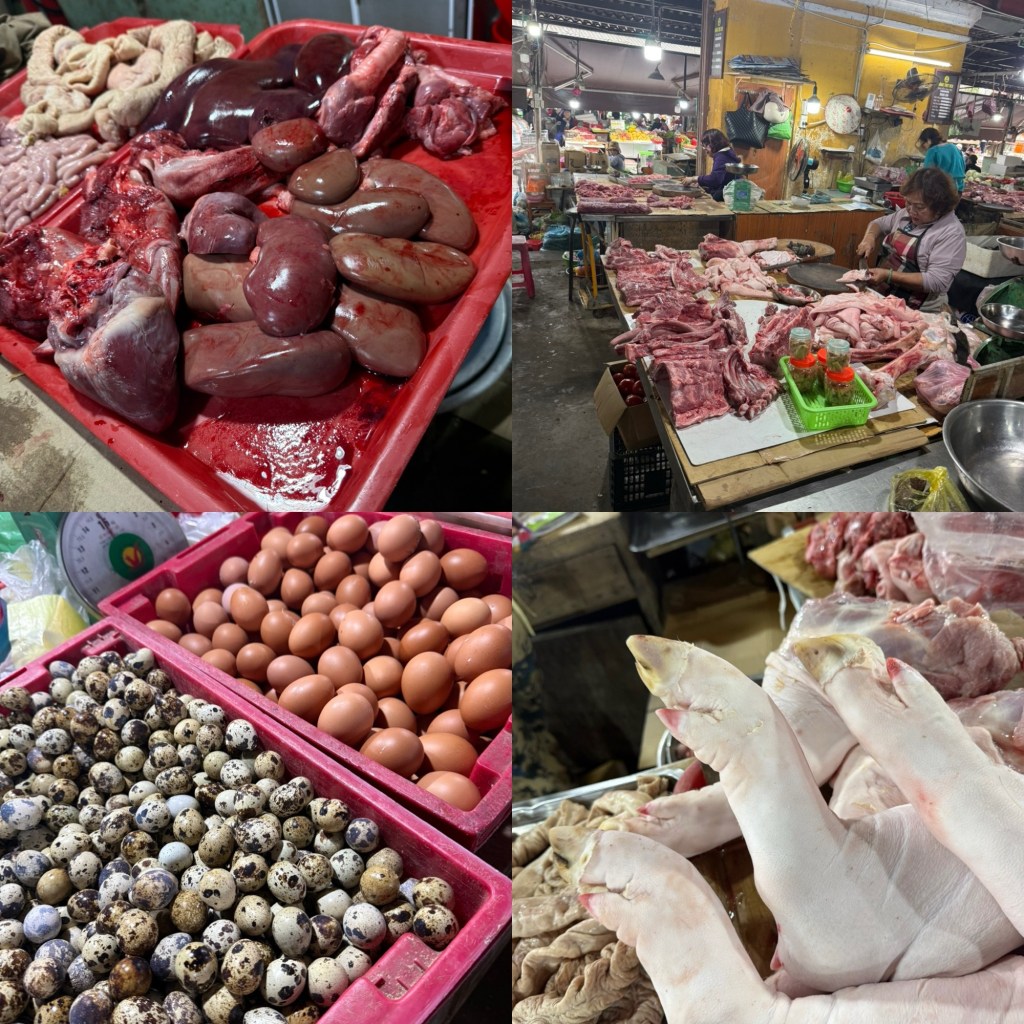
Freshness is at such a premium that what is not sold, is thrown away. I’ll let the pictures tell the tale.
Fresh!Still twitchingWowMeat and Eggs
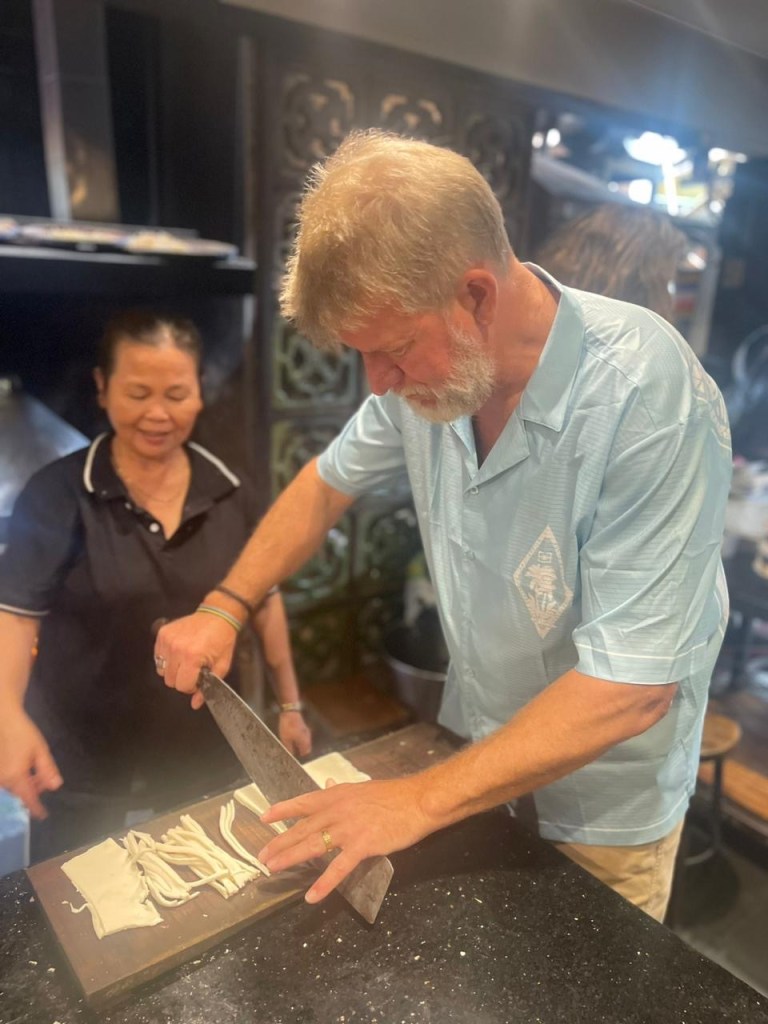
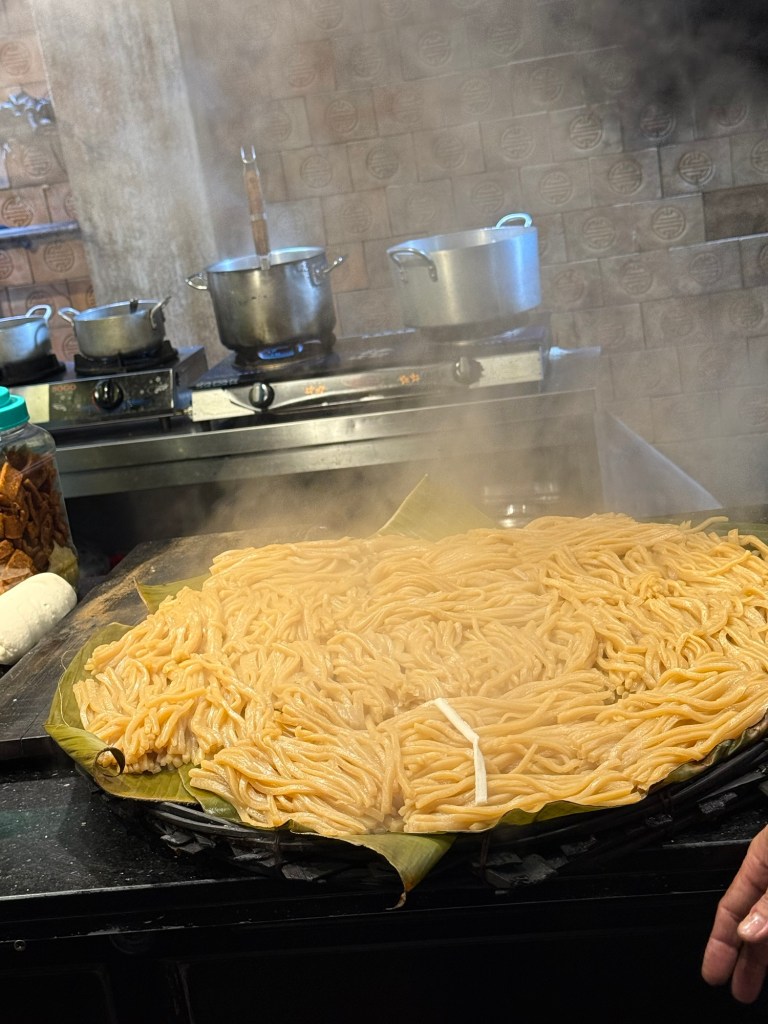
Next we headed off to Ms. Vy’s market. Four “experience-stations” were set up for us. At the first station we watched Guau Lo noodles being formed and steamed. A very specific water from the public Ba Li well is blended with gum tree ash resulting in a bright yellow noodle. Our lesson was in cutting these to shape before steaming. Humbled!
Guau Lo
She’s getting it…Yellow Steamer
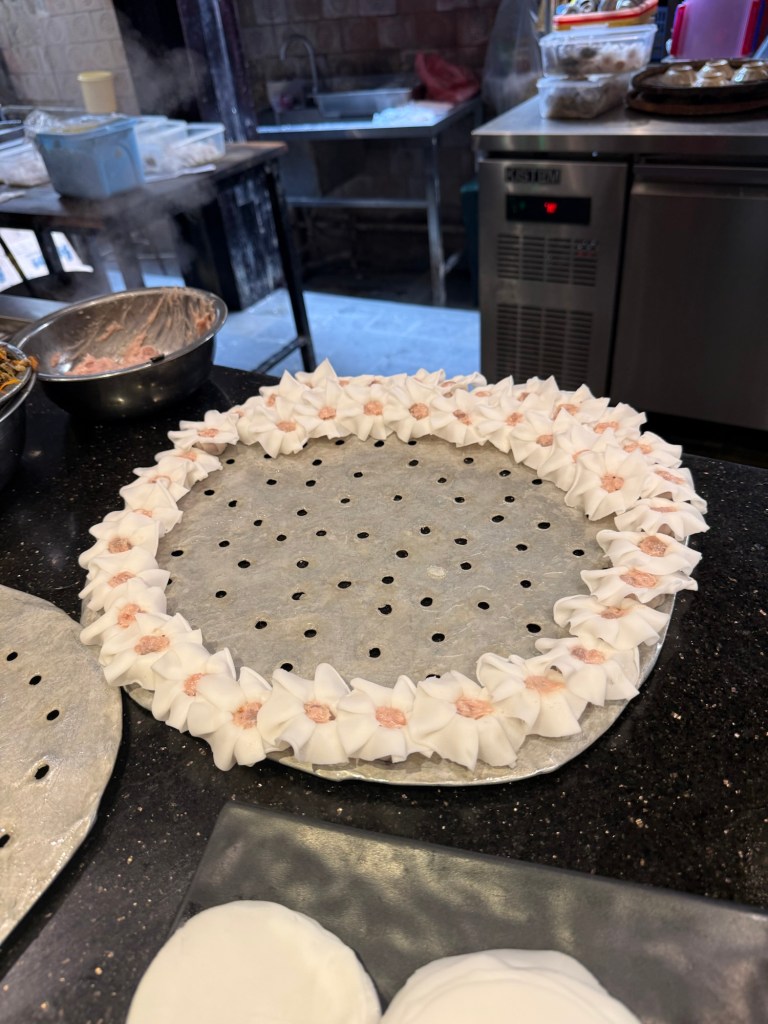
Our second stop was the White Rose Dumpling station. A practiced chef can form hundreds of these in an hour. Beautiful right? We tried our hand at this as well. Humbled again.
White Rose Dumpling
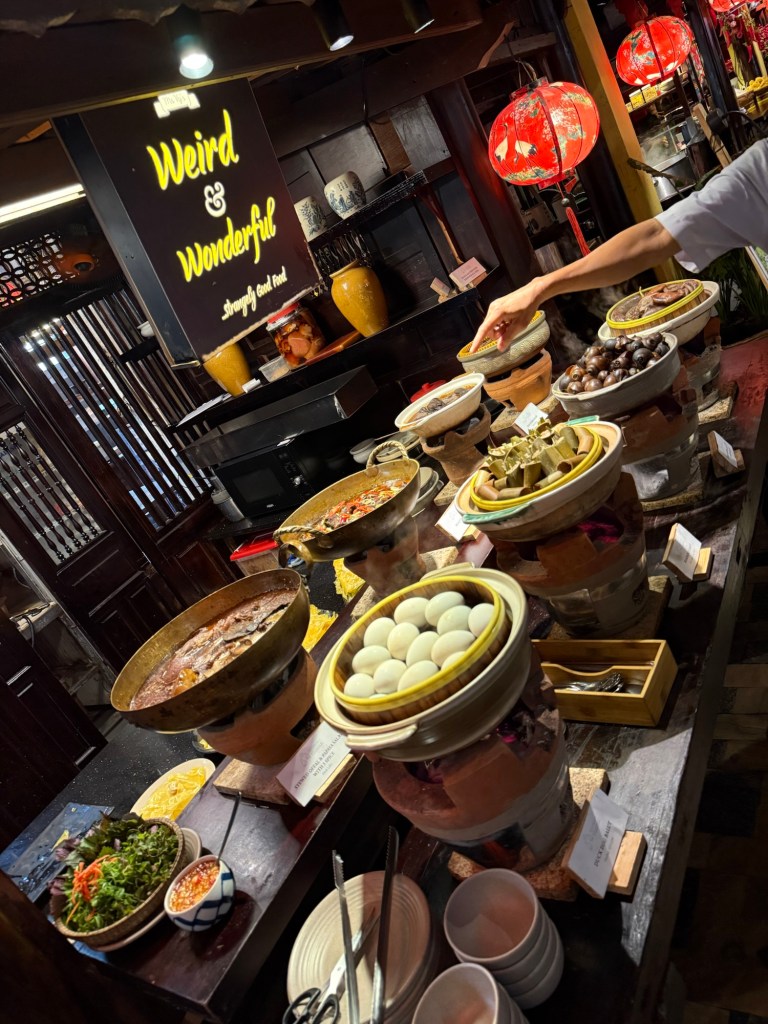
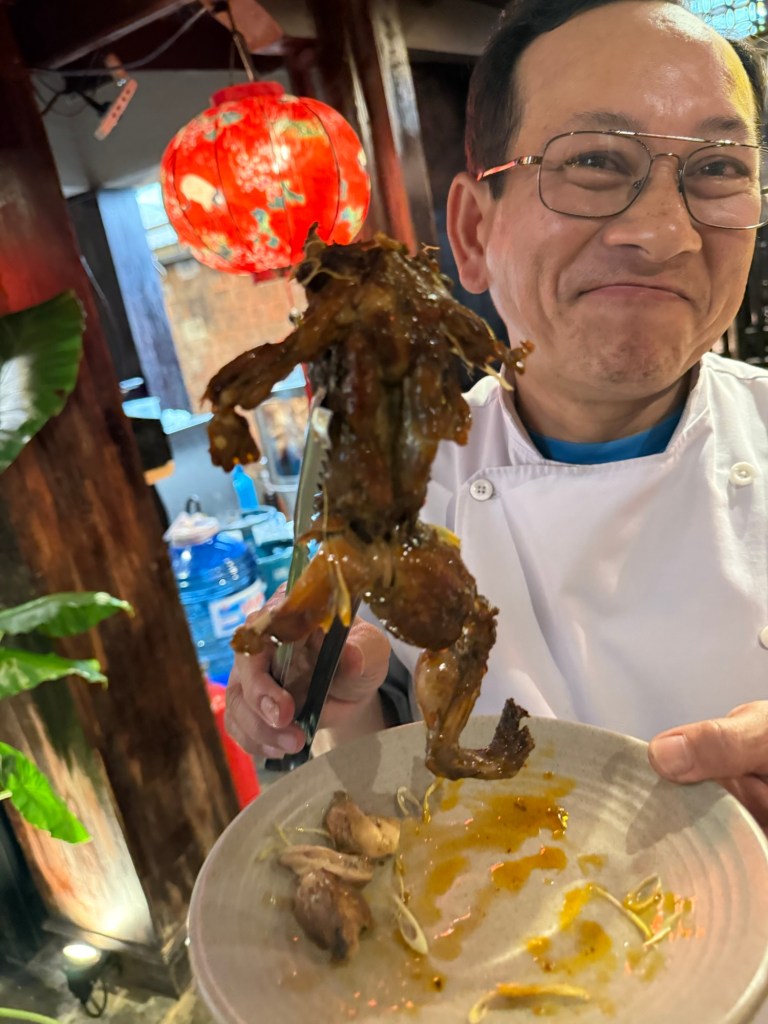
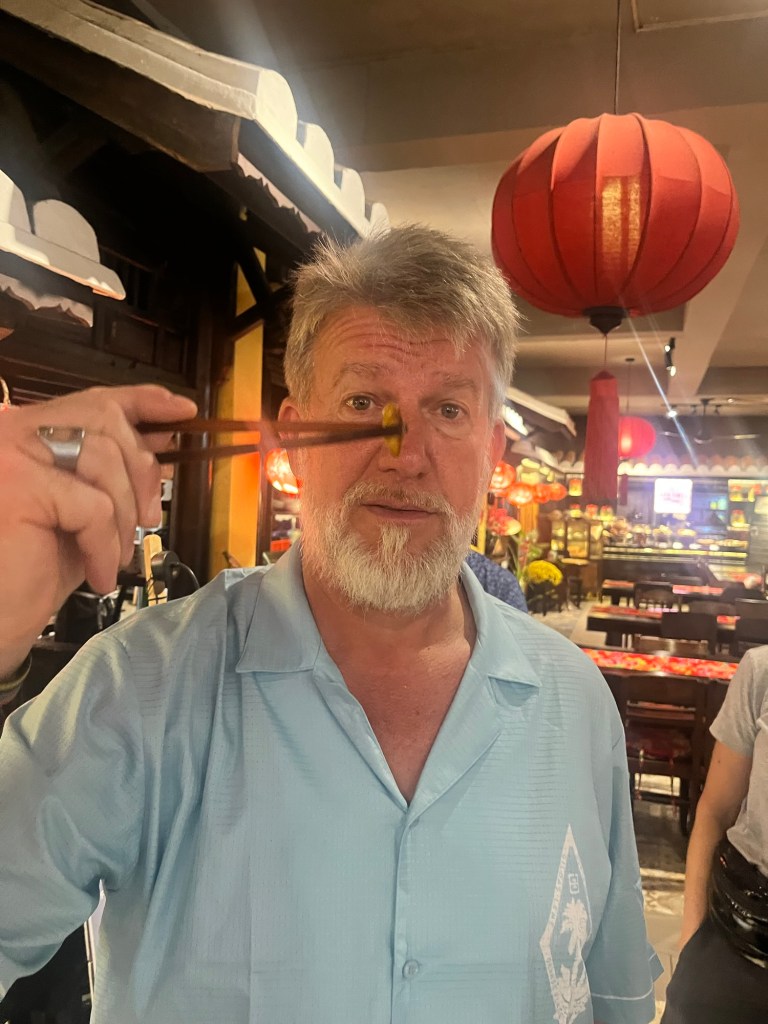
The third station consisted of a variety of challenging dishes aimed at shocking and testing westerners. It was called “Weird and Wonderful” and here JuJu and I were finally at the front of the pack. As our lame western classmates looked on we tried frog legs, snails (two varieties), and balut (a hard boiled egg with a developed duck embryo inside). I added silk worms (blech), but we both passed on blood sausage and offal. Juju wants to go back for that.
Weird and Wonderful Ribbit Silk Worm
At the fourth, we tried to use an automated noodle press to produce the omnipresent white rice noodle (think Pho again). Results were mixed.
Making Noodles
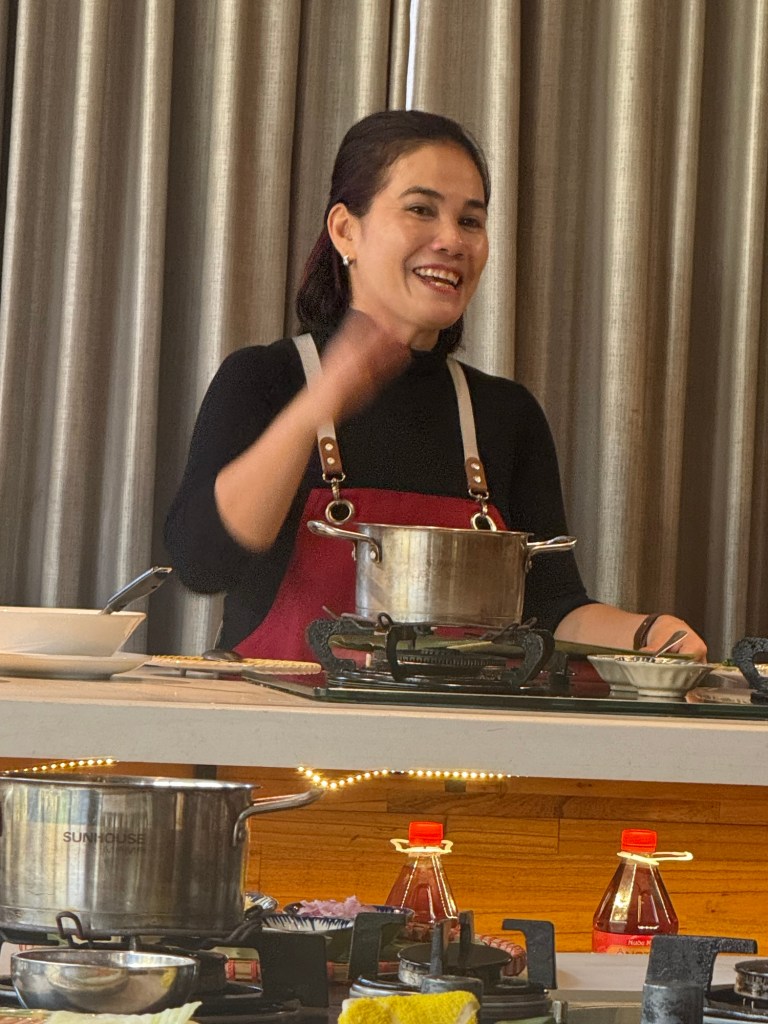
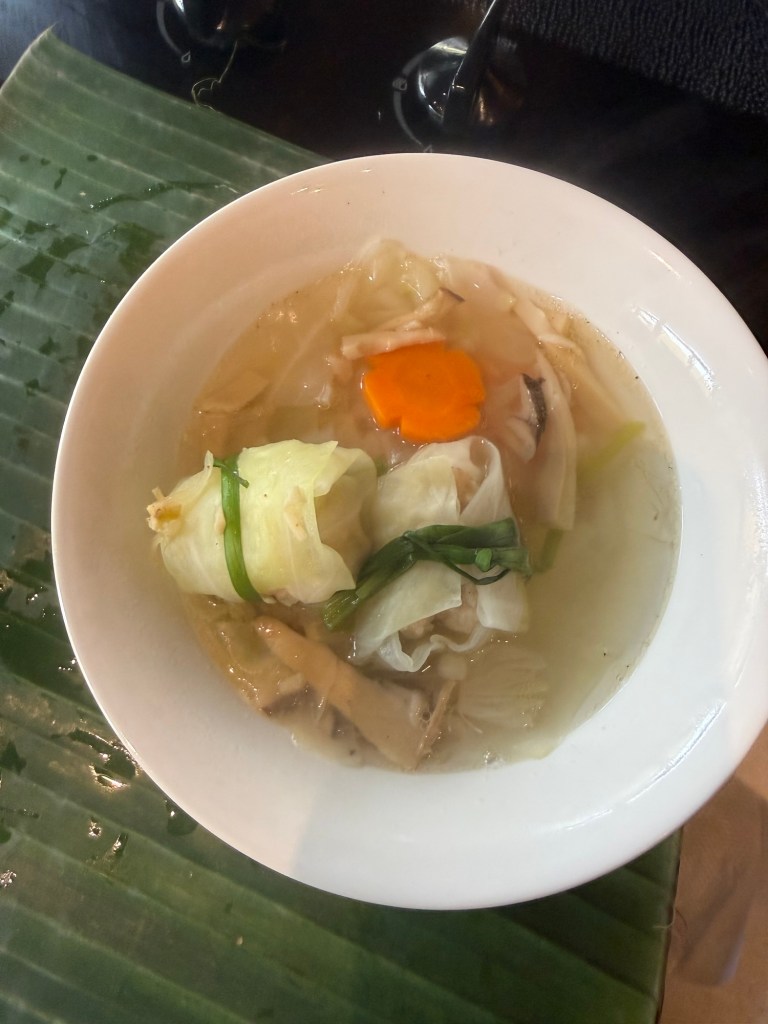
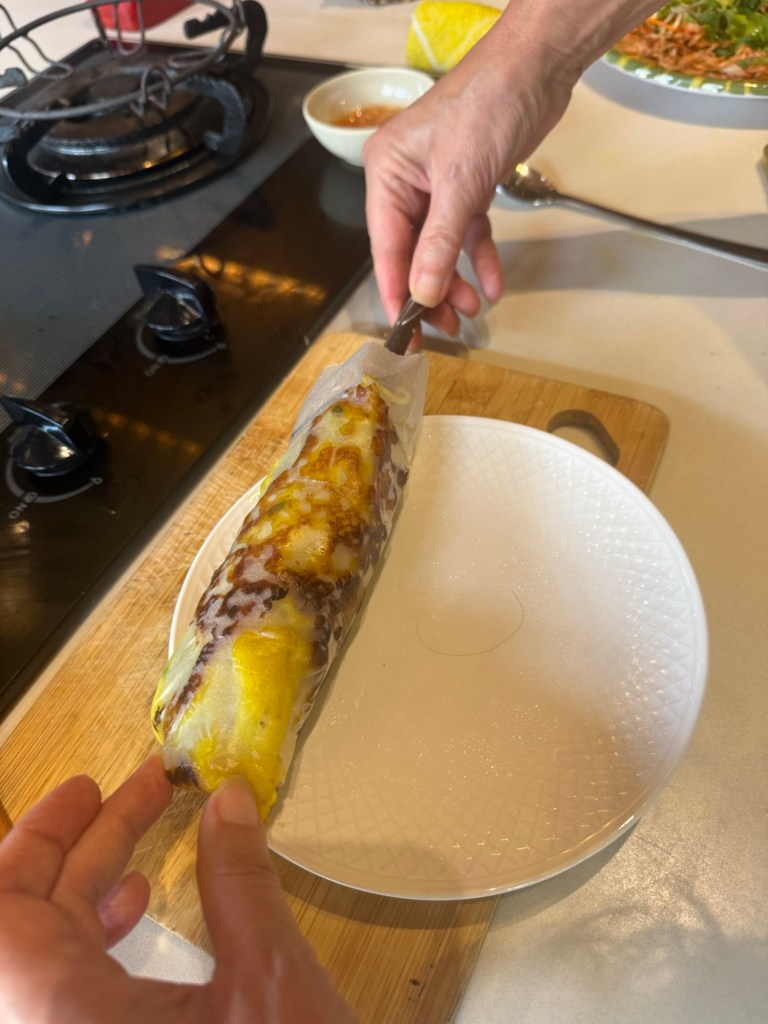
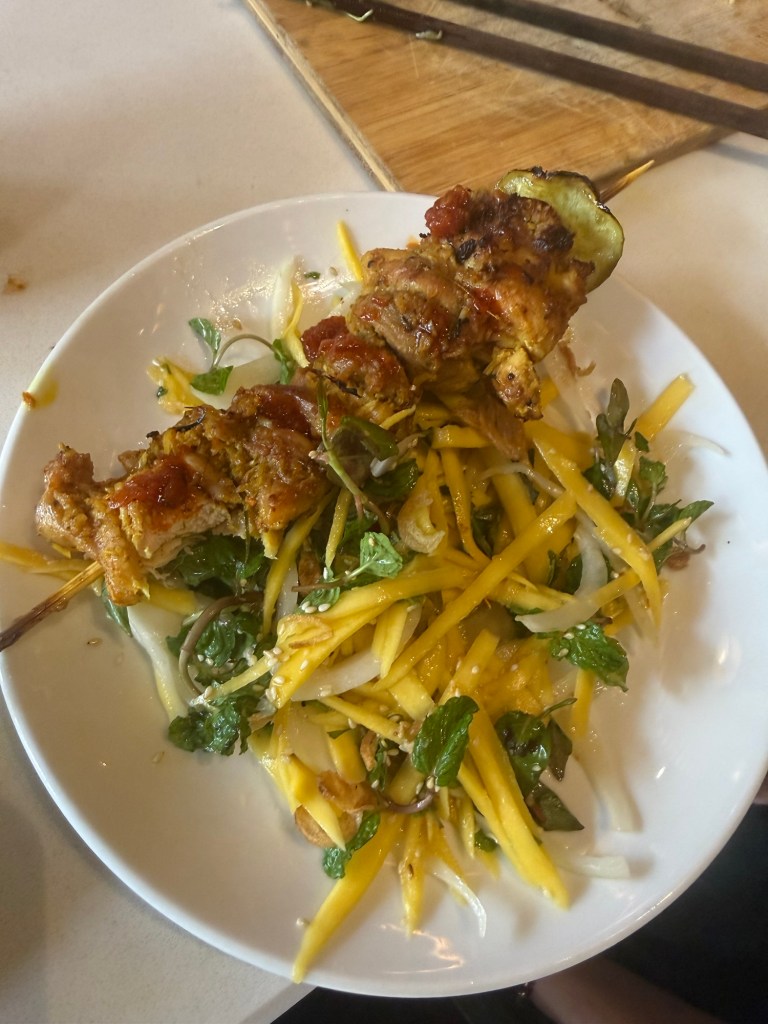
And now for our actual cooking class. Our host LuLu took us through four dishes – a cabbage parcel soup, a crispy Vietnamese pancake, Viet marinated chicken skewers, and a green papaya salad.
Chef LuLu
Cabbage Parcel Soup
Crispy Vietnamese PancakePapaya Salad and Viet Pork SkewerReady to Eat
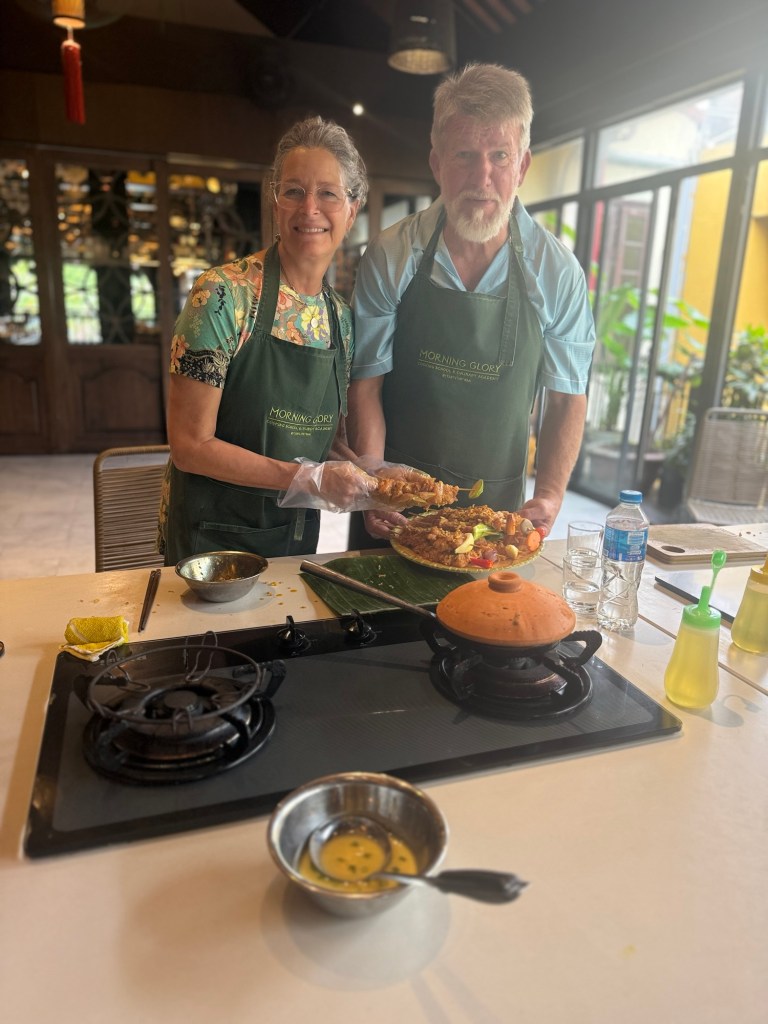
It was a step by step hands on instructional. The results were amazing. But all credit has to go to LuLu and the tastes and techniques of Vietnam
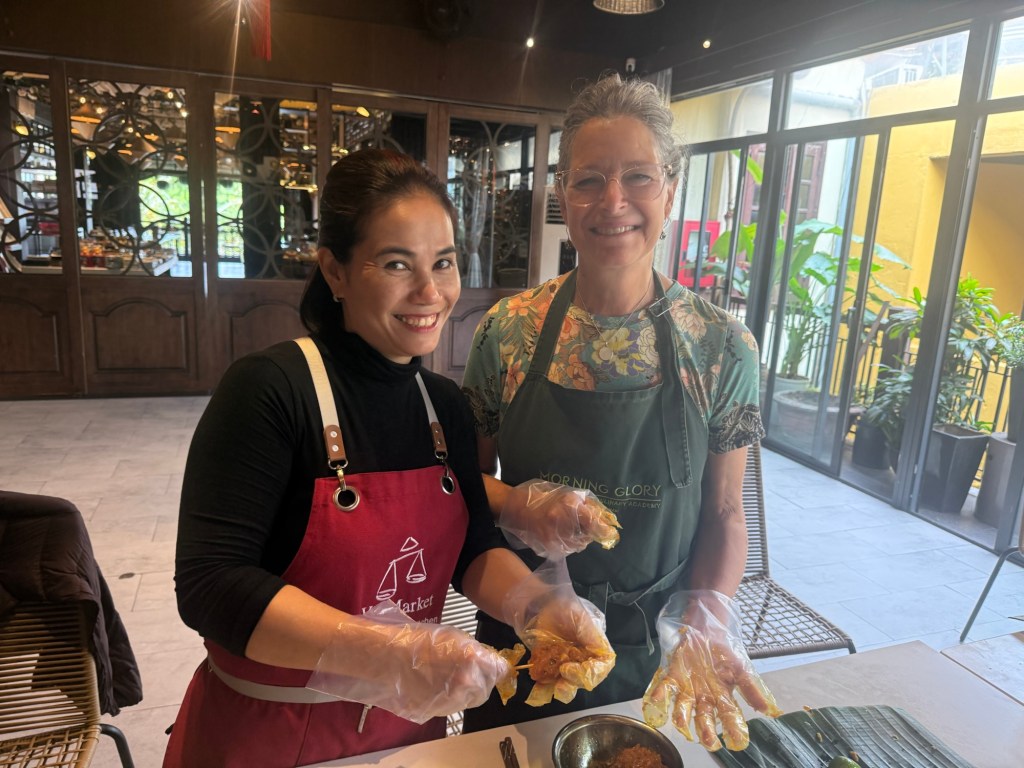
LuLu and JuJu
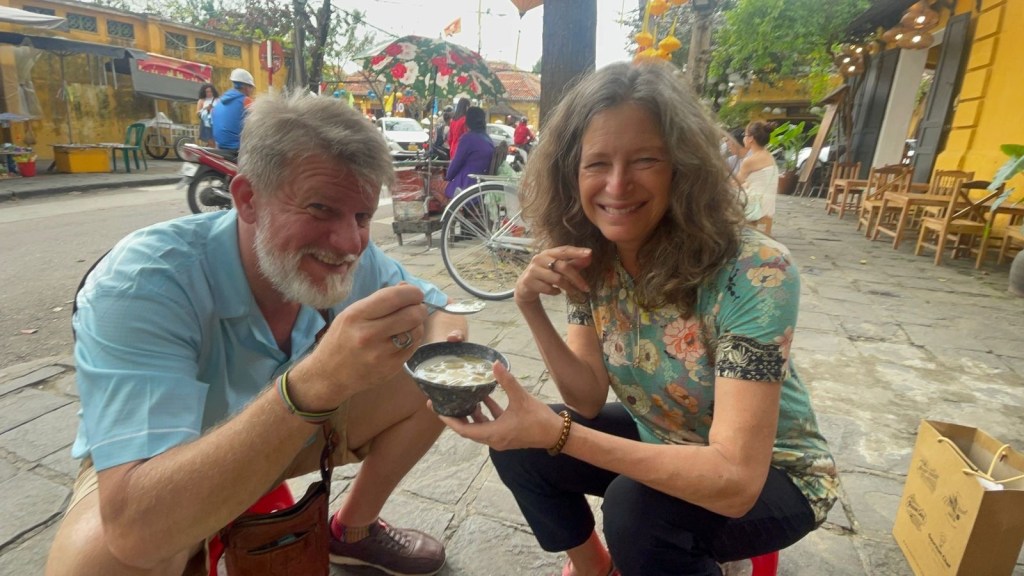
Tien met us after class for a walk through the Old City and quick tour of the market areas. Juju had a goal to find a treat called Hot-Cold soup, a mix of hot tapioca, coconut milk, ice cubes, ginger and lemon peel. Found!
Hot-Cold Soup
The Old Town was where foreign traders, generally prevented from moving inland, gathered and built homes. It was dominated by the Japanese in the 15-1600’s, and they were joined by a large Chinese population from there through the mid 1800’s. The two populations lived separately with a third zone dedicated to the Vietnamese.
Many of their gathering places, structures and even some residential buildings are there and still protected.
The Chinese, in particular, had a large governance structure and sought to have a little China within the district.
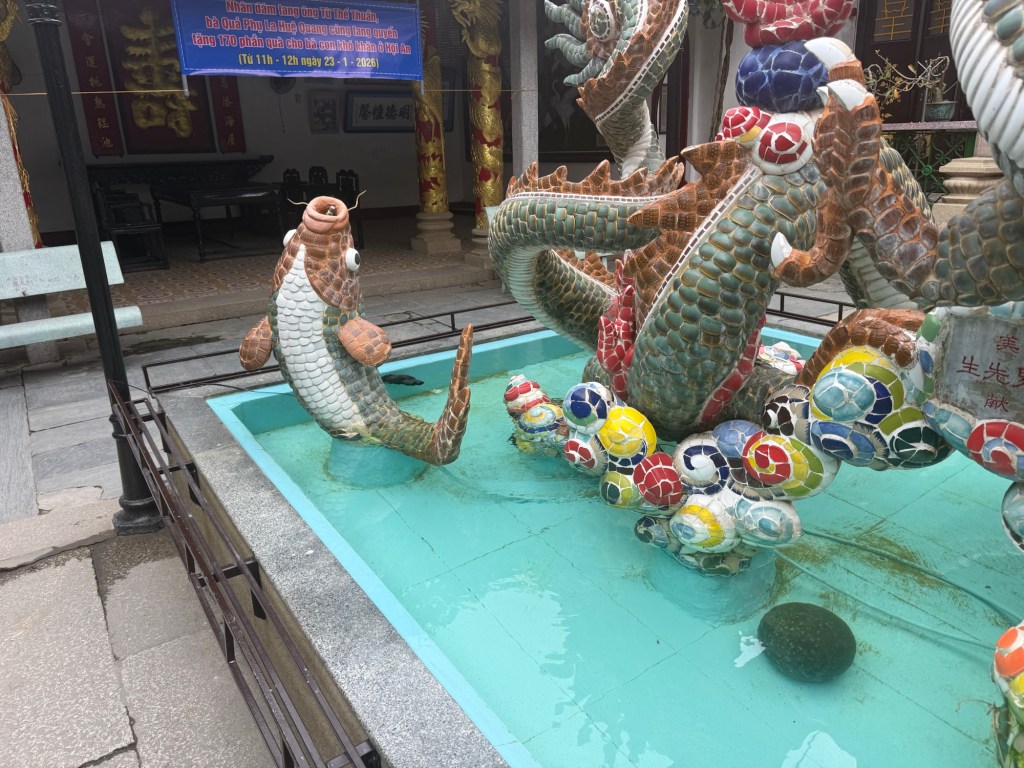
One interesting anecdote of Chinese lore (really unrelated but I needed a place to stick it.) Each year, one million catfish leave the ocean and charge to heaven to become the great dragon. Only one makes the cut.
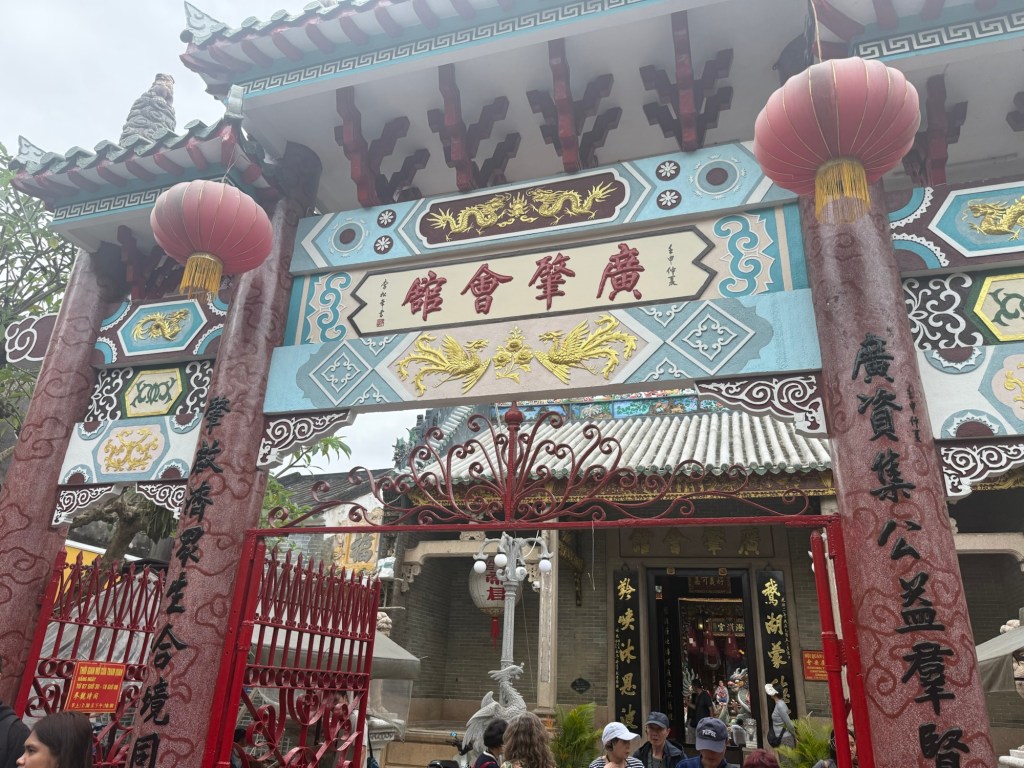
Chinese Assembly Hall (1800’s)The Millionth Catfish
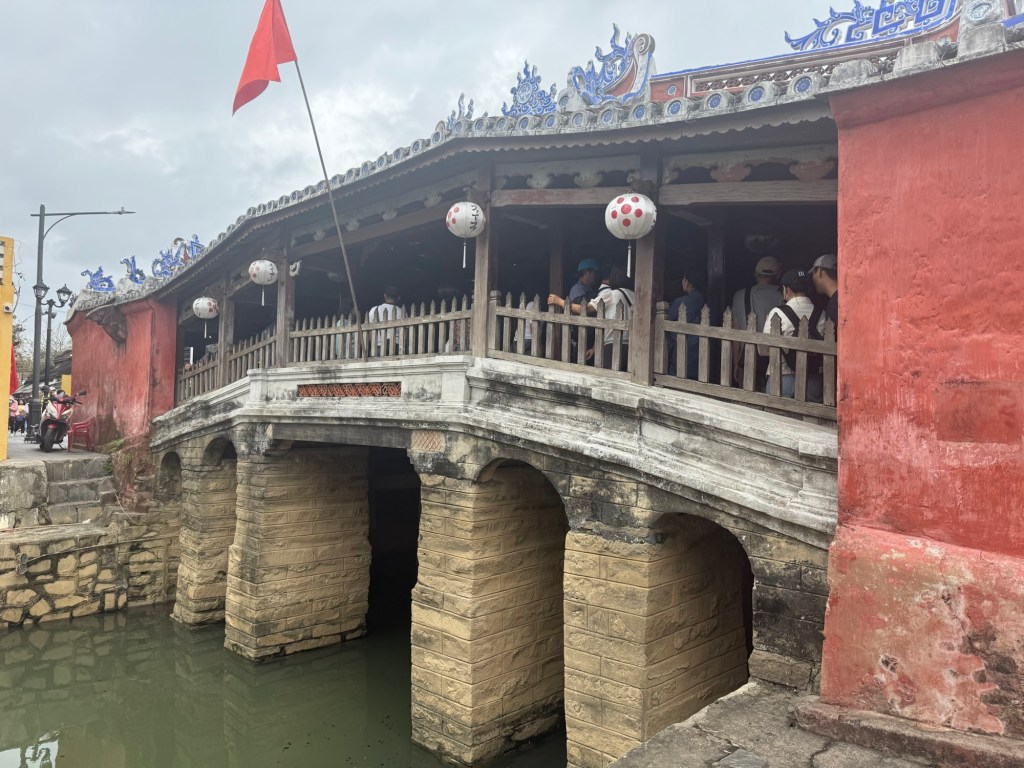
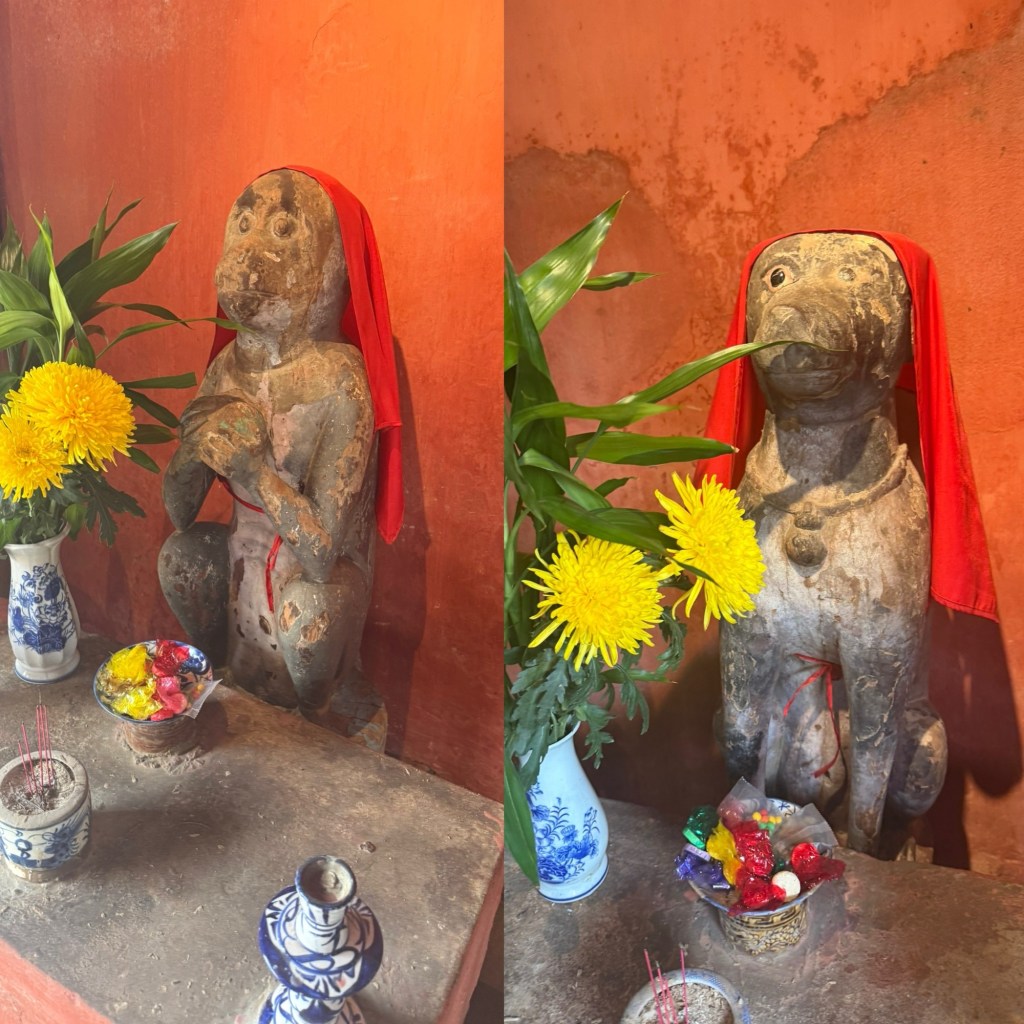
One of the oldest structures is the Japanese Pagoda Bridge. It is protected at each end by a guardian spirit, one monkey and one dog. These spirits prevent an attack on the district from the Japanese Crocodile God NaMa Zu.
Japanese Pagoda Bridge (15-1600’s)Monkey and Dog – Bridge Guardians
We plan on spending more time there tomorrow. We’ll have to because Mac ordered a pair of custom “hot trade” sneakers that will be ready for pick up tomorrow afternoon (fingers crossed). By the way, fingers crossed means something very different in VN…it means sexy time.
Shoe Shopping
We chilled at the hotel and had dinner with a a nice couple from Florida that we met in Hue. Downright pedestrian.
We left the Le Residence in Hue at a reasonable hour on Thursday the 22nd. We’re more or less at the halfway point in our journey with Hoi An left in Vietnam, and then Cambodia and Thailand still in front of us.
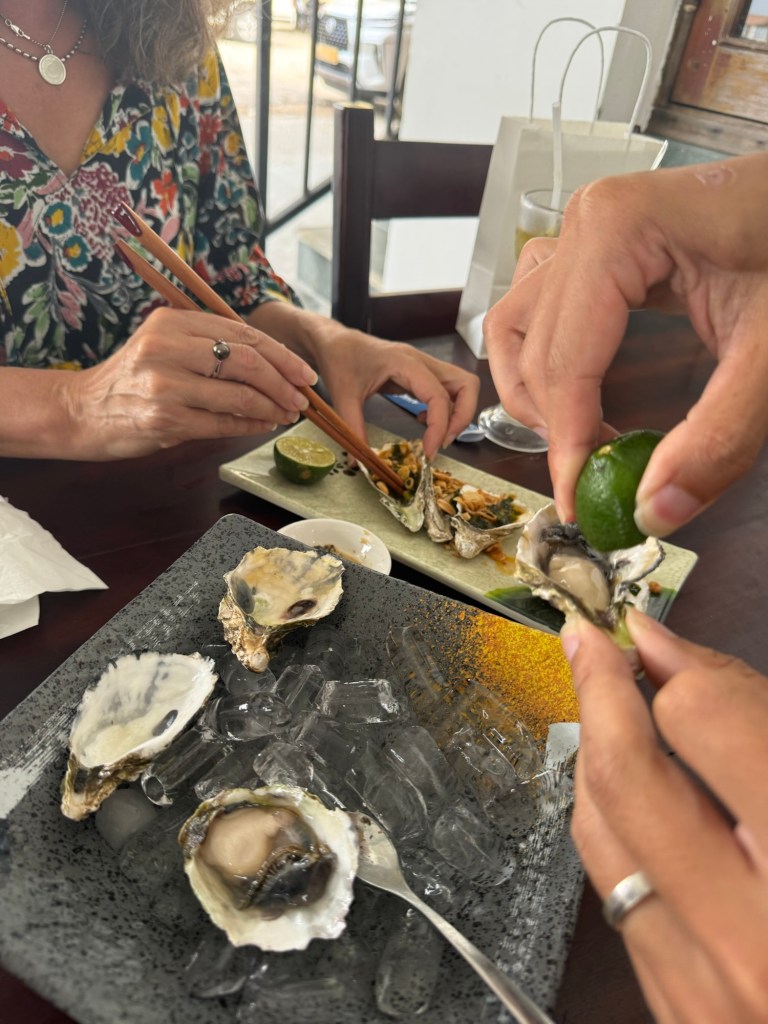
First stop today was an oyster farming village. We stopped at a little restaurant in town for oysters – raw (super muddy) and grilled (super delicious). We had quite an audience.
River oysters – not a favorite
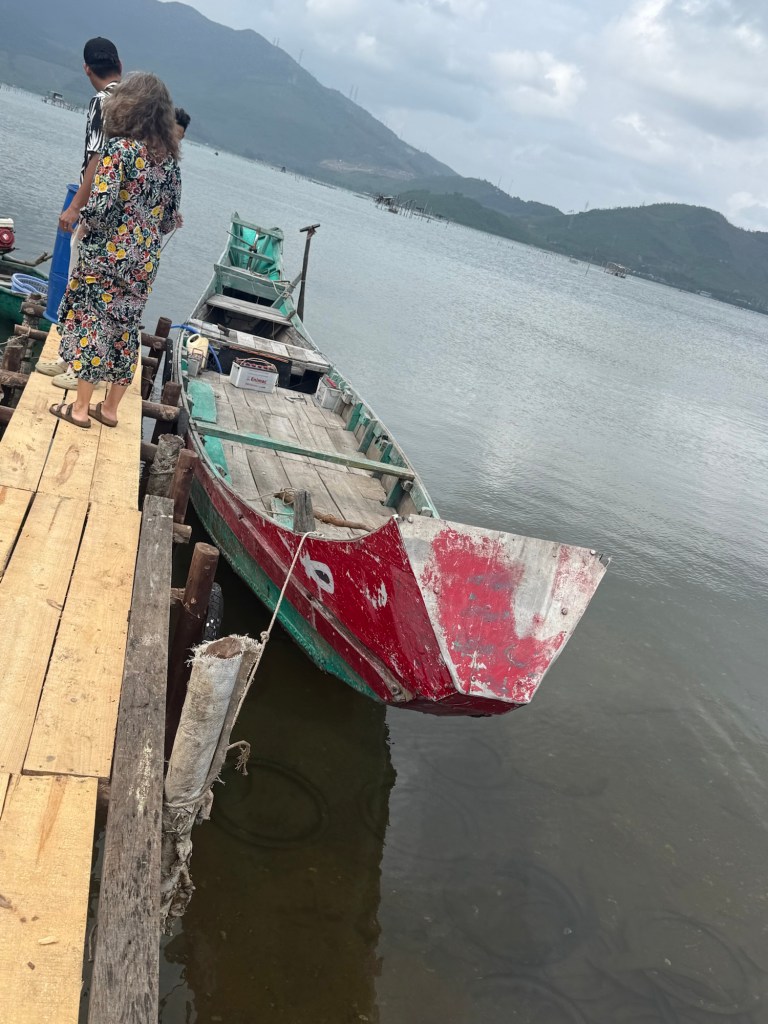
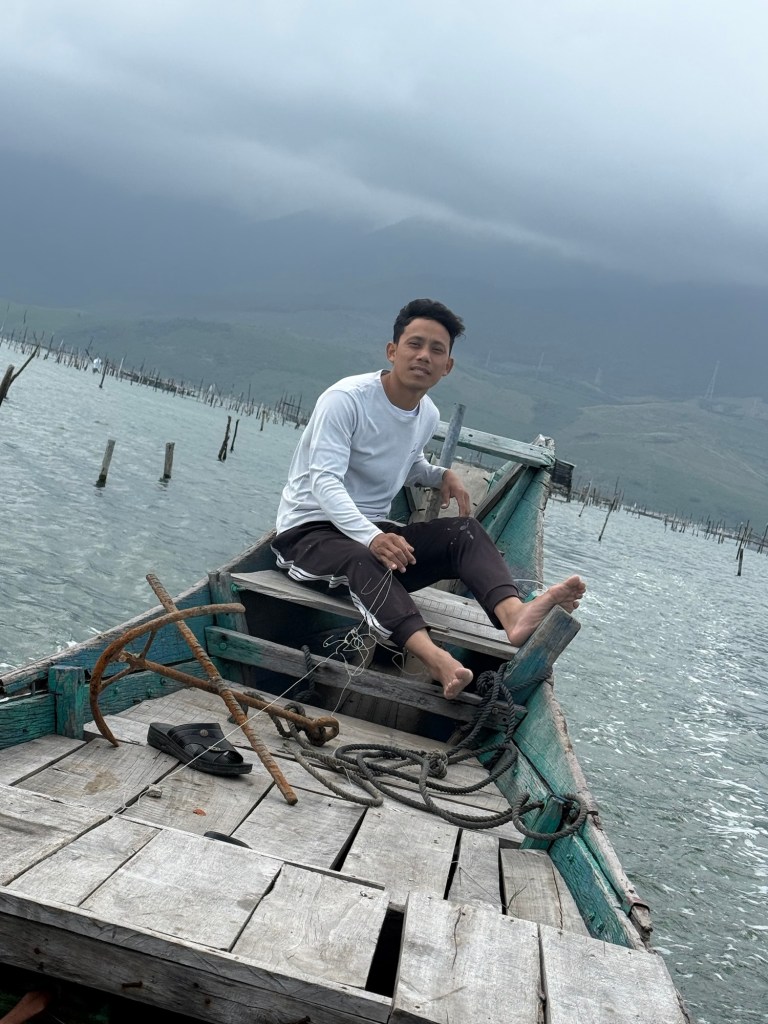
Tien promised an “experience” next, and man did he deliver. We took a banana boat out to where the fishermen work and live during the season.
Dragon BoatCaptain Quic
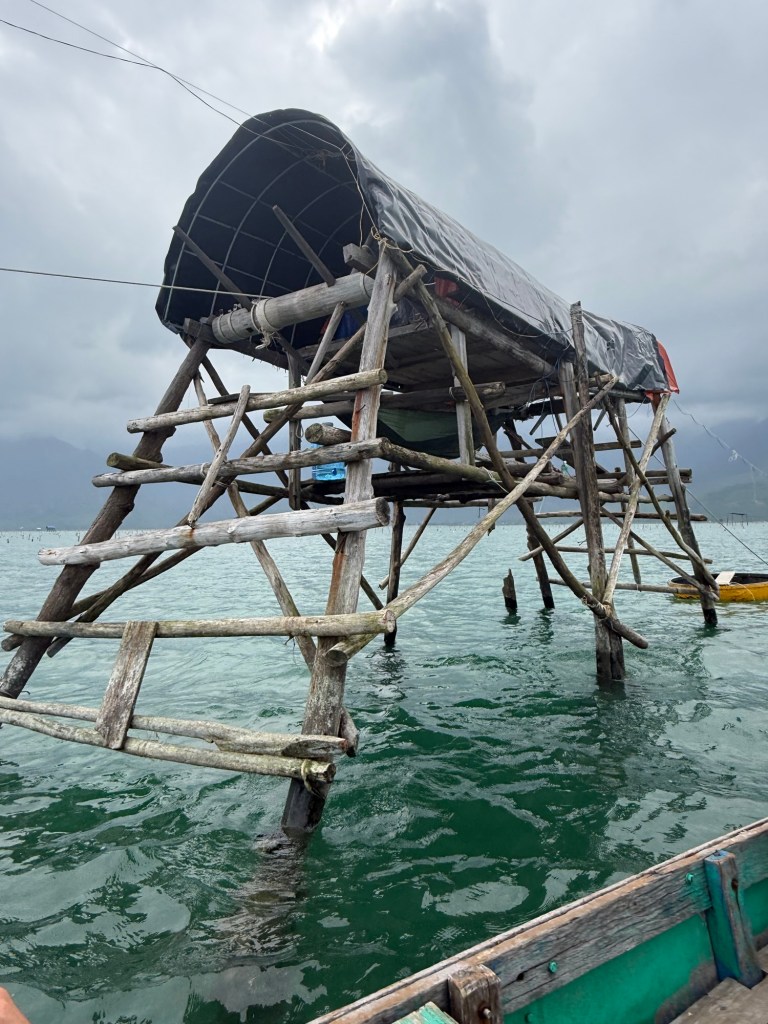
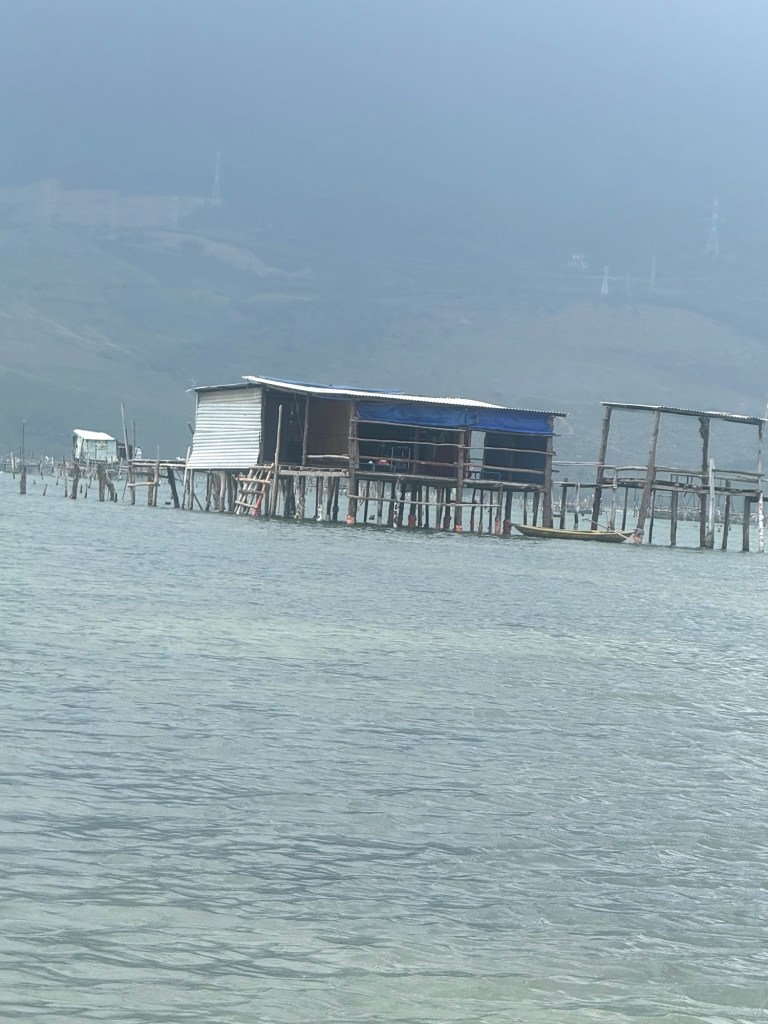
The first structure below manages the nets and oyster cages. The second is where the fisherman lives all season. (They pull nets once an hour all night and sleep during the day.)
Fish Farm TowerFisherman’s hut
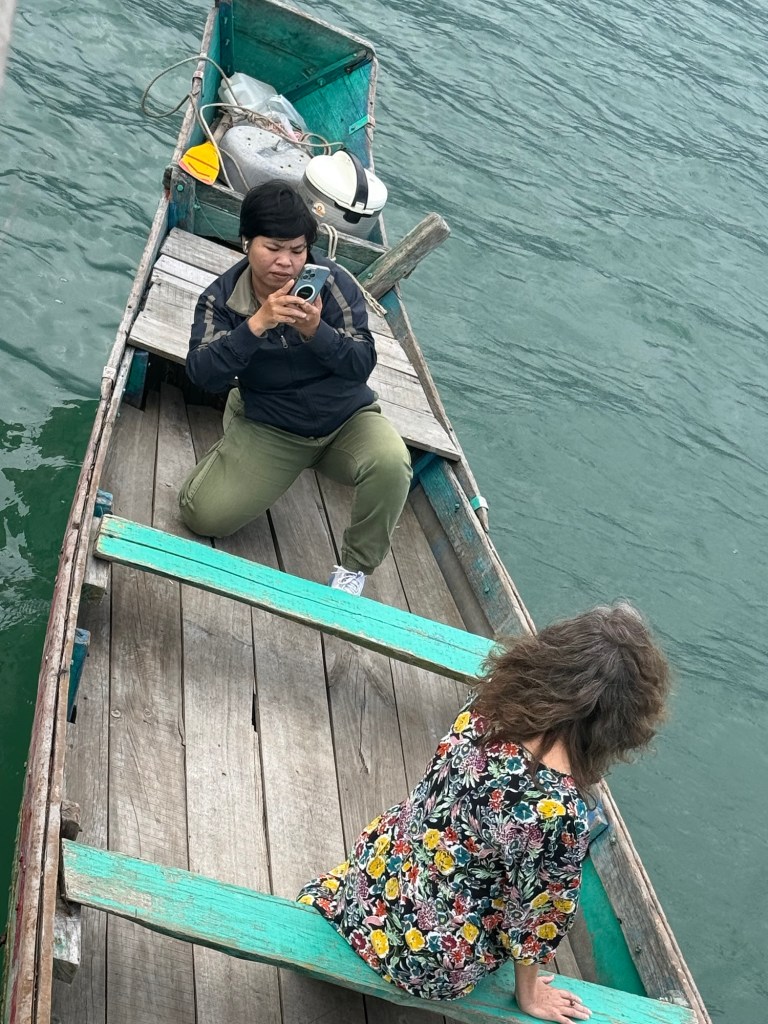
Hien the driver insisted on a photo shoot. She’s an interesting character and a very rare female driver. Hien does not eat meat and we’re told she does NOT like men. Well, she sure does likes JuJu.
“Make love to the camera”Hien’s got talent
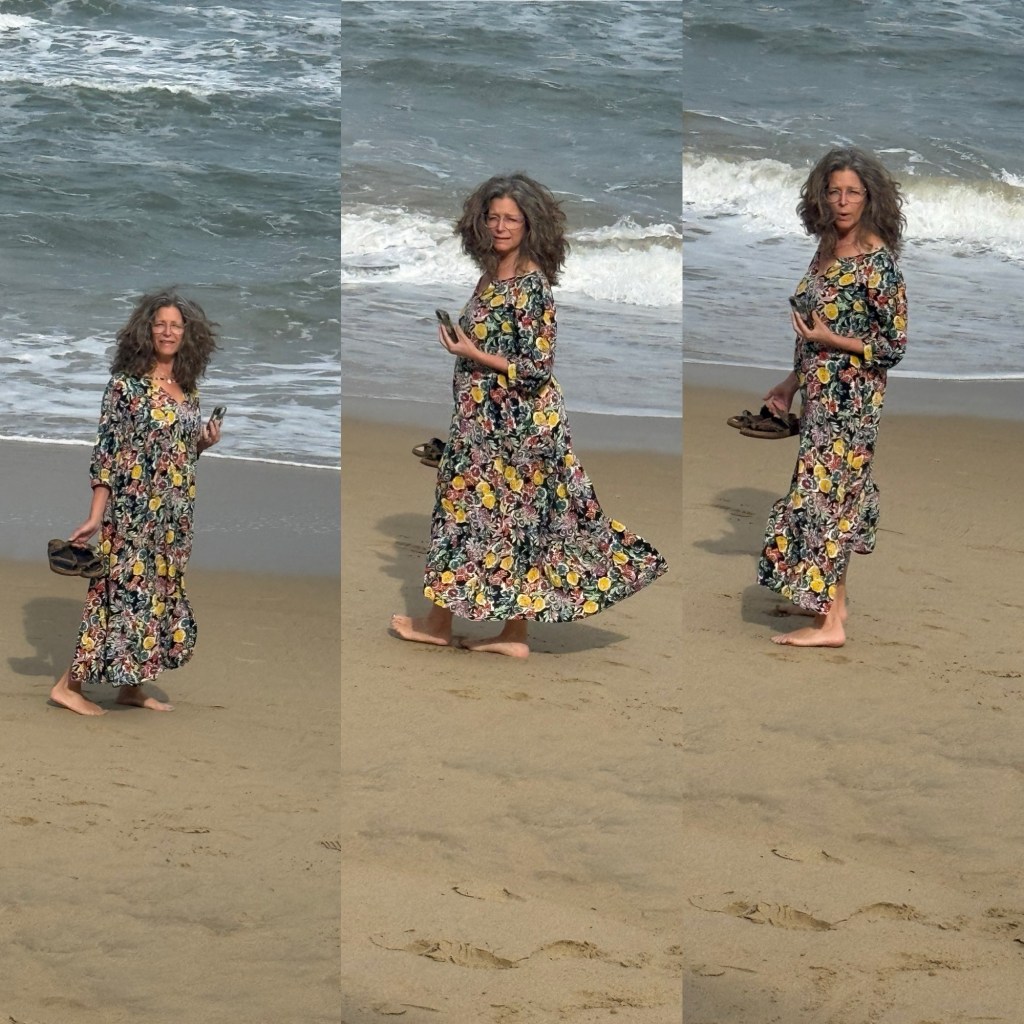
The fisherman had us clamber up into his work shop and experience one round of checking the nets. (Juju had some regrets about her choice of wardrobe.)
Oops. Wrong outfit
Earning our lunch
Hauling a 50 foot square net into the air with a hand crank? This was every bit as hard as it looks. We caught two tiny crabs and a guppy.
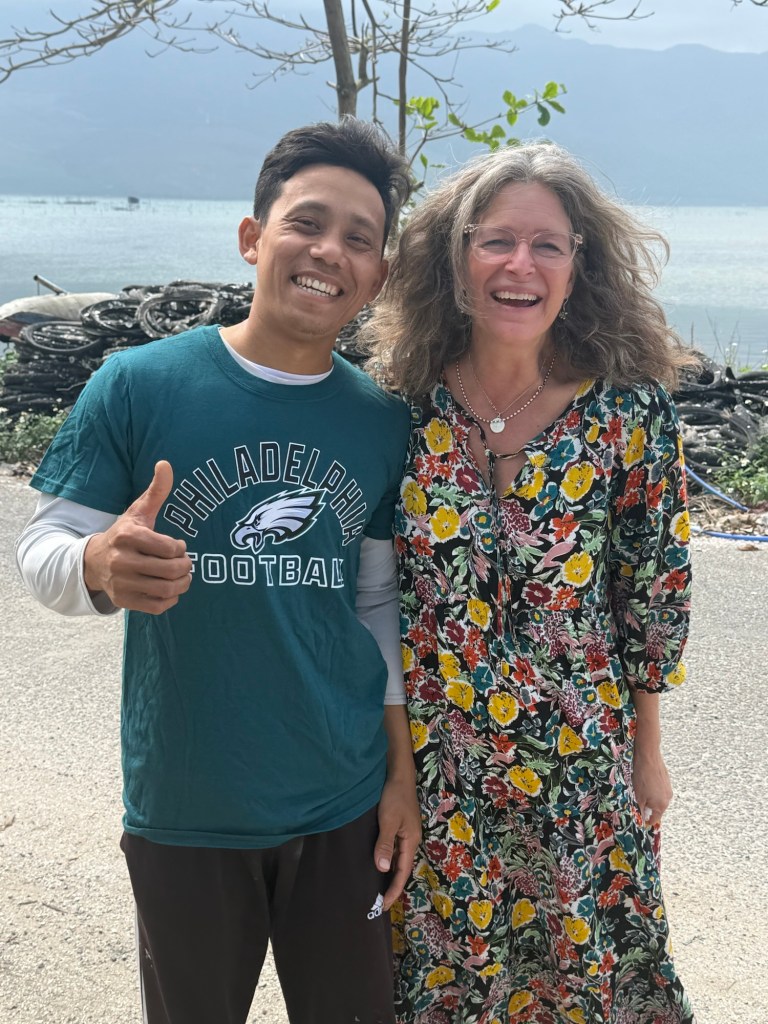
We were then invited into Quoc’s home on stilts where his mother cooked us (yet another) amazing meal. Big hugger this Mom and our host really appreciate a gift from our home.
Lunch on StiltsQuic: Go Birds!
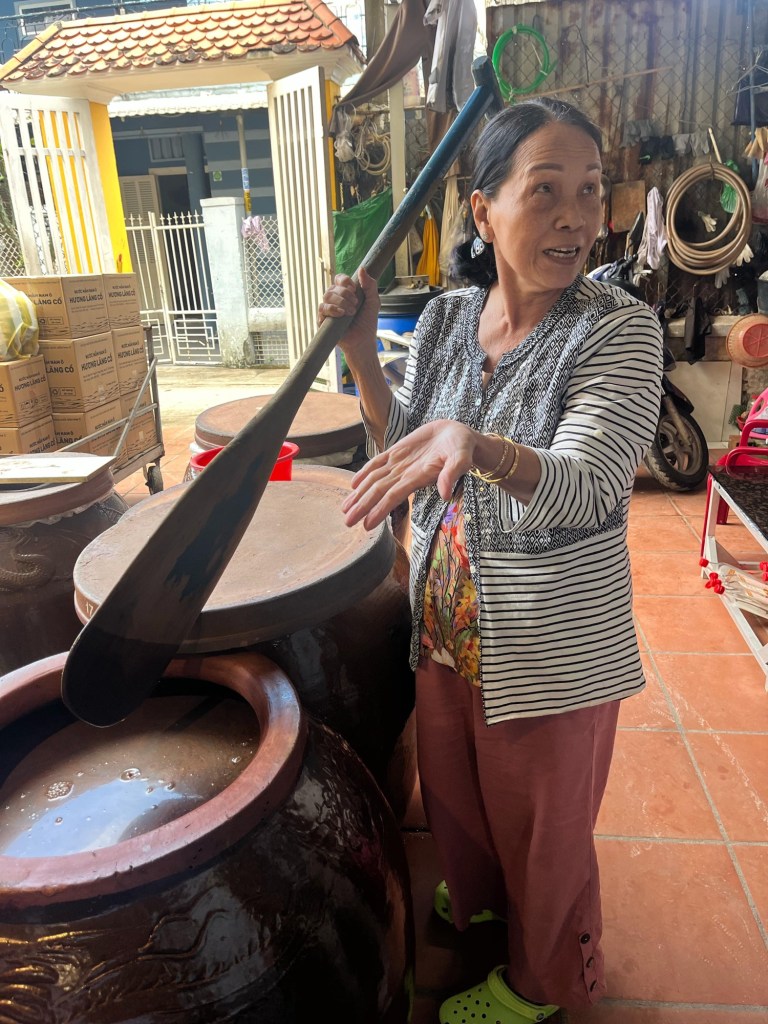
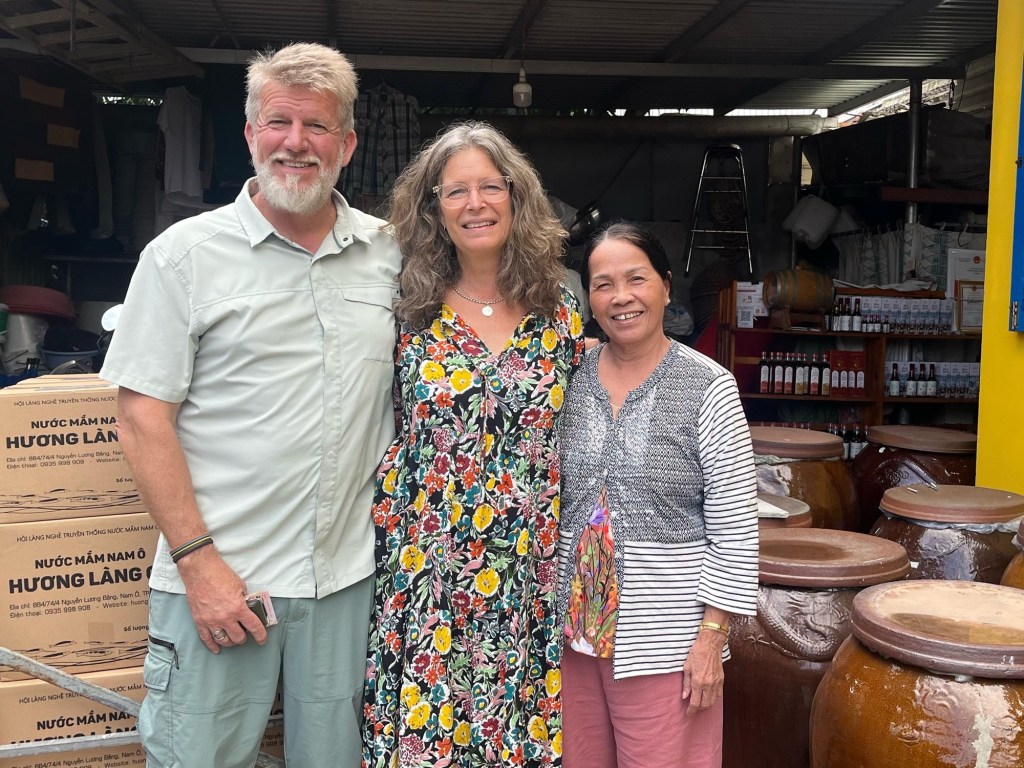
We passed through Danang next and stopped down a tiny backroad to a house where they make (and export!) fish sauce. They basically soaked tiny anchovies in salt for 6 months to a year until they dissolve. Strain, bottle and sell. The aroma, which we picked up from two blocks away, was….special.
Fish Sauce Entrepreneur The Proprietess
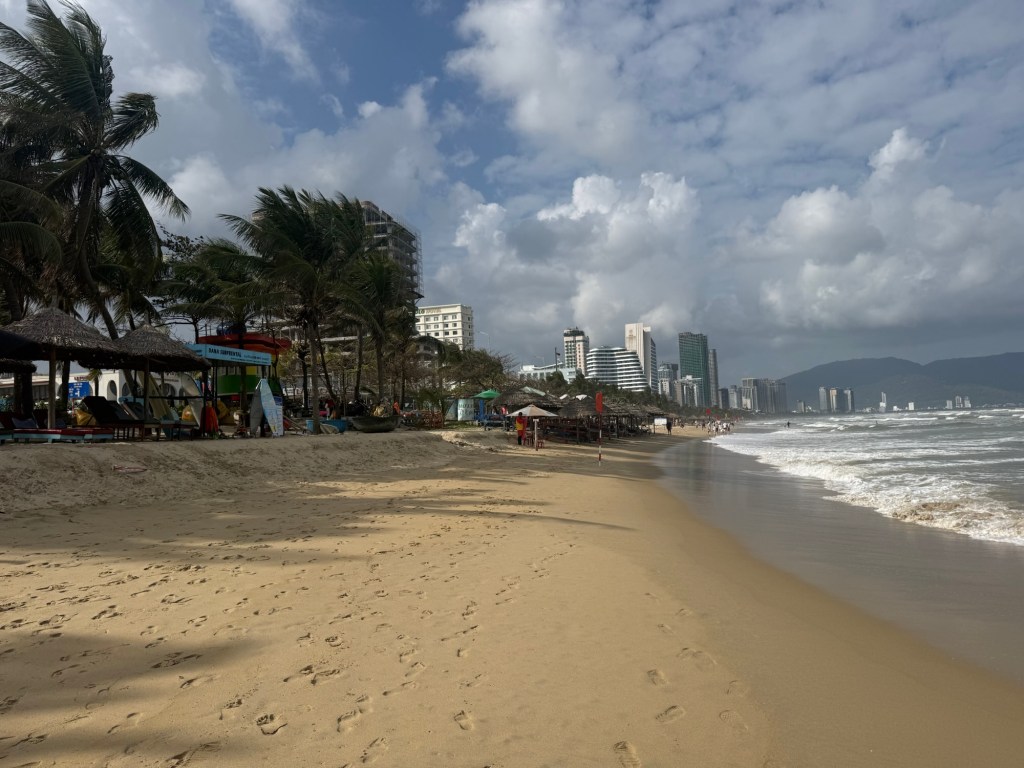
After a mandatory photo op on Danang Beach (our guide Tien can be a bit of a bully)…
Danang BeachDamn!
… we arrived in Hoi An. It’s a beautiful coastal city, a tourist Mecca and Asia’s center of “hot-tailoring.” You can get a suit in a day. The hotel Anantara is beautiful.
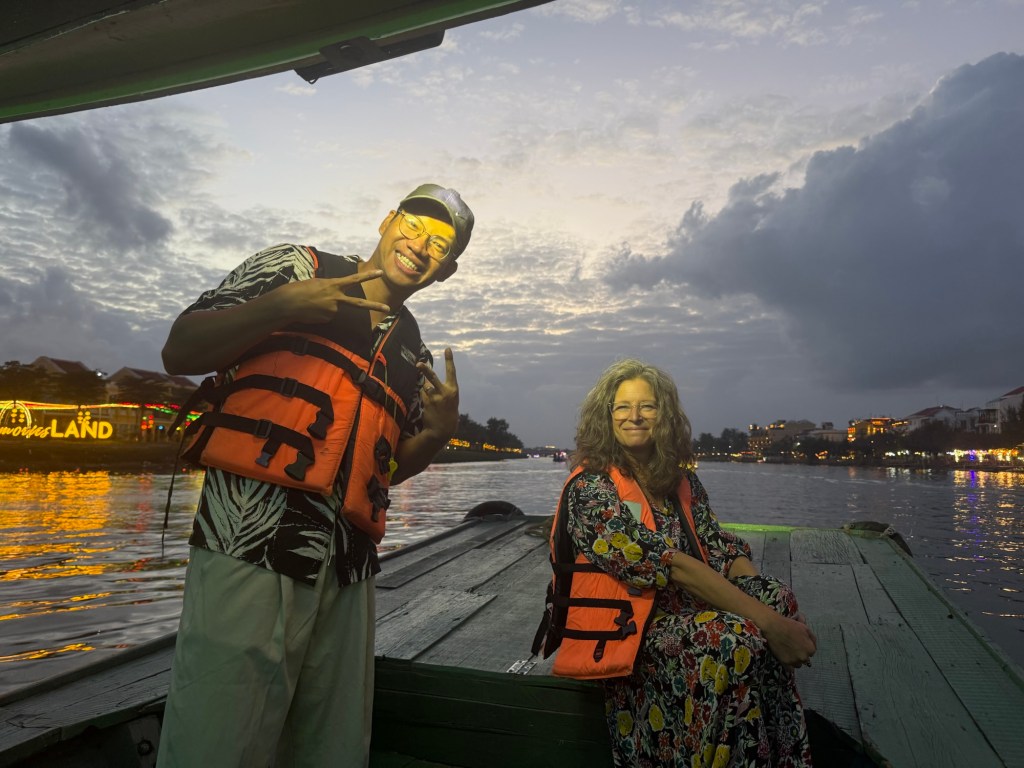
We took a sunset launch into town for dinner (after our captain went diving semi-naked to untangle a rope from the prop). Then we finished the night with Monique and Sophie, our two new Aussie friends.
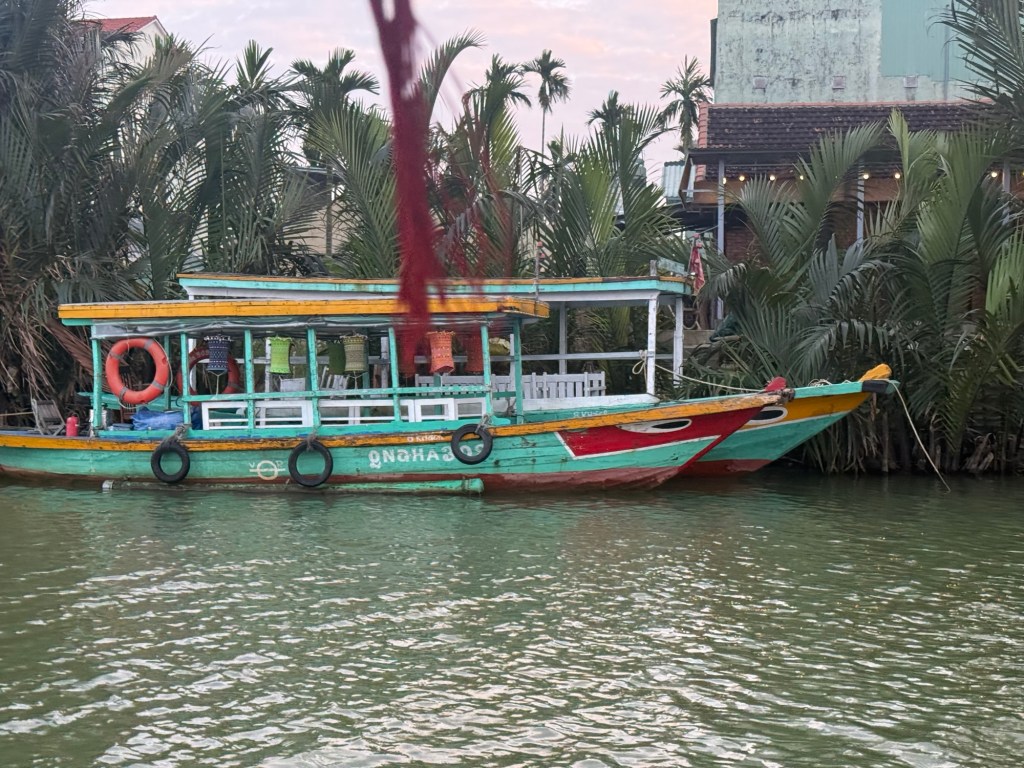
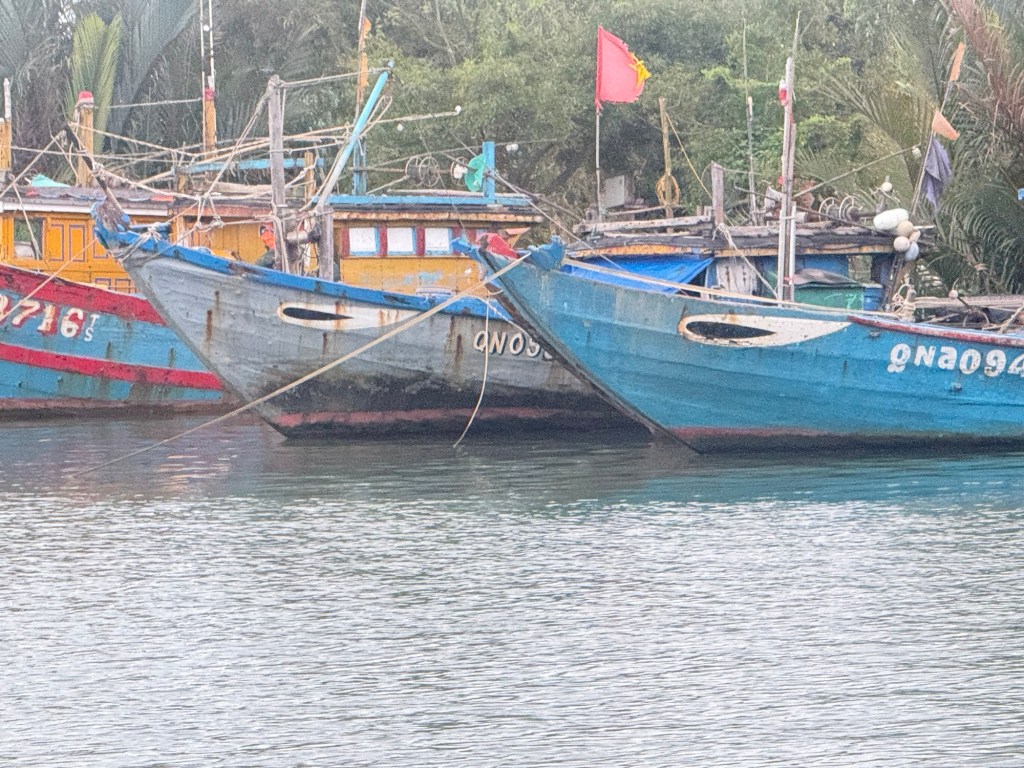
Weird Shrek VibesHoi An Public Transportation Fishing Boats
We spent a full, and I mean FULL day yesterday in Hue – the Imperial Capitol of Old Vietnam.
Our new guide Tien (accent up at end) and driver Hien (accent down at end) are wonderful. Tien is 6’1″, huge by VN standards, and owns a ladies-only gym. Hien is a five foot tall lady from the rural north but learning karate. We have quite the body guards.
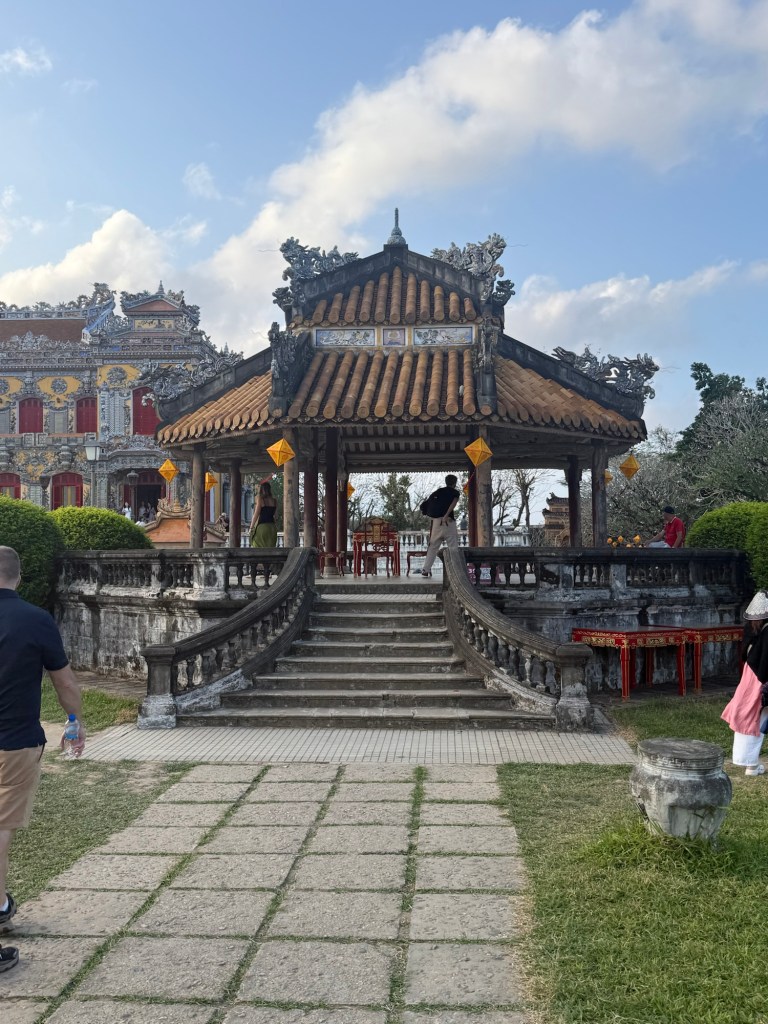
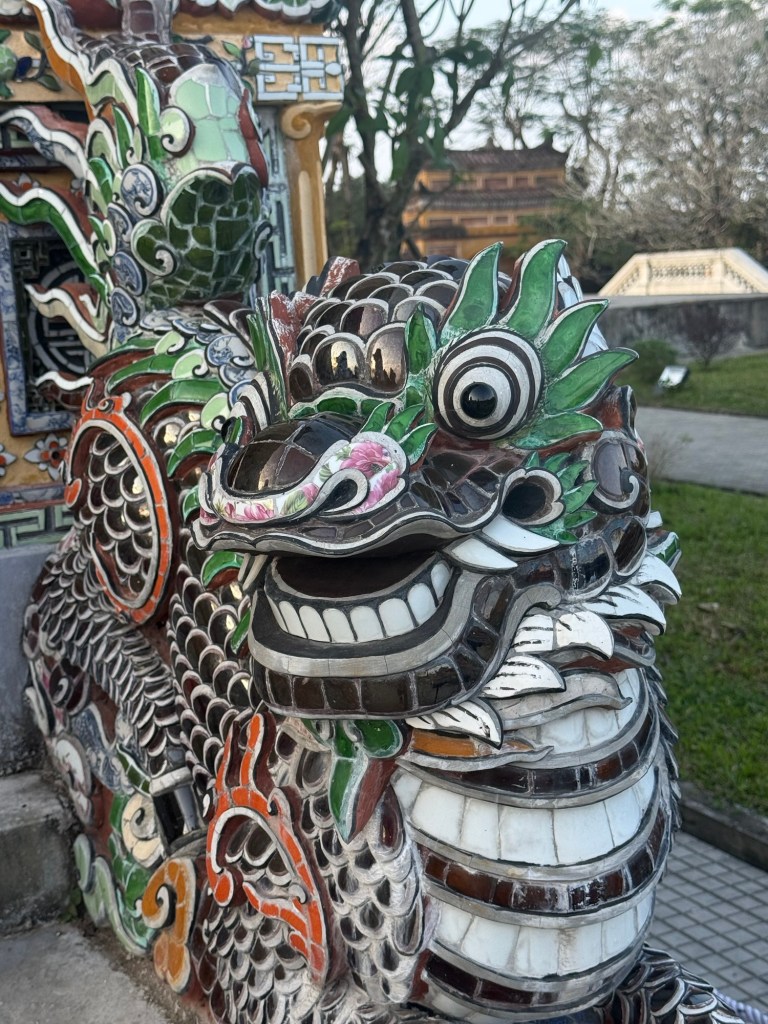
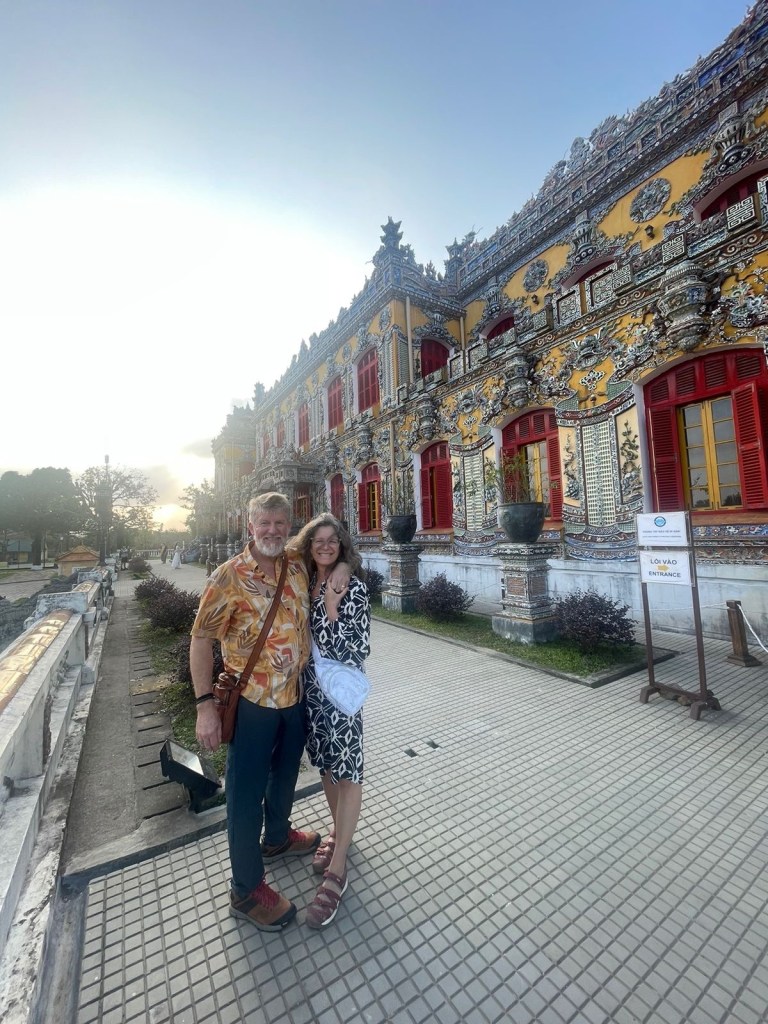
A long post today, and if you’re interested in Colonial Vietnamese history (1802-1945) you can ride along. You can also just scan through and look at pictures of the incredible architecture (and my beautiful smiling JuJu).
A timeline:
1601 – early Nguyen history, begins construction of the Cellestial Lady Pagoda
1802 – Nguyen Dynasty under Gia Long, first Emperor, consolidates control of Vietnam.
1845 – French colonization begins
~1900 – the Nguyen Dynasty (with French support) consolidates Vietnam, Laos and Cambodia. A series of puppet or “scarecrow” Emperors (one as young as 9) rule the populace but under strict French control
1941 – the Japanese army conquers VN, and enslaves the populous to maximize rice production for their army. Millions die and the Vichy French (now German allies) withdraw to the South
1945- the Japanese exit under terms of the Paris treaty. The French attempt to retake VN and send the last, and 13th Nguyen Emperor Bao Dai into exile in Paris
1945-54 – the French battle Ho Chi Min for control, losing the North decisively at the battle of Dien Bien Phu
1955 – the US enters VN, and sets up a South Vietnamese Government
1955-73 – The Vietnam War (the American War in VN parlance); Kennedy, Johnson and Nixon embrace the “domino theory” seeking to stop the spread of communism into South Asia. Major US ground troop involvement is from 1963-1973. America exits but the North-South civil war continues until 1975.
April 3, 1975 – Vietnam Independence Day, the Geneva Accords
Yesterday’s marathon-day was focused primarily on the Nguyen Dynasty. Our first stop is the Sky Lady or Cellestial Lady Pagoda. Construction was started in 1601 and expanded to its current state under the Nguyen leaders in 1845.
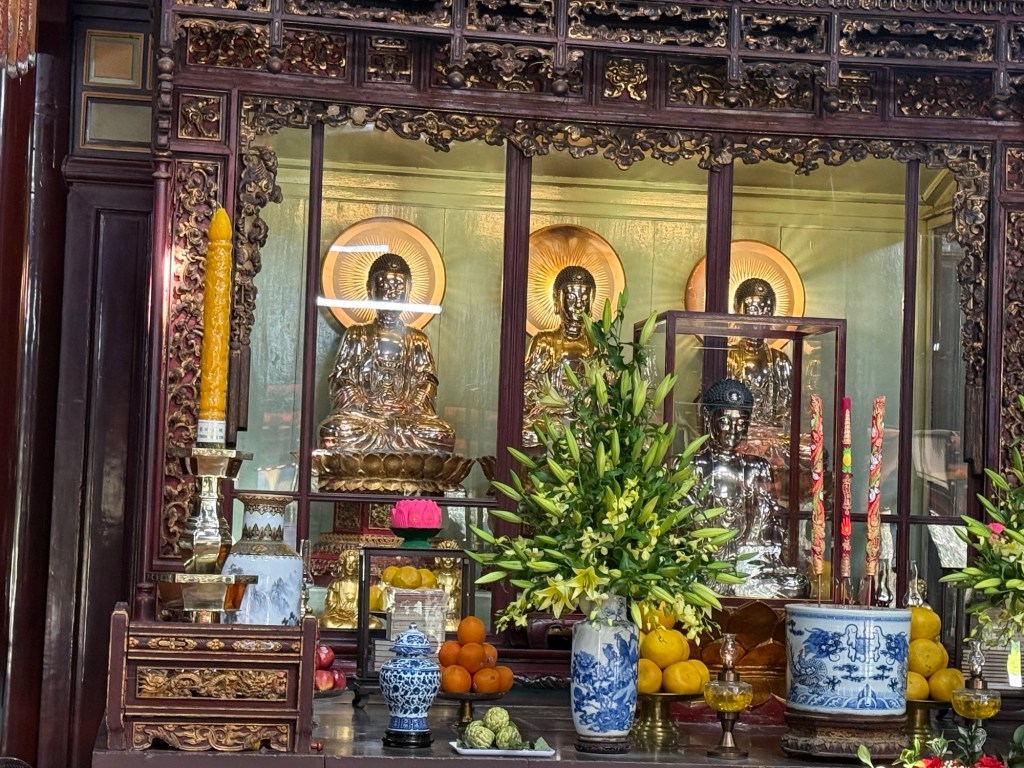
It was another sheep-dip on the Buddhist way, including discussion of the Gaurdians, the role of the Lady Buddha and the ranking systems of the monks (a top monk in yellow robes can pull down $500,000 a year and flies business class?). We’re still confused on how reincarnation, offerings to dead ancestors, karma and self-actualization all fit together.
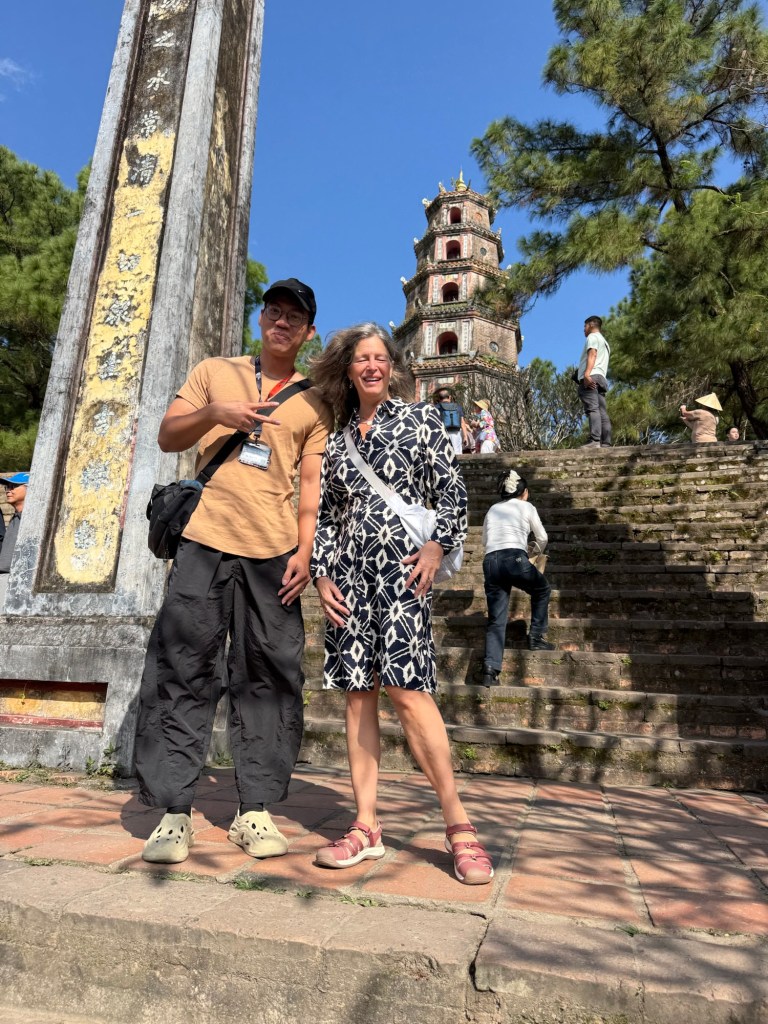
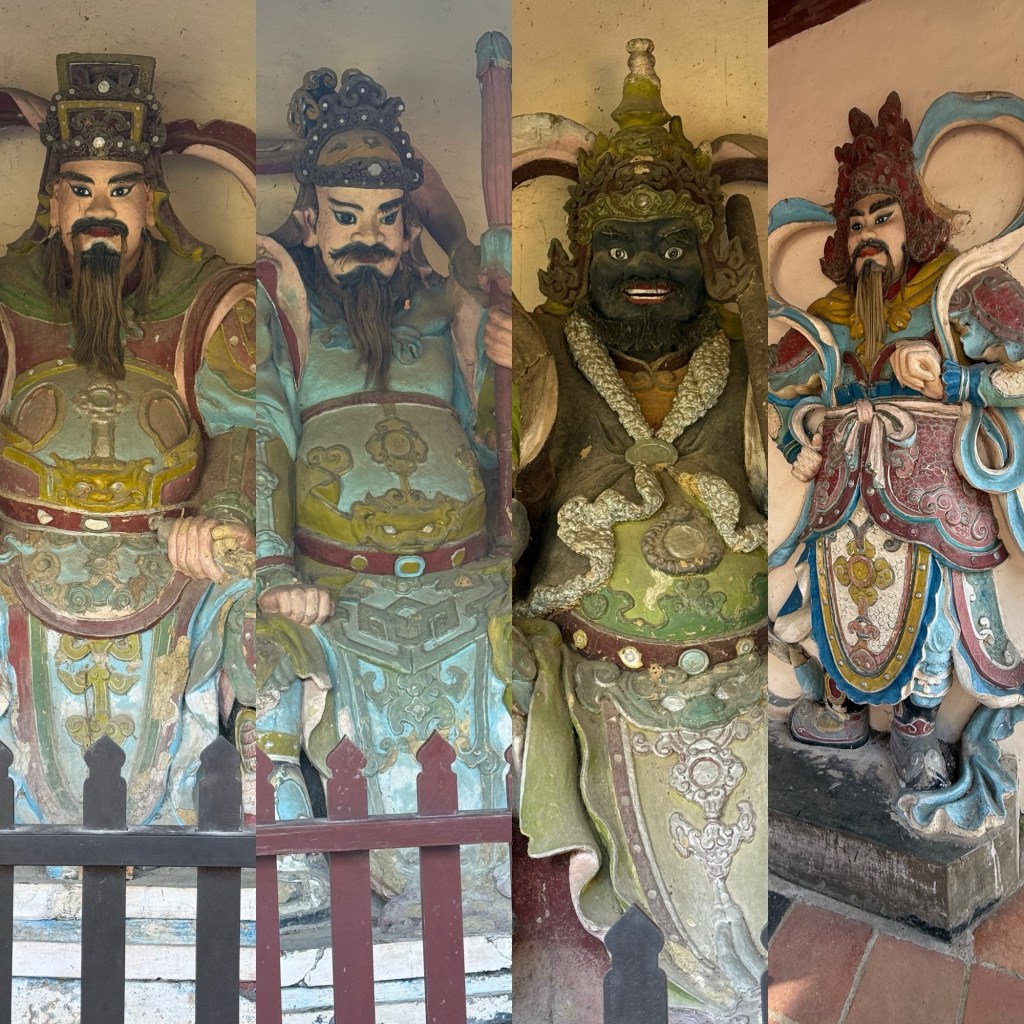
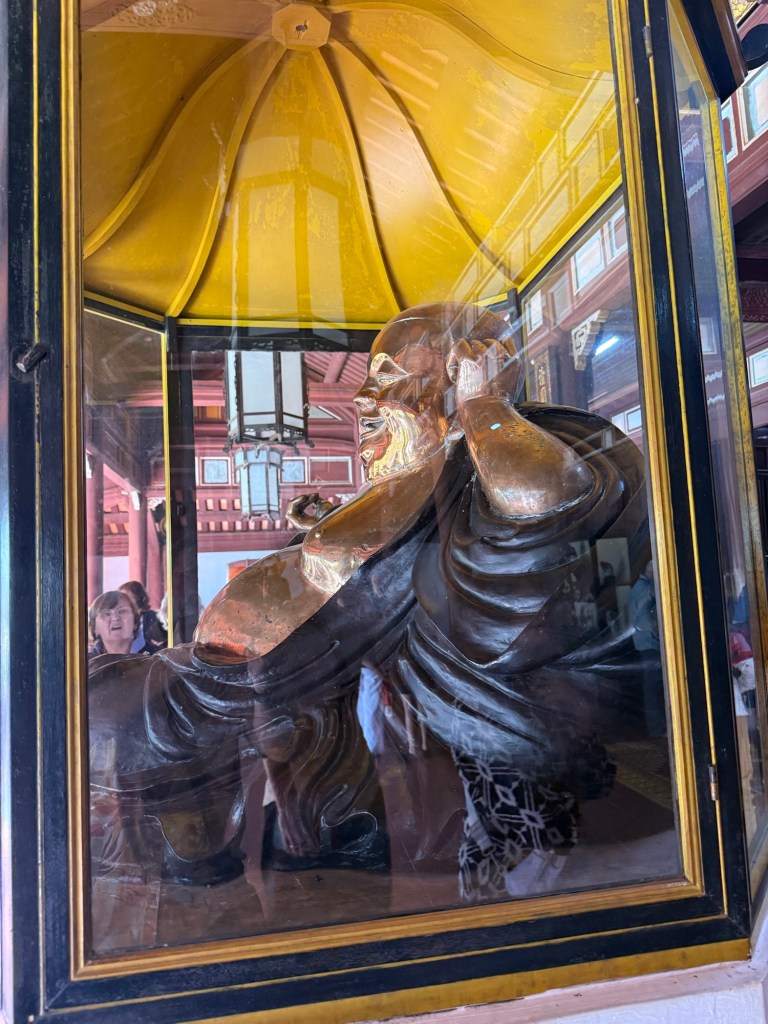
Tien and JuJu at Celestial Lady Pagoda The Four GaurdiansLaughing BuddhaPast, Present, Future Buddha
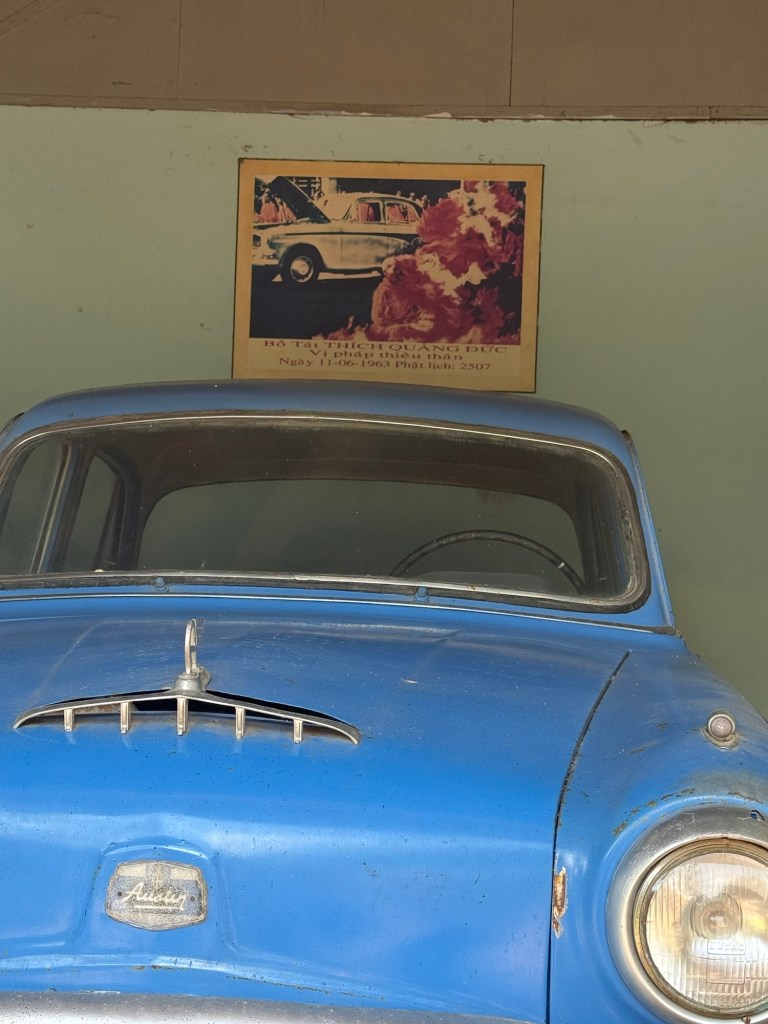
One of the exhibits commemorated the self-immolation of the monk Bo Tat Quang Duc in 1963. When the US first entered Vietnam they encouraged the new government to persecute and drive out the Buddhists (who supported Uncle Ho). Duc set himself on fire in front of the US embassy in protest, a visual that was a first wake up call to nascent protestors in the US.
Bo Tat Quang Duc Auto
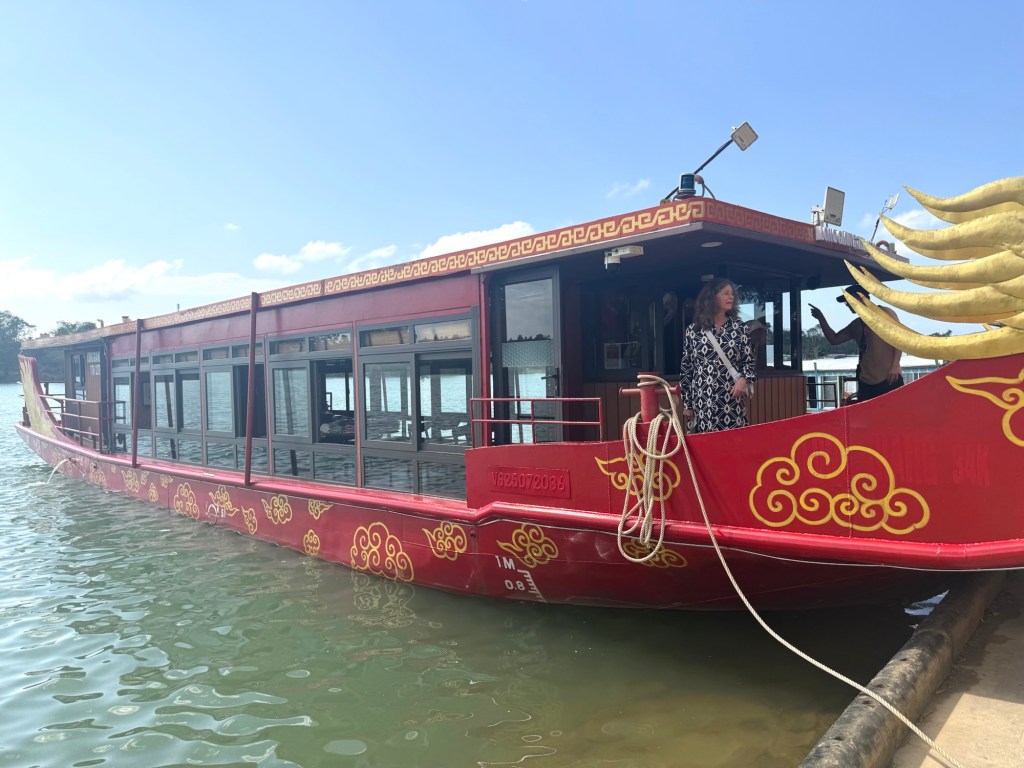
Tien put us on a boat from the Pagoda to our next stop. It was 50 foot long with seating for 30+. We were alone. Cost of transit, $27.
Private Dragon Boat
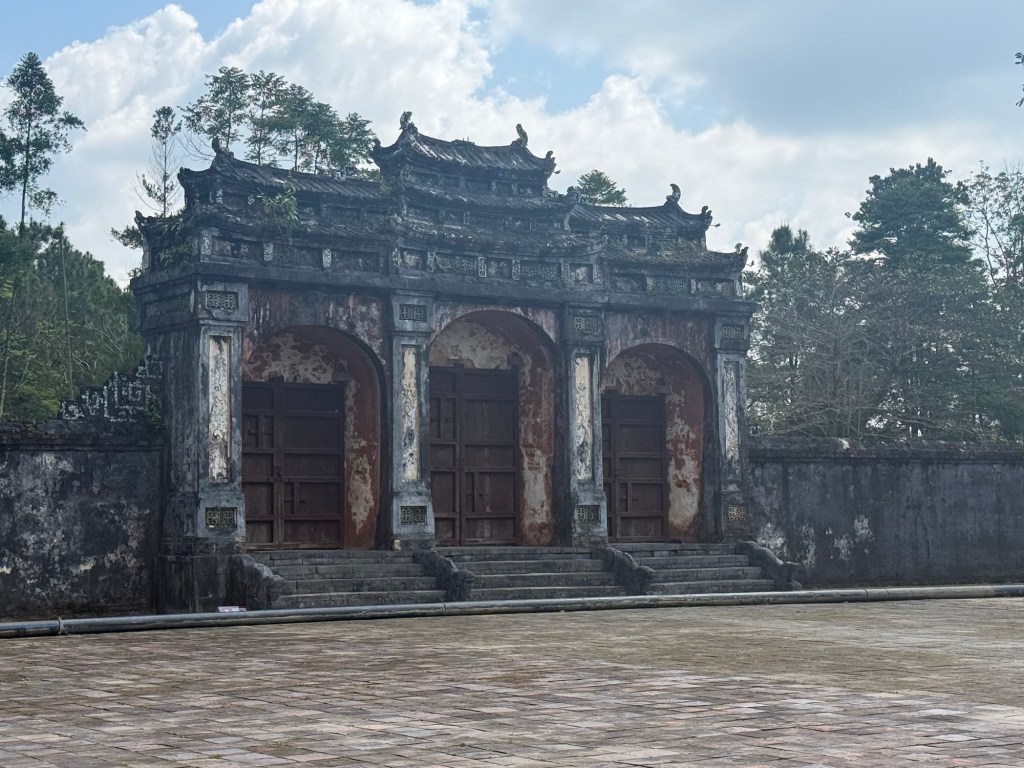
Our next stop was the tomb of Minh Mangh, the second Nguyen Empower. It was a huge complex dating to 1841 including a series of gates, homes for his Mandarins (ministers of finance, war, agriculture, etc) and his concubines. Mangh had 141 children as did many of the Emperors. A huge number of Vietnamese still have Nguyen as a surname today.
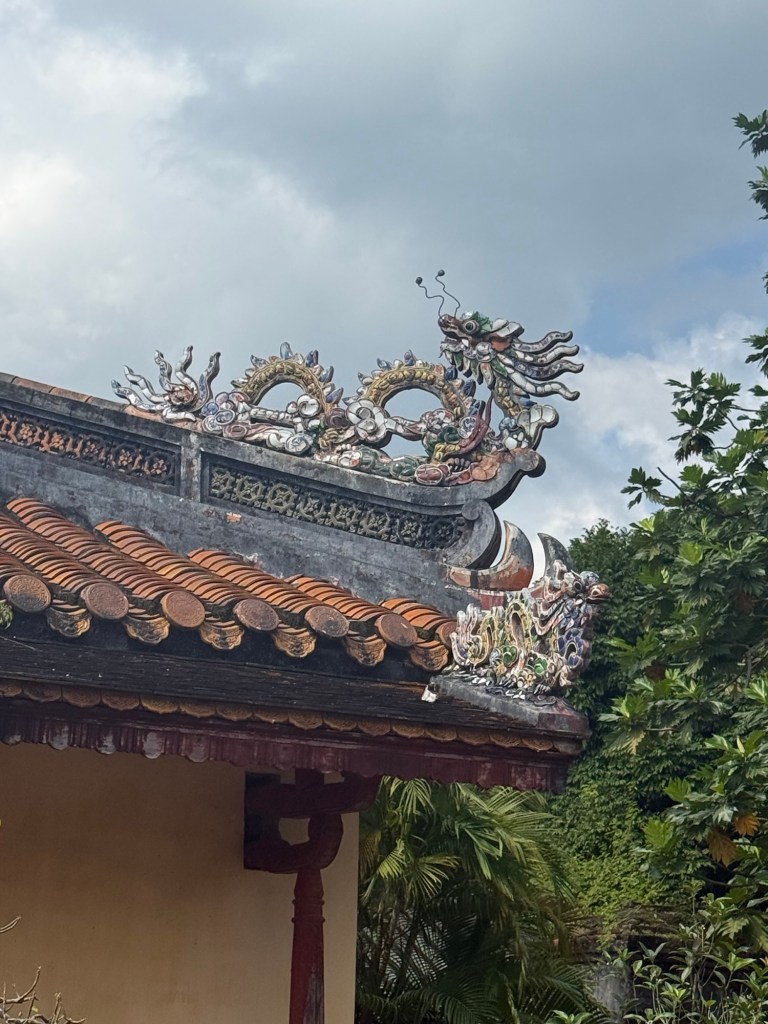
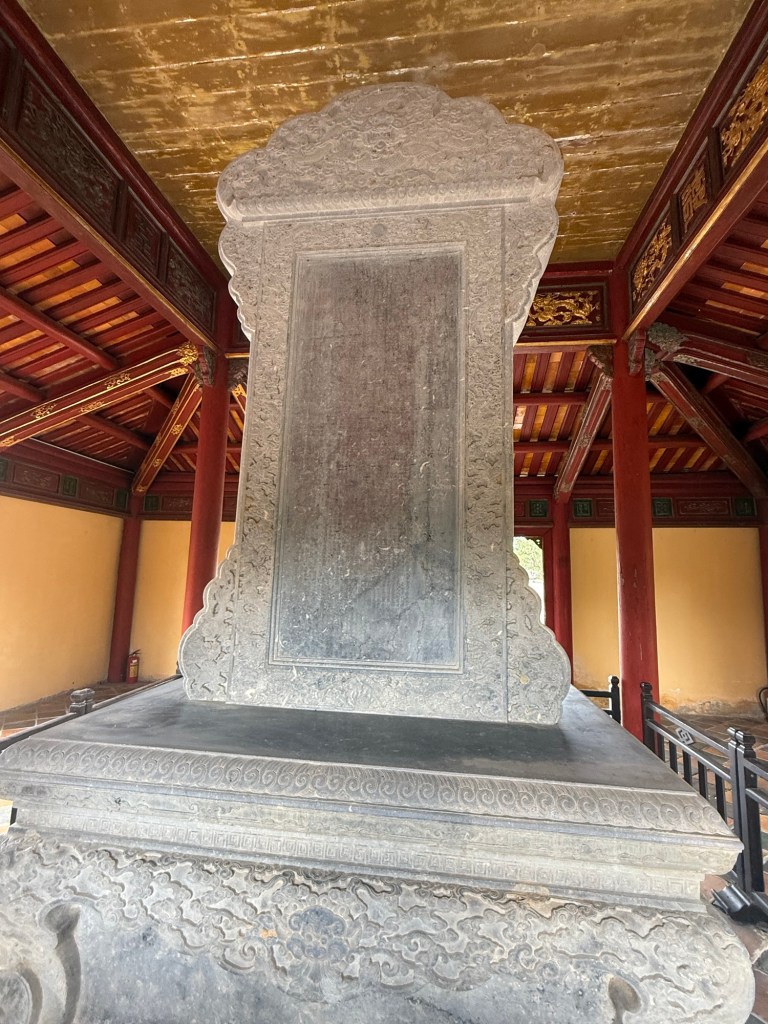
Minh Mangh Gate (sealed)Corner detailSele (commemorative stone)The Coveted Ao Dai Dress
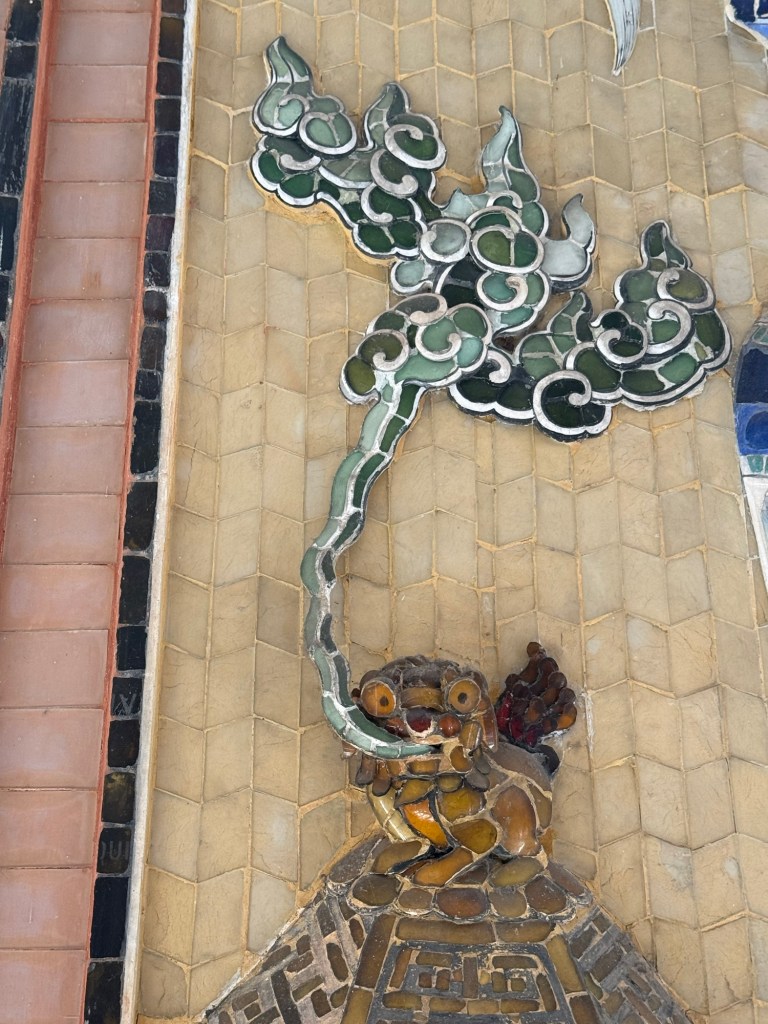
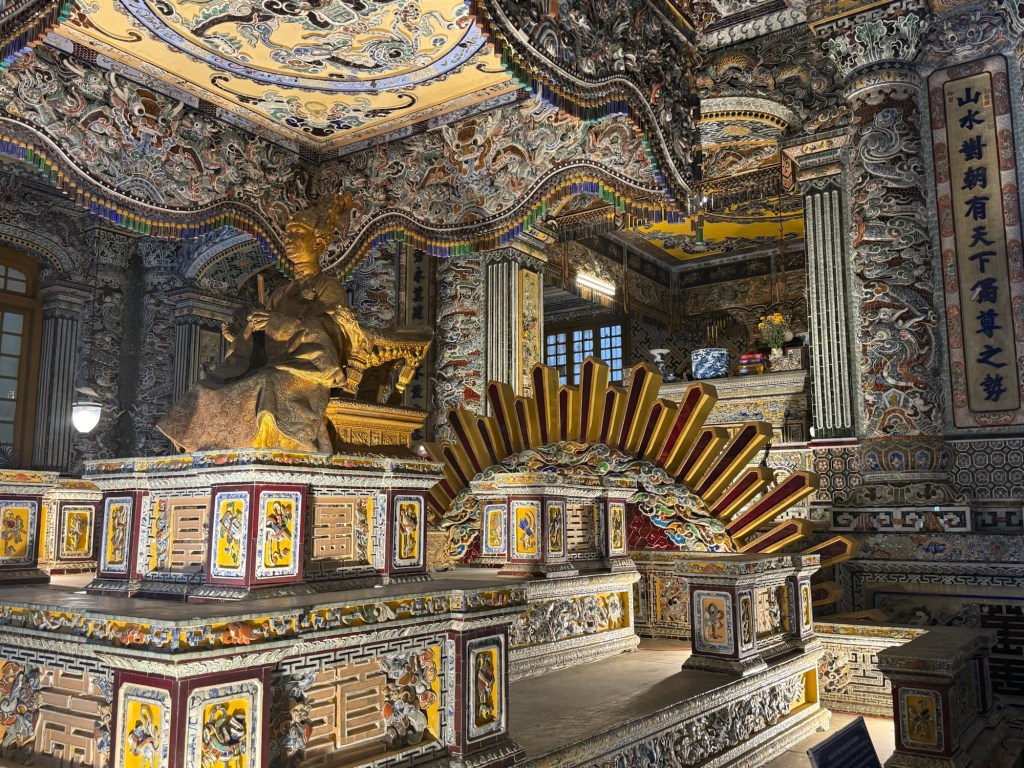
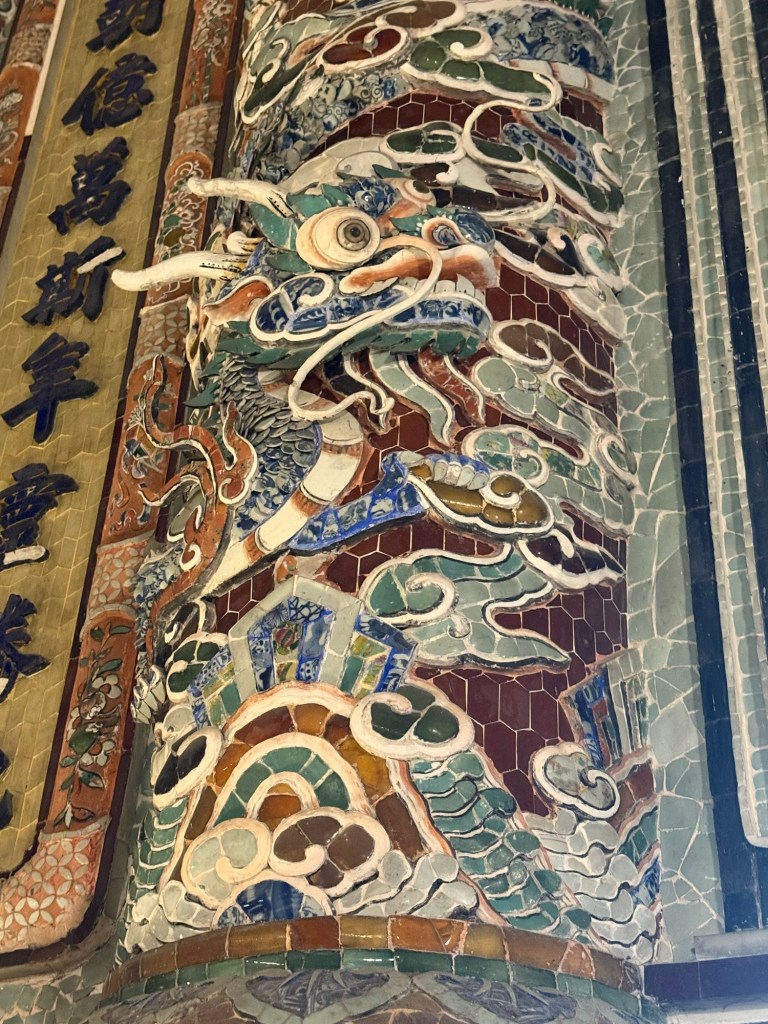
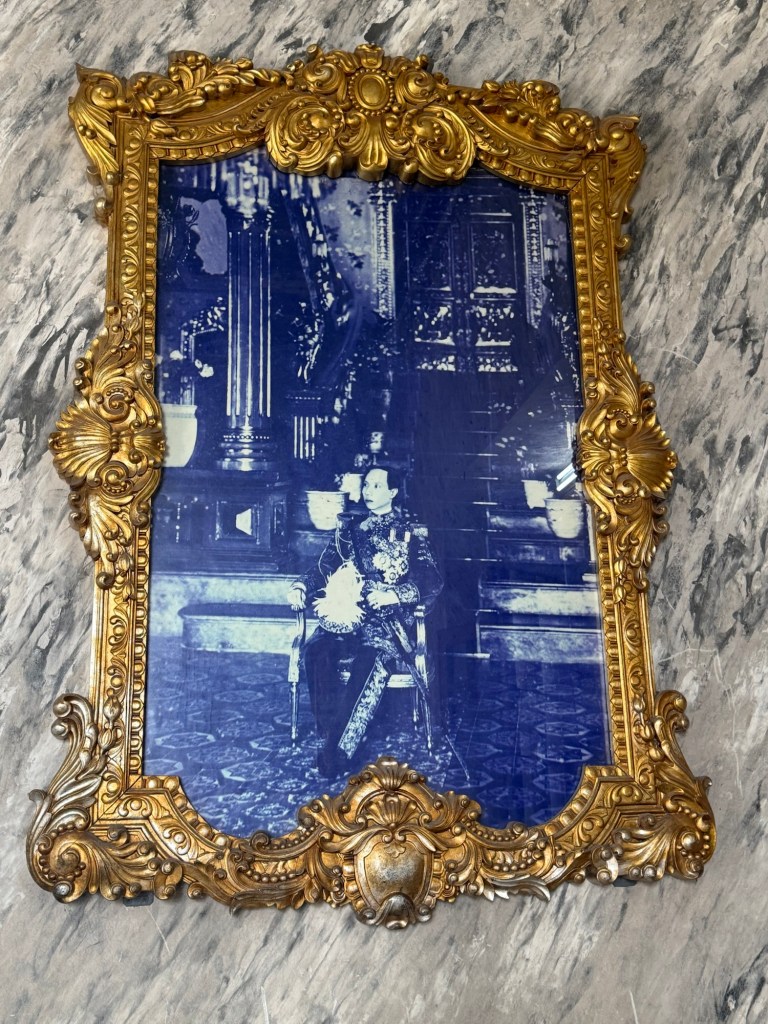
Jumping to the other end of the Dynasty we visited the Tomb of Kahl Dinh, the 12th and second to last Nguyen Emperor. Dinh was completely owned by the French. But he lived in royal splendor with all the trappings and wealth. His tomb, dating to 1925 was composed of beautiful, colorful ceramic mosaics. French influences were seen in the art, and in his ceremonial uniforms.
Kahl Din DetailThe Emperor as the SunMore DetailKahl Din (1885-1925)
Great local lunch and more awesome coffee was arranged by Tien. Tien refers to American coffee as “Starsucks”. Some of the local flavors (sour river fish soup?) were a bit tough but the egg and salt coffee were sublime.
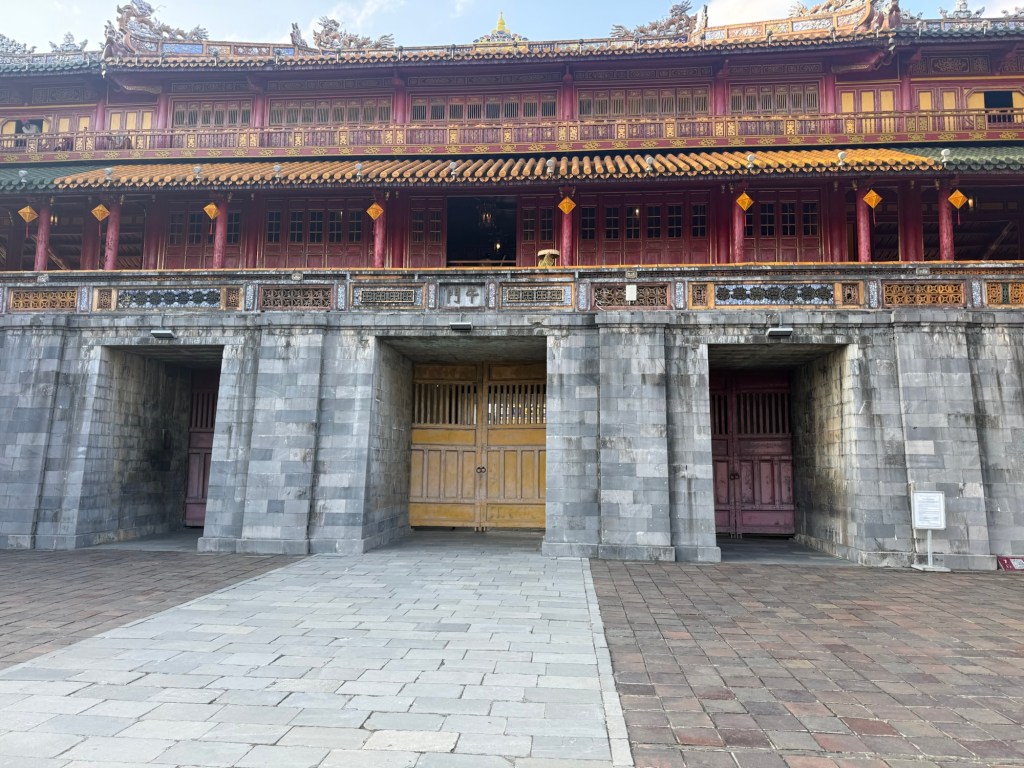
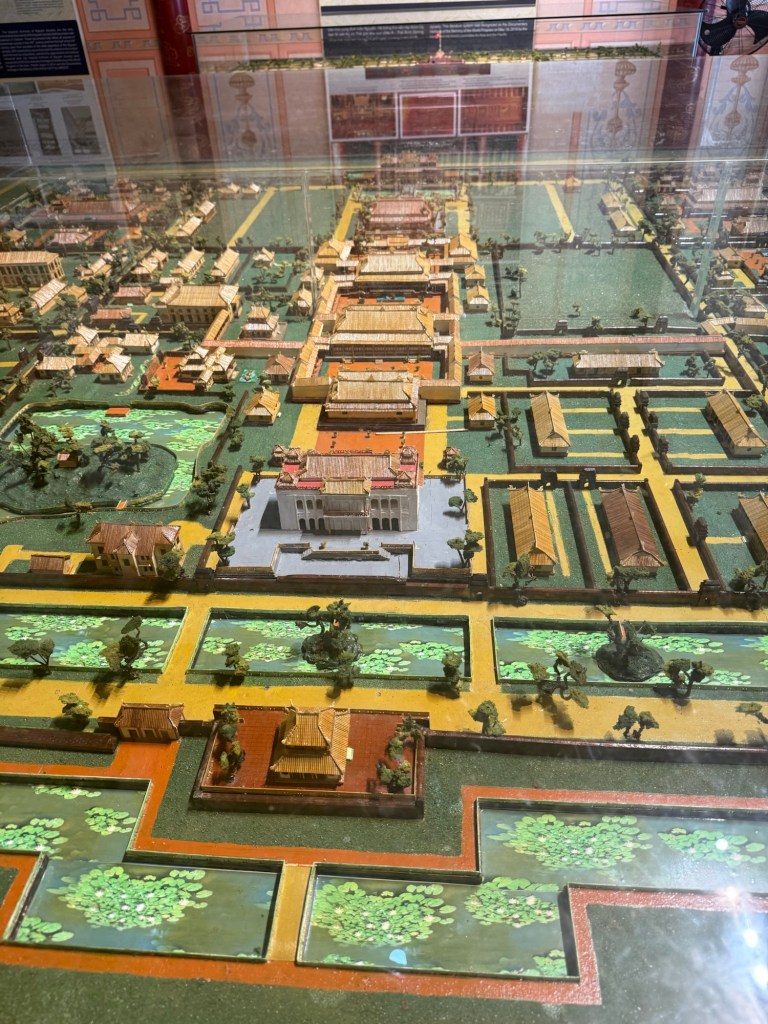
Our next stop was the Imperial City – really three cities the Citadel City for citizens, the Imperial City for the military and the Mandarins, and the Purple Forbidden City for the Emperor himself.
The Forbidden City was a huge 100 acre complex consisting of a barrier wall, a series of gates and a series of governmental management offices and temporary residences for the governing Mandarins. The complex contained the Emperors palace, library, treasury, temple, and gardens as well as palatial residences for his mother, mother in law and primary wives. More basic dormitories were on site for his hundreds of concubines.
Forbidden City GatesCity MapEmperors PagodaCorner DetailImperial Palace
The center of the complex, including a series of three lesser palaces, had been destroyed by French bombs during a conflict with Emperor #8. They were in the early phases of reconstruction with UNESCO support.
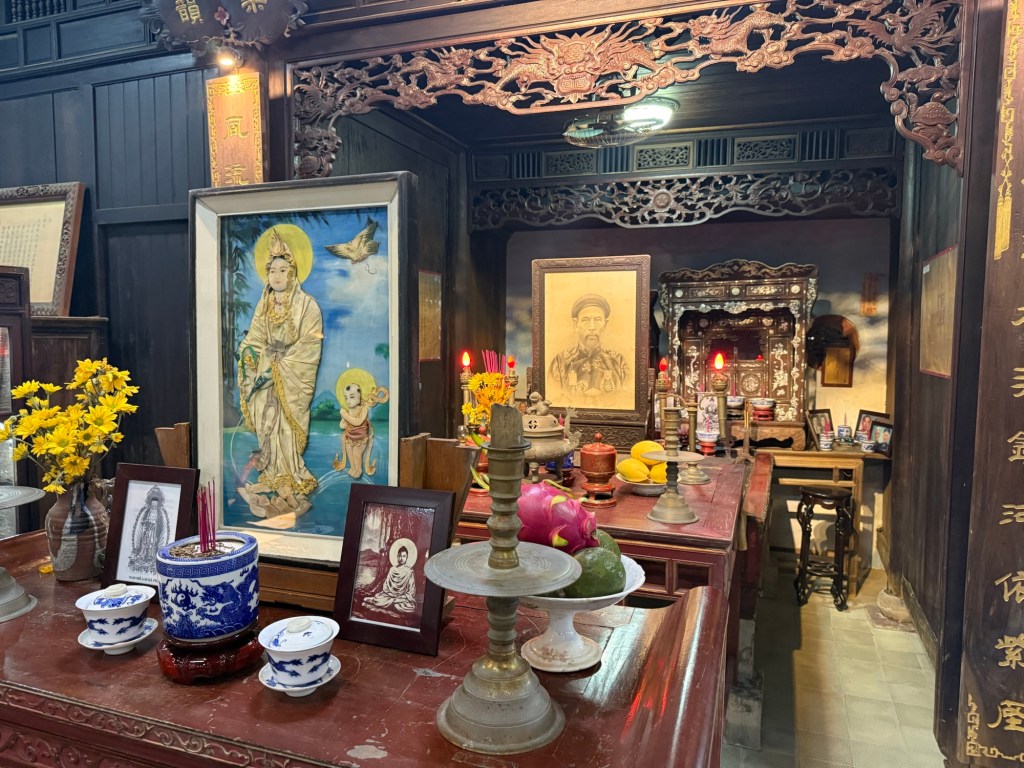
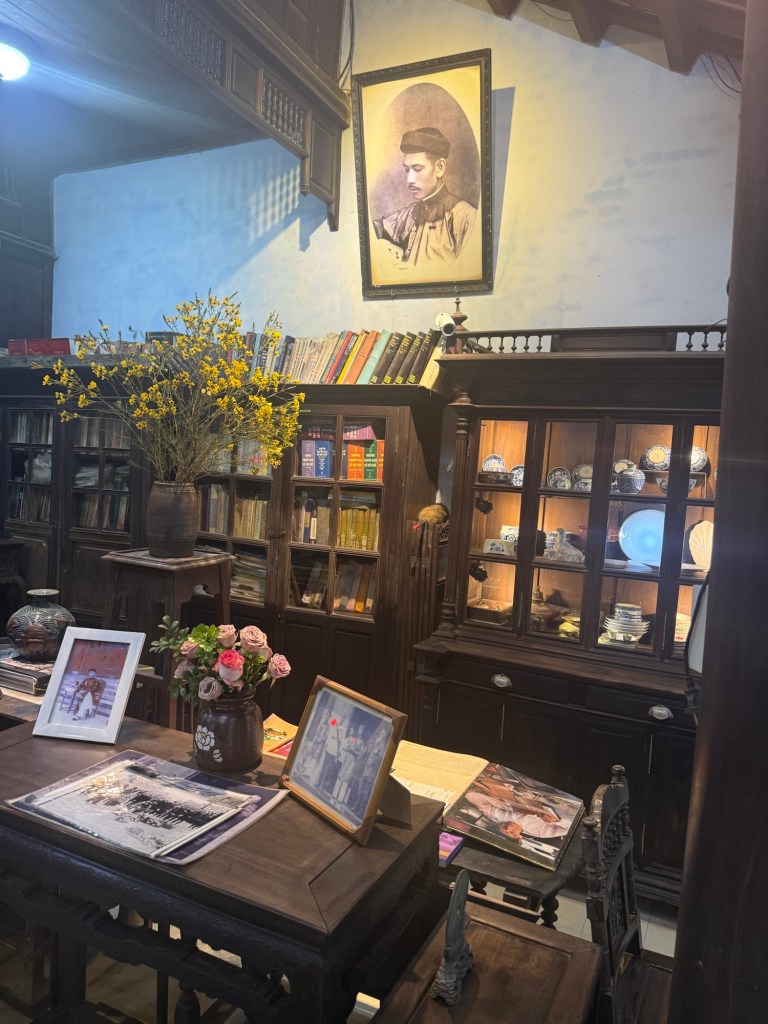
The last stop for the day was a private dinner at the Temple of Princess Ngoc Sun Ho – actually not a Temple but one one of the private residences of a ruling Mandarin.
Family ShrineThe Mandarin’s Study
Our host Huong (perfume) carried us through the story of her 6th grandfather (a Principle of War under Emperor 12), and her 5th grandfather (a Mandarin under the last Emperor). This emperor, Bao Dai, was a bisexual French pawn who was eventually banished to Paris and died in 1997.
The Mandarin lost his first wife, a royal princess and built his home in honor of her. His second wife, with whom he had 14 children, was buried on the premises. The home was filled with photographs and historical family artifacts as well as a shrine to various ancestors.
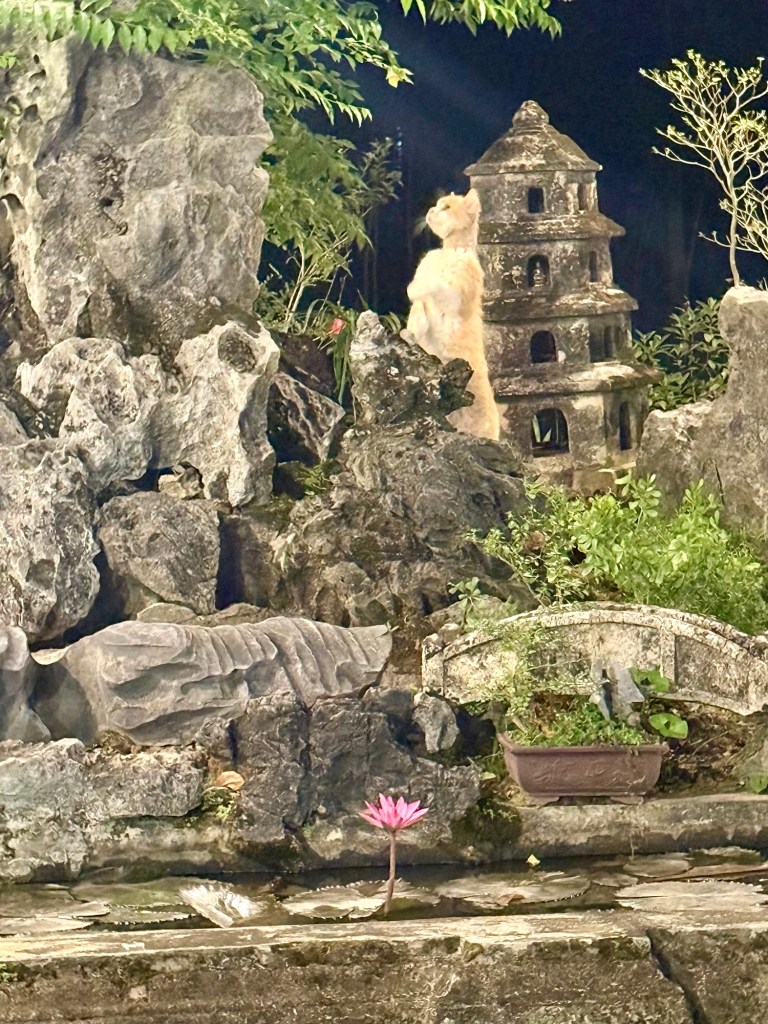
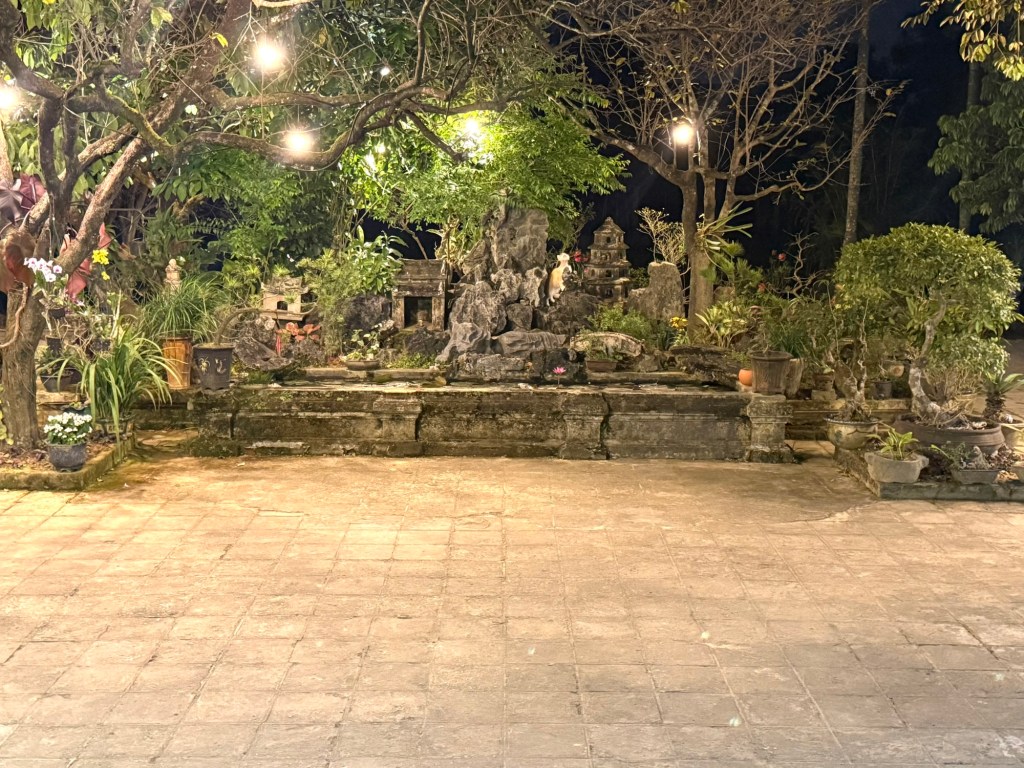
The gardens surrounding the home were incredible and Ms. Huong educated us on the feng shui principles involved in the layout of water features, seasonal gardening and stone features.
Lotus & CatFeng Shui Garden
We discussed a variety of historic stories and language lessons over a traditional Mandarin dinner.
But the most interesting parts were insights into Huong’s life as a recent college graduate, fiancé, and typical 22 year old Viet trying to find her place in a changing culture.
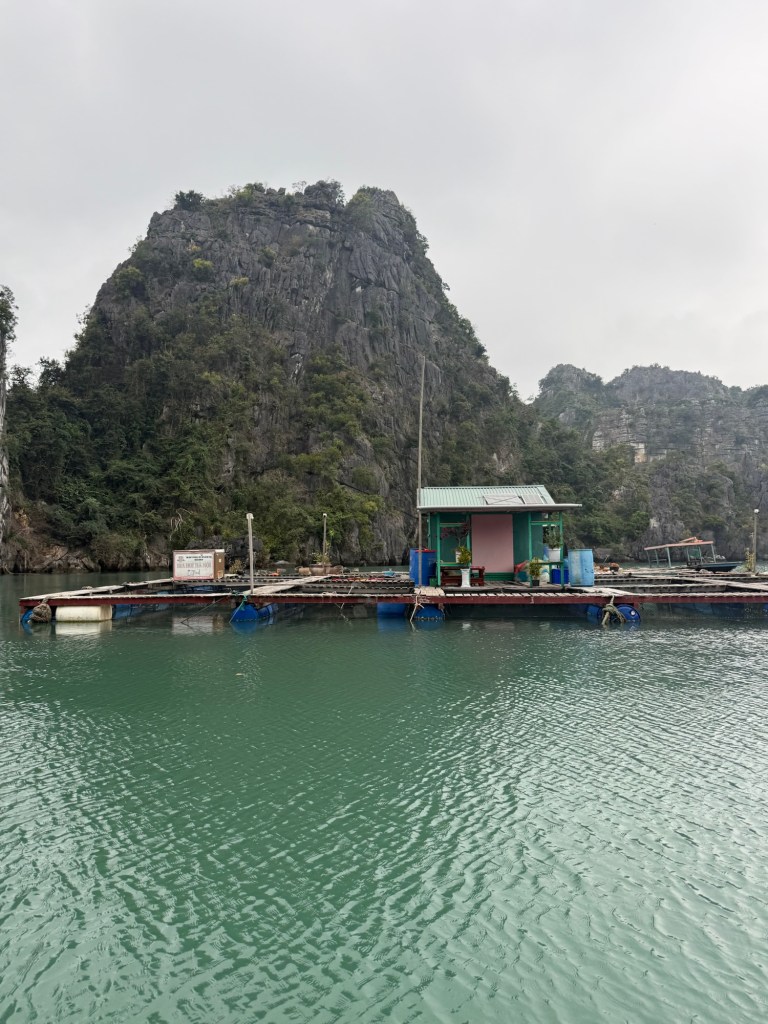
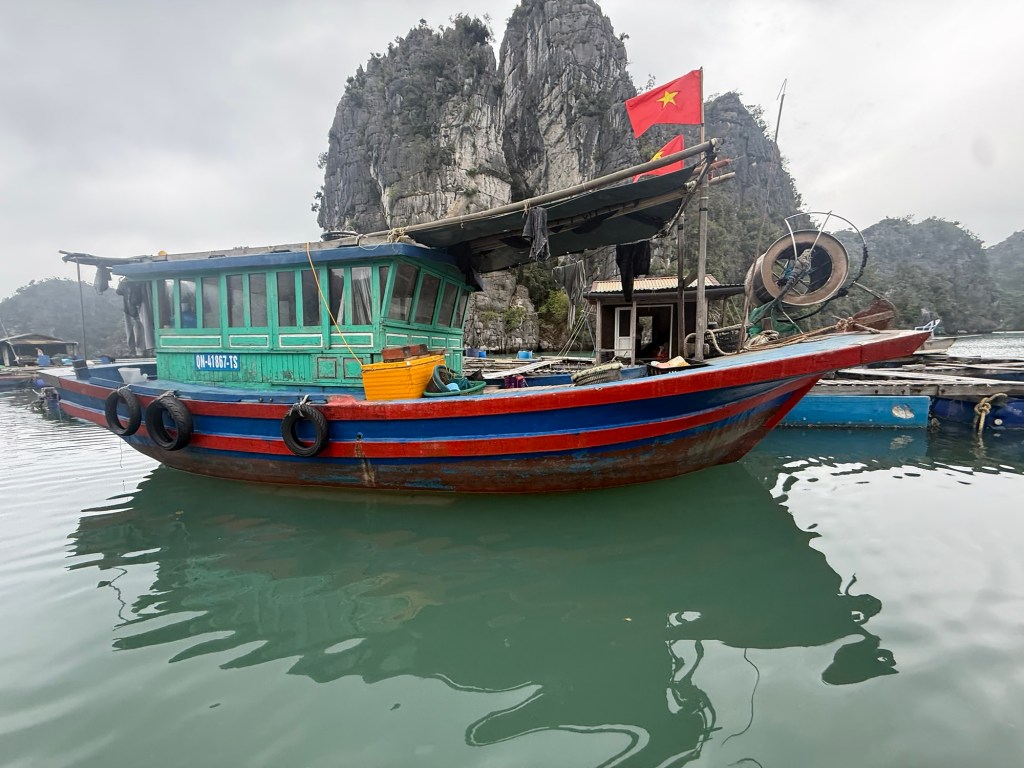
Short trip this morning at 6am to Vung Vieng, a floating fishing village of about 50 families. The families live in small huts on rafts, or aboard their boats. Some are connected, some separate.
Floating Home A Live-aboard
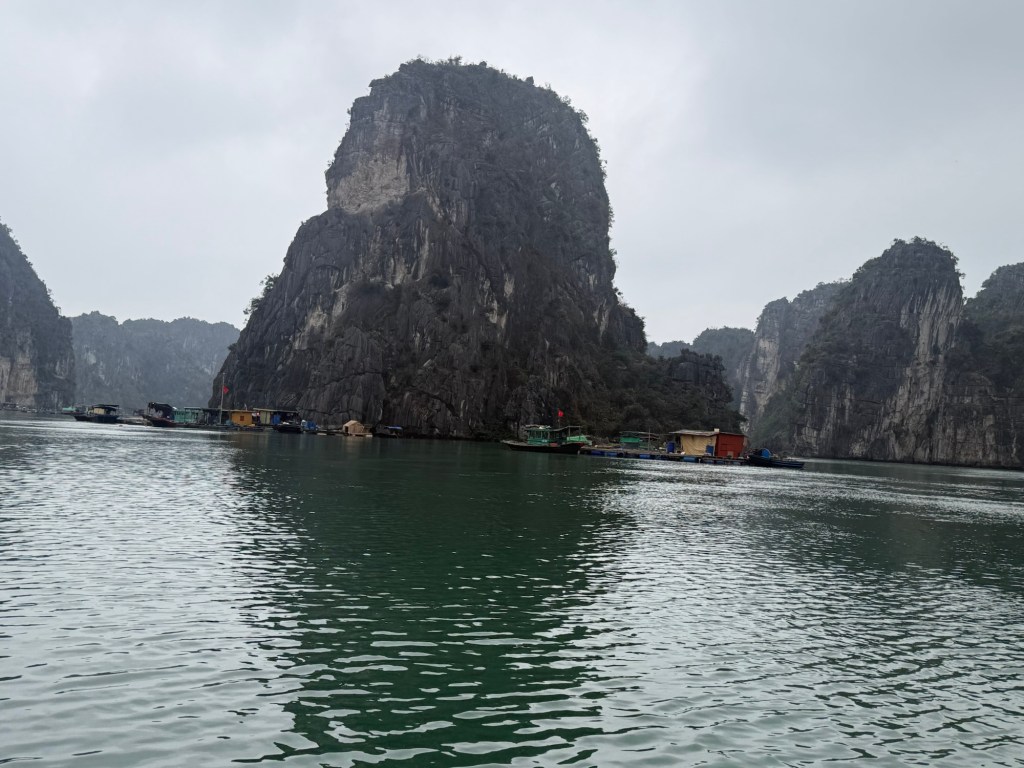
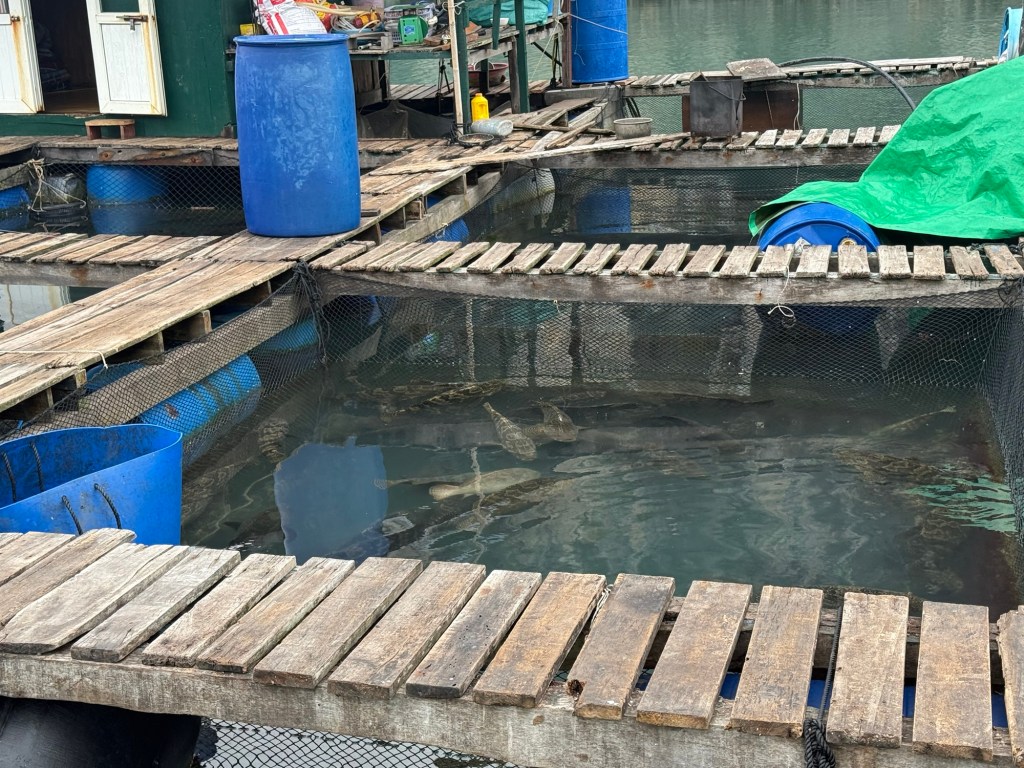
The community formed centuries ago in an area of closely clustered karsts that provide “Vung Vieng” or quiet and shelter from wind (and the occasional typhoon). The theory is that this temporary shelter evolved to permanence as the people started farming oysters, grouper, etc.
Gate to Vung VienGrouper pens
The village has had many changes since 2014 when it numbered 100 families and USAID and other global charitable organizations engaged. They were seeking to address both severe poverty, health issues and poor education. This, while also maintaining the history and traditions of Halong Bay fisherfolk.
Today, Vietnam pays for the children to be schooled and housed on the mainland from Monday to Friday. A tourist business, primarily boat tours and the sale of pearls has been established.
Leo told us that his tour company “IndoChine Junk” contributes significant fresh water from their onboard systems to the fisherfolk – one of the most expensive aspects of living on the ocean 3 hours from the city.
We were rowed into the village from a staging area outside the grotto – the only way in, which helps to limit some tourist volume. It was quiet and relatively empty as the children were away and many of the adults were out fishing.
Powered by “Ms. Guave”
Inside the grotto
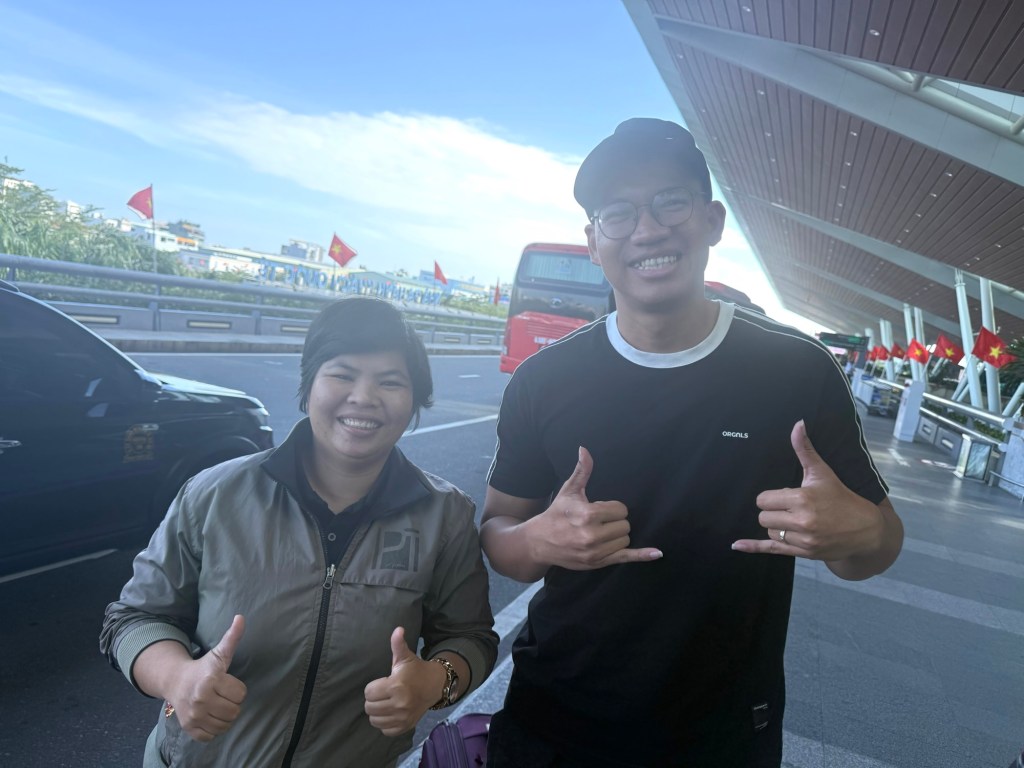
We were on the boat, packed up, back on the dock, and off to Hanoi airport by 10am. Somehow they managed to feed us twice before we left. Good to see Q and Angh again for a bit! Good bye friend 🥲
G’bye Q
Not a lot today, so JuJu and I went back through our notes and grabbed some random anthropological notes that didn’t make the blog.
1.) in Vietnam a first introduction always starts with age. This allows due deference and also an understanding of what parts of their history impacts their language, perspectives, etc
2.) The Vietnamese daughter in law is responsible to produce pillows (1,5,20) for guests to sit on. The quality and craftsmanship is a huge social metric.
3.) Hanoi is 38% Buddhist, 50% atheist (though some of this is communist social positioning), ~1% Christian and ~1% Muslim. Outside the main population centers there are a huge number of hybrids or tribe and regional traditions – many Animist, Tao, nature-spirit or ancestor based.
4.) A “siesta” culture is very much evident. People stop for an hour or two early afternoon for a nap (or in the cities, a coffee).
5.) Shoes OFF even in a peasants home. Naked toes, and bare shoulders are low class. Shorts and logo t-shirts are not stylish.
6.) It’s the little things. But when we fly Juju loves being called “Dear Passenger”
We arrived Hue at 6:45 and met our guide Tien (sound goes up at end), and our driver Hien (sounds goes down at end). He’s energetic, young, solid English, and a Danang/Hue local. Checked in at the beautiful La Residence.
Quick bite and chat at the bar with a Scottish couple. They’re in NATO so we pretended to be Canadian for a bit. We eventually confessed and WTF’d our idiot in chief for a bit.
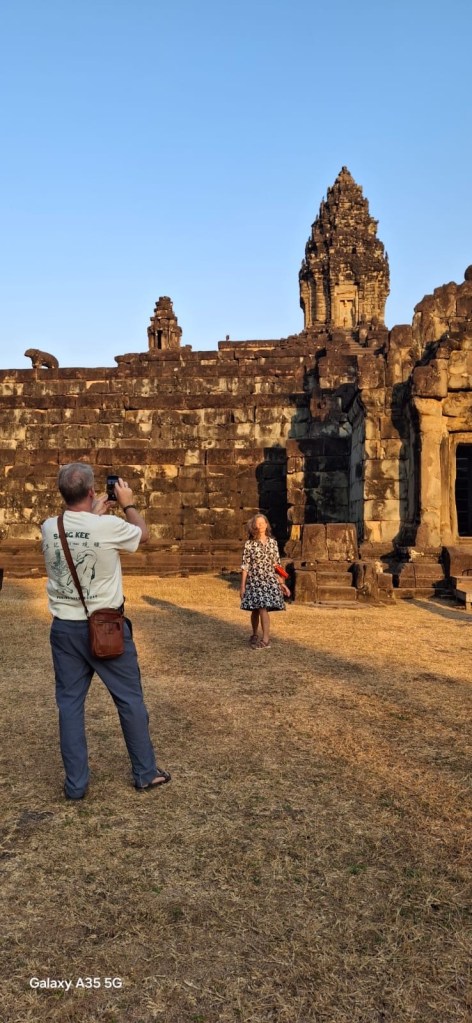
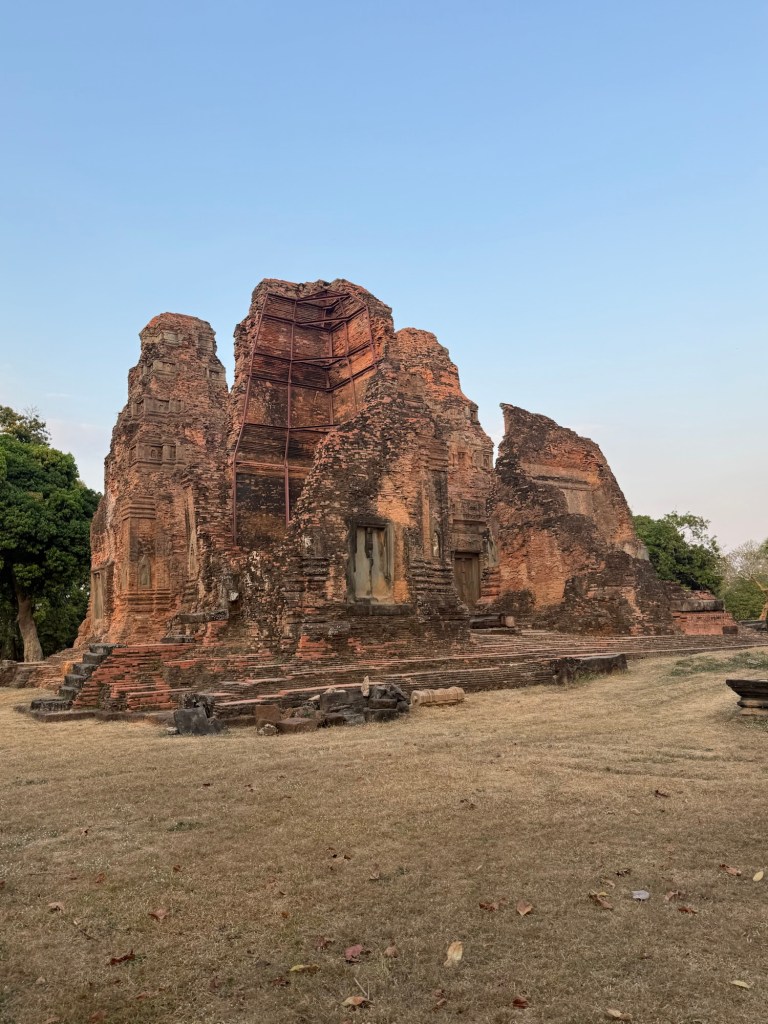
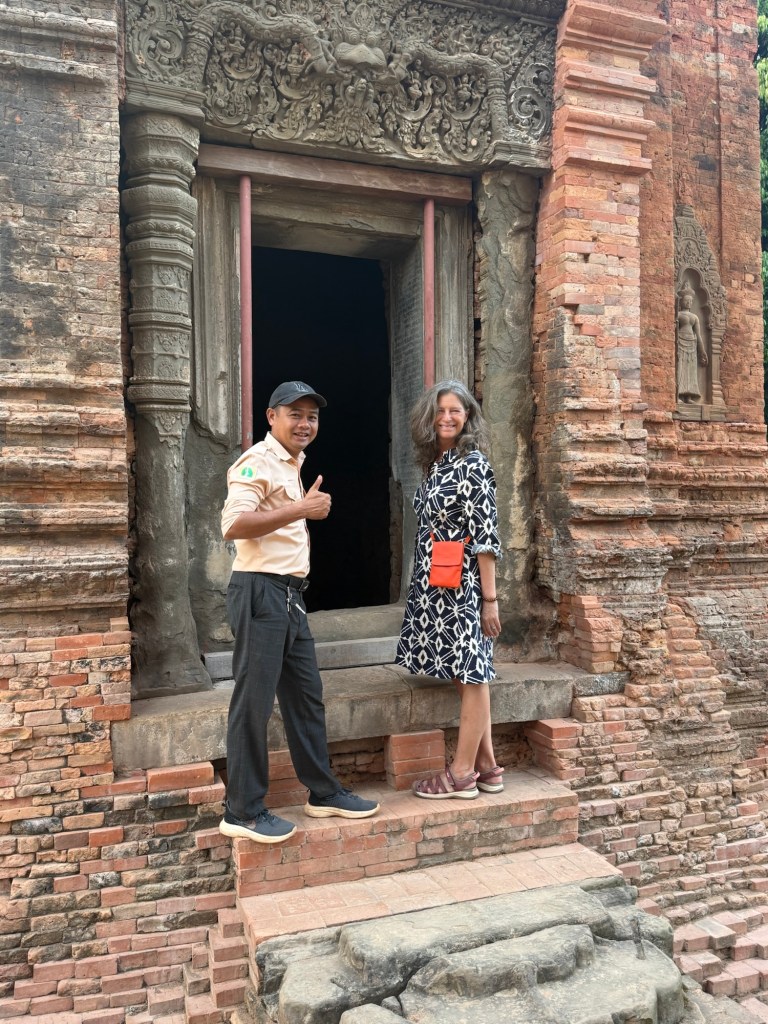
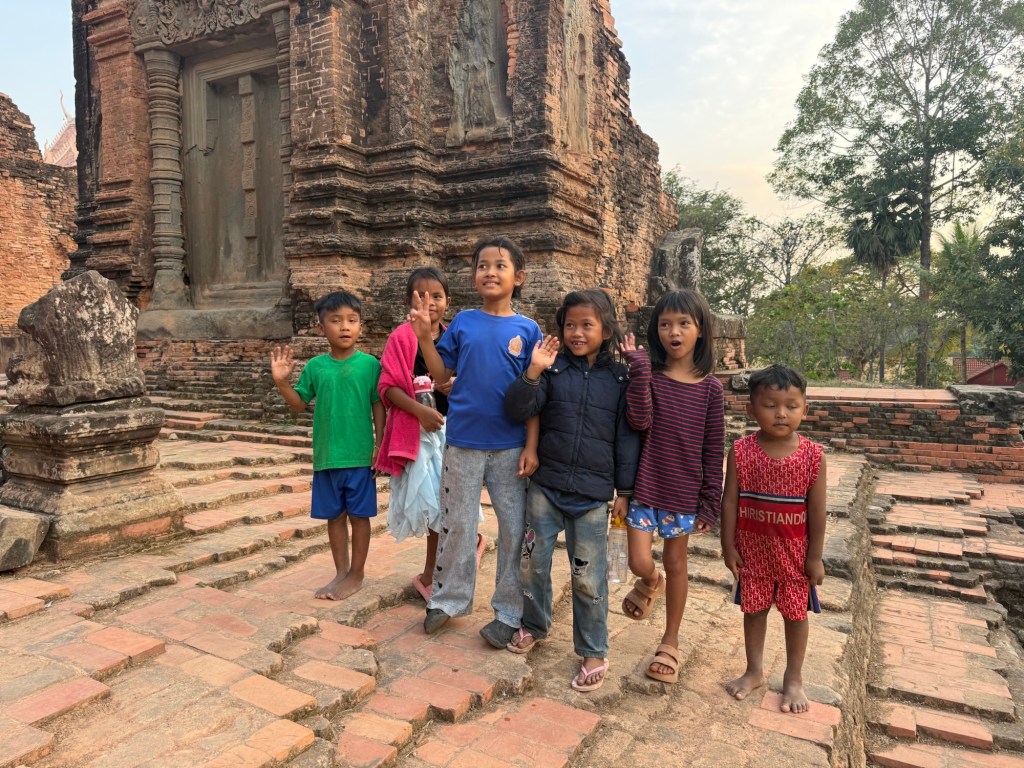
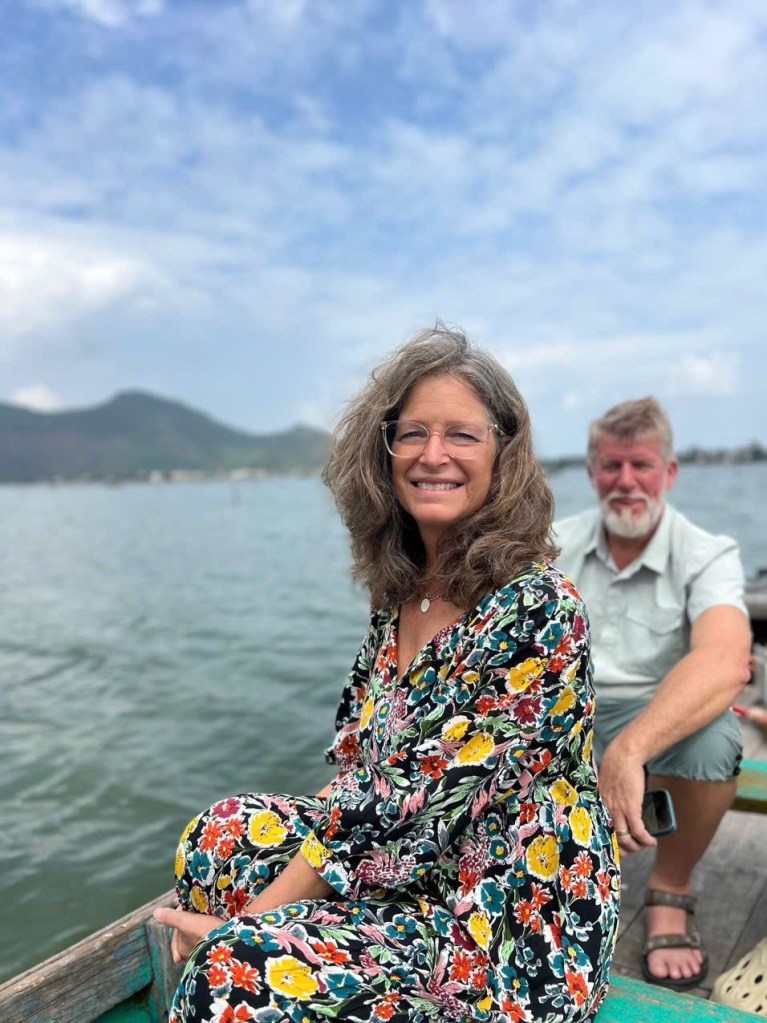
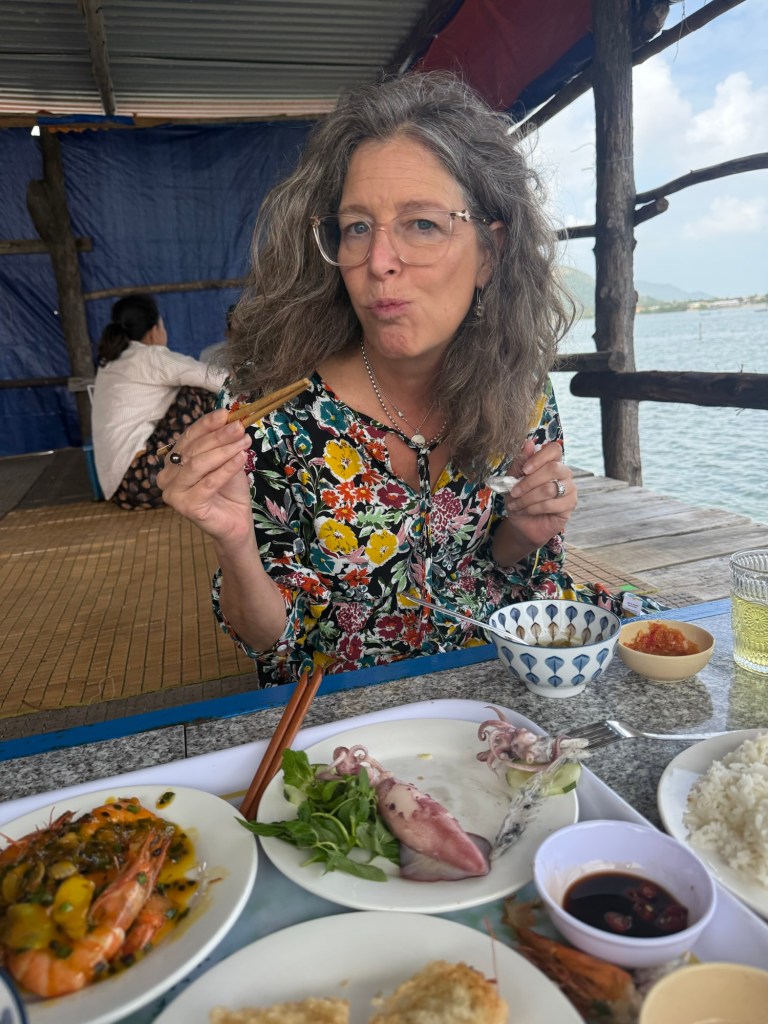

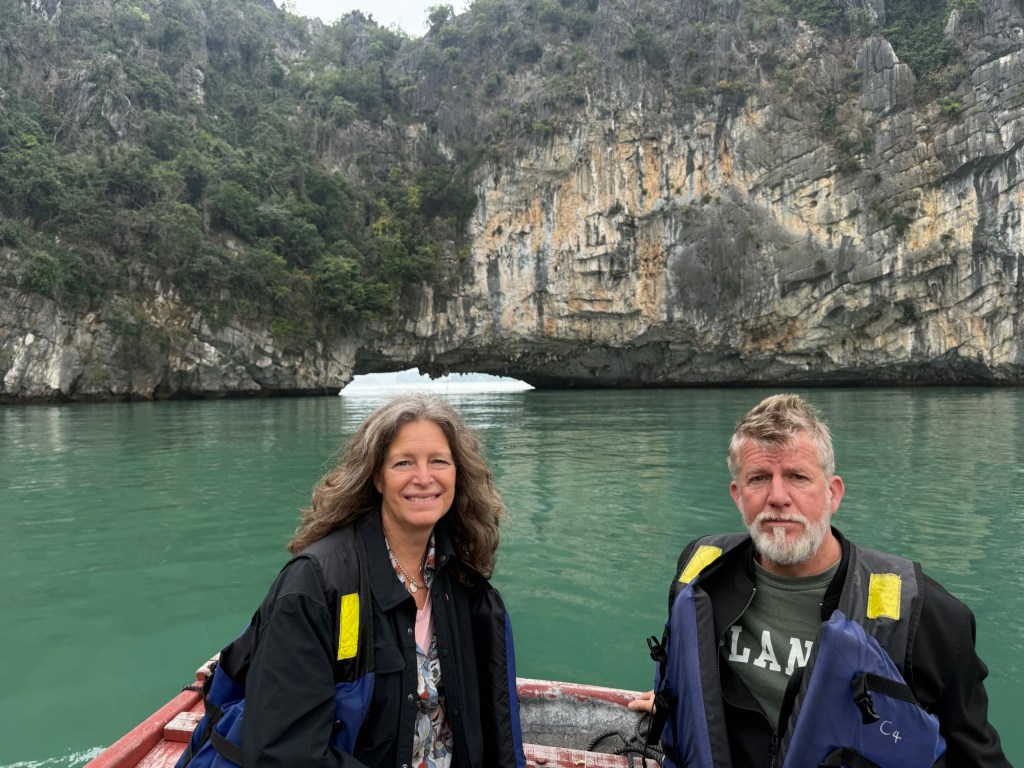
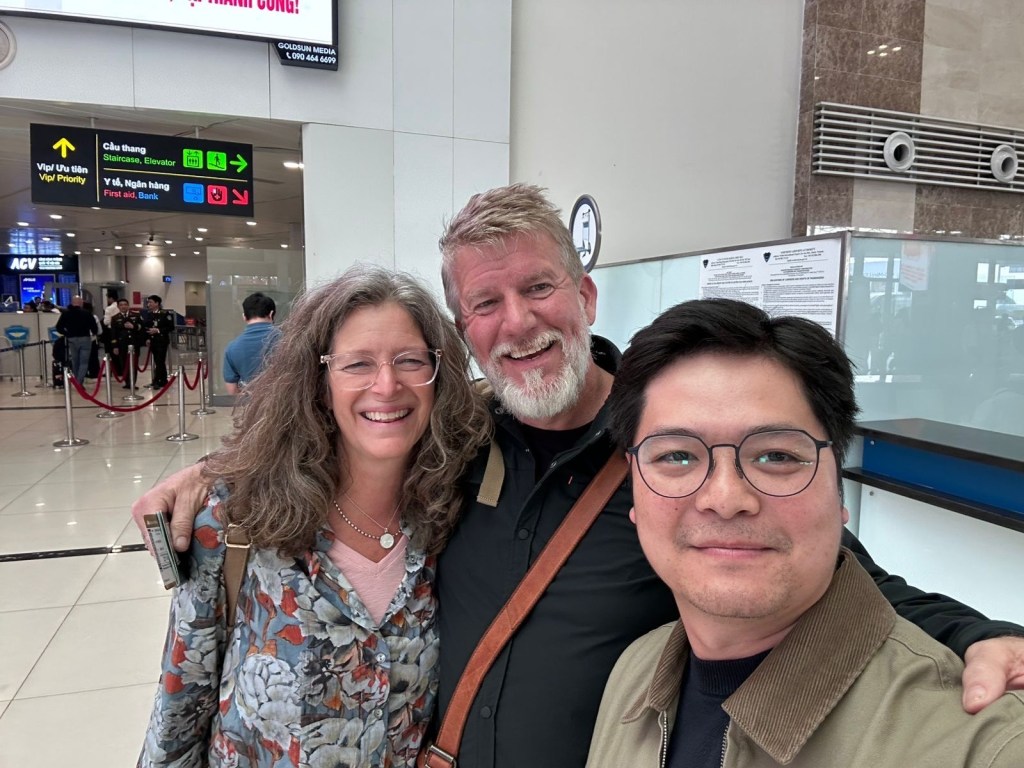
 Mac and Juju explore Southeast Asia