We heard as we left the US (and we were very concerned) that there were border skirmishes between Thailand and Cambodia. Then in Cambodia, we learned that the clashes were over control of 3 UNESCO temples.
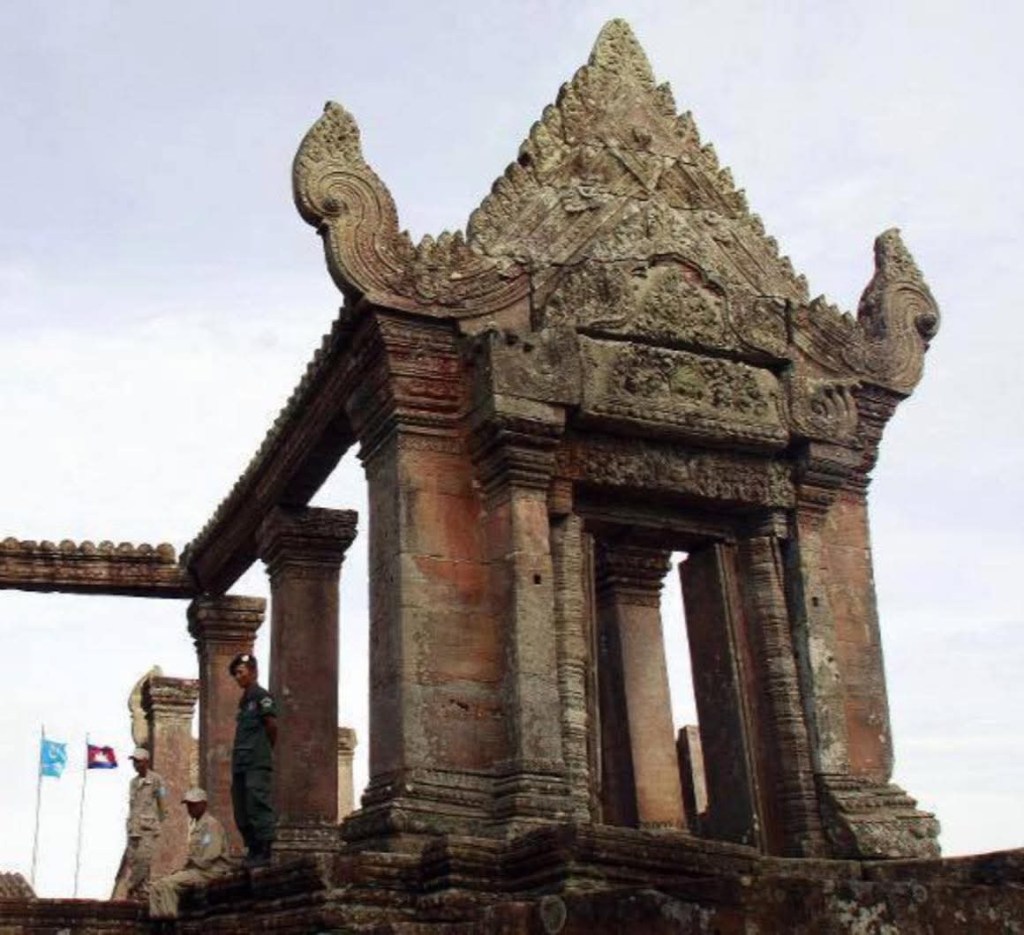
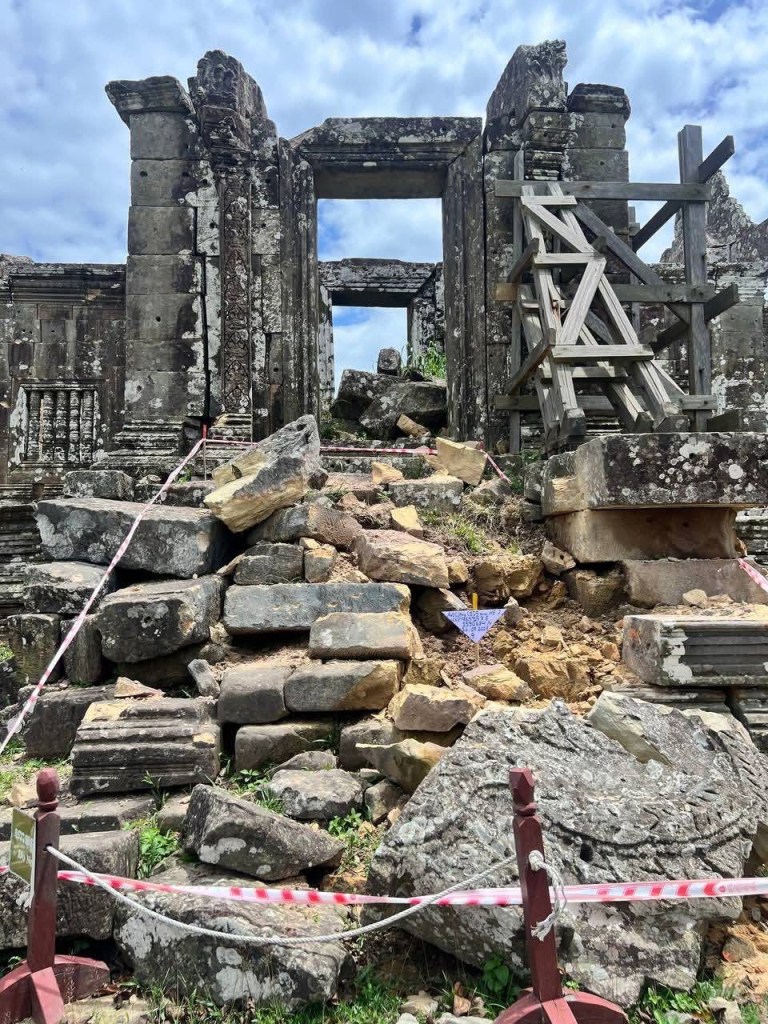
As we arrived, Thai F-16’s did this to a 9th century temple last week.
Pre-bombingPost
The depression in Cambodia is universal – one guide described it with tears in her eyes, like a loss of family. Destruction of Ancient Temples over religion, politics and ignorance (and in this case access to an oil port) continues in January of 2026.
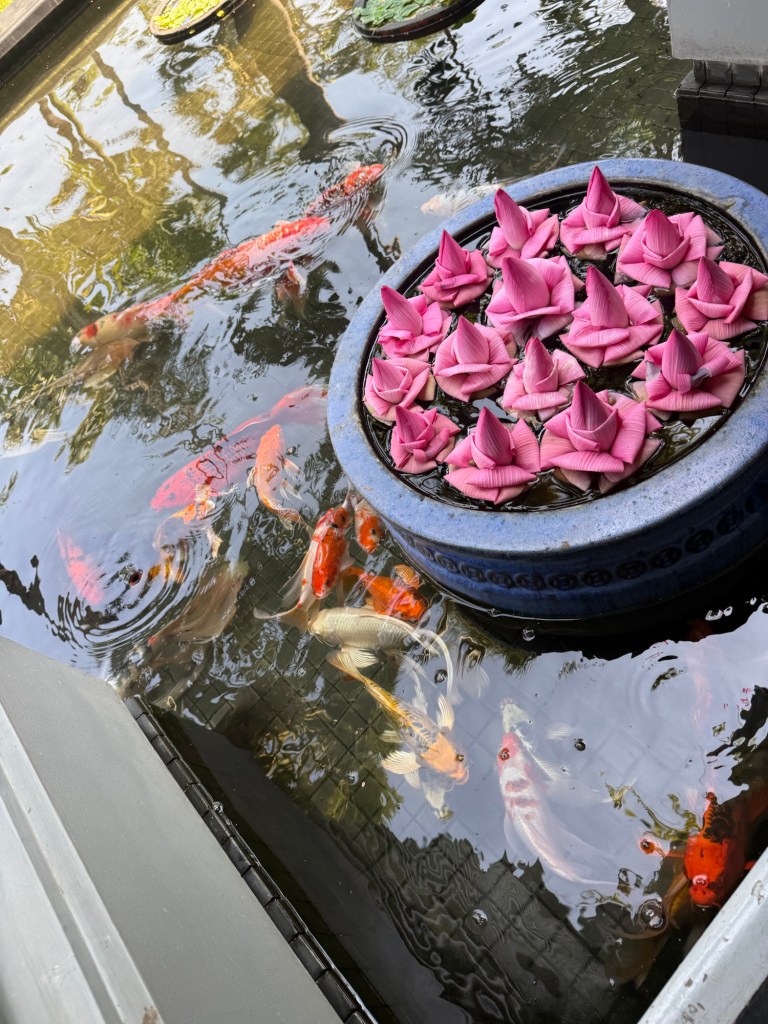
A depressing way to close out our Siem Reap narrative and I’m sorry. Here’s some Cambodian beauty as a reset.
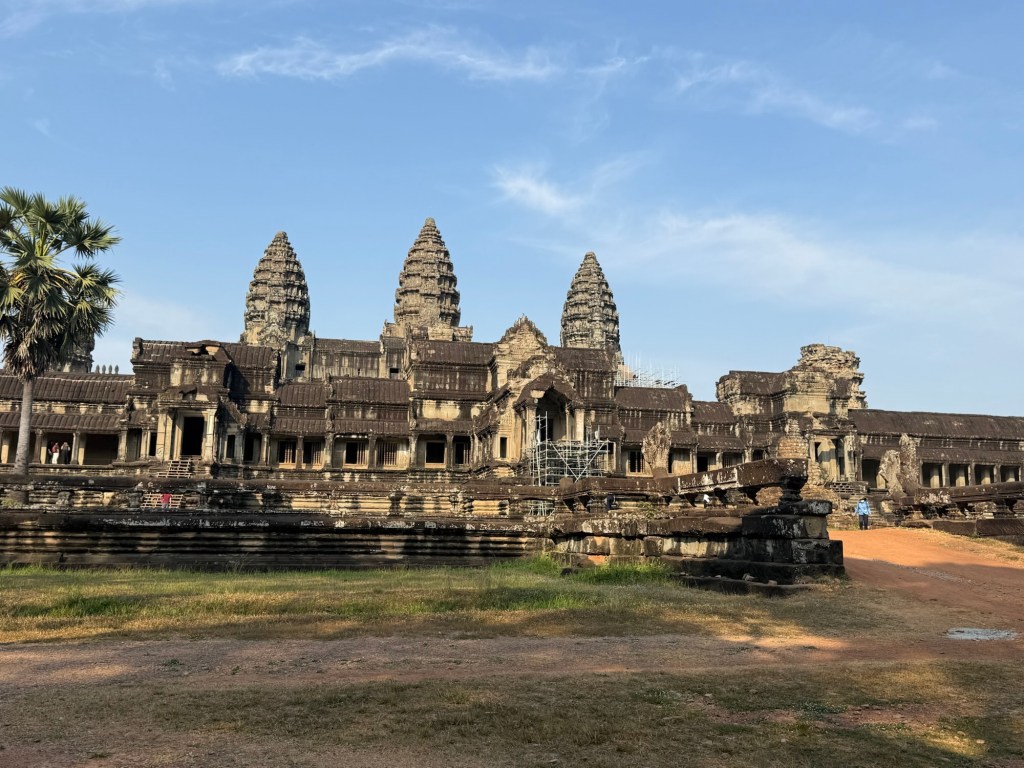
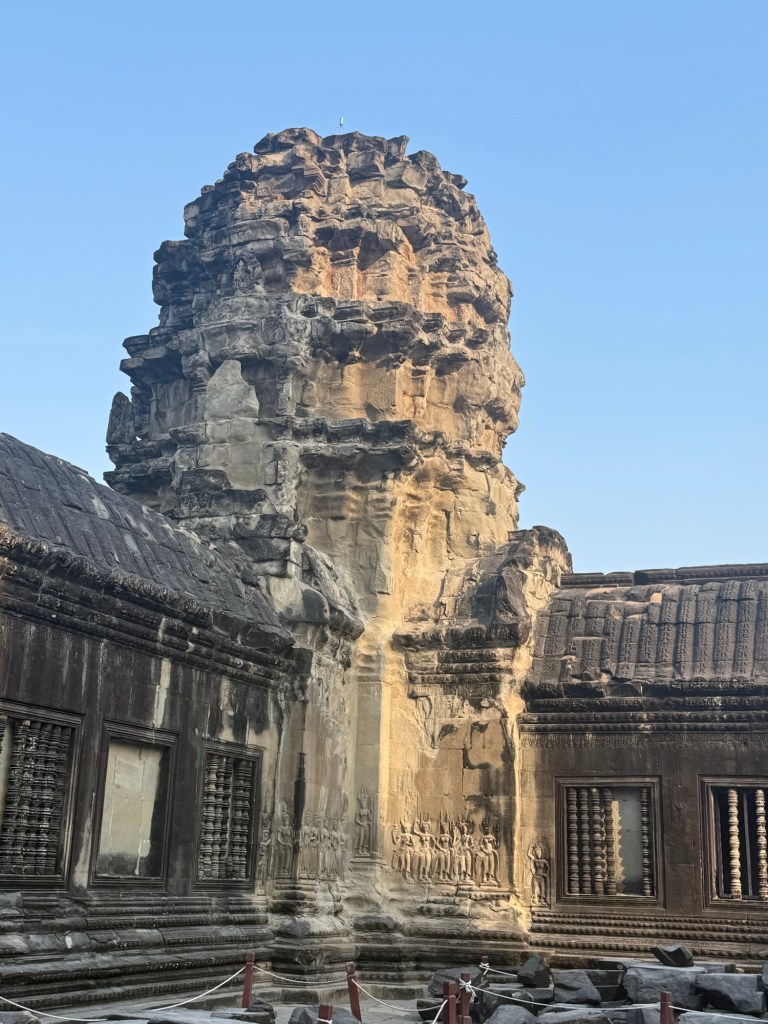
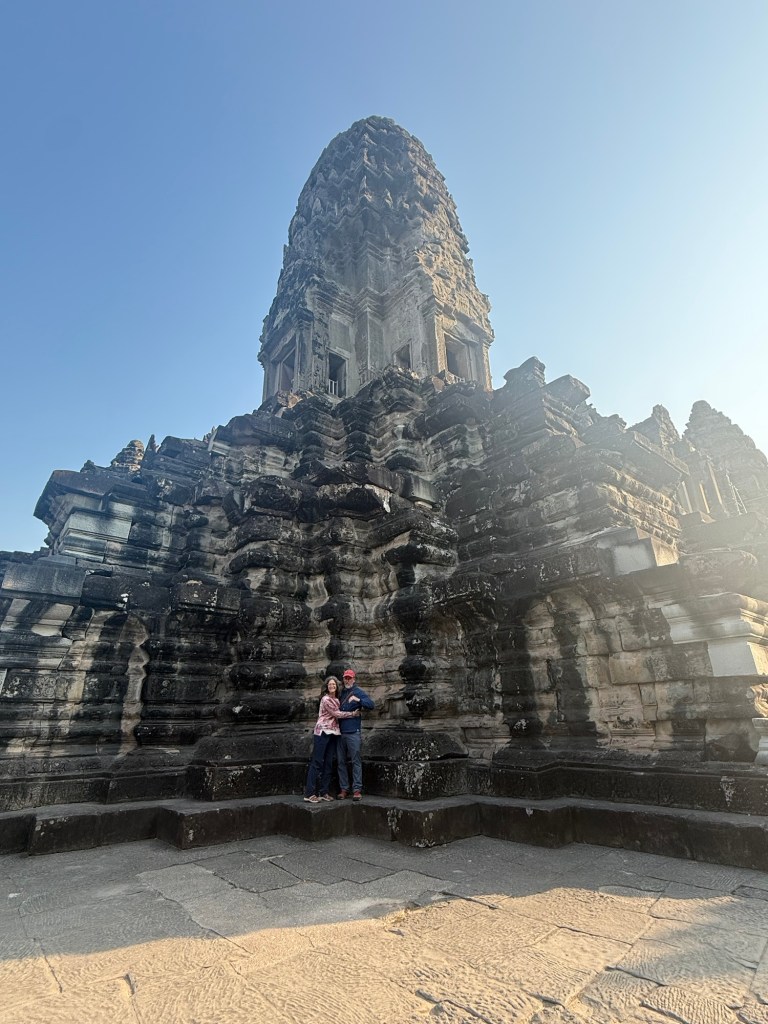
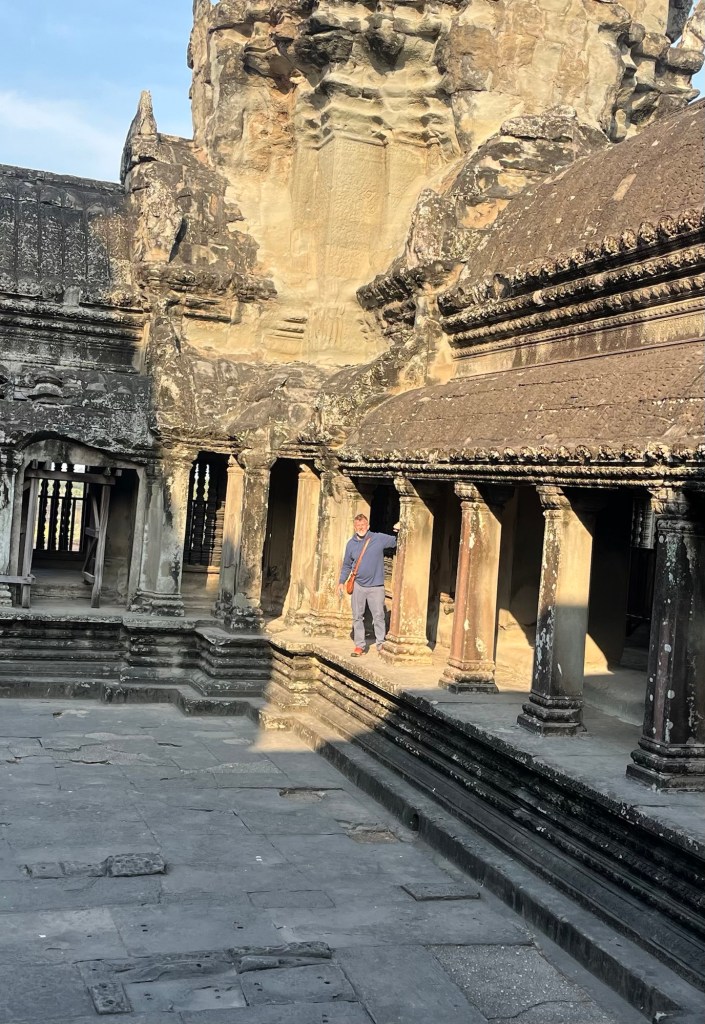
Thursday AM, and JuJu’s birthday. We travelled to Angkor Wat, the tallest and most famous Cambodian temple.
Angkor Wat
The original name is Parama Vishnu Loka (Universe of Vishnu) and like many temples this one shifted emphasis between Hindu and Buddhist over the centuries.
It was constructed by Suryavarma II of 10 million stones transported by elephants from 50 km away in 15 ton cubes. 6,000 elephants and 30,000 workers were engaged from 1113 to 1150 C.E..
Interior Tower
Angkor Wat is one of the 7 Wonders of the World. It is the largest religious building on earth (approximately one square mile). It is both Temple and Stupa (royal grave) and is 55 meters tall.
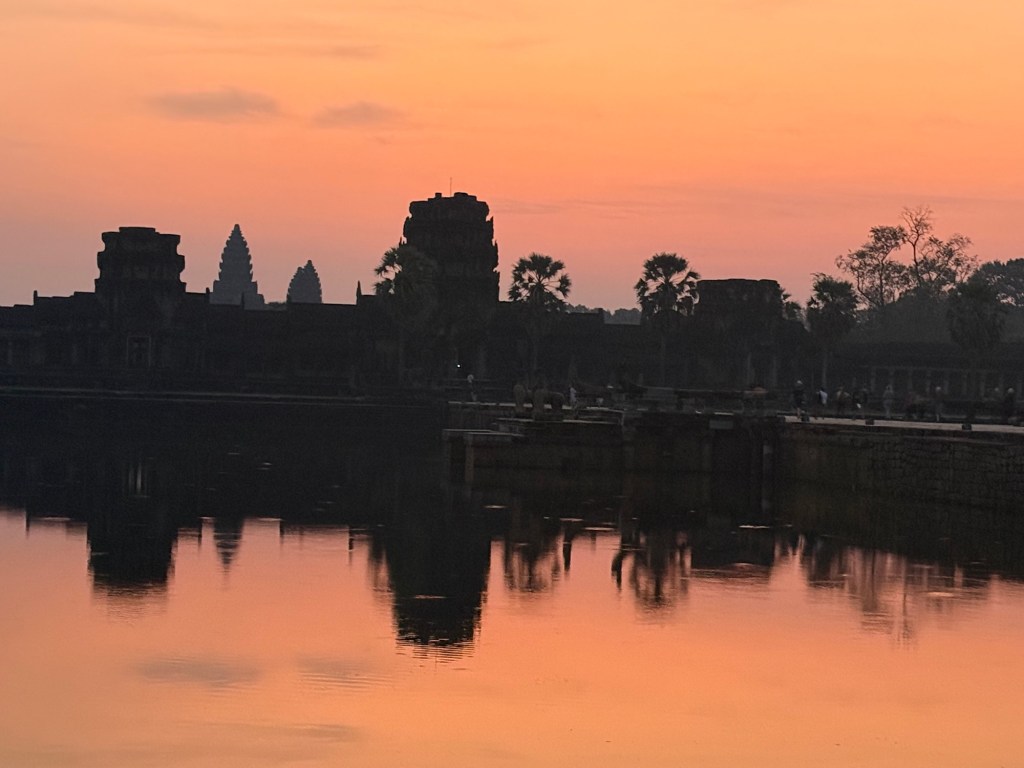
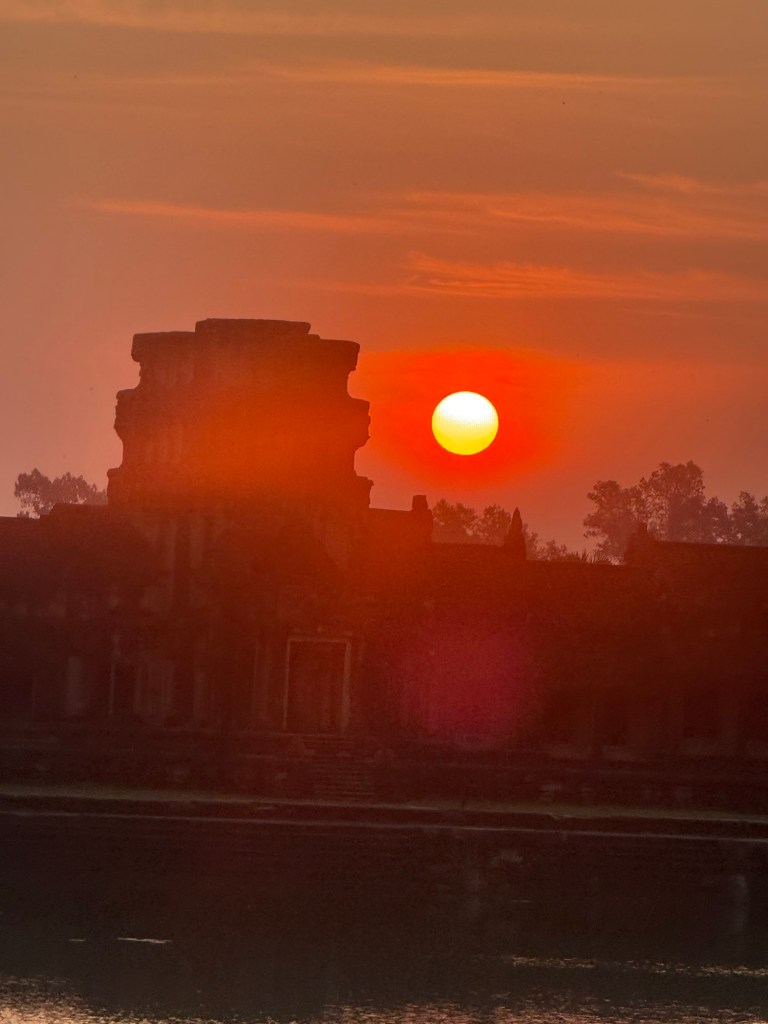
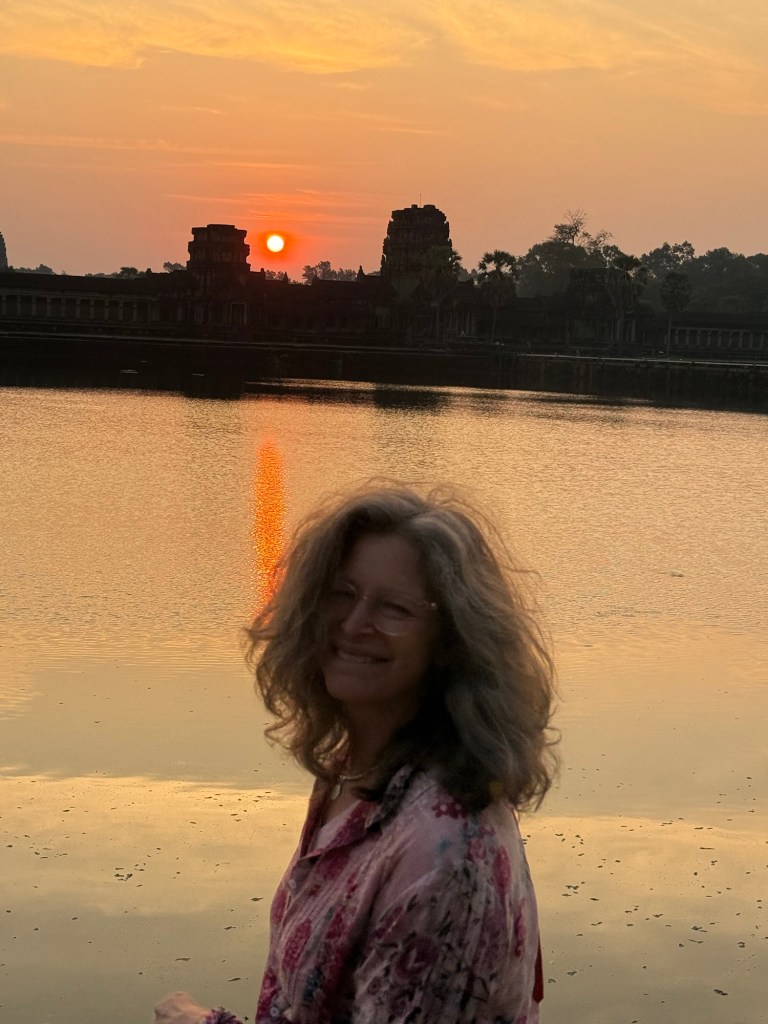
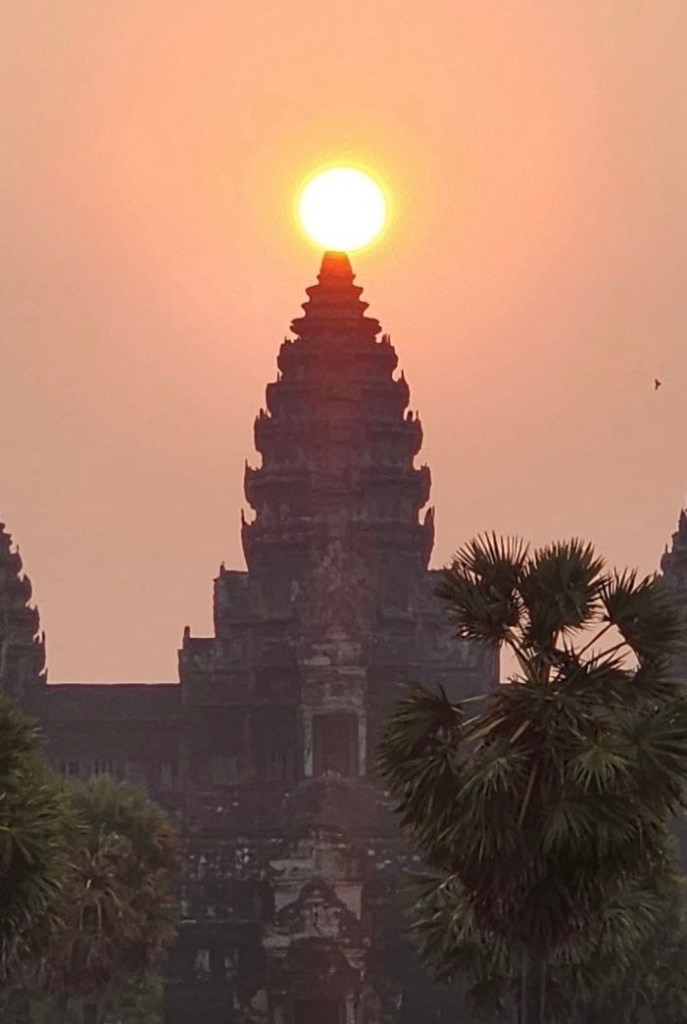
We sat at an exterior moat and watched the sun rise over the temple. At the spring equinox this occurs perfectly at the top peak of the central tower.
Angkor Wat at DawnSunrise at Anchor WatBirthday GirlAngkor Wat, Spring Equinox
We entered over the huge moat, across a rainbow bridge, between two massive Naga, and through the first series of gates. The only word you can think of is MASSIVE.
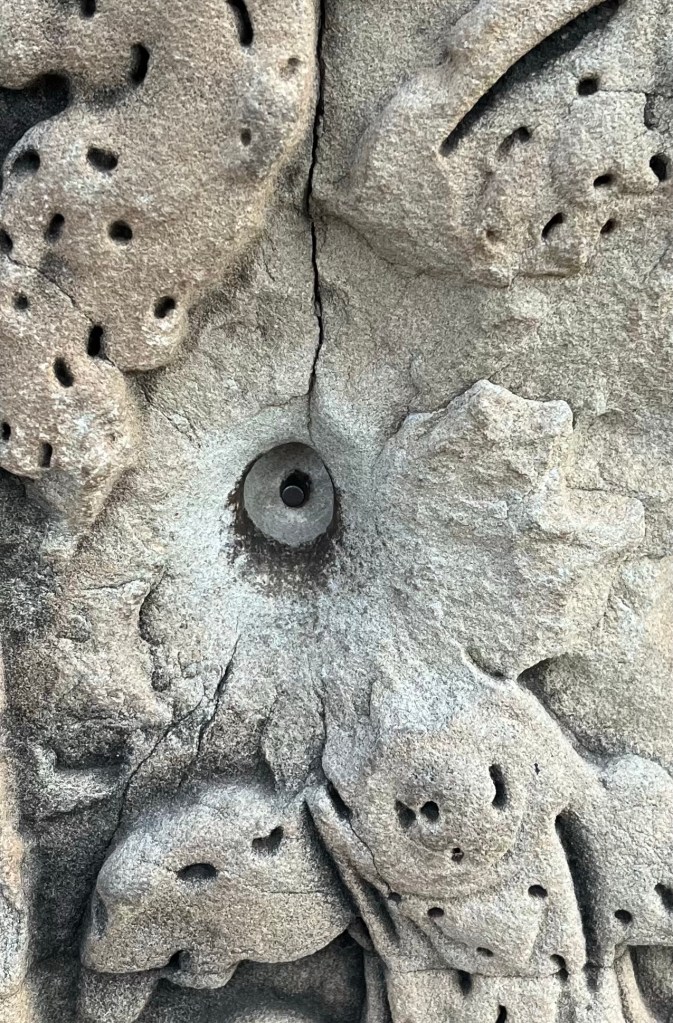
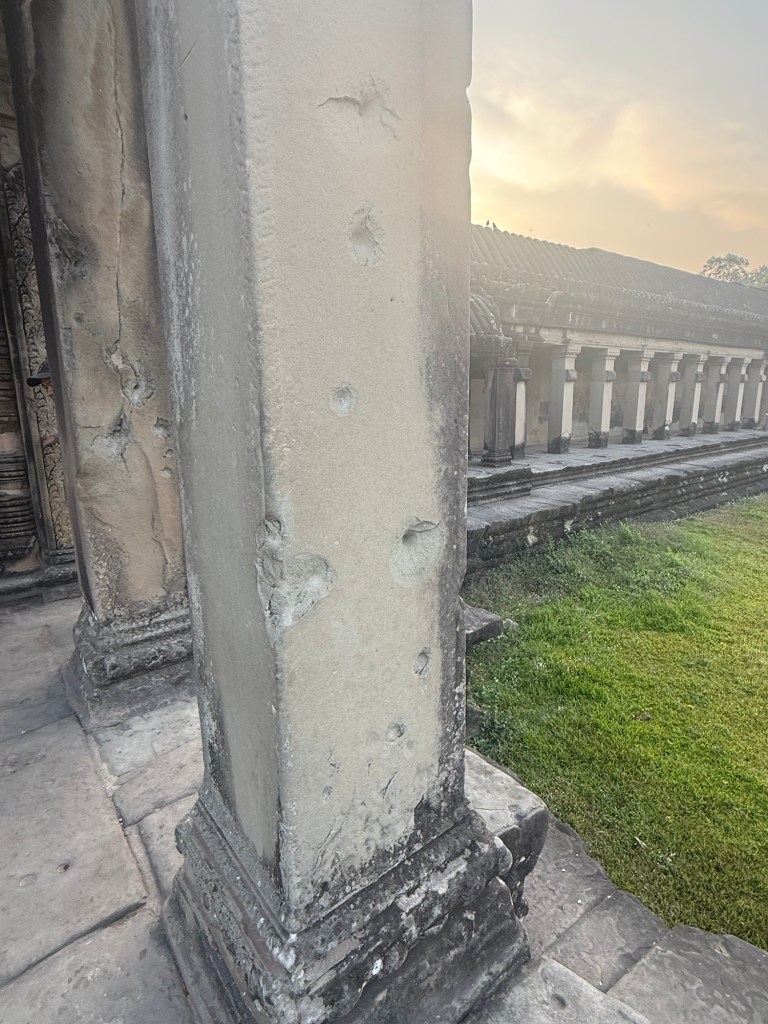
Angkor Wat is also one of the most thoroughly restored temples in Cambodia. It’s a little confusing as to what’s old and what’s restored. But all renovations are made from the same quarries as the original mines (sans elephant.) Some care was given to leave evidence of desecration like these Khmer Rouge bullet holes in the first gate.
Khmer Rouge bulletKhmer Rouge Shell Damage
Other features of specific interest…
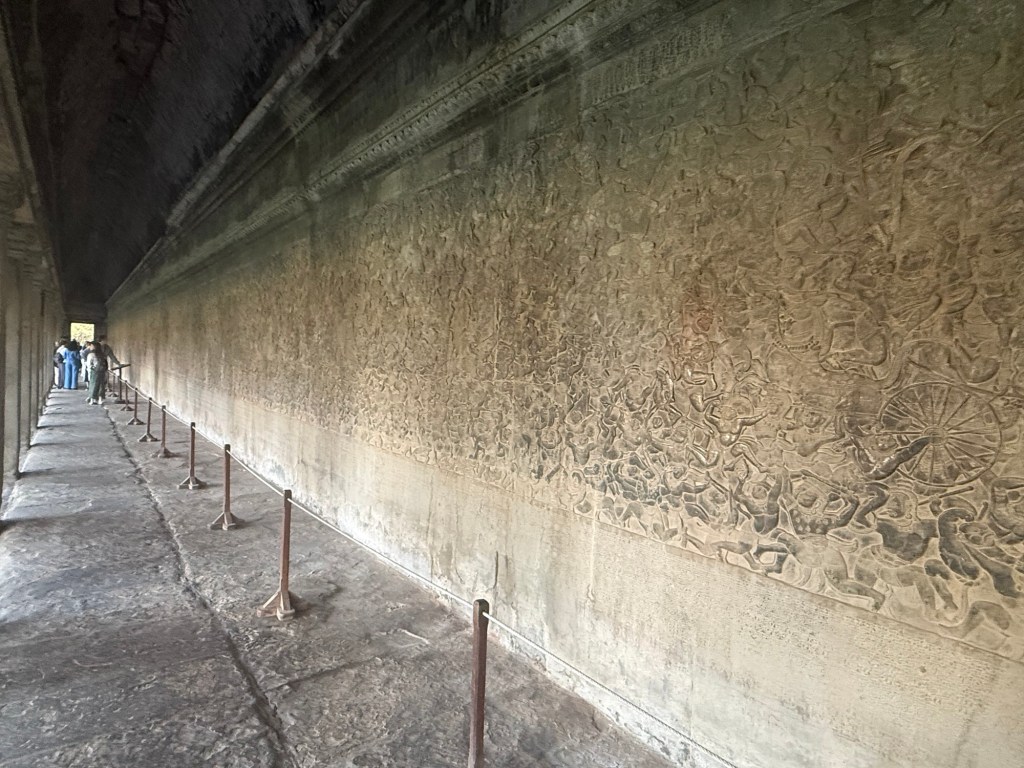
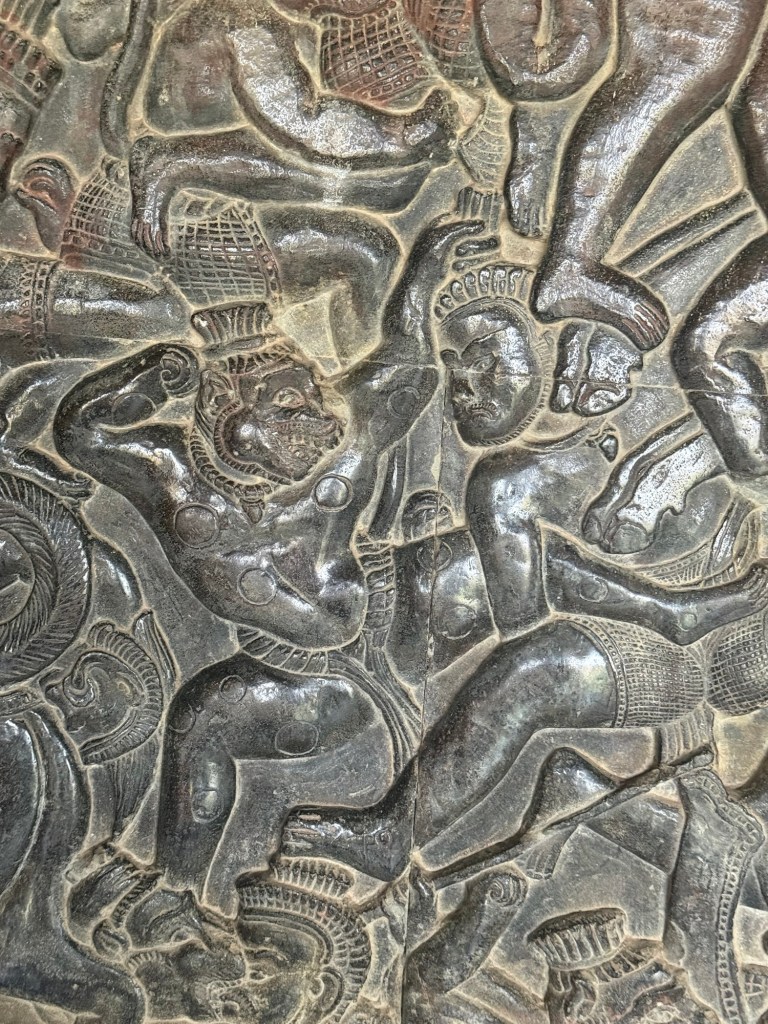
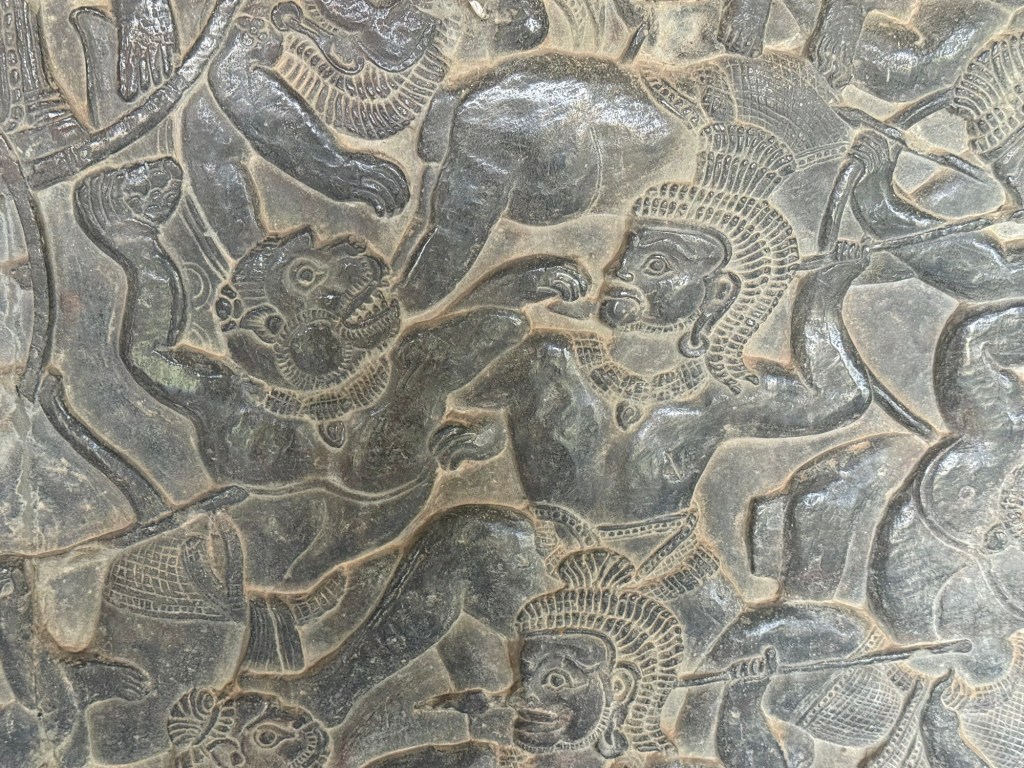
A 100 feet wall carving depicts an army of monkey troops (led by Hanuman the monkey God) in vicious hand to hand battle with both demons and enemies of the king. This mural represents the Battle of Lanka and the recapture of the abducted queen Sita – the last scene in an epic 8 hour Hindu saga.
Monkey War Mural WallBattle Scenes – Hanuman’s ArmyAttack Monkeys
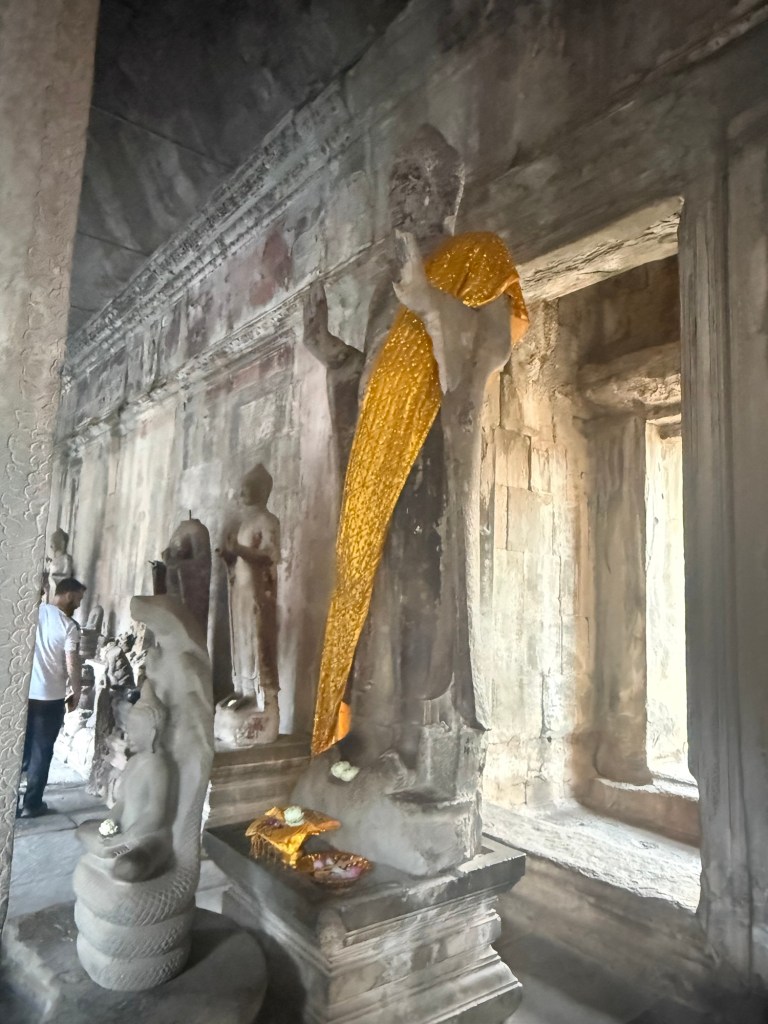
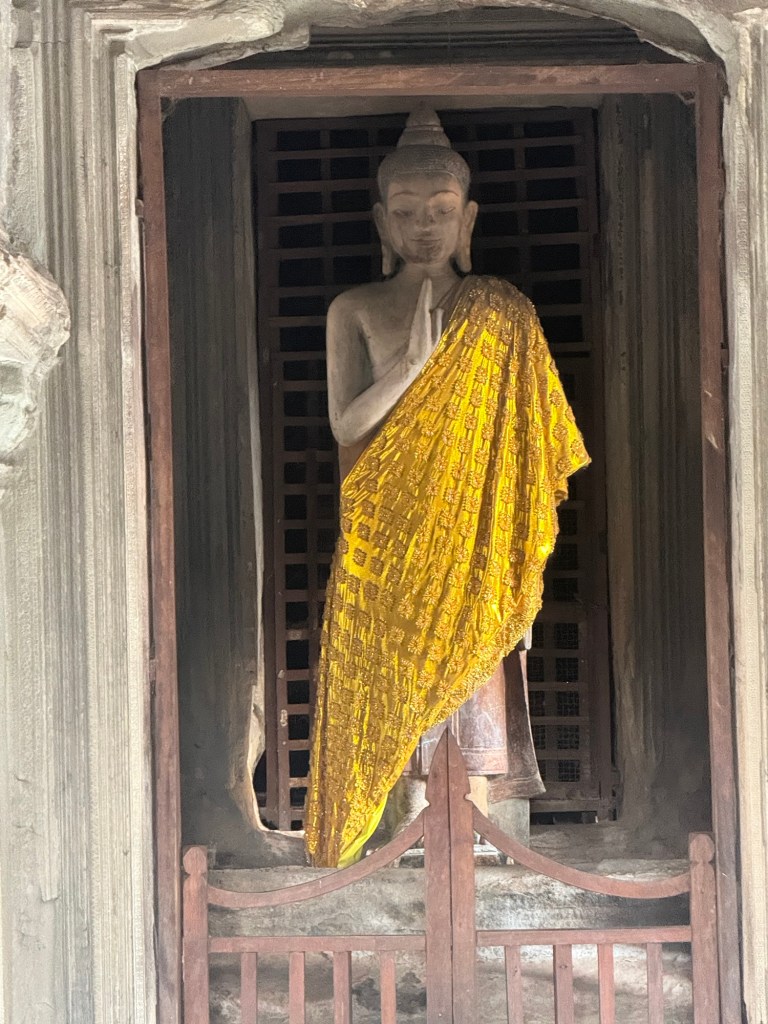
Angkor Wat has several complete Buddhas including an 18 foot tall, 16th century statue that is a destination for Buddhists globally.
18 foot BhuddahReligion Surfers
The Hindu faith has 37 heavens, and 32 hells (depending on the state of your karma and where Yama the God of Death sends you). Many steps, levels and features repeat this numerology. The cover charge for Barang foreigners? $37 U.S.
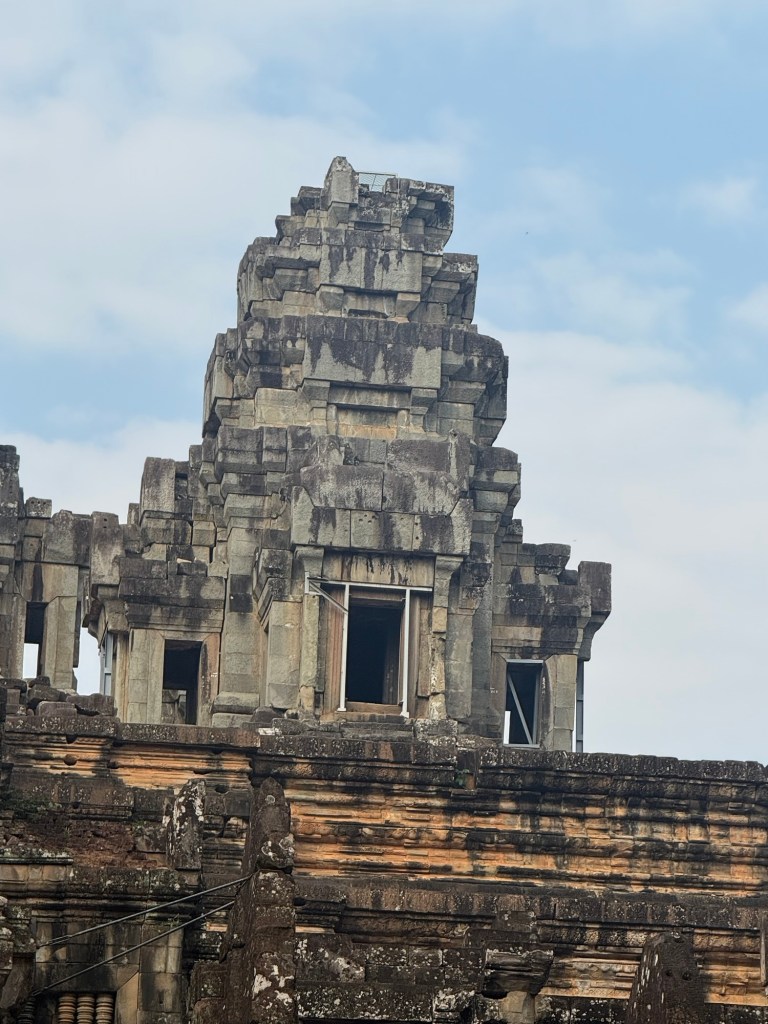
Bakon tower is the central tower. Much of it is closed for repair. A Korean NGO is funding a large project. An equally large restoration is indefinitely paused due to the elimination of USAID.
Bakon Tower
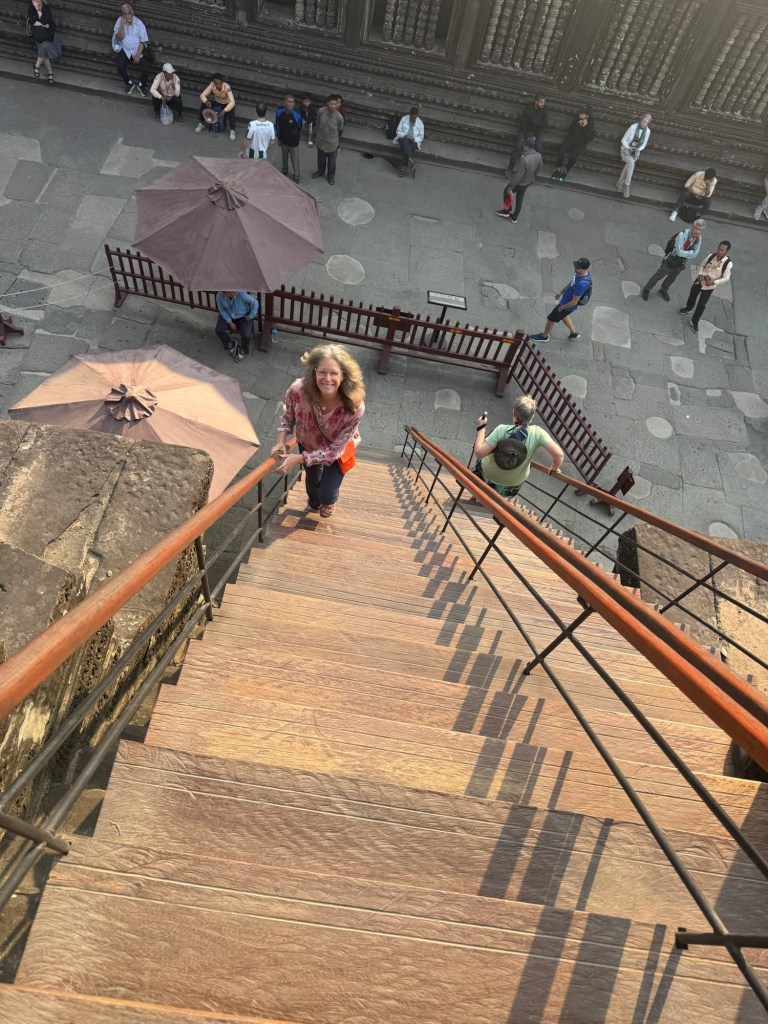
We climbed Bakon on 51 temporary wooden steps. They were very steep but the steps being repaired number only 37. More of a ladder really with 24″ vertical stone rungs. When open, guides were stationed at the bottom to assess whether you looked fit enough to climb.
Temporary Bakon Stairs
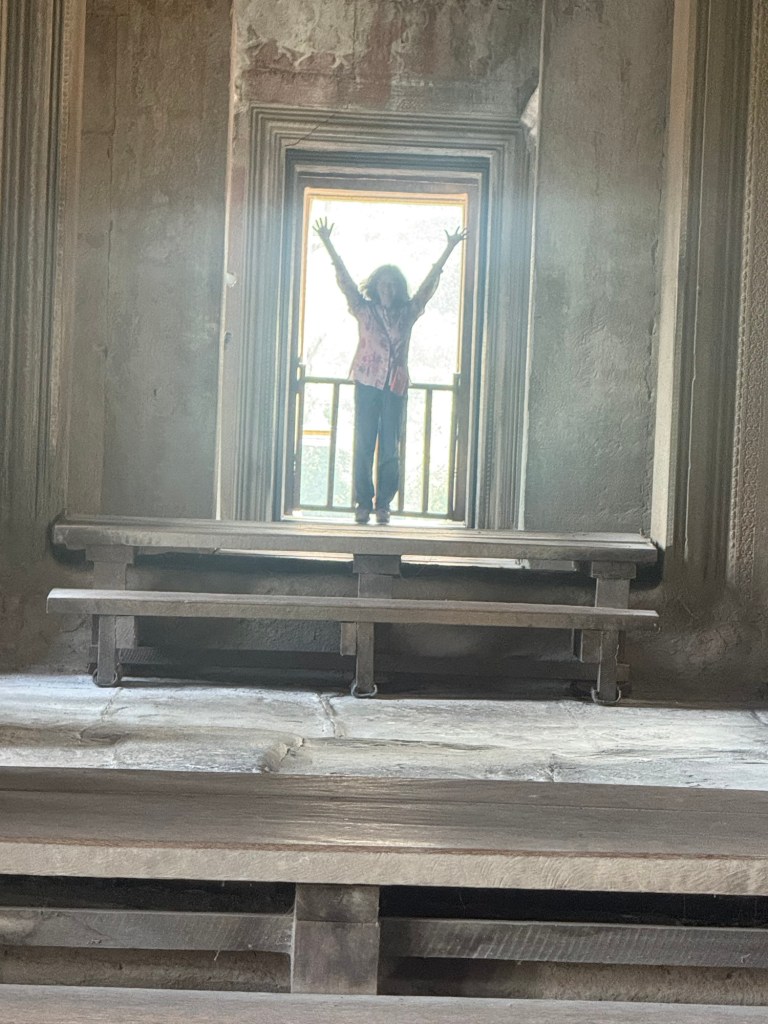
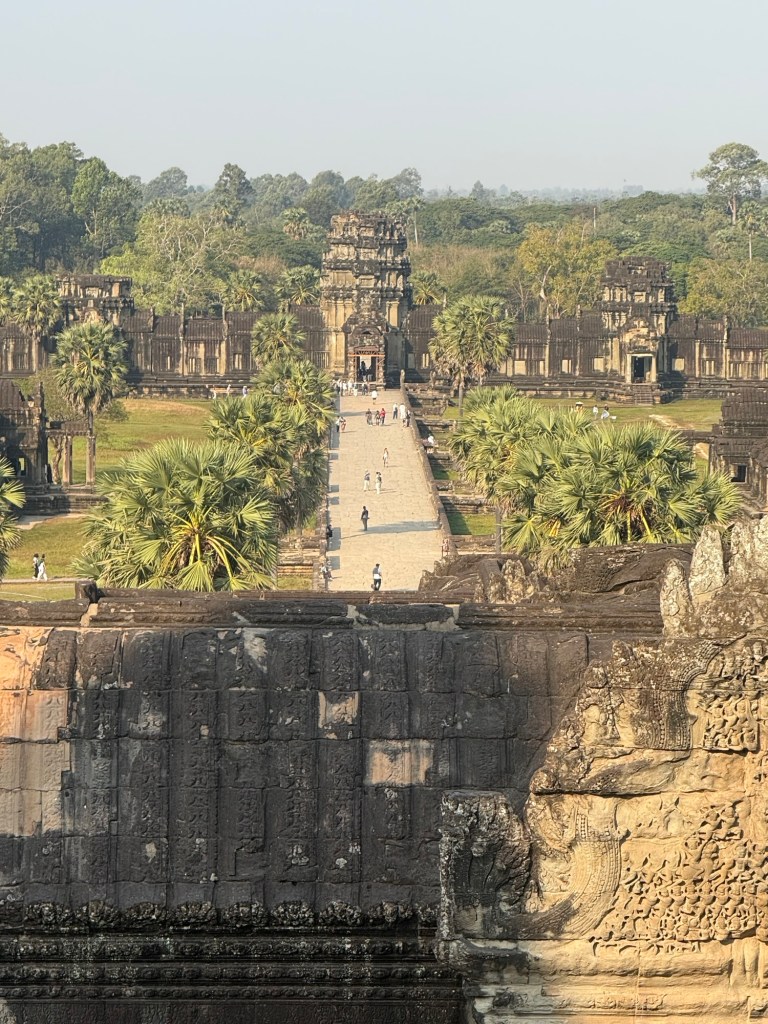
At the top were spectacular views, more 16th century Buddhas (with heads) and more purification pools. We also met a couple from Boxford and debated whether the Community Store where the boys worked should be called Jack’s or Wayne’s (too weird).
JuJuView from Bakon TowerBuddha Head-onCeremonial Pool in Bakon Tower
Angkor Wat was our last temple and we need to confess some serious temple-fatigue. But I’m glad we saved the biggest for last. The learning of the last three days made digesting Angkor Wat… at least possible
I want to note that Malcolm has been a meticulous note taker and digester of incredible amounts of information. While I’m “in the moment,” taking it all in (maybe even day dreaming or half listening), Malcolm is taking notes and getting all the facts straight. It has been heavy lifting understanding pretty complicated religions and political situations.
We keep running into other fellow travelers from Vietnam as we progress. Hello Bev and Jackie, Bruce and Laurie, Simon and your beautiful bride (?? sorry).
And now a random list of Cambodian commentary, events, and experience that aren’t history and aren’t temples…
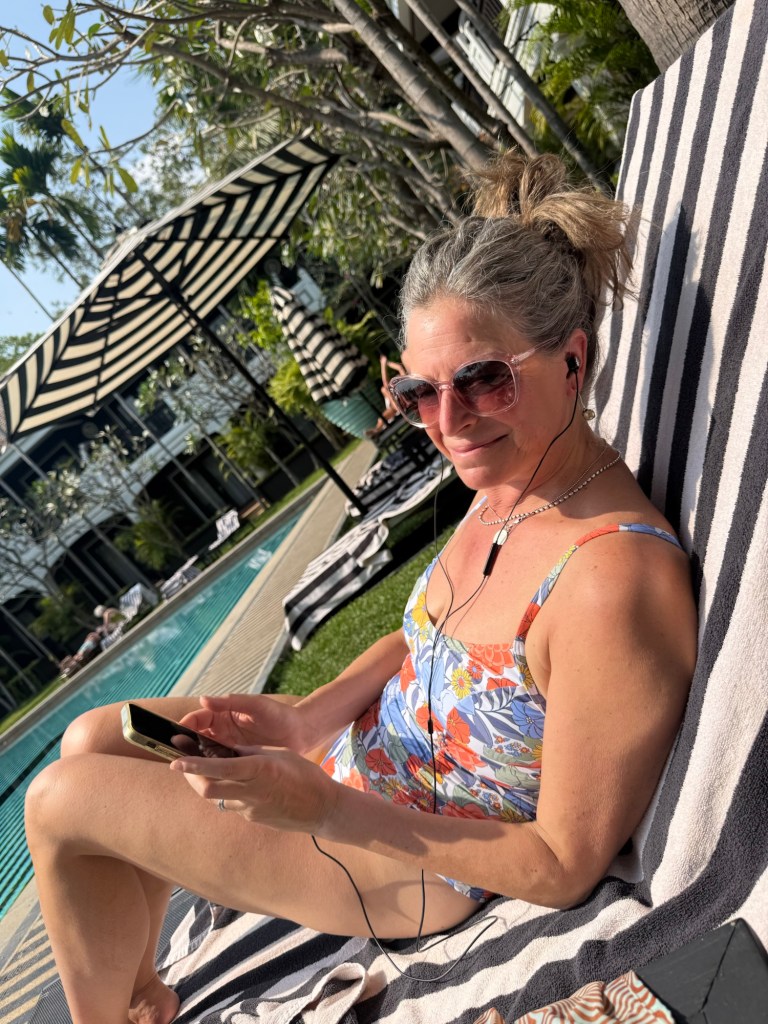
The Sinta Mani Hotel is a western focused hotel. Lots of loud Americans, and missing our Asian breakfast buffet. But a smash burger by the pool? That’s alright.
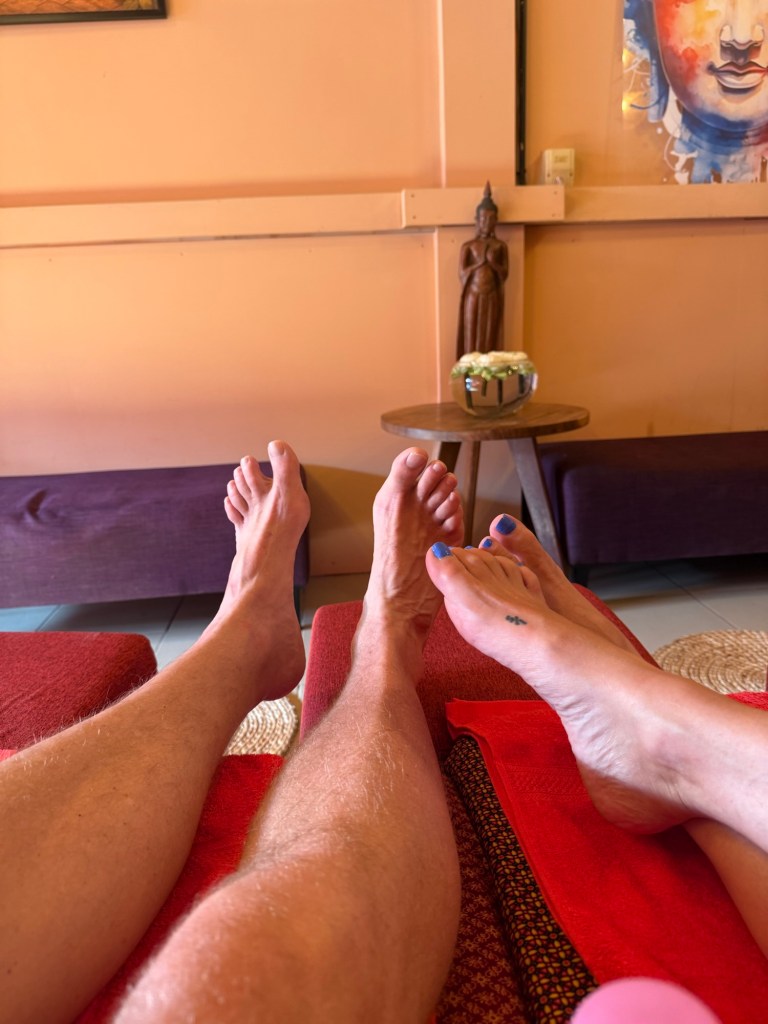
Pool Time2 Foot massages, and 2 double margaritas, $13
Another round of music lessons – Juju jamming’ for mine victims.
Juju laying it down
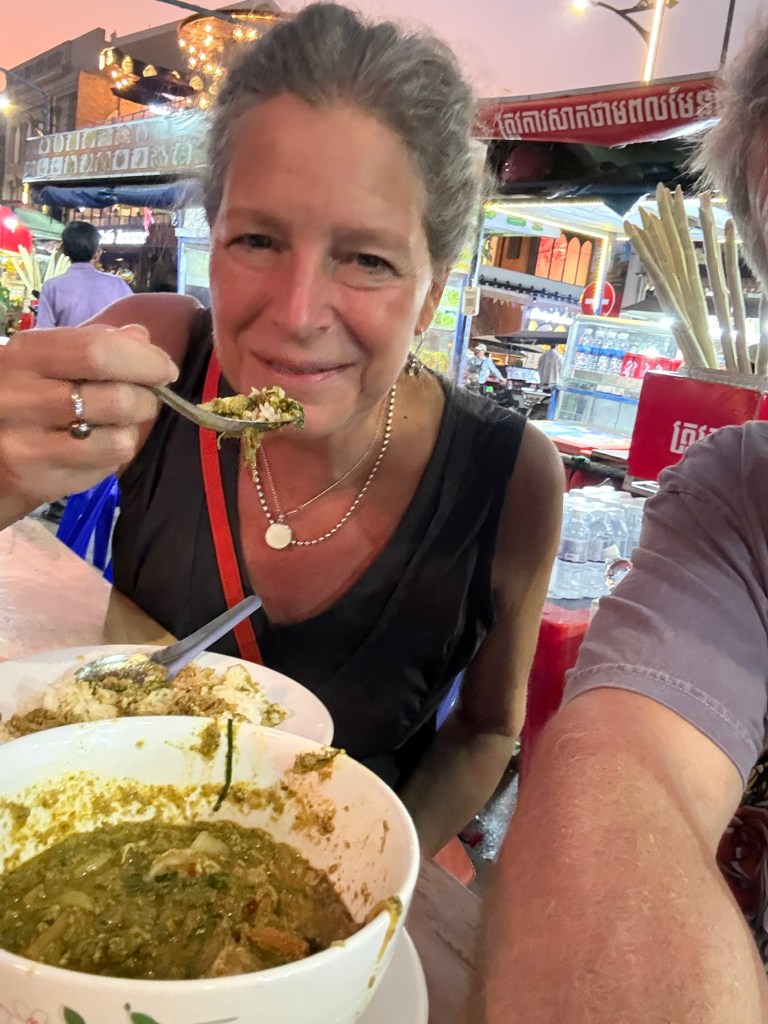
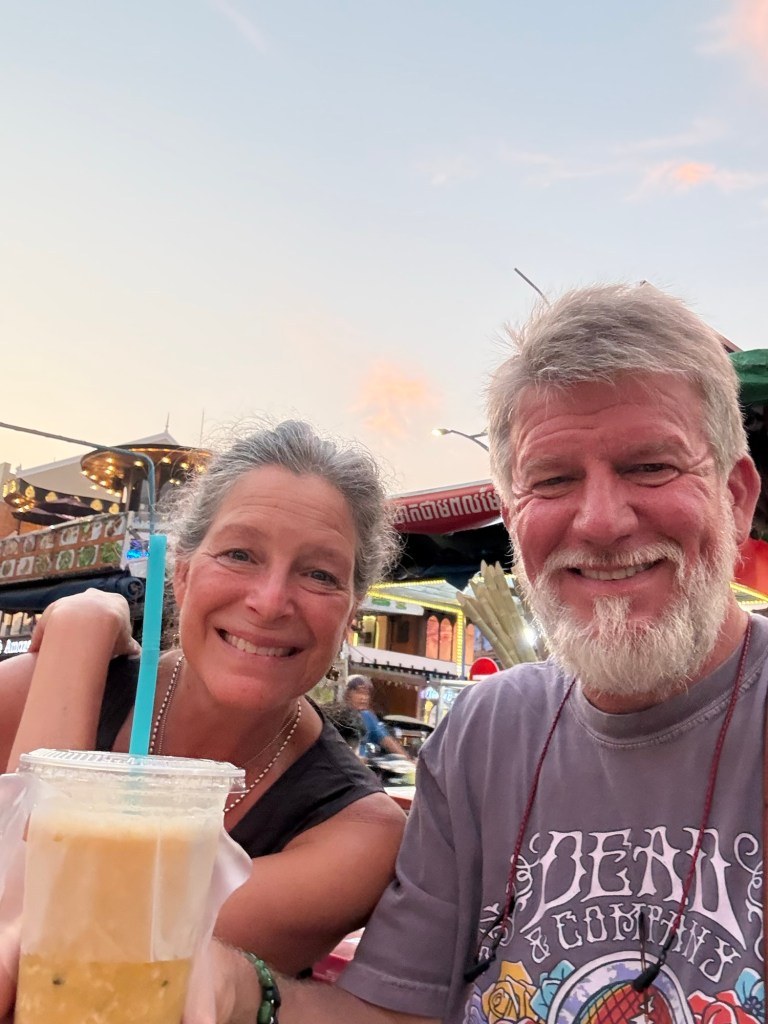
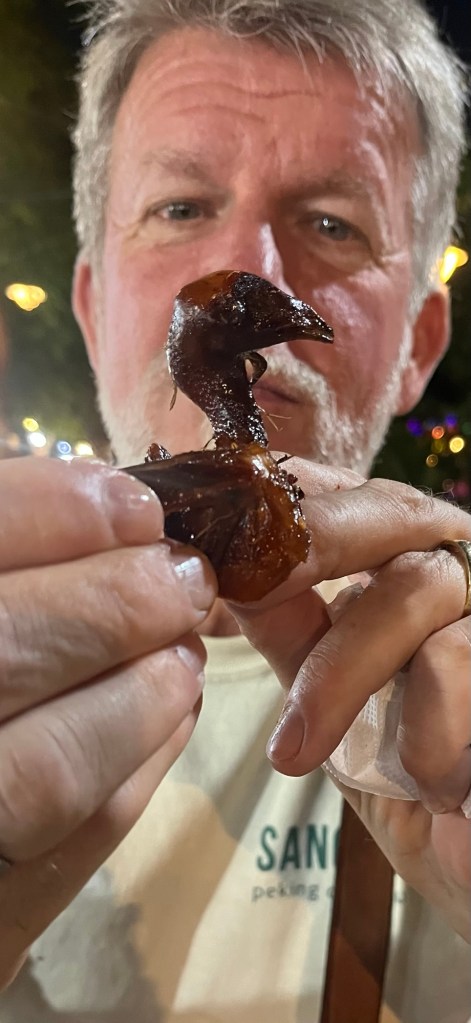
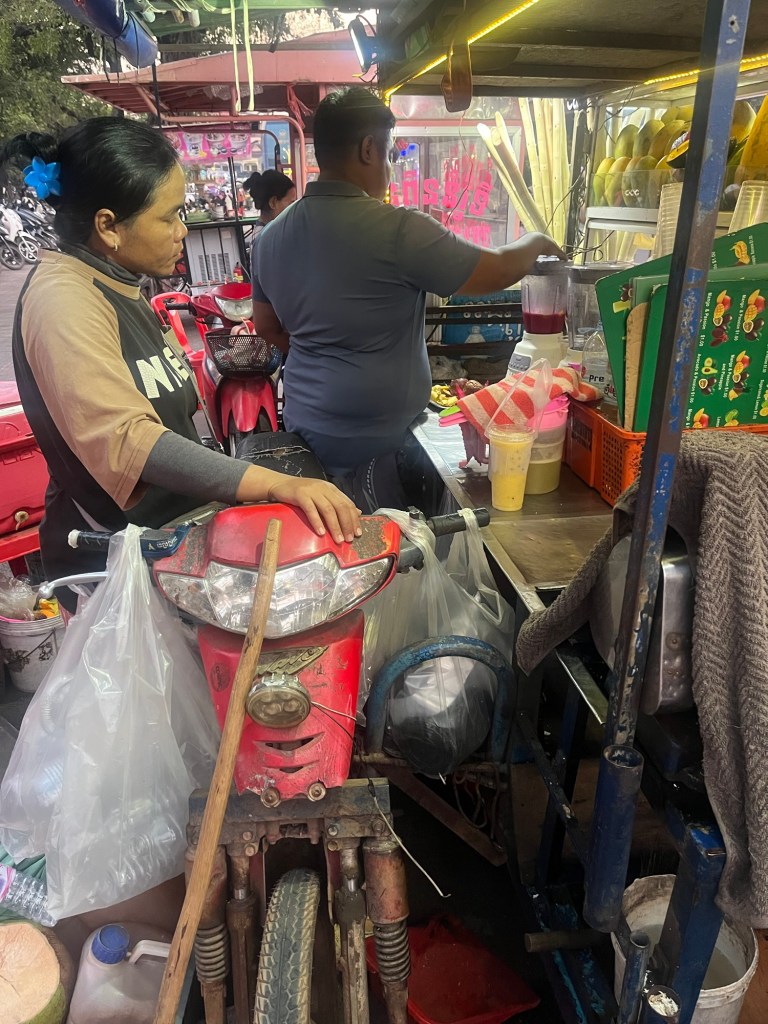
Street food: Amok (traditional Cambodian stew) and fresh fruit and rum slushies (blender powered off a motorcycle!). Grilled quail, squid, and pork belly.
AmokRum Slushies ala YamahaNot much meat on the skullGas powered slushy blender
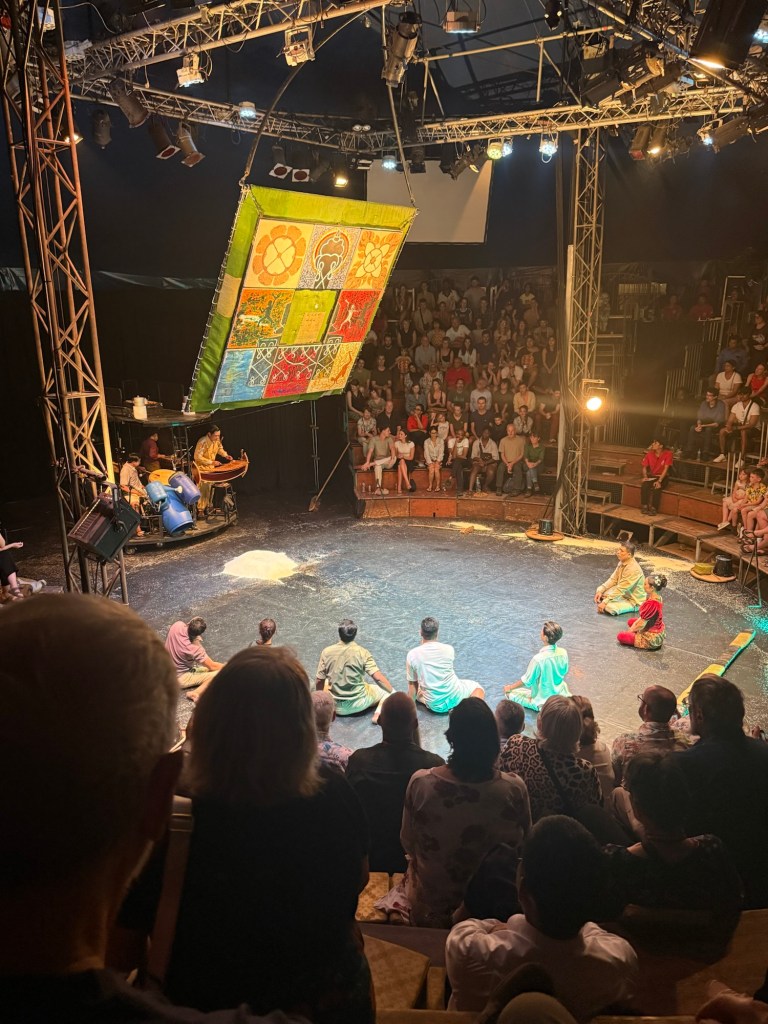
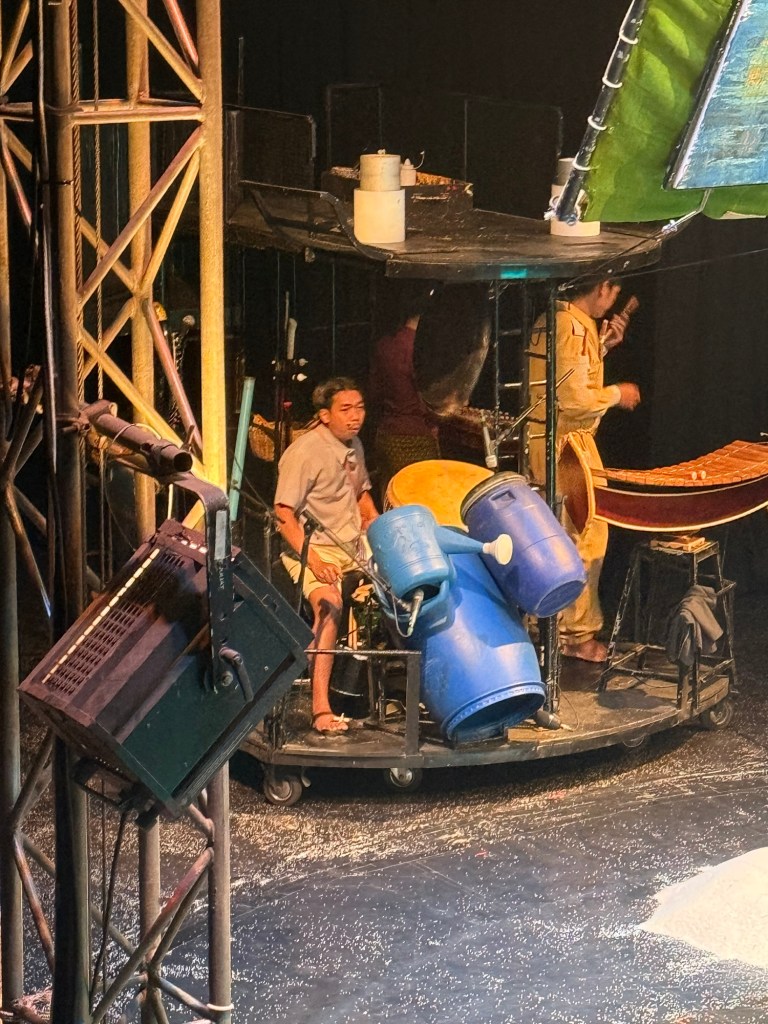
Cambodian Circus Performance – mind blown
Circus TimeThe Rhythm Section
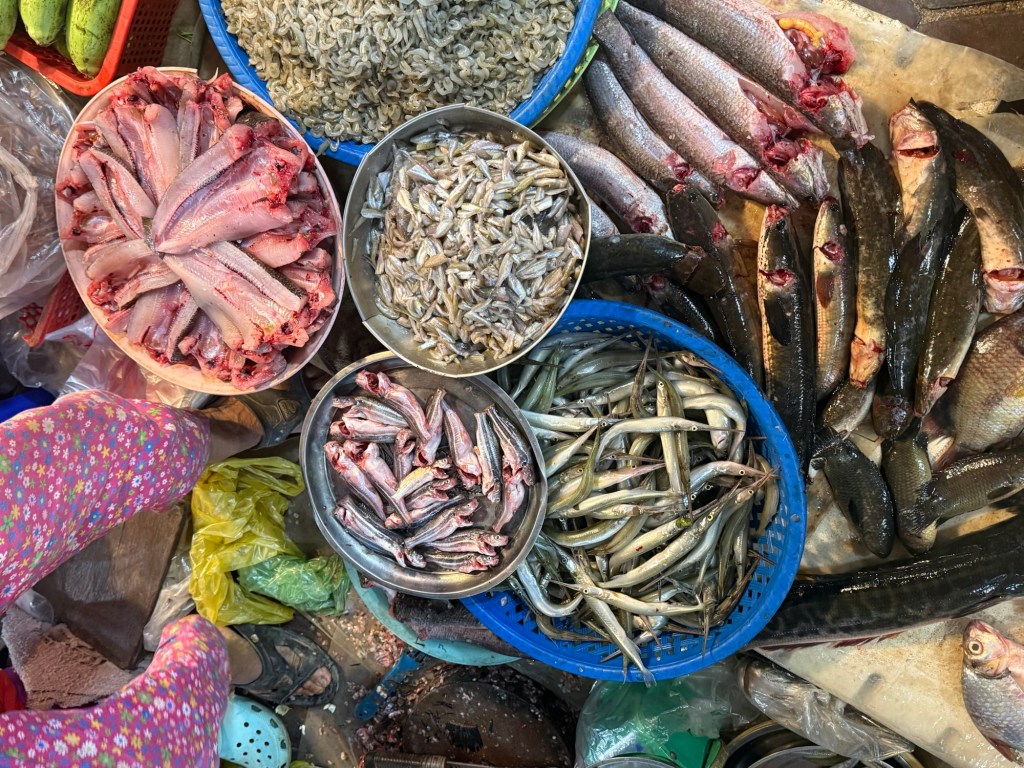
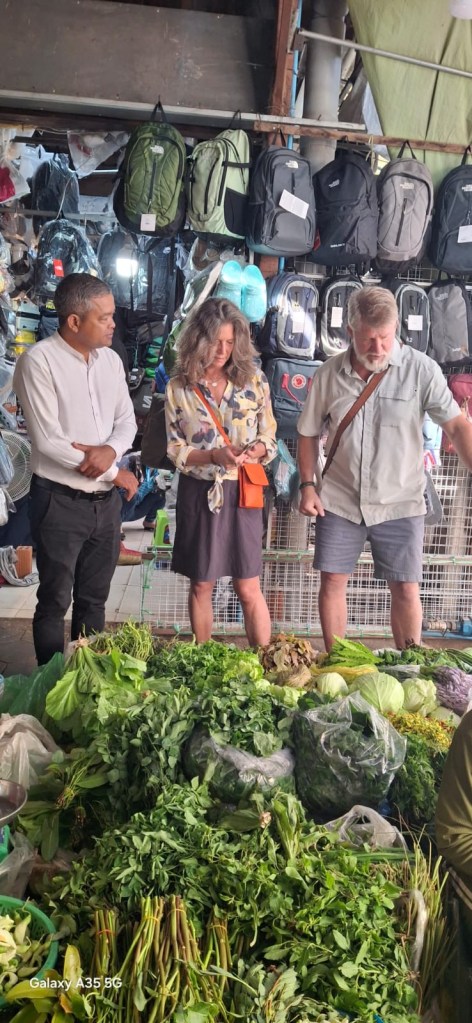
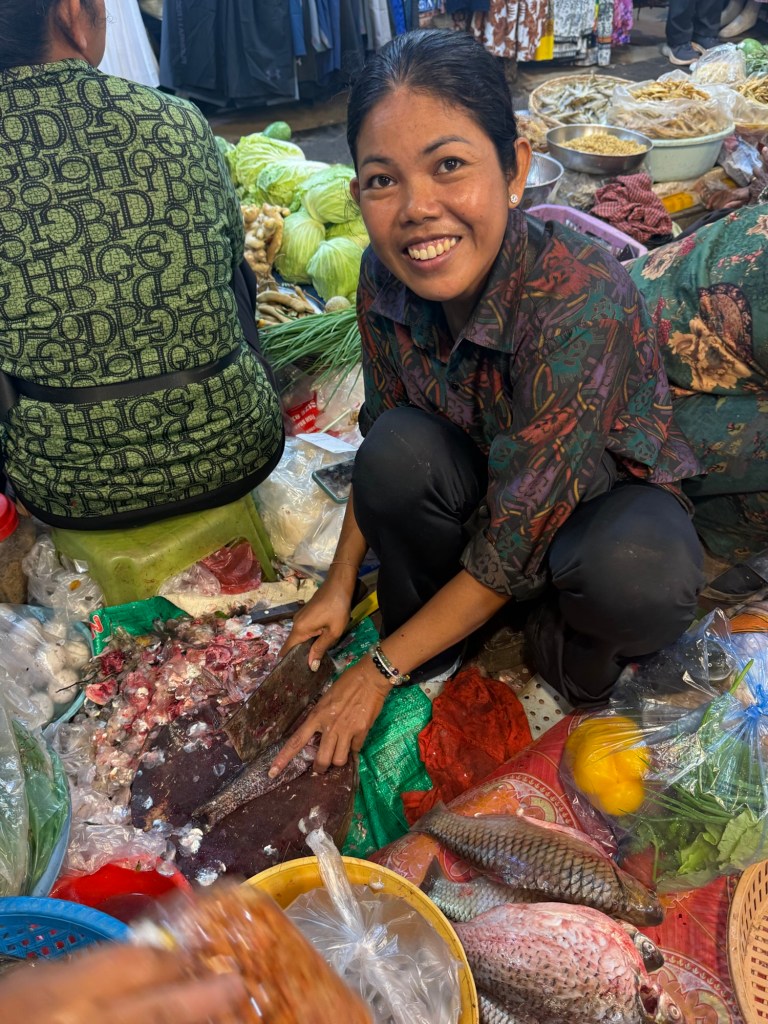
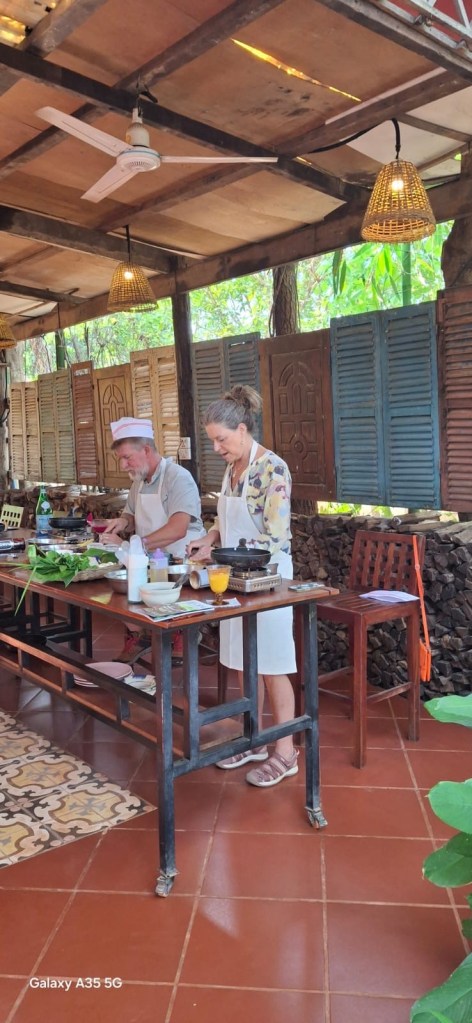
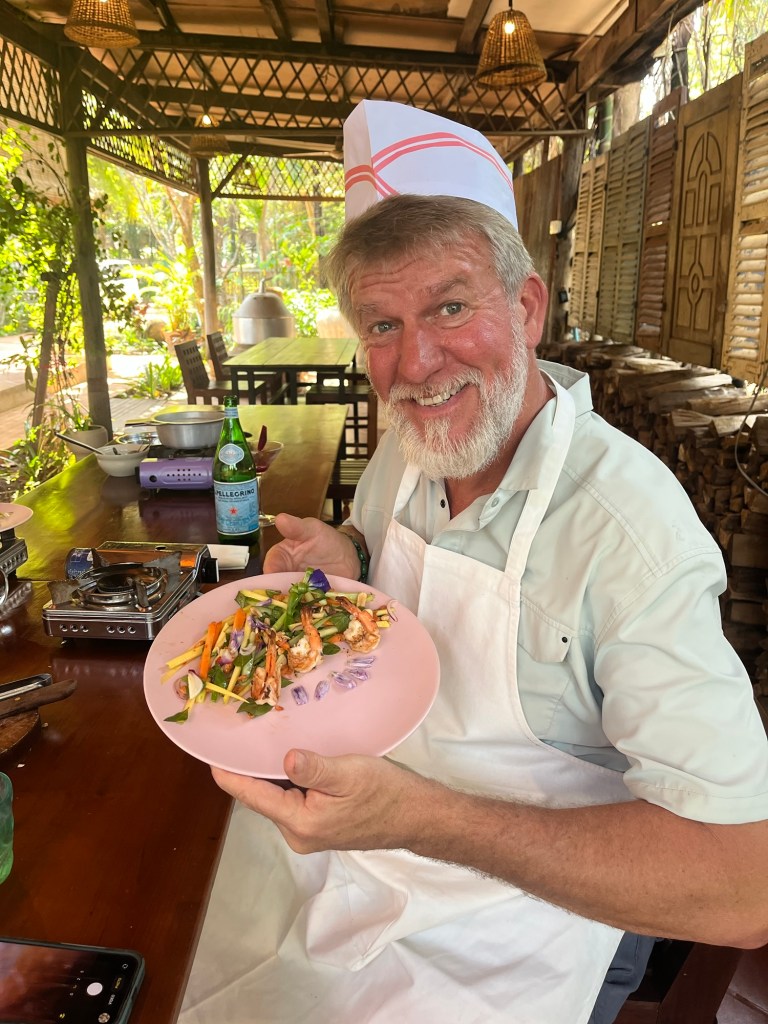
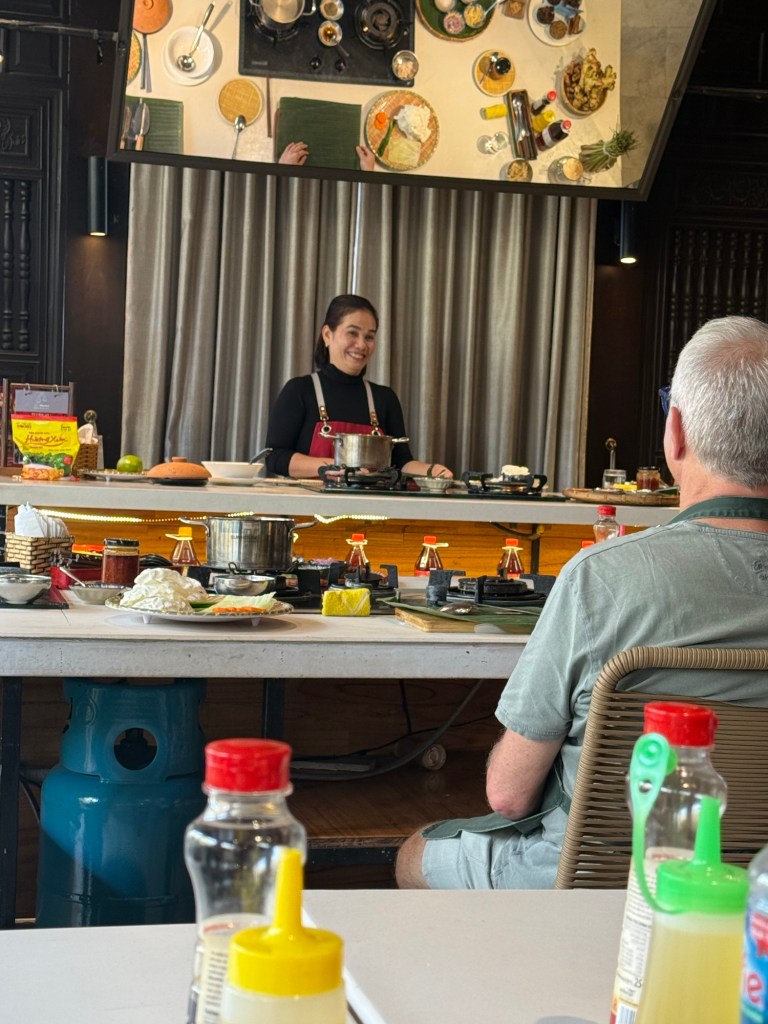
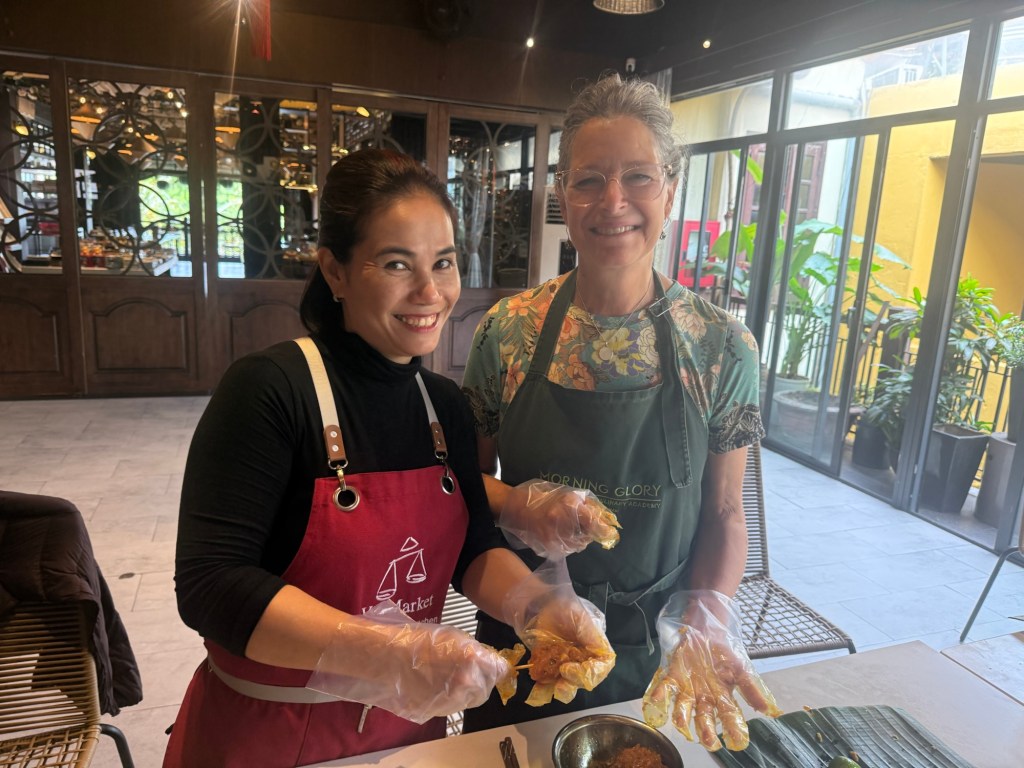
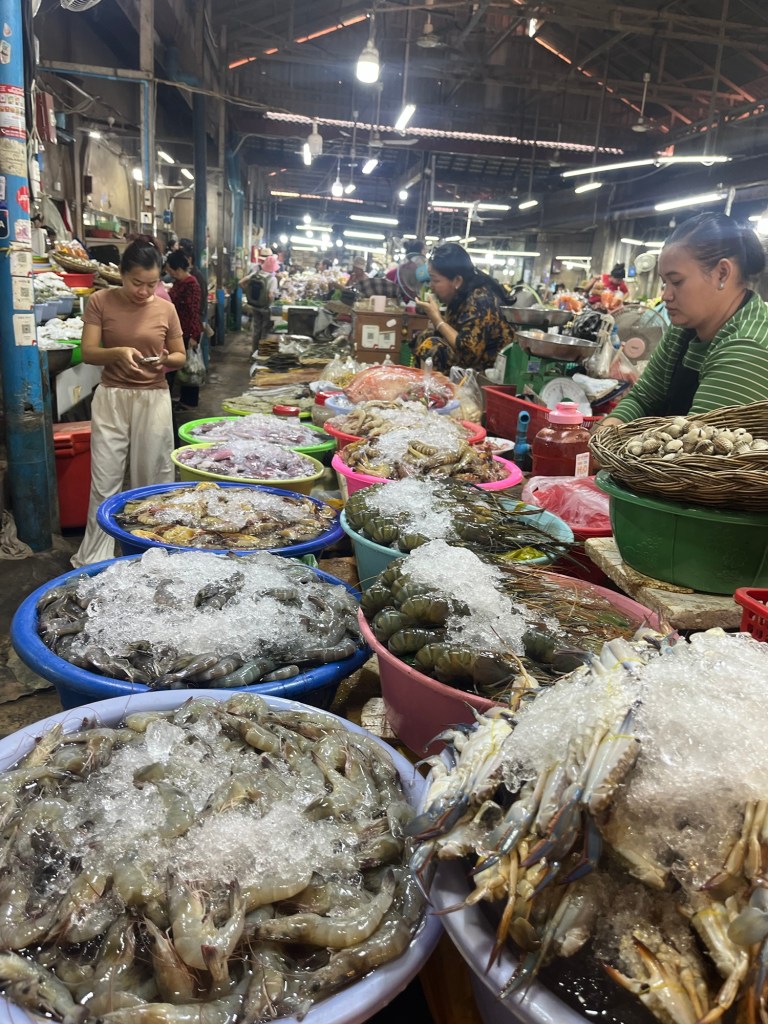
Half day market tour and Khmer cooking lessons. Just as good as the one in Hoi An – but just the two of us.
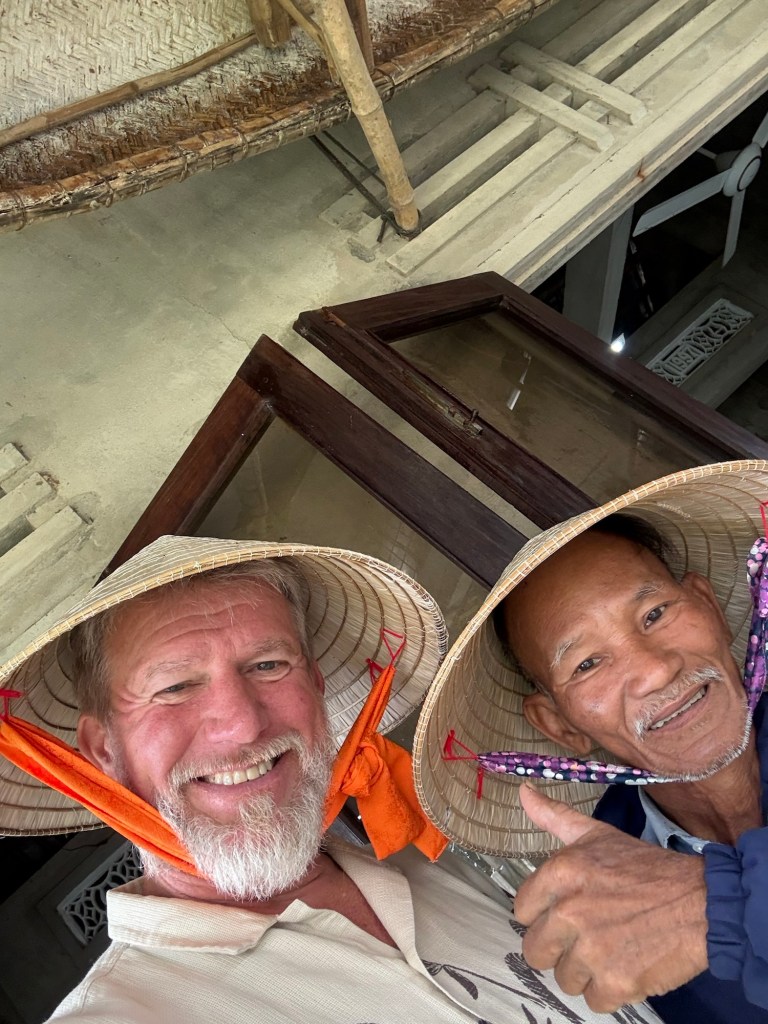
Gills still movingChef Reit “Happy to see you”Yes ChefSilly Hats
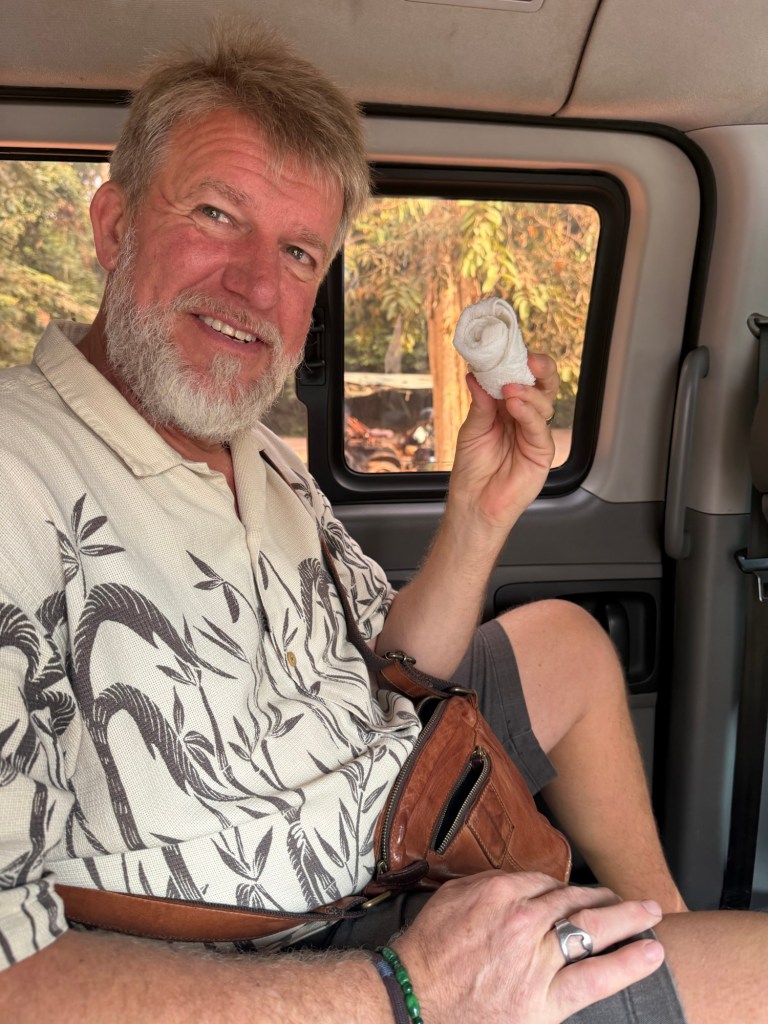
Spring Rolls – it’s hot. But every time you pause for a breath, someone hands you a tightly rolled, damp, ice cold towel – often jasmine scented. This happens 5-10 times a day and washing your hands and cooling down your face and neck with a “spring roll” is a miracle.
Spring Rolls – Better than a cup of coffeeTemple Dust Gone
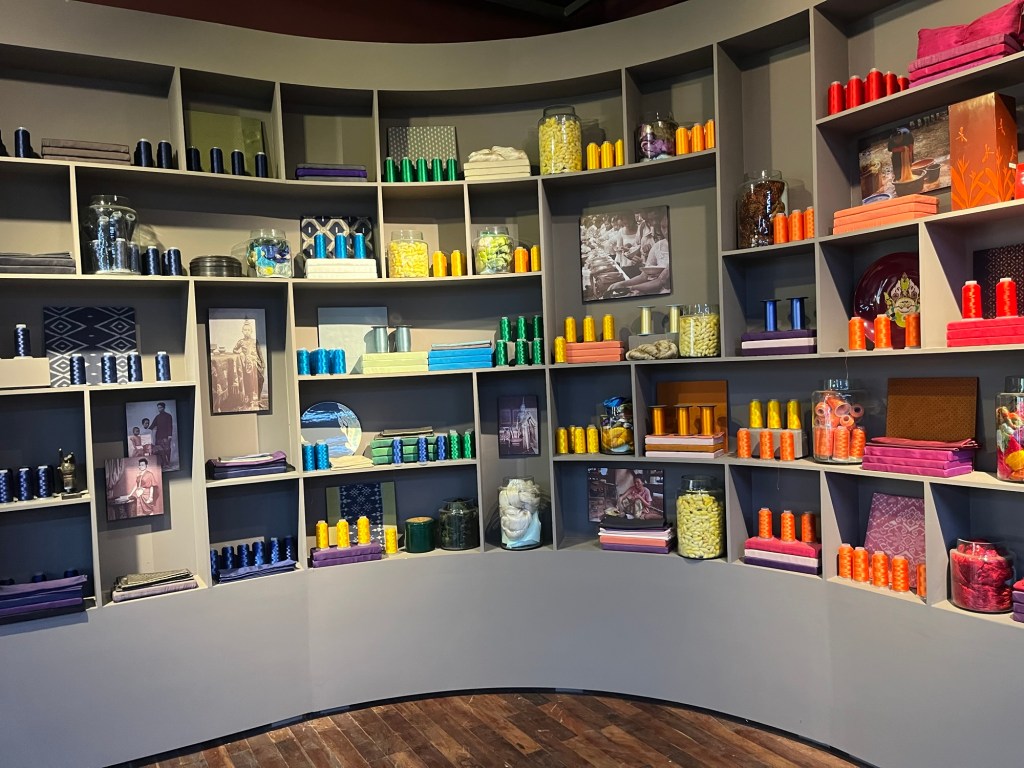
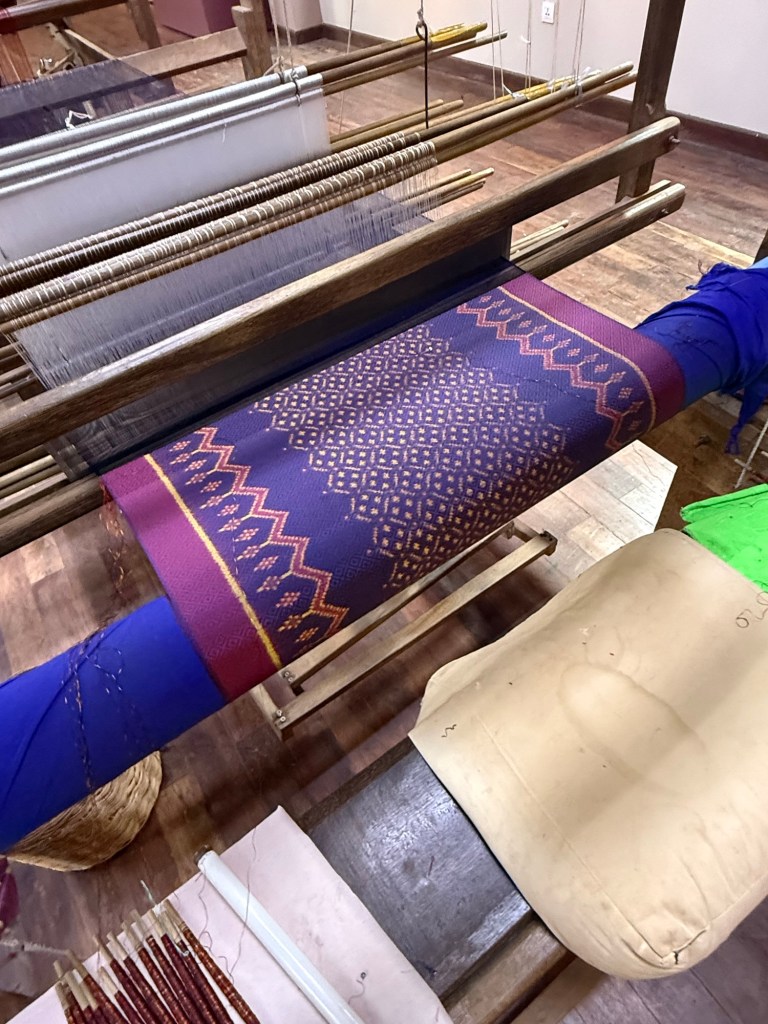
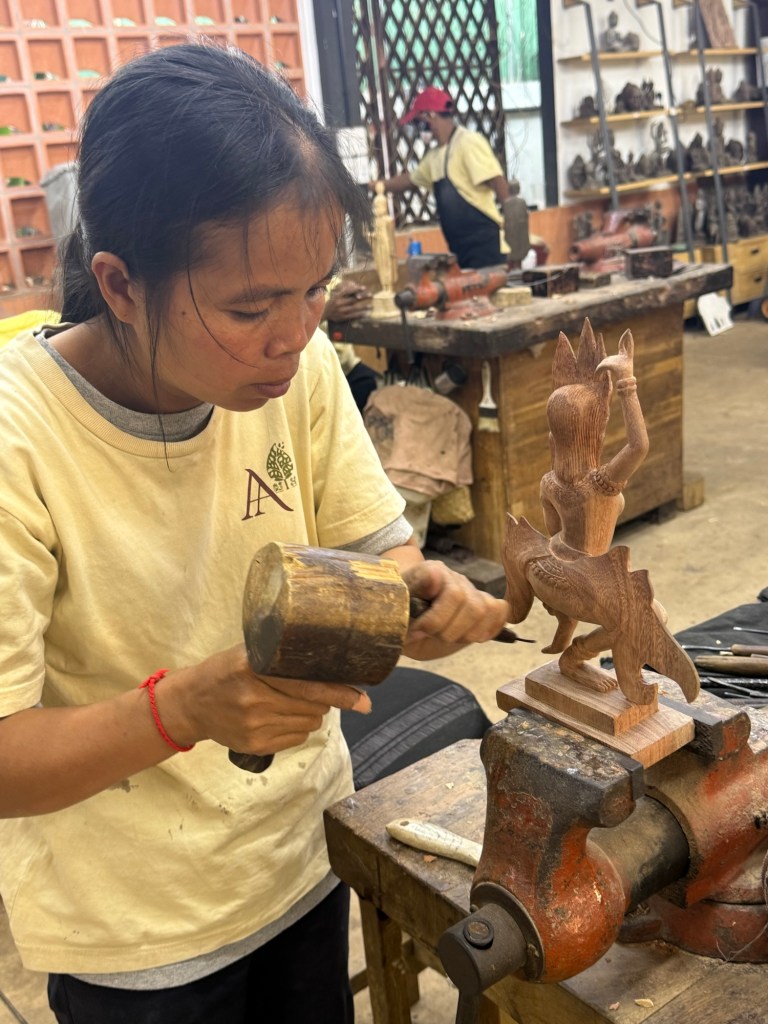
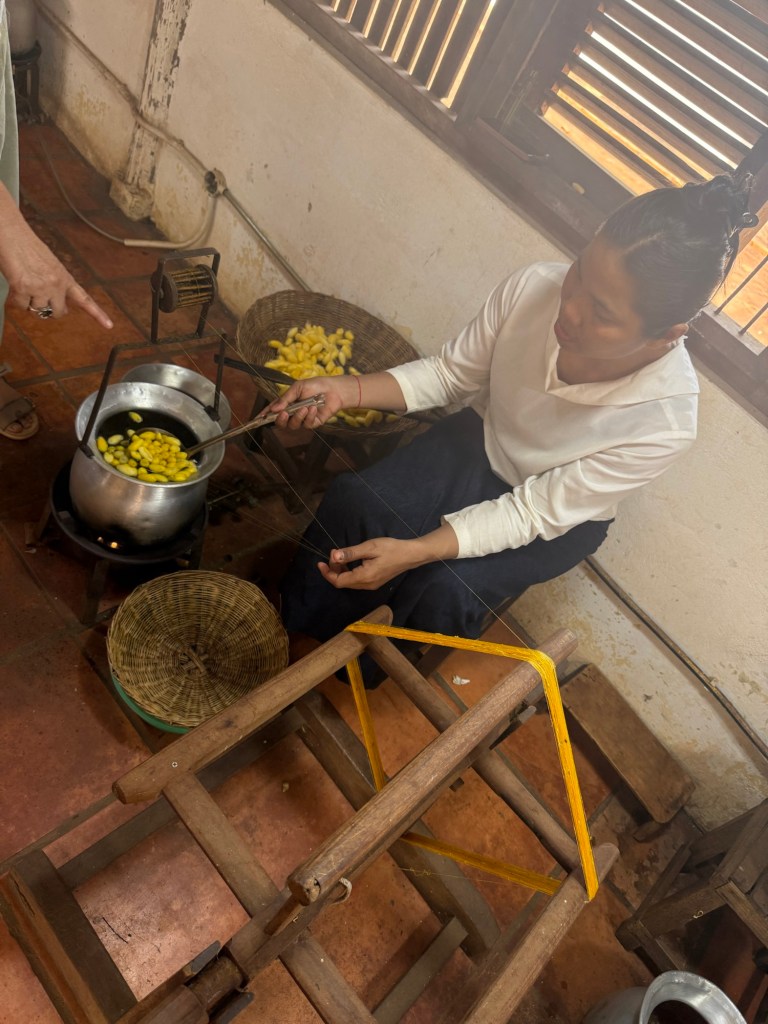
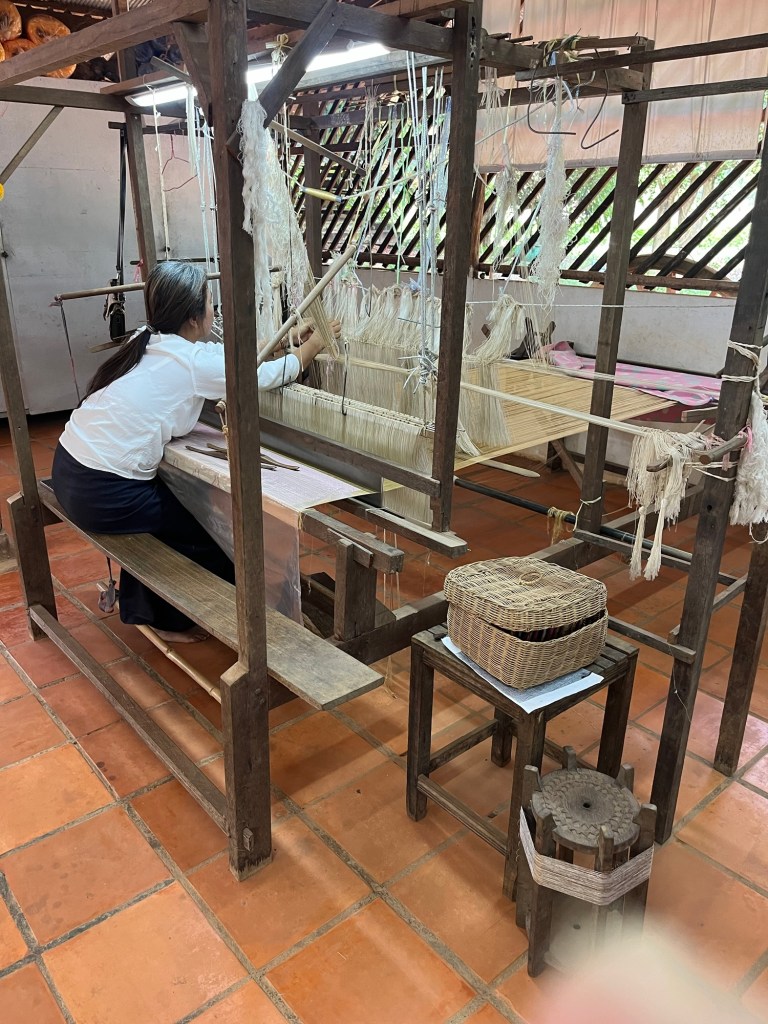
Artisan Angkor Center – We attended demonstrations of silk making, wood carving, and metal smithing. I splurged on a silk shirt. You know, for the orphans
Silk SpoolsWarp and WeftCarving an Absara
Yellow Hornbill Sighting
Wildlife
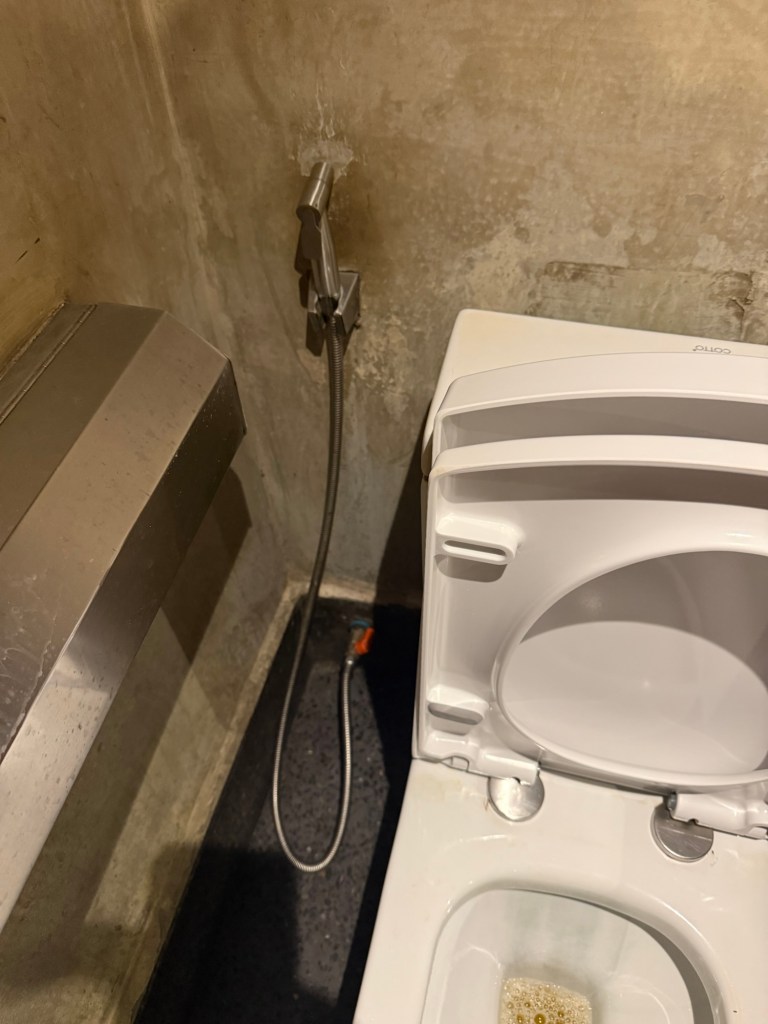
Toilets: everywhere in Vietnam and Cambodia we ran into the poor man’s bidet – a kitchen sink sprayer, mounted behind the bowl. I’m putting one in when I get home. And also – don’t squat on the seat, Chinese tourists.
A definite ToDo for the KSQ list
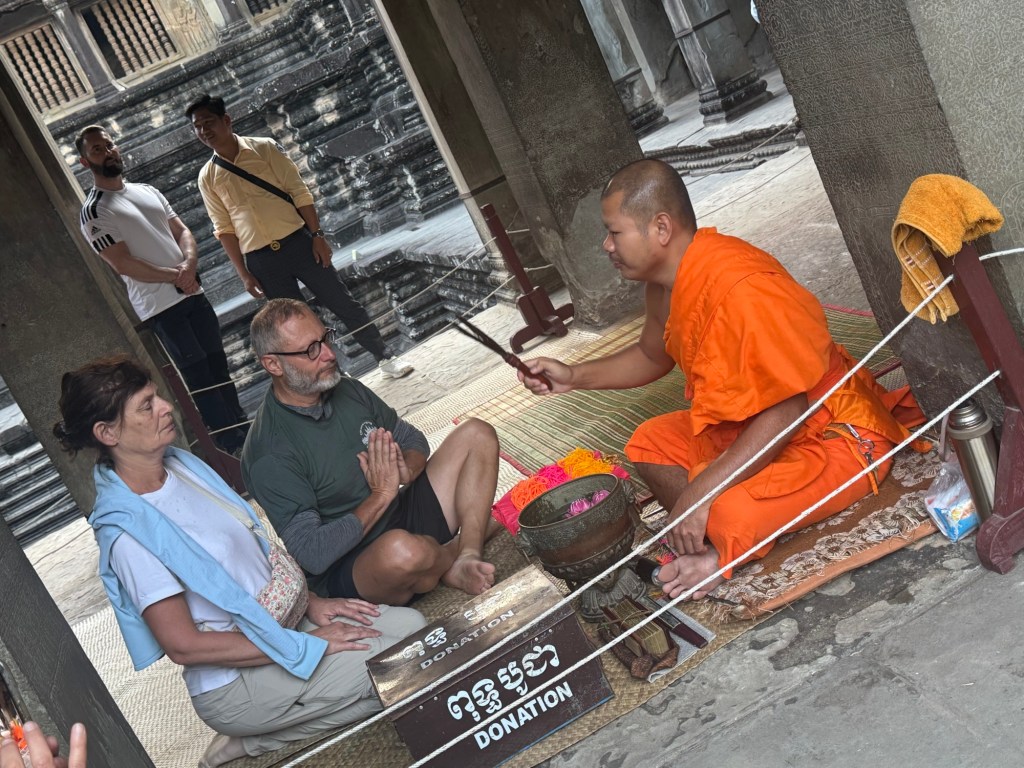
Monasteries are a form of social safety net. Disabled kids, delinquents and oldsters without family support take on the robe and exchange a life of piety for sustenance.
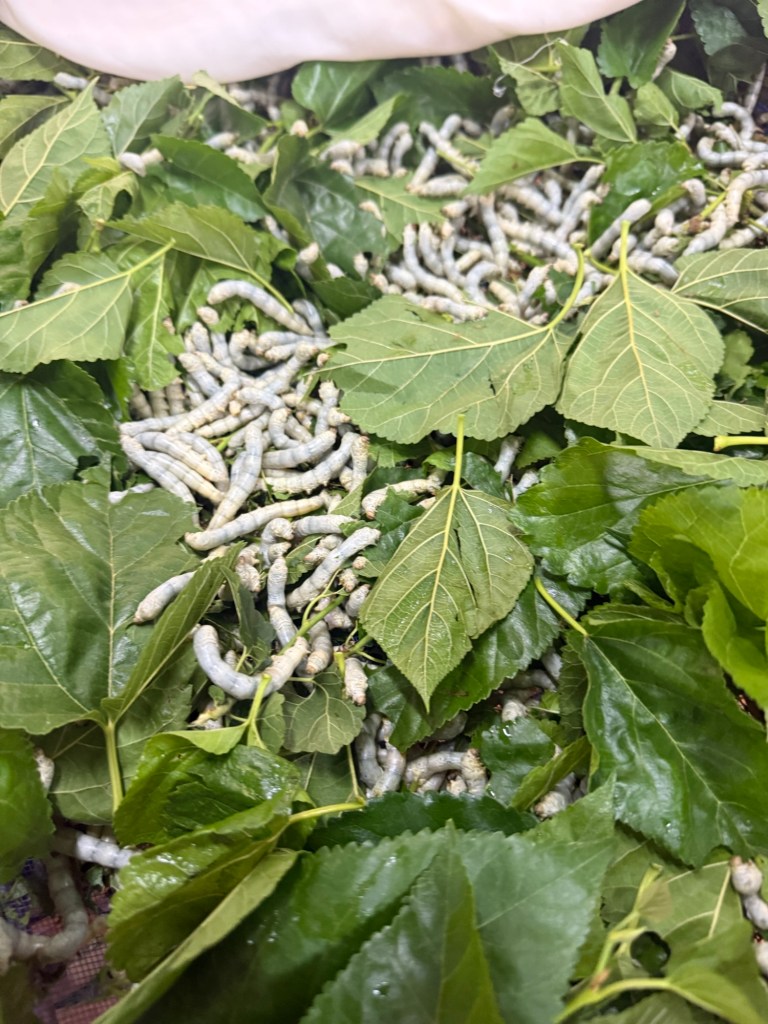
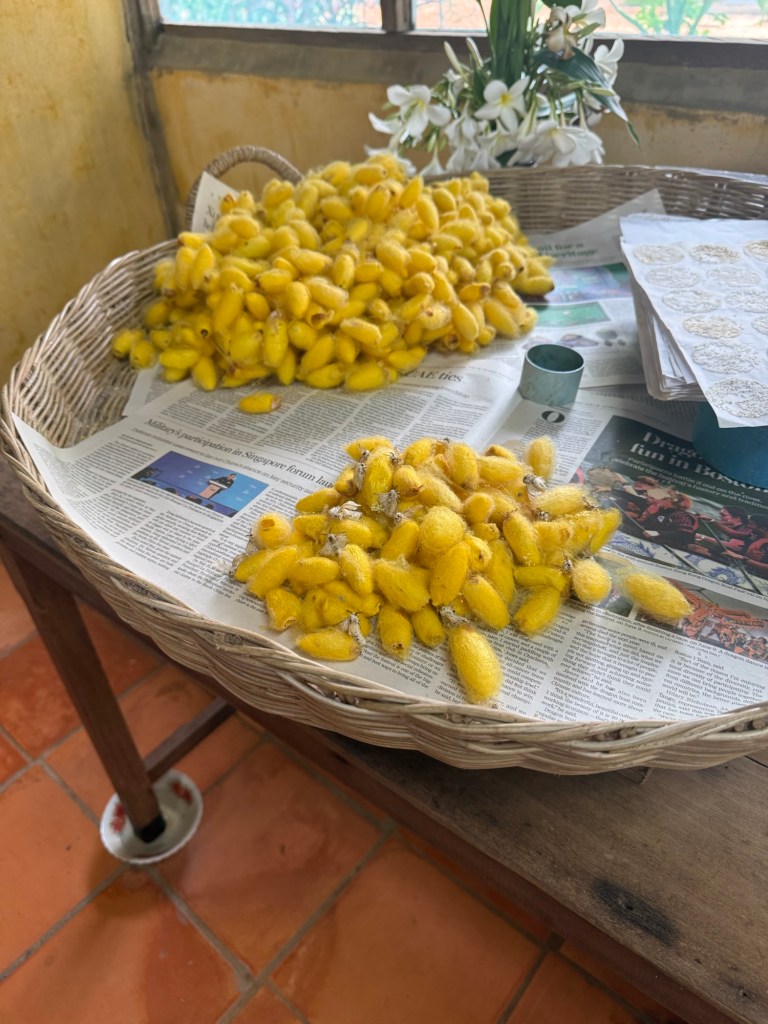
Gold Silk Farm: A Wednesday visit to a working silk farm and an education in Cambodian real-politick from the owner Pheach. The farm and factory were built to employee refugees, victims and orphans of the Khmer. Pheach’s commentary cut through the propaganda and changed our view on quite a few things.
Feeding mulberry leaves to silkwormsRaw silk in the makingDrawing from the podsWarp and Weft
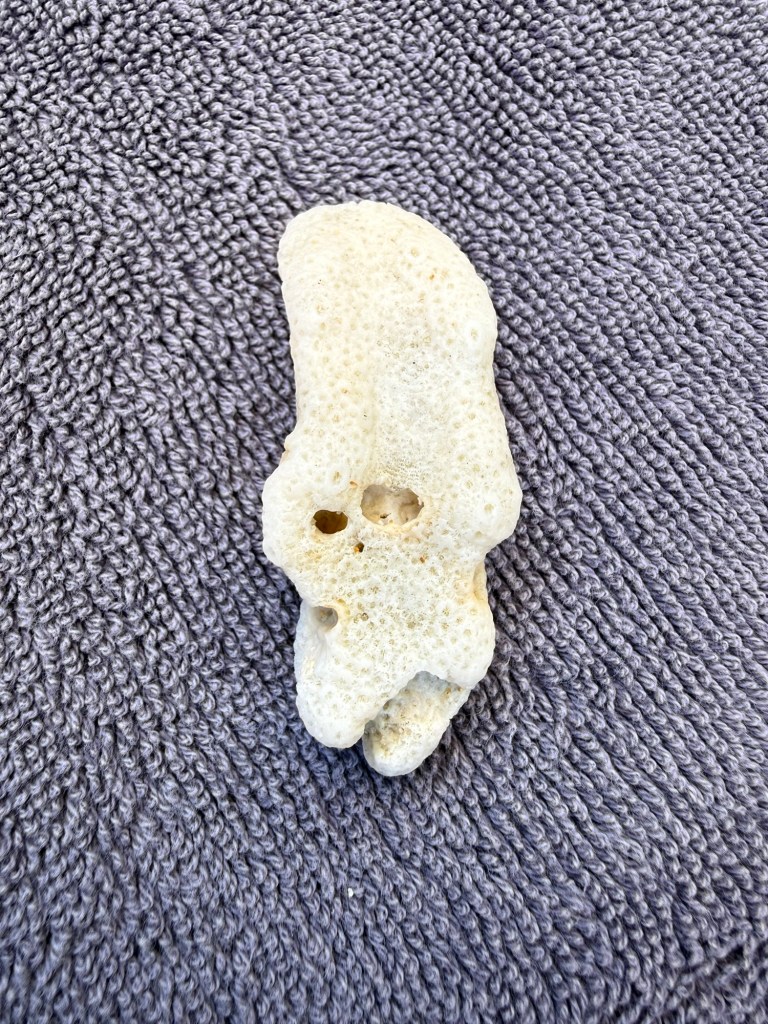
Aliens: so Mayan Temples and Cambodian Temples are way more alike than different. And both peaked at exactly the same time (900-1000 AD?) And nobody knows how they did it. And this fossil.
Just sayin’
Alien baby skull, Phuket
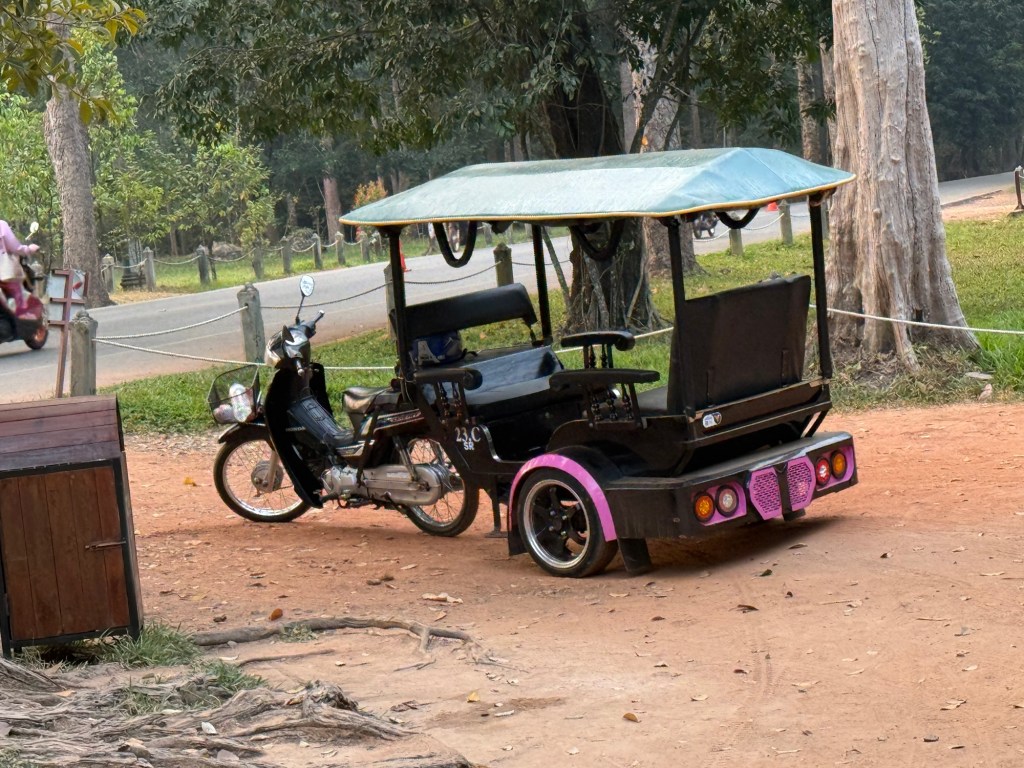
The Remok: Cambodia’s version of the Cyclo (Vietnam) or TukTuk (Bangkok)
The Remok
“A little templed out”
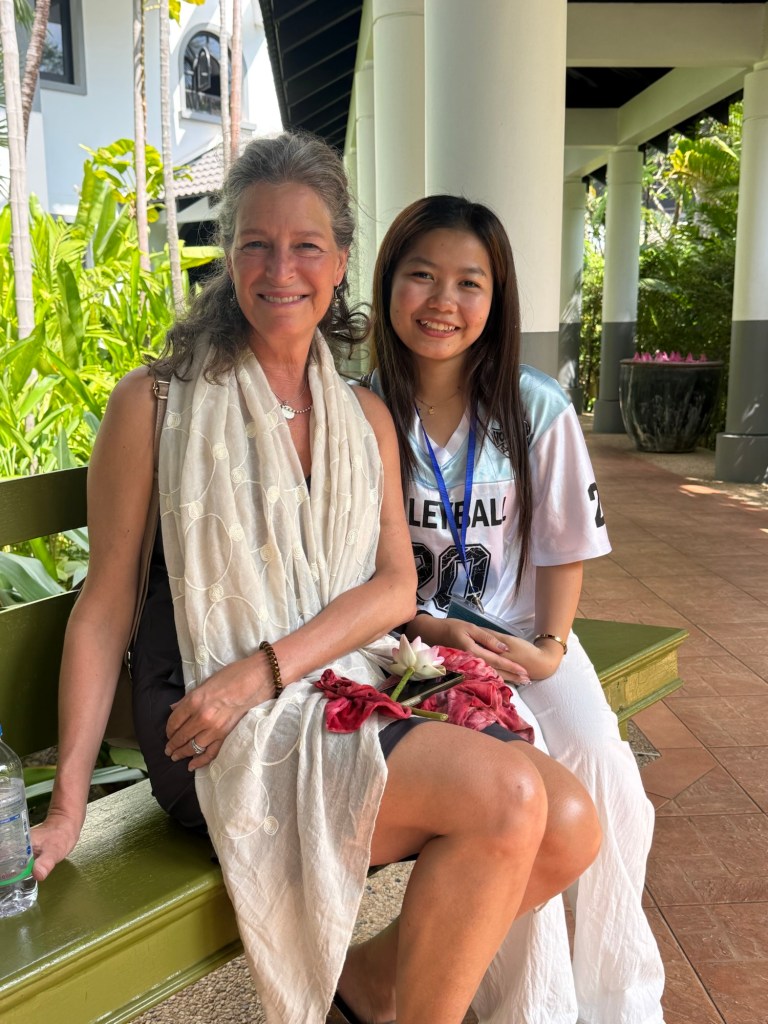
Ms. Moly. Justine met a lovely, warm and gracious young graduate of Shanta Mani hospitality training. Her role there allows her to support her entire family. They met again on our last day and committed to staying touch!
New Freinds
JuJu’s 58th: What a way to spend it! A visit to a 7th wonder of the world – Angkor Wat, a goodbye to Siem Reap, and a business class upgrade to a resort in Phuket.
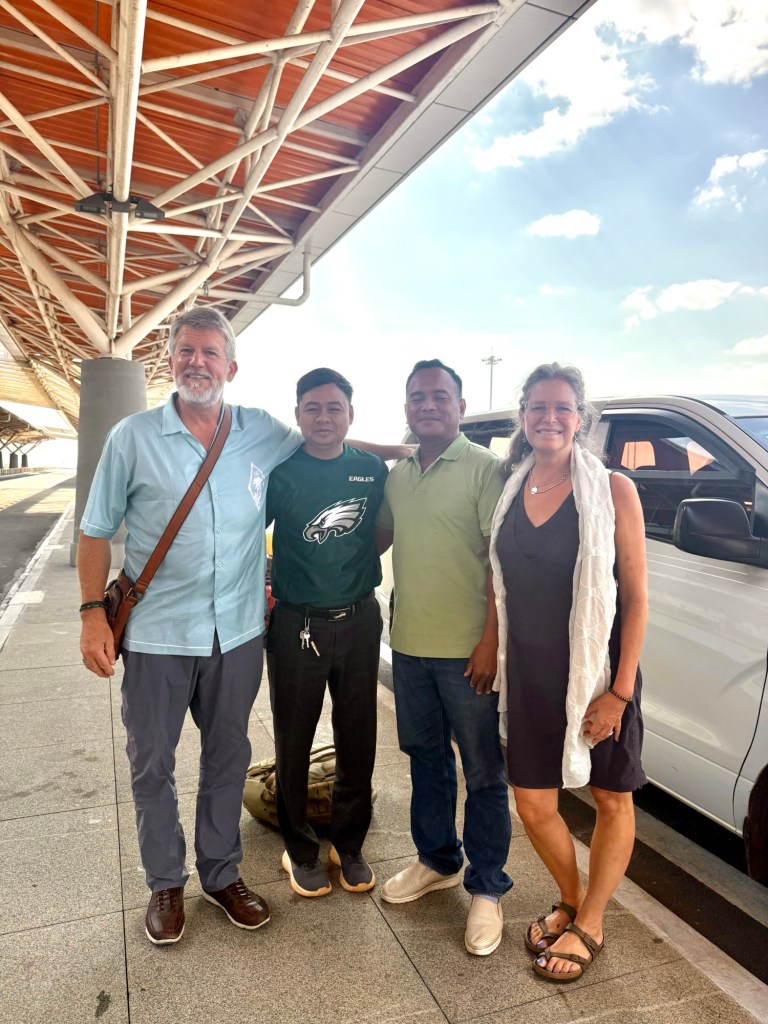
Goodbye! Thank you to our guide Rom (Seng Phearom) and our driver Ravouth. So knowledgeable, professional, and fun to travel with.
First some pre history – Animism dominated the area until the 1st century when Buddhism & Hinduism arrived at the same time from India. From the 1st to 12th century, the dominant empire, was the Angkor and Cambodia was 70% Hindu until about 400 A.D. A slow conversion to Buddhism accelerated under Java 7’s reforms and Cambodia is now 90% Buddhist. The Angkor Empire fell in the 1400’s after successive invasions by Siam (Thailand.)
The Cambodian Genocide: Pol Pot was the leader of the Kampuchea Communist party from 1963-75. He was a Maoist and believed society should retreat 400 years to be completely agrarian. He was supported by Vietnamese infiltrators, trained in Khmer, and had Chinese Communist weapons and financing.
Gaining control of Cambodia by uniting the hill tribes, he organized a new government and put his beliefs into radical action. He drove everyone out of the cities and systematically killed intellectuals, student, doctors and professionals.
But it evolved into the psychopathic and indiscriminate “killing fields” and 3 million people were murdered.
People were killed for having glasses. Feces checks identified anyone who was “over-fed” and their throats were slit. Soldiers were conscripted and their families were killed to keep them ideologically focused. Whole villages were burned alive for no apparent reason. 25-30% of the population was murdered in the name of one man’s ideology.
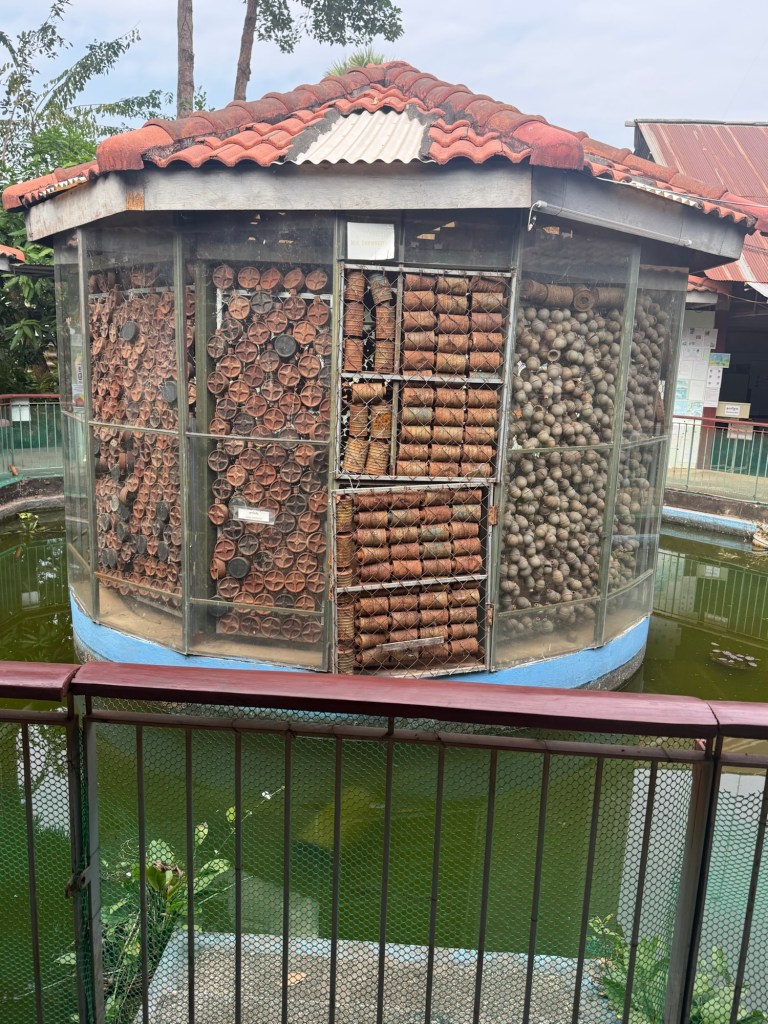
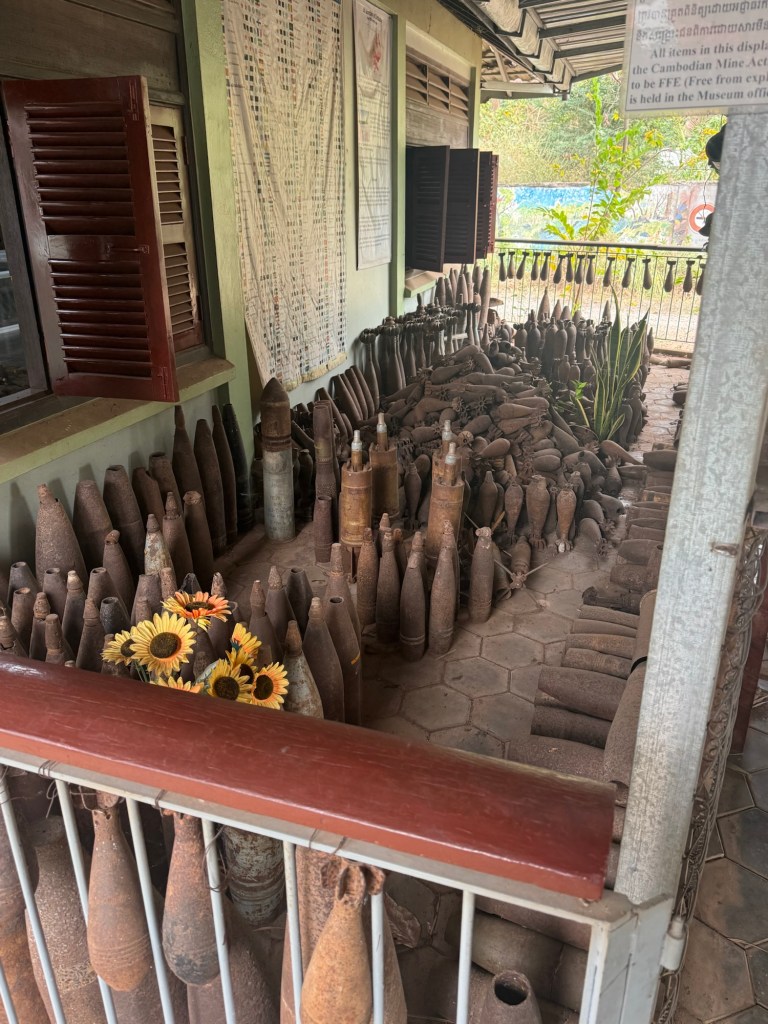
Cambodian Land Mine Museum: The visit here was harrowing. There were case after case of recovered Russian, Chinese and US mines, and also rooms full of unexploded ordinance.
27 million US bombs were dropped on Cambodia during the American War. 5 times that many mines were deployed. Millions still remain.
Mines were made to maim not kill. A dead enemy is quickly buried. An injured enemy requires evacuation, care, and resources.
Many of the staff were amputees, and we heard story after story of lives ruined and lives still being ruined on a daily basis (510 mine incidents were recorded in 2024).
Antipersonnel Mines – Designed to Maim Unexploded ordinance
Siem Reap, Killing Fields we visited a small killing field in a monastery in urban Siem Reap. We were wrecked by stories of mass execution, torture, and viewed a drinking well where hundreds were drowned and their skeletons recovered.
A Maoist social experiment of cooperative farms, the elimination of currency, forced marriage, child abduction and indoctrination started with destroying the existing structures, religion and economy. It devolved into a psychopathic killing spree.
From Pol Pot to now: Pol Pots government was defeated by the Vietnamese as Cambodian peasants joined them en masse. The VN ruled formally from 1979-89 until UN pressure for Cambodian independence (based on 1953 treaty w/ French) resulted in a Vietnam exit. Cambodians we talk to say it was a “show exit” and the Vietnamese and some Khmer still rule in the shadows today.
The first Cambodian election was in 1993 – and the Kings son won as Prime Minister. Later under an impending revolution the King made the guy who came in second (Hun Sun), a dual prime minister. Hun Sun ruled until 2023 when he won again. But he appointed the current Prime Minister in his place – his own son Hun Manet.
Both families are incredibly wealthy, and are heavily inter married. And both are rumored to have Vietnamese or Khmer Rouge roots and connections. There is zero tolerance for public or press criticism and even the stories above were delivered in a whisper.
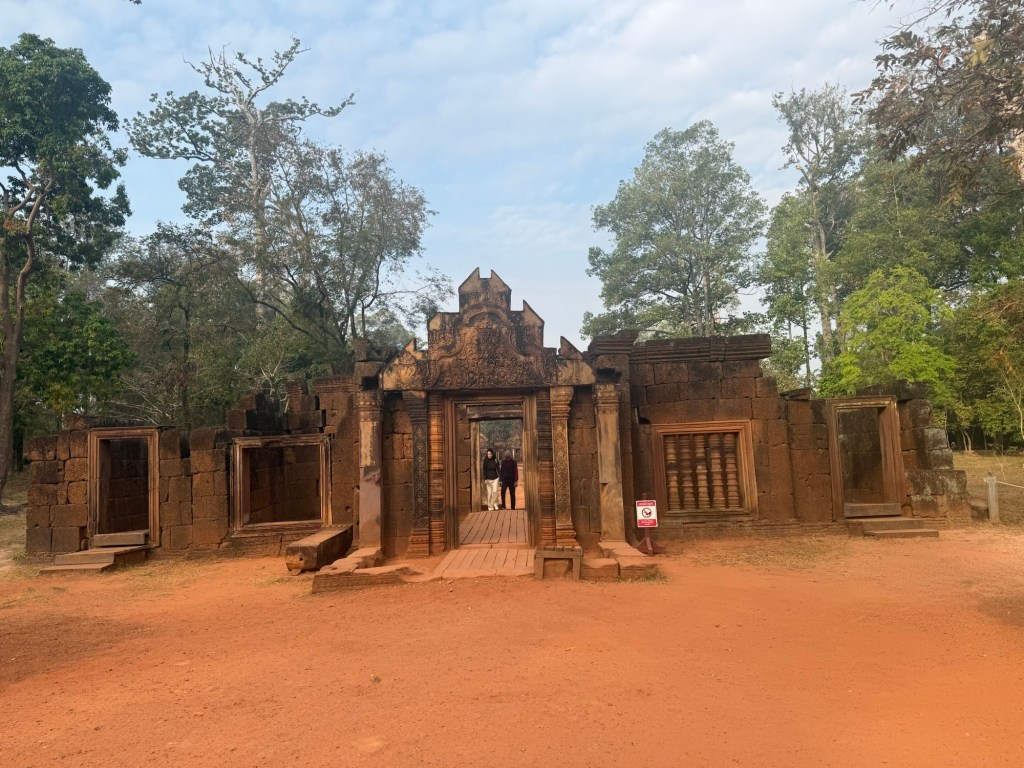
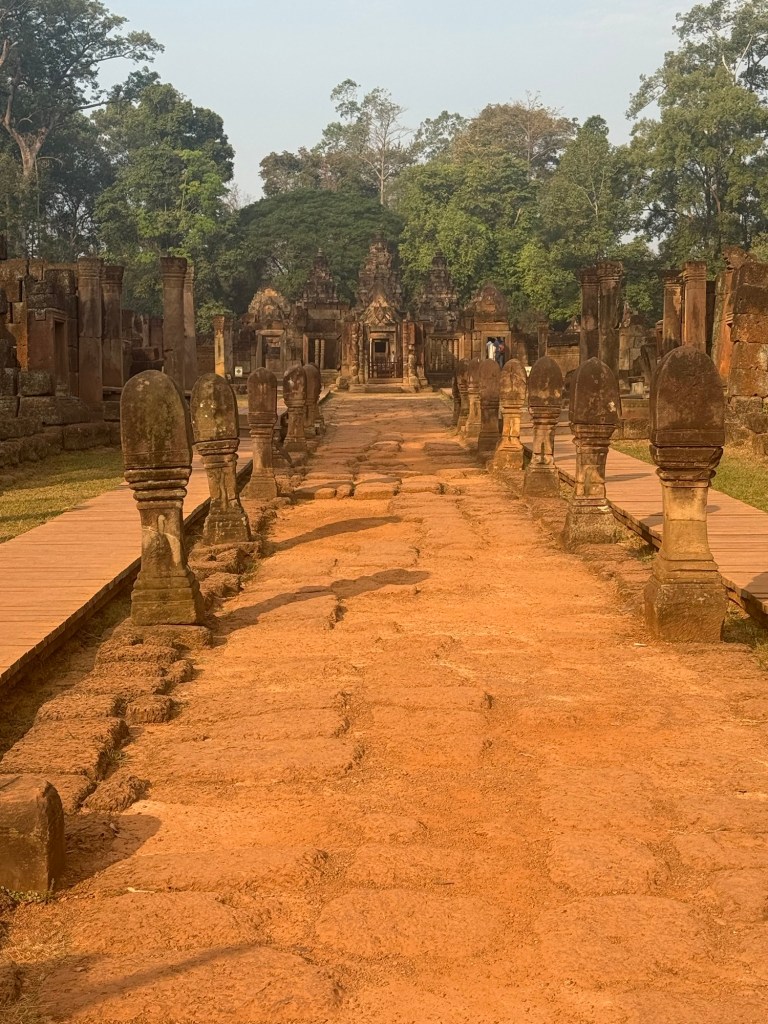
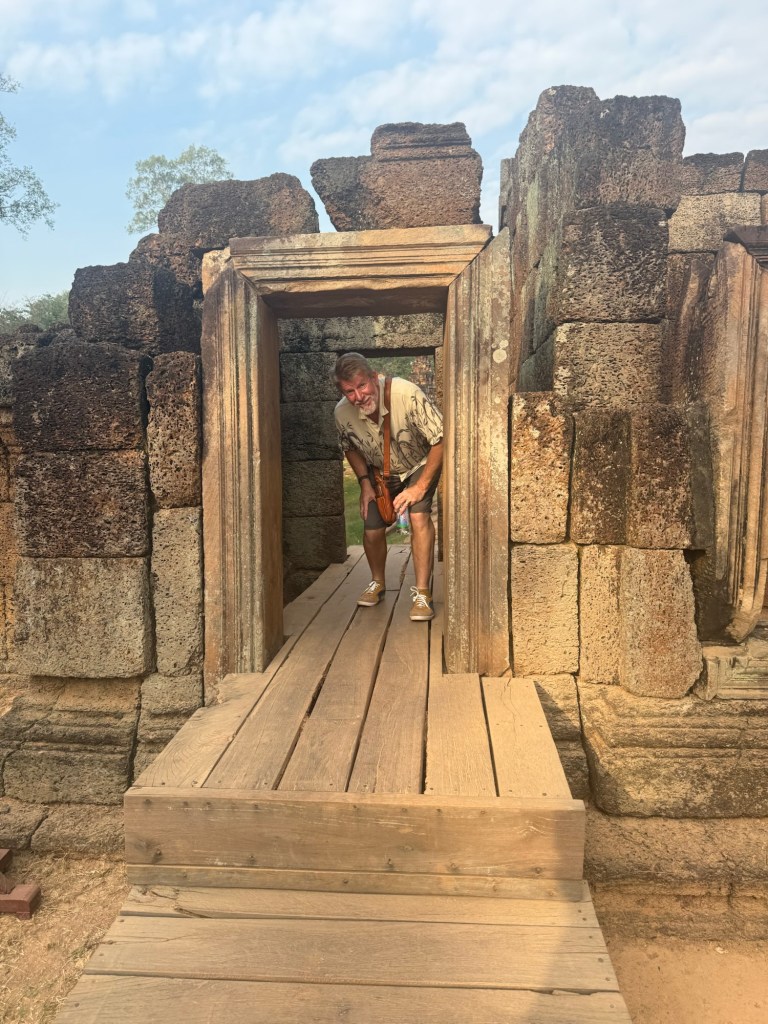
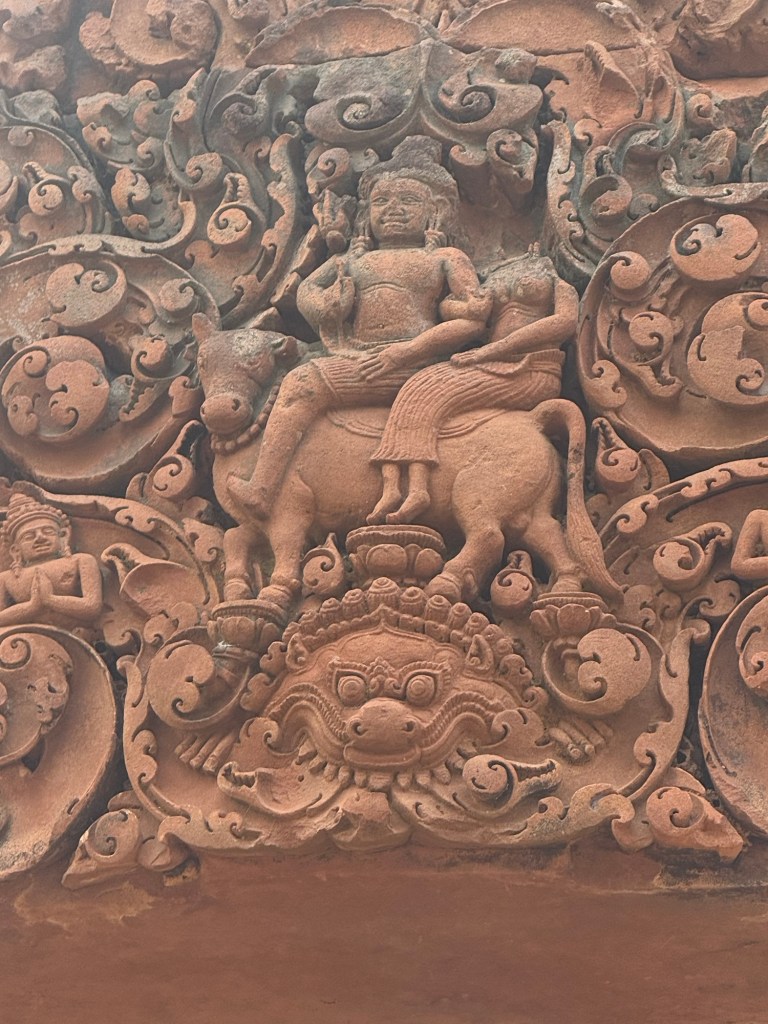
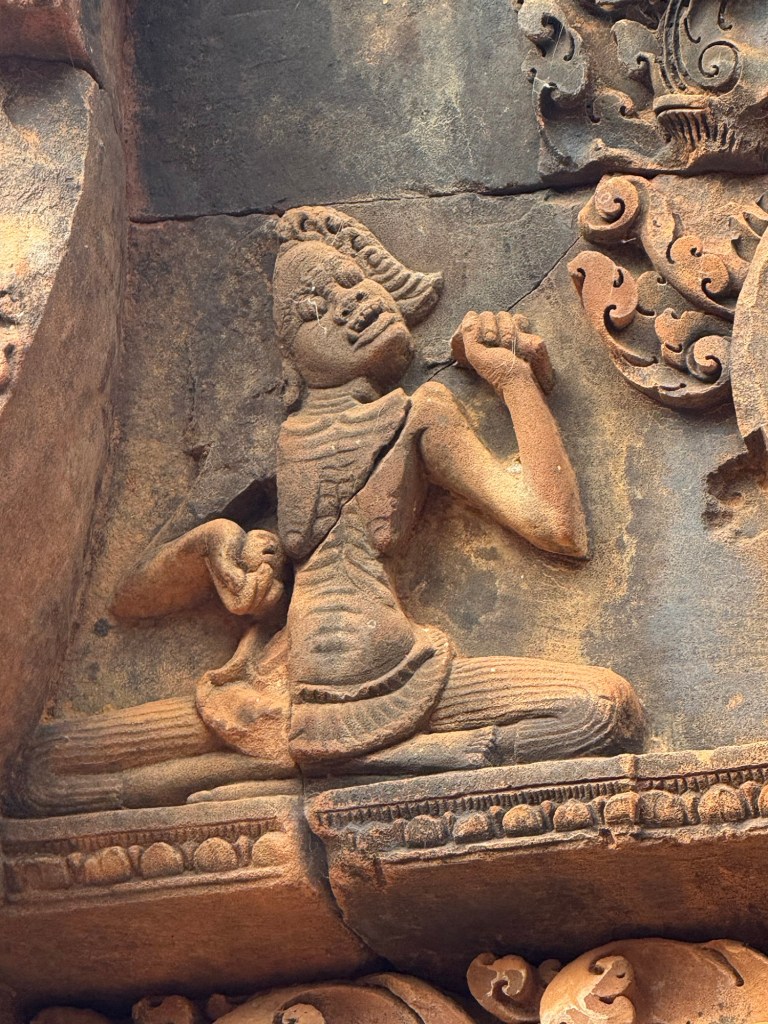
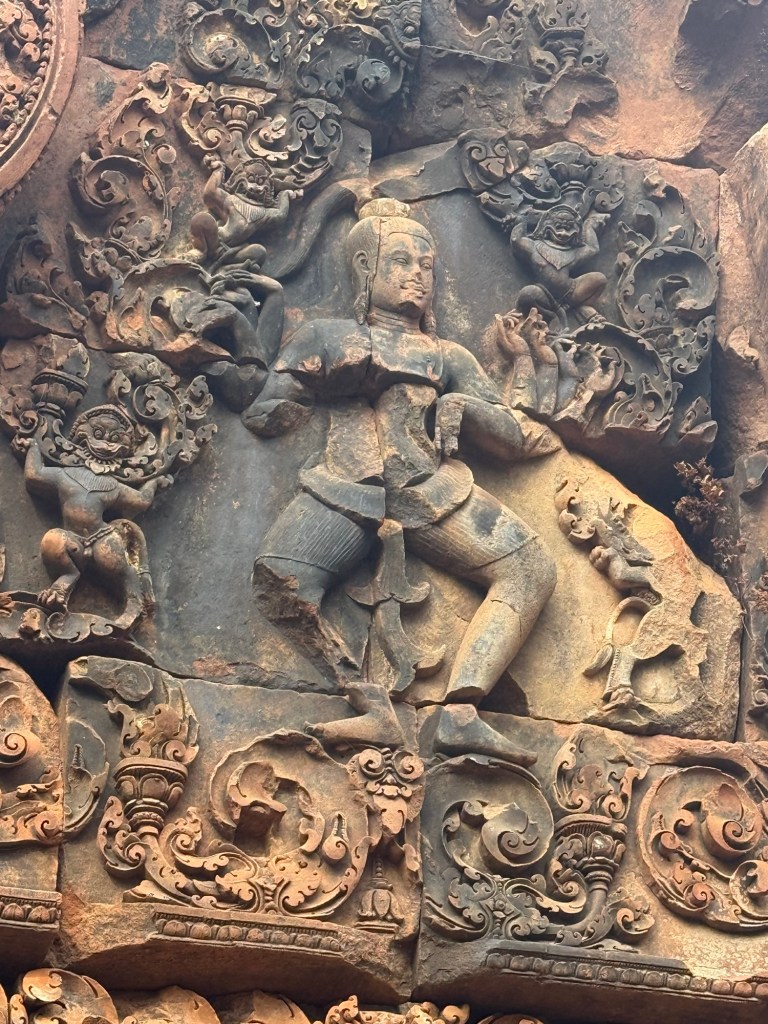
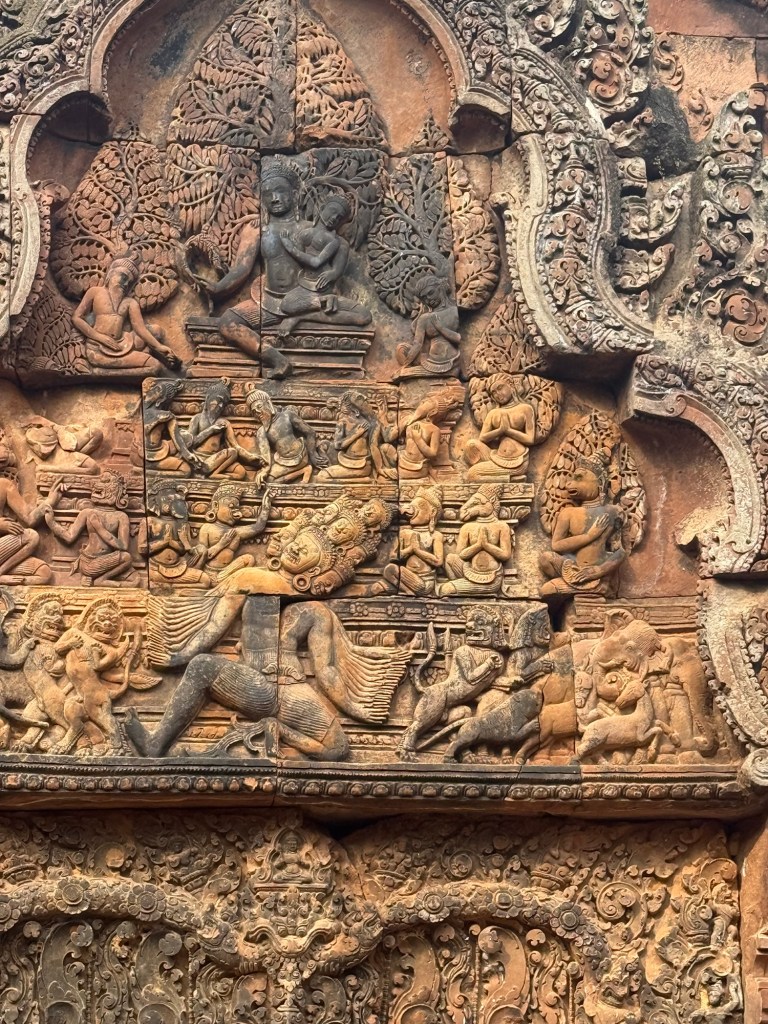
Wednesday 7 AM, we travel to Banteay Srei, a 10th century Hindu temple that predated everything we’ve seen. Much more ornate and preserved, it’s called the Lady Temple because of the carefulness of the work.
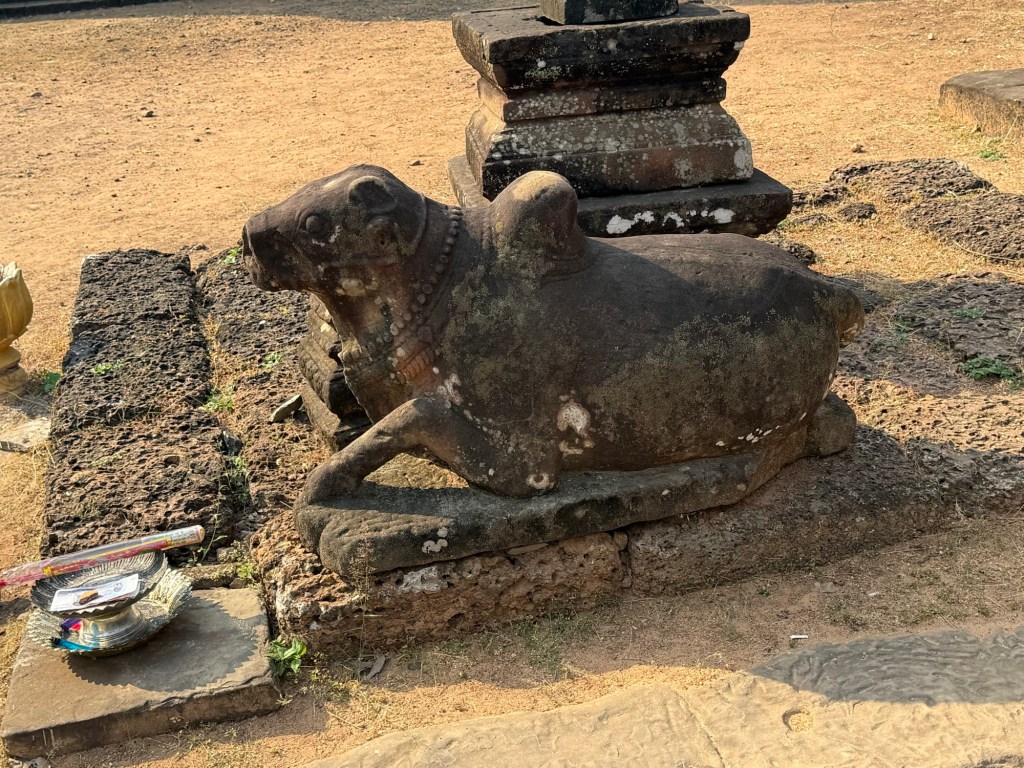
Banteay Srei TempleCausewayLow entrances force you to bow on entering Vishnu – God of Earth on the Sacred Bull Nandi.Nani – aged by Vishnu to prevent war over her beautyMany Armed Shiva the DestroyerDemon King (10 faces, 20 arms), shaking the mountain to interrupt Shivas meditation
Some how I missed Darma, the Creator. But she, Shiva and Vishnu are the theee most important entities. There are hundreds, and many have reincarnated 5-10-20 times with a new manifestation each time. Gonna leave it there.
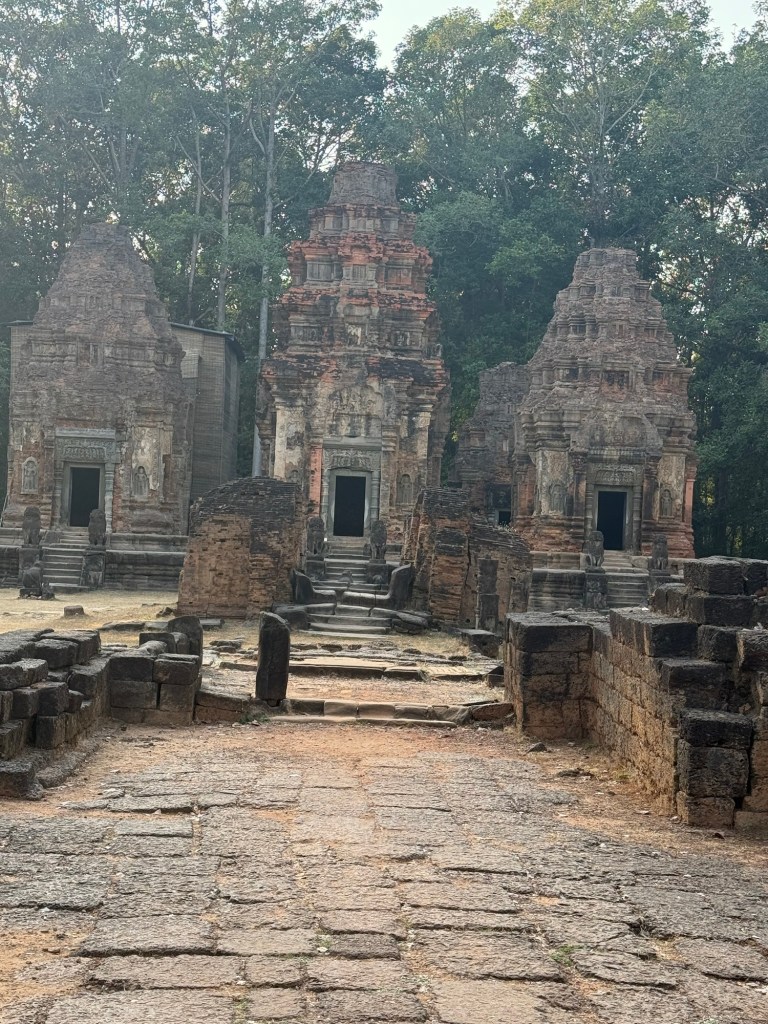
In the afternoon we toured the Rouluos Group, current name of Hari Haralya, the capitol city of Cambodia in the late 9th Century
The emperor Rouluos, like Jaya 7 sought to make space for both Hindu and Buddhist – placing Buddhist monasteries and temples on the grounds of Hindu temples.
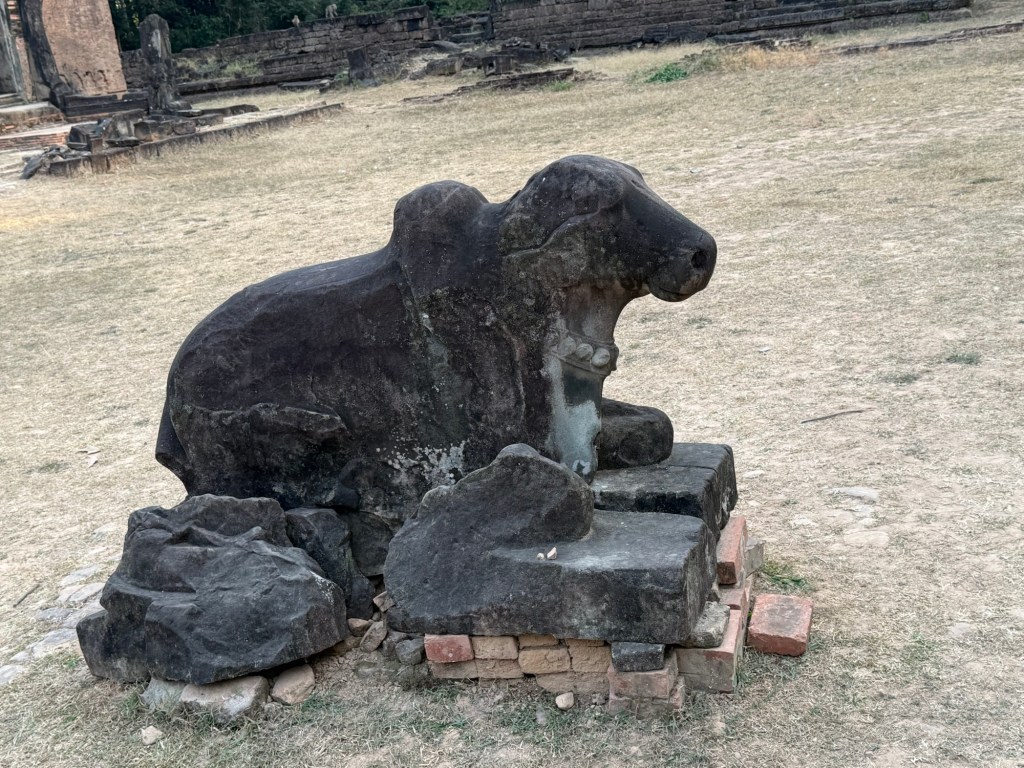
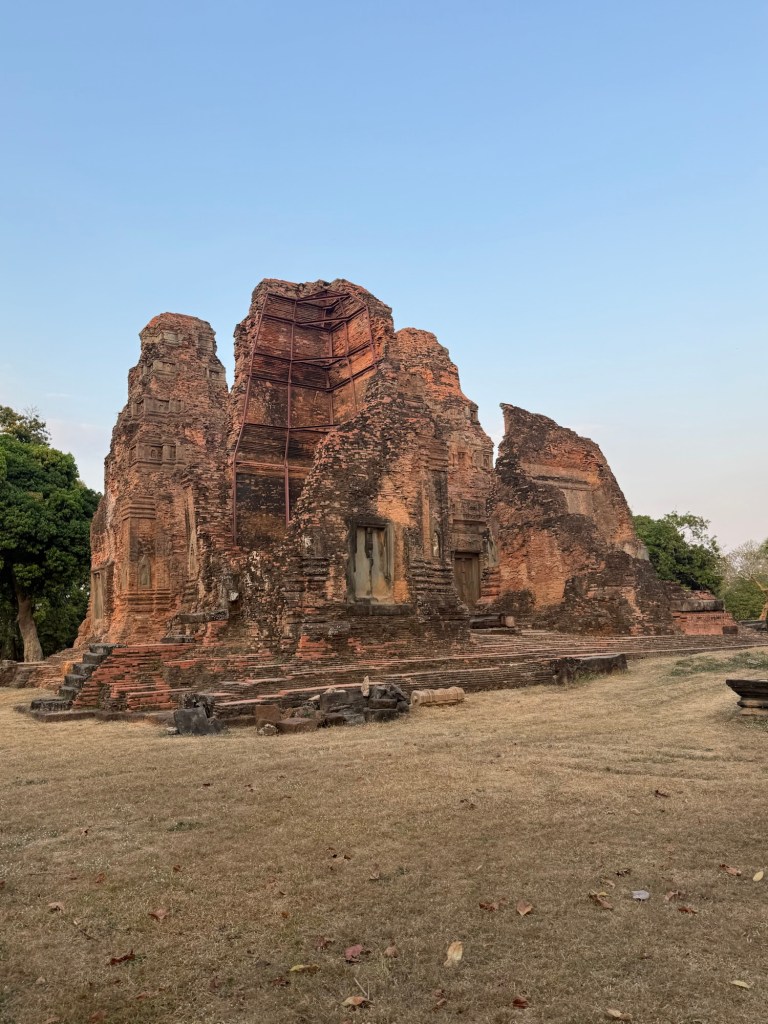
The first, Preah Ko was brick covered with Stucco and built to honor Shiva (lots of Nandi). It also included a tower, out of the way in the back, for his In-laws.
Preah KoThe Cow Nandi
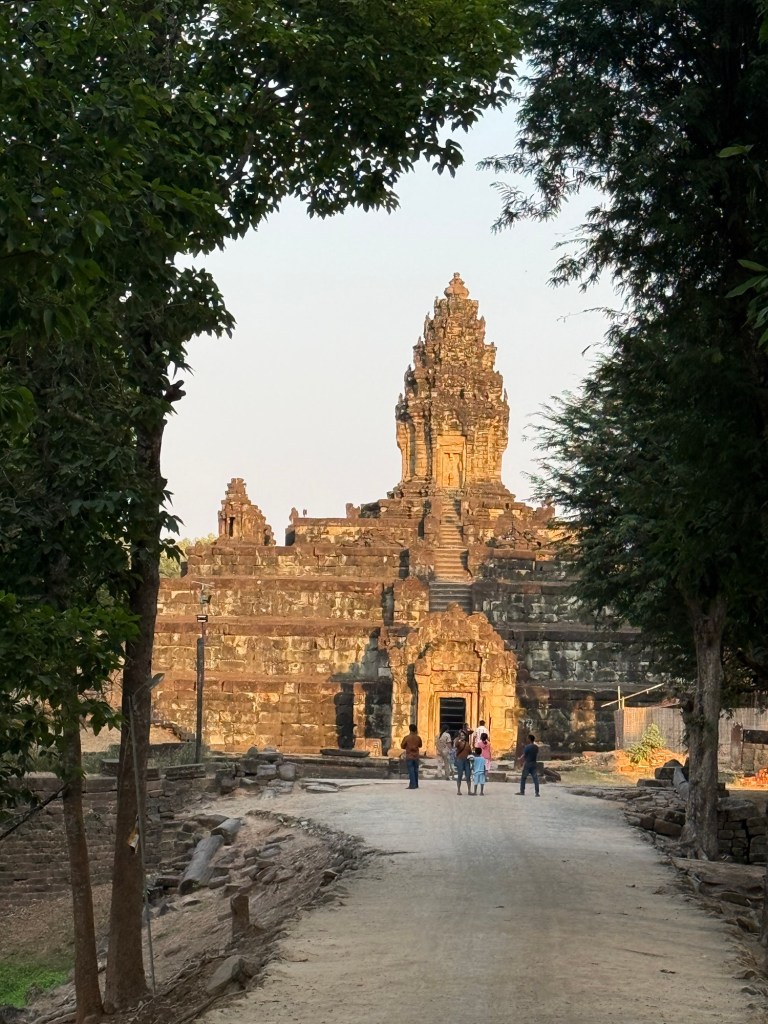
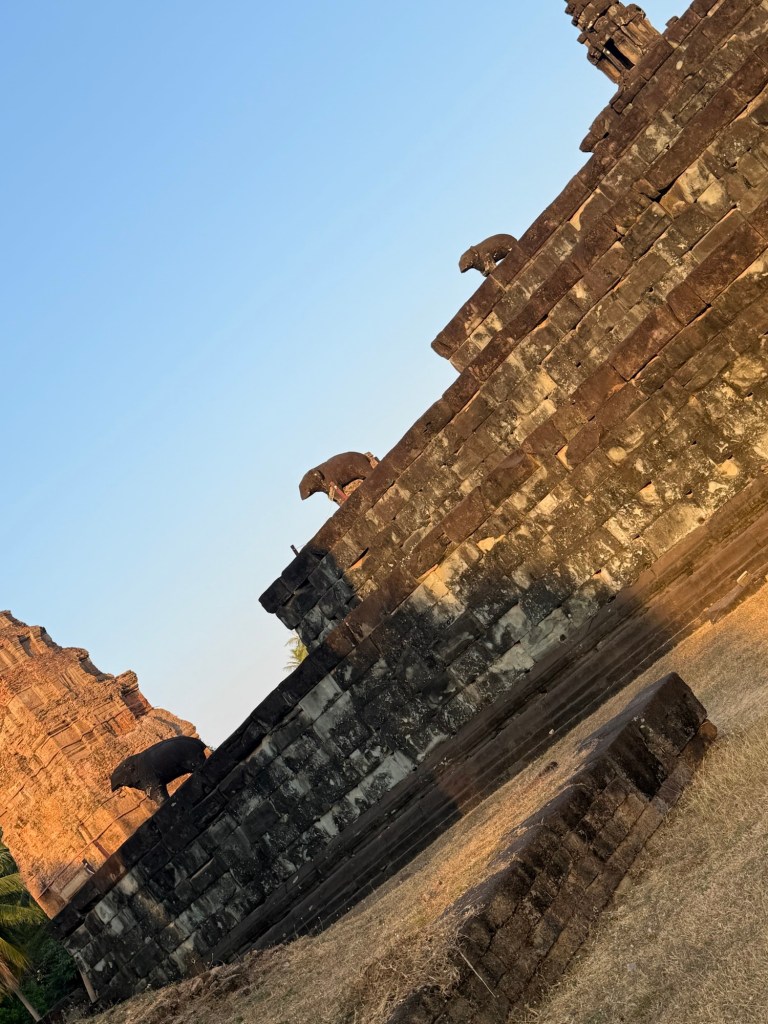
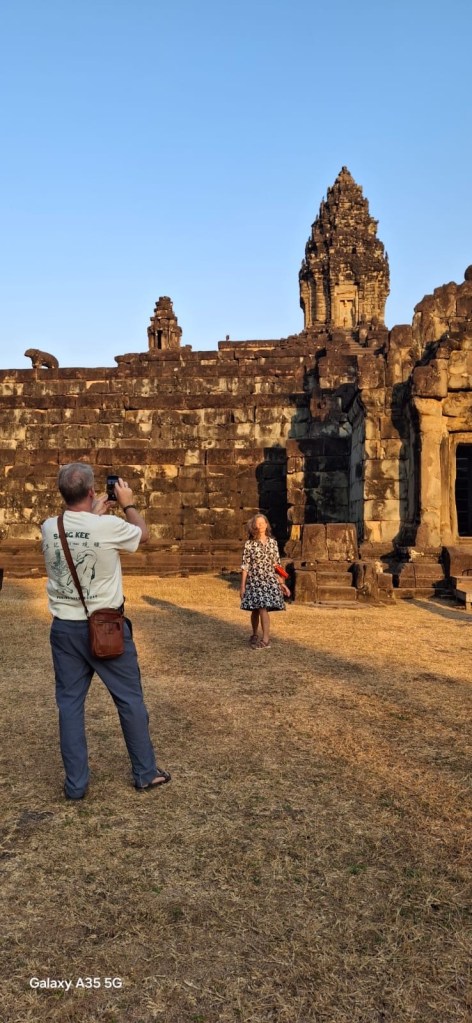
The second, Bakong Temple was also for Shiva and included the King’s stupa. . It was the first five tier temple and the first to include stand alone Naga on the causeways.
BakingElephant GaurdiansPrettying up a Trmple
The third, Lolei Temple was built in 893 AD in the center of a reservoir. It is compact but beautiful. A series of gates and Naga connected it to land and it included boat landing docks on the far side (we parked there as the reservoir is now dry.)
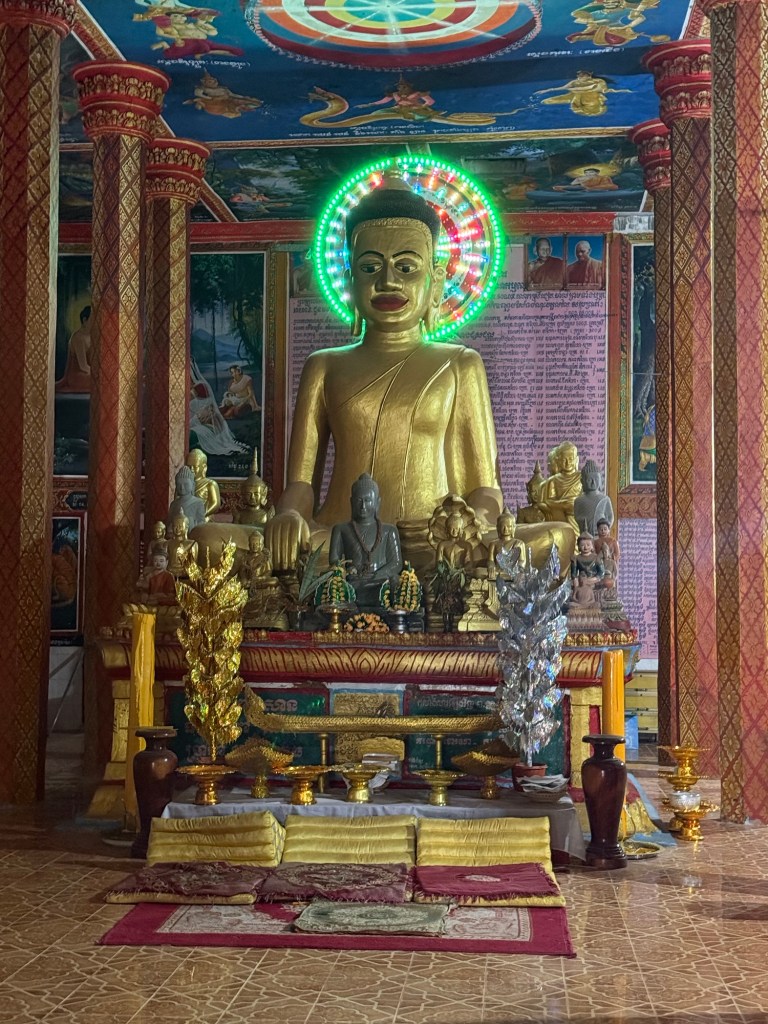
LoleiRom and JuJuNew Friends for the GarangElectric Buddha in the Monastery at Lolei
There’s something far, far away about the name itself. Cambodia is a country of 17 million people, 90% are Buddhist (but with a strong Hindu history and a lot of hybridization). The balance are a few Muslims from Java, and a few Christians – mostly Korean ex-pats, or refugees from oppression in China.
Cambodia is a democracy on paper. But the same family has been on the throne or leading the parliament for 40 years. Voting is universal. But it’s largely a symbolic support for the family, and a protest recognizing the end of Pol Pot’s murderous communist regime. Free speech or criticism of the royal family is not a thing.
The country is a bowl, ringed by high mountains. The result is near complete protection from annual Typhoons. The climate is warm and water is plentiful due to a 5 month rainy season from March to August. There is a deep lake at the center (the deepest in South Asia) that serves as a drainage basin and prevents flooding. No flooding, no typhoons – so two full rice harvests, and lots of surviving ancient architecture.
Travel here is about Temples. Angkor Wat is the largest and most famous (by law, no building in Siem Reap can be built taller). But there are 1,900 ancient and significant temples in Cambodia.
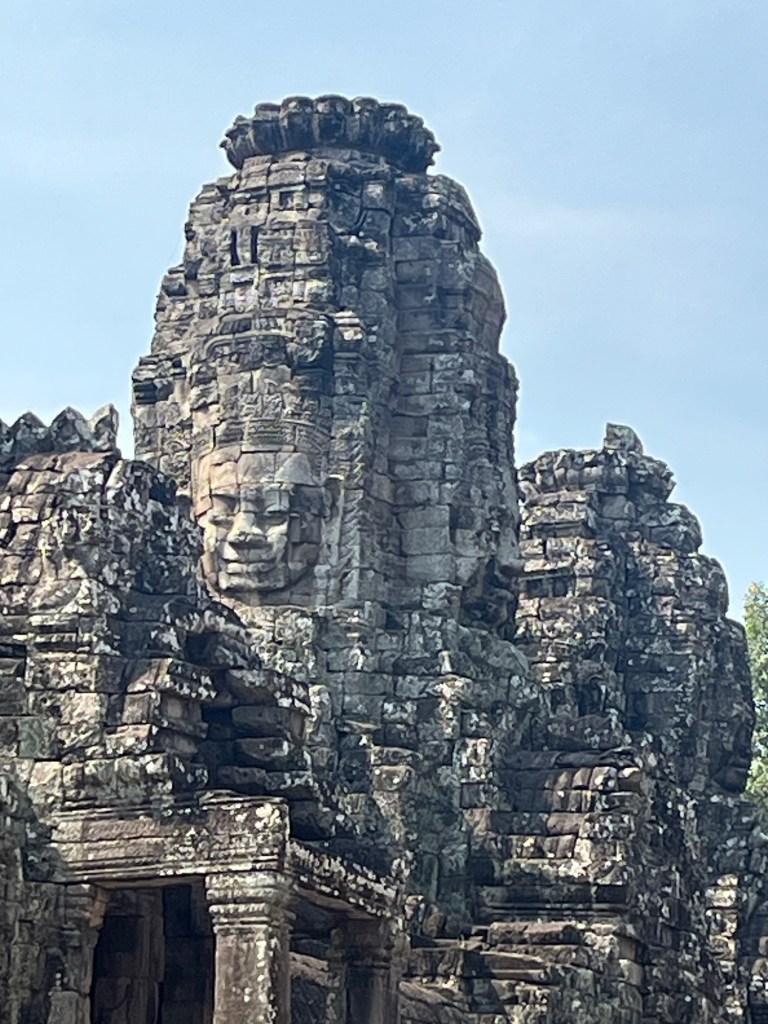
Boyan Temple
The Cambodia’s Golden Age was 1200-1300, and particularly the reign of Jayavarman VII (or Jaya 7), the strongest leader of the Angkor Empire.
Cambodia’s Dark Ages were only 40 years ago when the Khmer Rouge under Pol Pot murdered over 2 million people (25% of the population at that time) in a Communist purge from 1975-79.
They killed all students and professors, doctors and professionals, and drove the citizens out of the city enslaving, starving and massacring them whole cloth. This oppression and death continued for 4 years and is a psychic scar on everyone we meet.
Everything in Cambodia seems to revolve around one of these two histories. The current generation still includes victims of Pot. But the pride and zeitgeist (and business) spans back to Jaya 7.
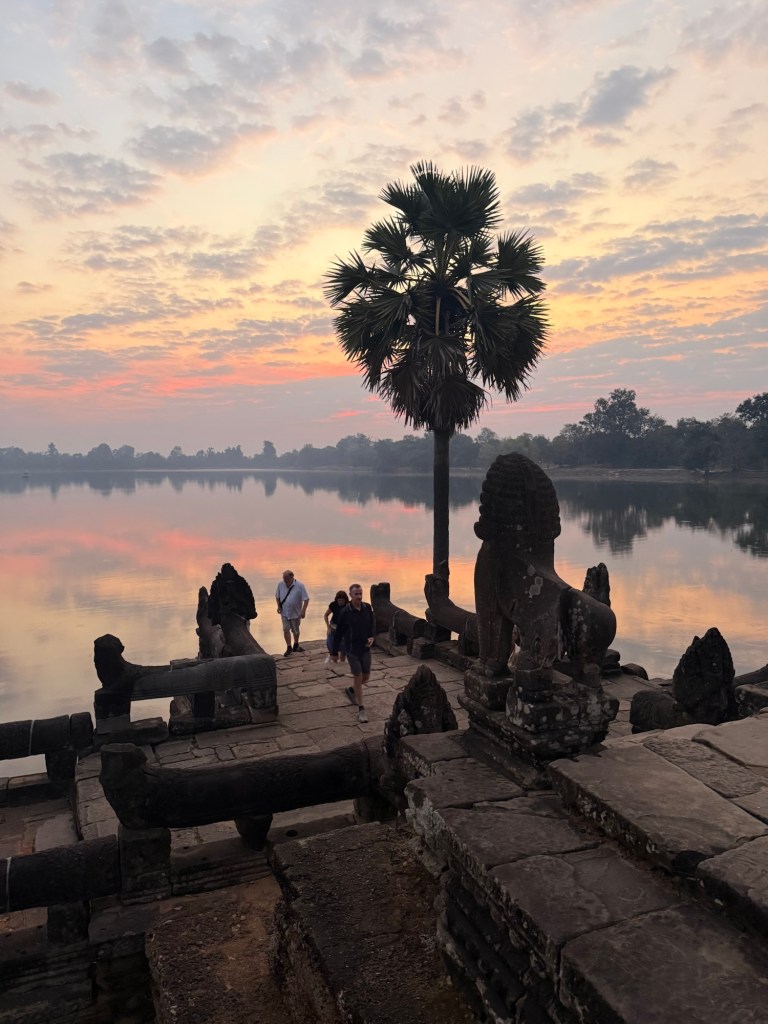
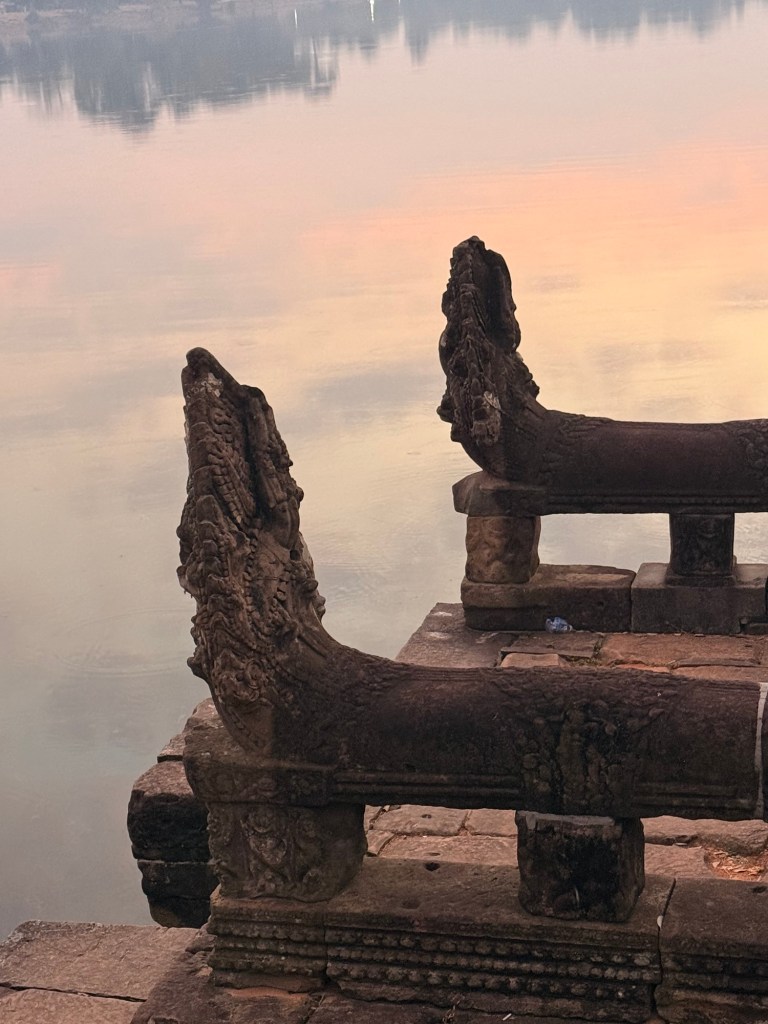
We started our day at the temple of Sras Srang, watching the sun rise over a gigantic 8×12 kilometer hand dug reservoir. Constructed under Jaya 7, the reservoir served the entire community with drinking water, communal swimming, rice irrigation and worship.
Seas Sarang Reservoir at Sunrise
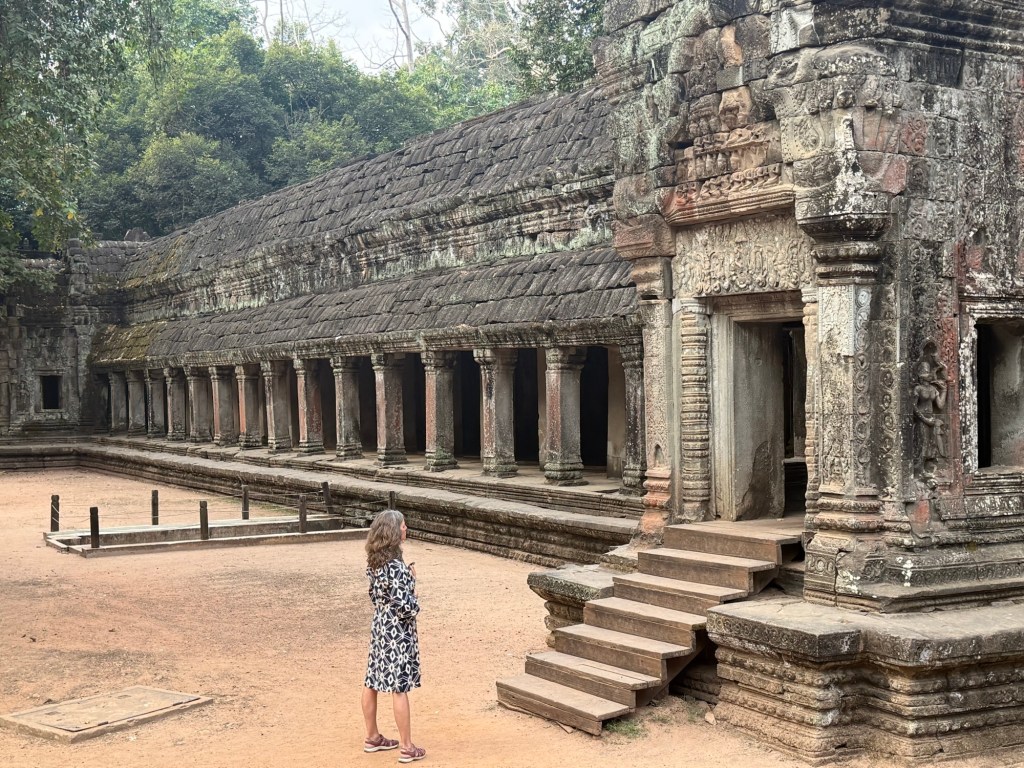
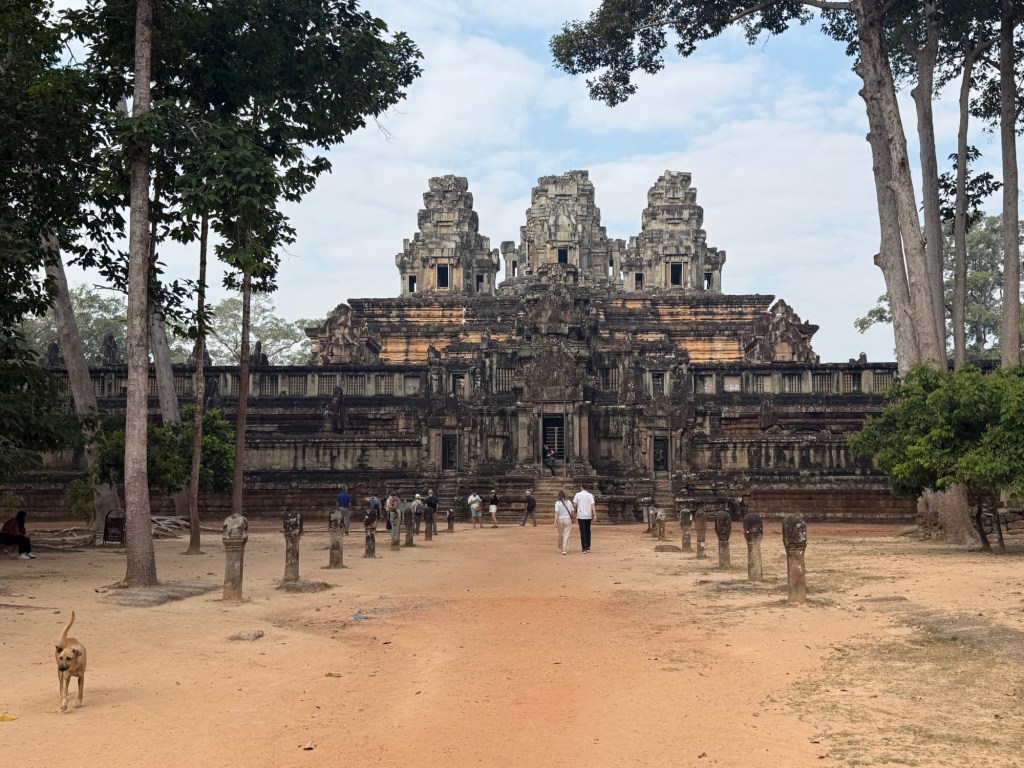
Sun up, we made visits to two other temples Ta Prohm, and Takeo.
Ta Pram Ta PramTa KeoTa Keo
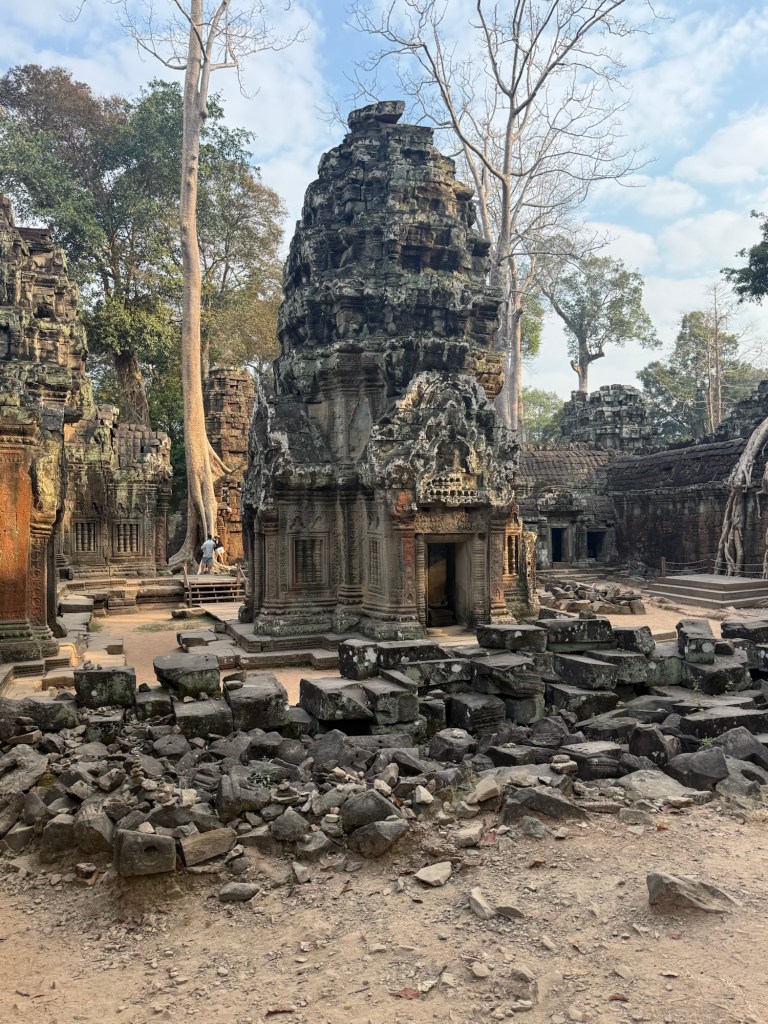
The temples are fascinating. Generally built communally as acts of worship, the bases are laterite – a form of quartz. The tops are sandstone, allowing the most intricate carving imaginable. The temple structure is built from the bottom up. A second set of craftsmen does the carving – from the top down!
The temples often structurally represent Meru, the home of the Gods. Meru is sounded by rings of 7 seas and 7 mountains. And the gates and moats that surround the temples are representative.
Some of the largest and most ornate temples are also Stupa, burial places for the Kings
Like Mayan, Aztec and Egyptian sites the temples are built on exact NSEW axis and frame Cellestial events (like the sunrise, spring equinox, etc) with mathematical precision. A mystery best explained by Aliens I think.
Many of the temples were destroyed during an invasion by Siam (historic Thailand) in the 14th century. They were literally pulled down by elephants!
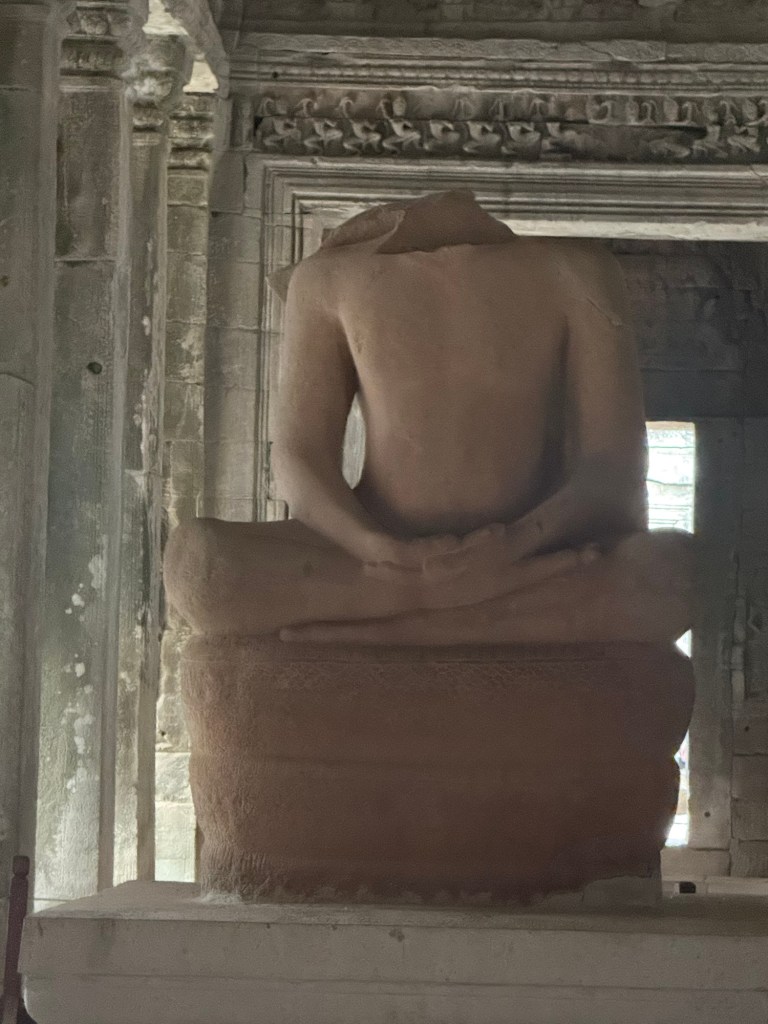
Many others were defaced as a backlash against the transition away from Hinduism under Jaya 7. Most of the Buddhas have been chiseled out. Others have been changed to include a Hindu third eye, or recarved into Hindu deities or lotus flowers.
Headless BuddhaBuddha “hole” at center
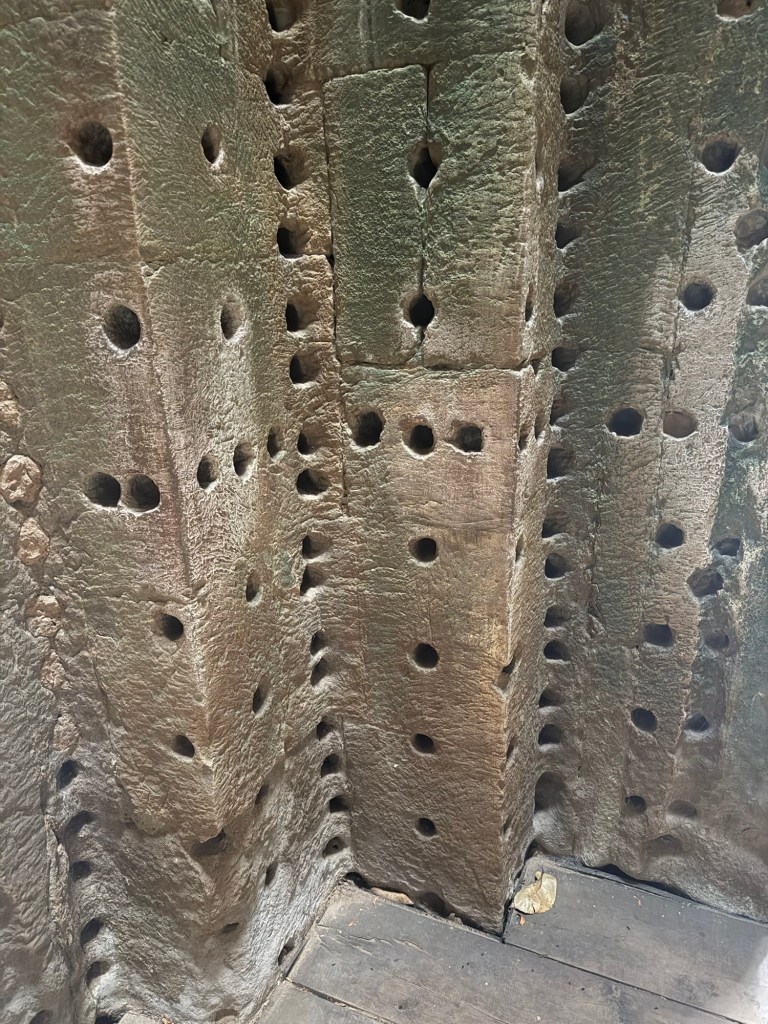
In the 16th through 20th centuries Western treasure hunters stole many of the gold artifacts and jewels. Each hole in the shot below was a large, rough cut precious gem (typically rubies, emeralds or sapphires). These were chiseled out in the early 20th century ala Indiana Jones. If you own a ruby today it’s as likely to have been stolen from a Cambodian temple as mined for you anywhere else.
Stolen gemstones
From 1975-85, the Kmer Rouge shelled and mined temples in their manic quest to purge all religion and history. More damage.
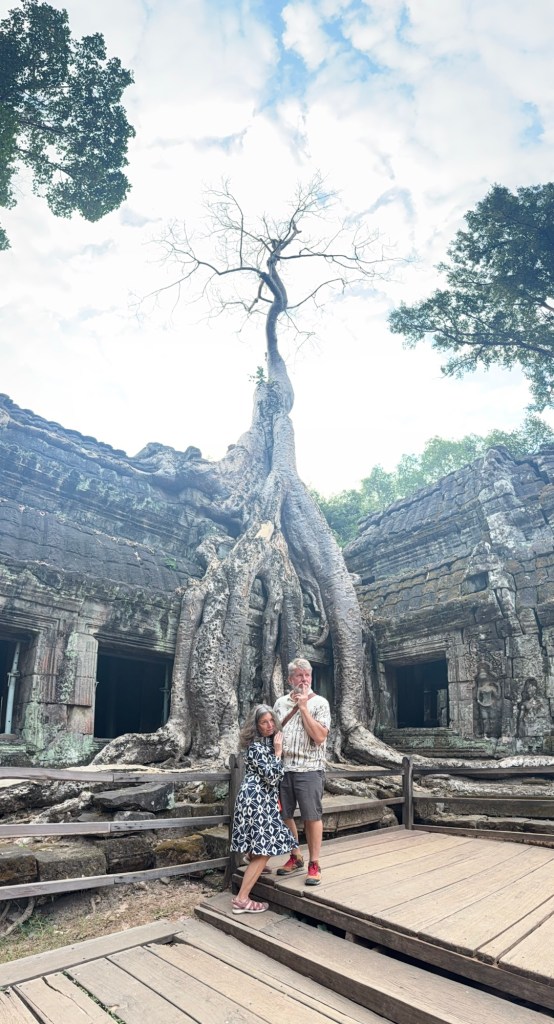
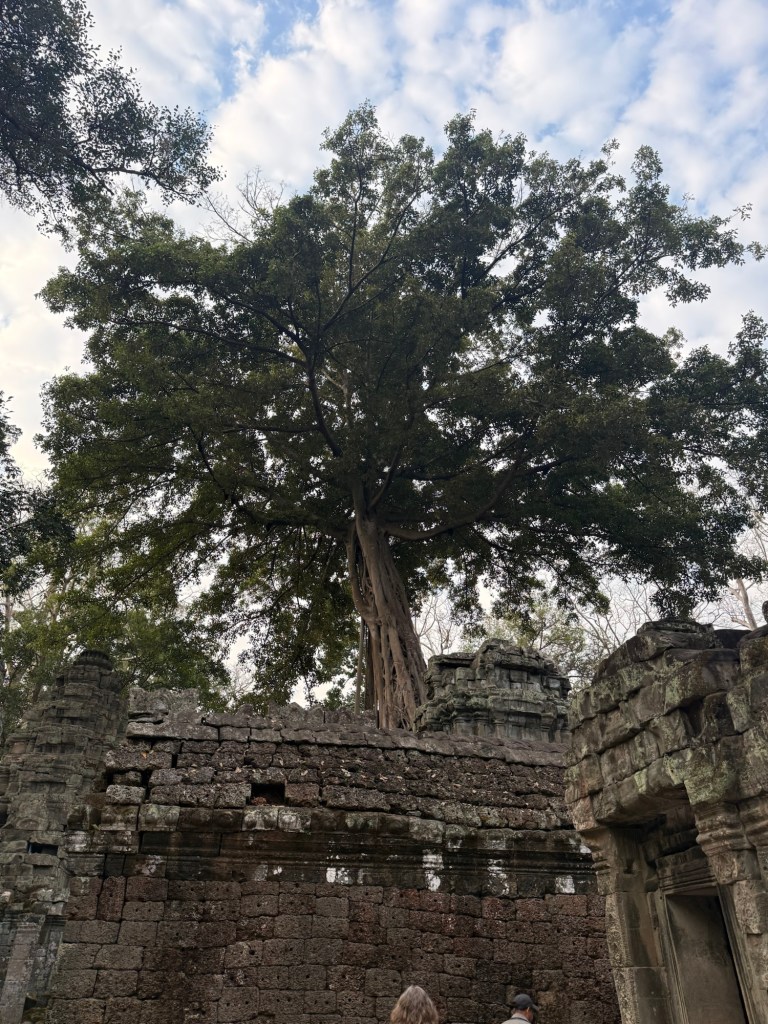
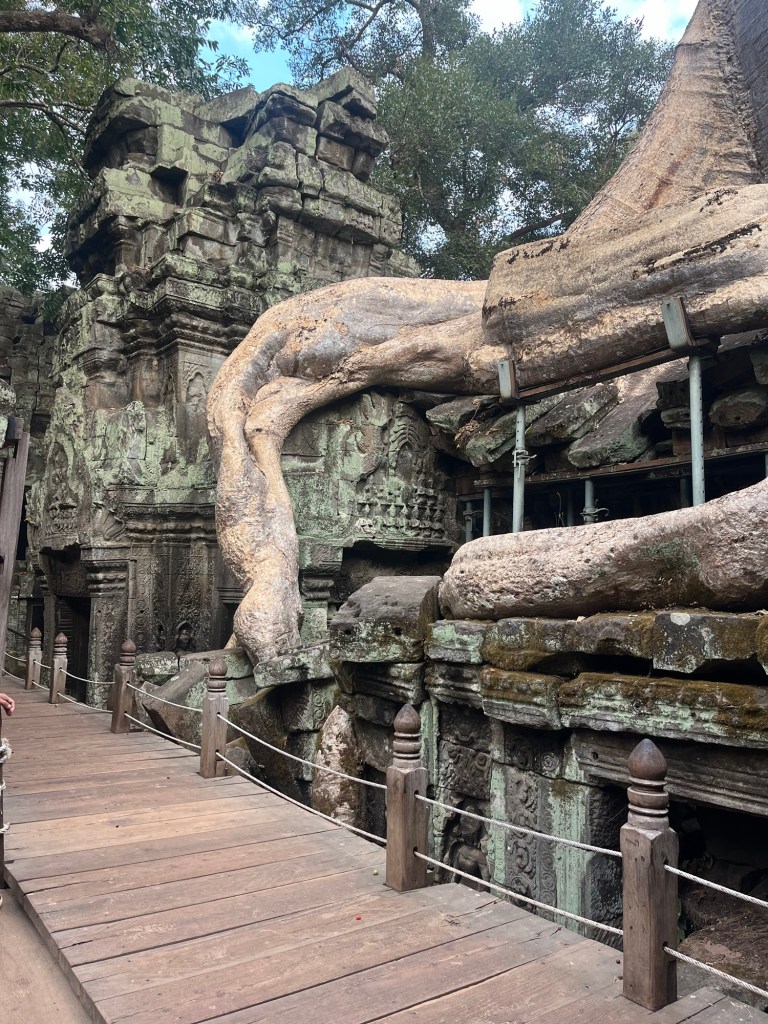
Even today the jungle itself is pulling sections apart as gigantic (protected) trees grow through and over the stones.
Ficas Invasion50 Foot Tree150 year old roots
85% of the damage and loss is man-made. From the Hindu desecrations of Buddha to the destruction by Siam to the Khmer Rouge – noone knows how many temples were fully destroyed and scattered – fully gone.
What’s most amazing is what’s standing today. UNESCO has 90 temples under restoration. USAID had another 20 (we’re really sorry Cambodia). Many other global agencies and many Chinese NGOs have done or are doing miraculous restorations. Later temples and current restorations were often built from stone scattered by the Siam invaders. Each temple is a story of what was, what happened, what’s restored, and what they’re working on.
Incomplete tower at Bayoun
Rom points out each spot where a Tomb Raider scene was filmed. We also learned that both Vietnamese and Cambodians are a little Angelina Jolie obsessed.
Describing each temple and the detail Rom shared would be almost impossible here. The dude is encyclopedic. I’ll try and describe some common themes and features of the temples below. And I won’t try and describe where Hinduism and Buddhism start and stop.
The hybrid Buddha/Hindu traditions spin out a variety of characters that are featured in the temples
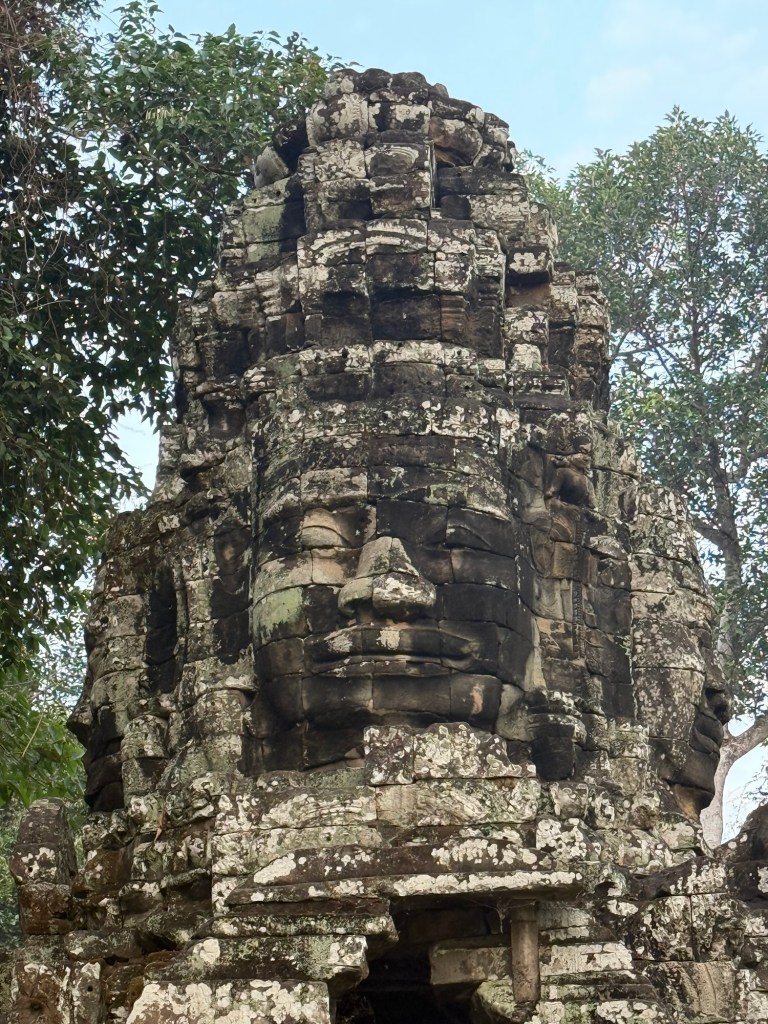
The Buddha – Before the Hindu and Siam defacements many towers had 4 Buddha faces pointing North, South, East and West. In Cambodian the four faces represent equanimity, compassion, loving-kindness, and appreciative-joy. These features are the goal of each real Buddhist as he seeks enlightenment. It seems like there are a hundred paths. But both Juju and I see it every moment in the culture, and friendliness of the people.
Buddha Tower
Jaya 7 – Jayavarma VII, also known as Mahaparamasaugata (1122–1218),
This guy! During his 50 year reign he built 189 temples, an entire royal city, 102 hospitals, 120 rest homes for pilgrims, public universities, extensive reservoirs, and 170 miles of moats.
He conquered a couple of neighboring countries, and established a governing system of 12 regional kings. As a side gig he basically started a new hybrid Hindu-Buddhist set of governance, ceremonial practices and architecture that stopped a millennia or so of blood shed.
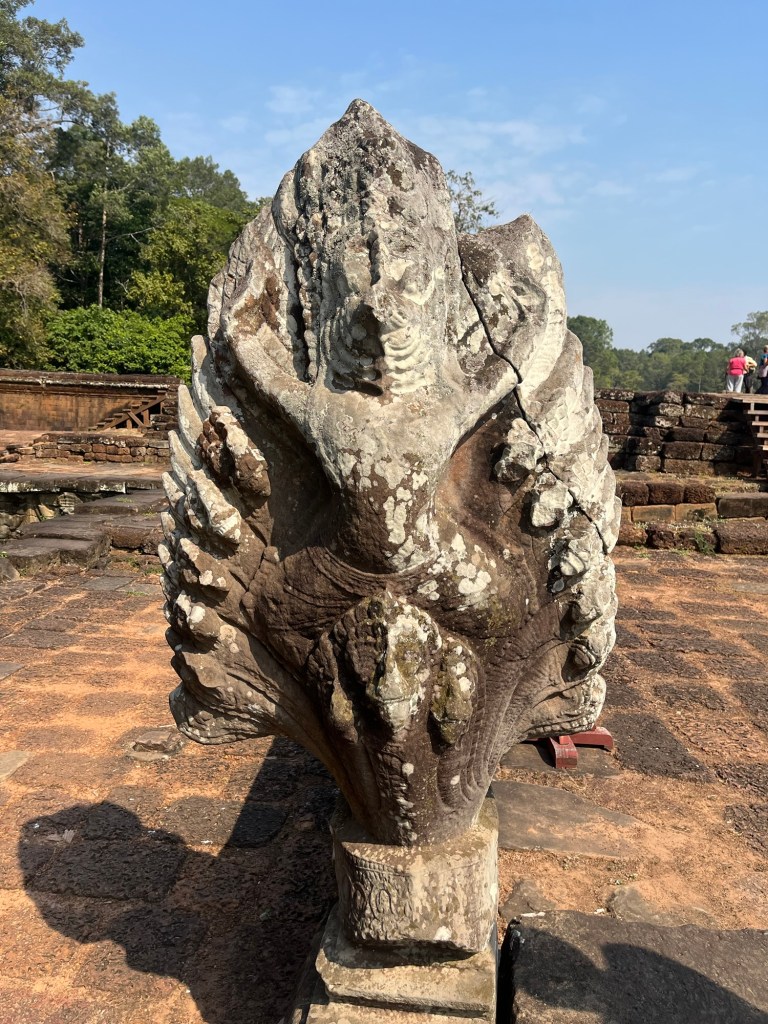
Naga and Nagini, Demons and Gods – Vishnu (the God of Men) negotiated a truce between Gods and Demons so their warfare would not destroy the earth. It involved two huge snakes wrapped around an island and pulled back and forth by the two armies. This spun the island, churning the sea and producing the nectar Anrita which gave the gods immortality.
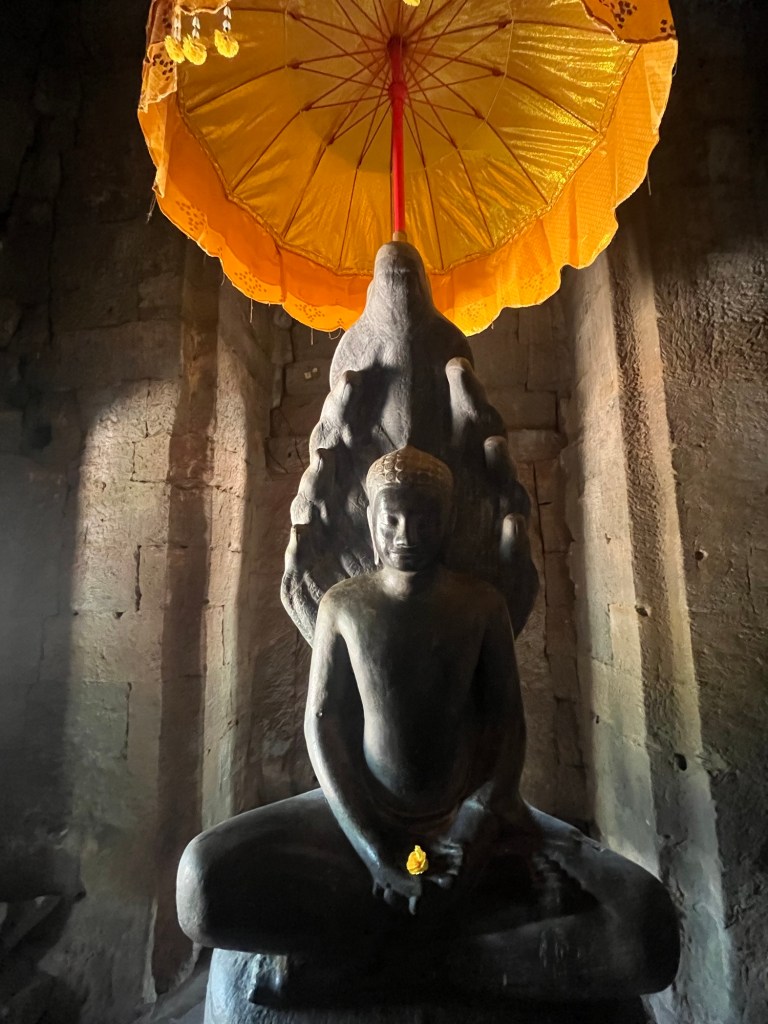
It also spawned a variety of new characters. The huge snakes, Nag and Nagini are featured as rails, roofs, and head covering for the Buddha in every temple. Kipling, of course, used them as primary character names in Riki Tiki Tavi.
Naga shading The BuddhaNaga and Nagini
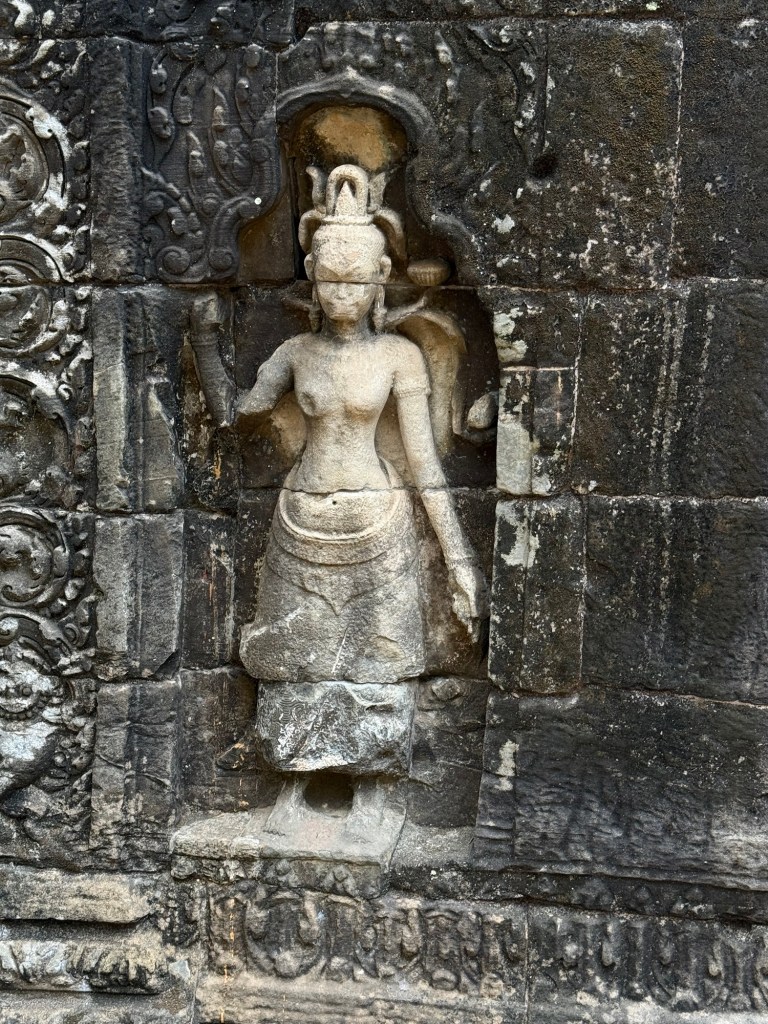
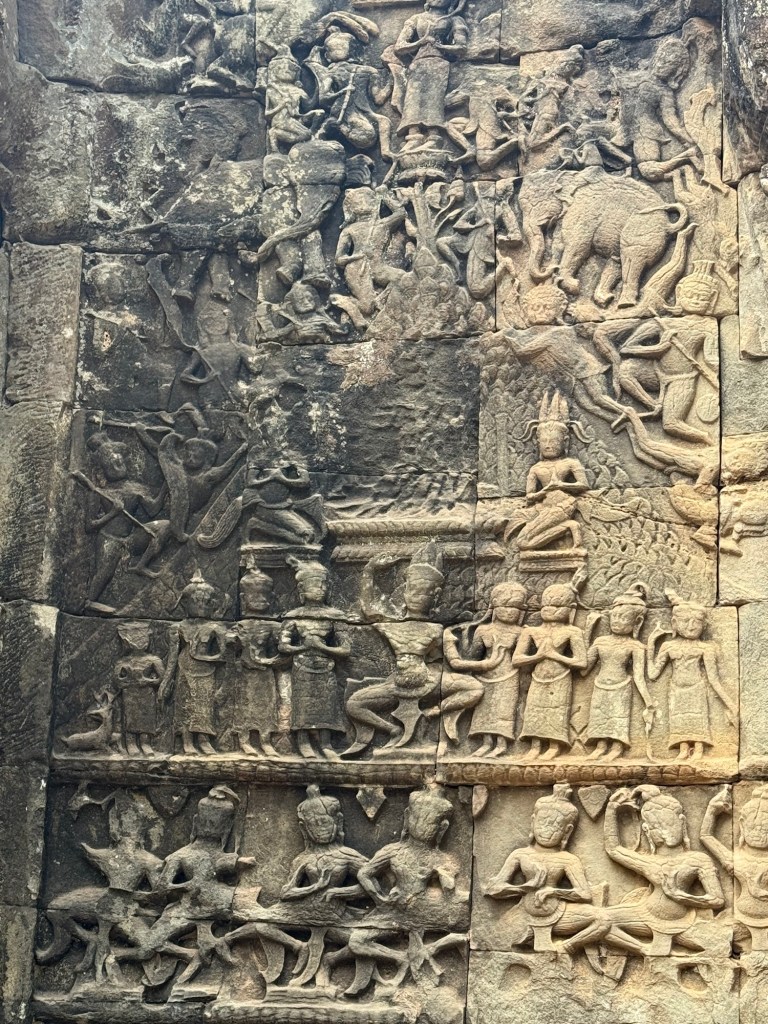
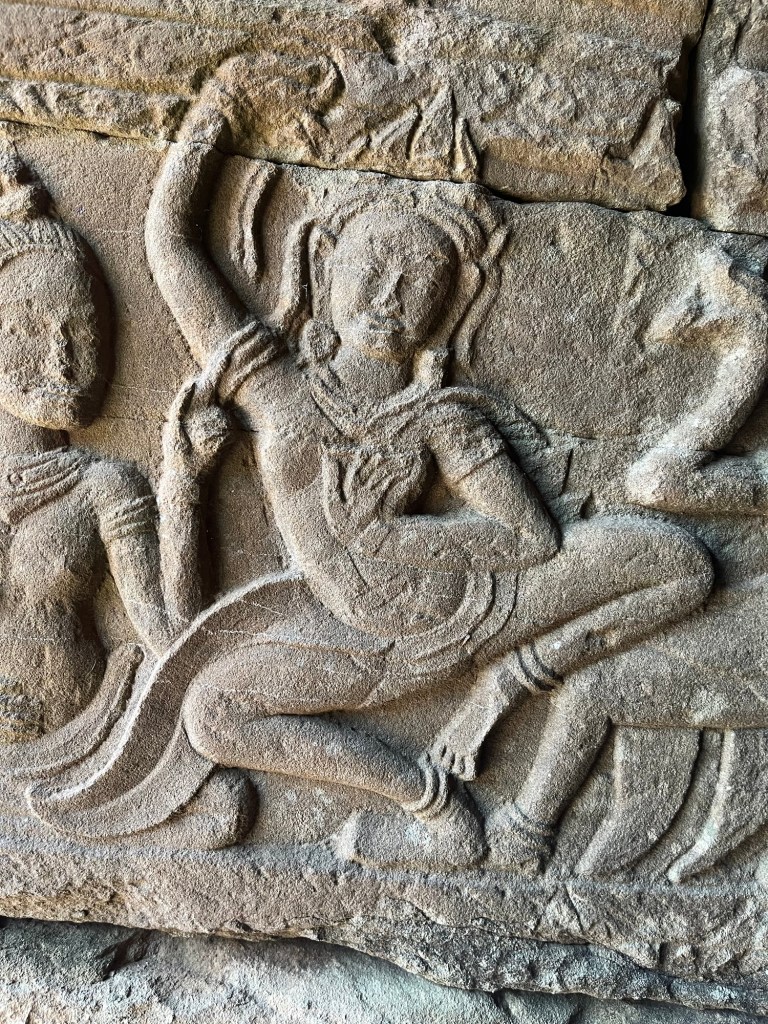
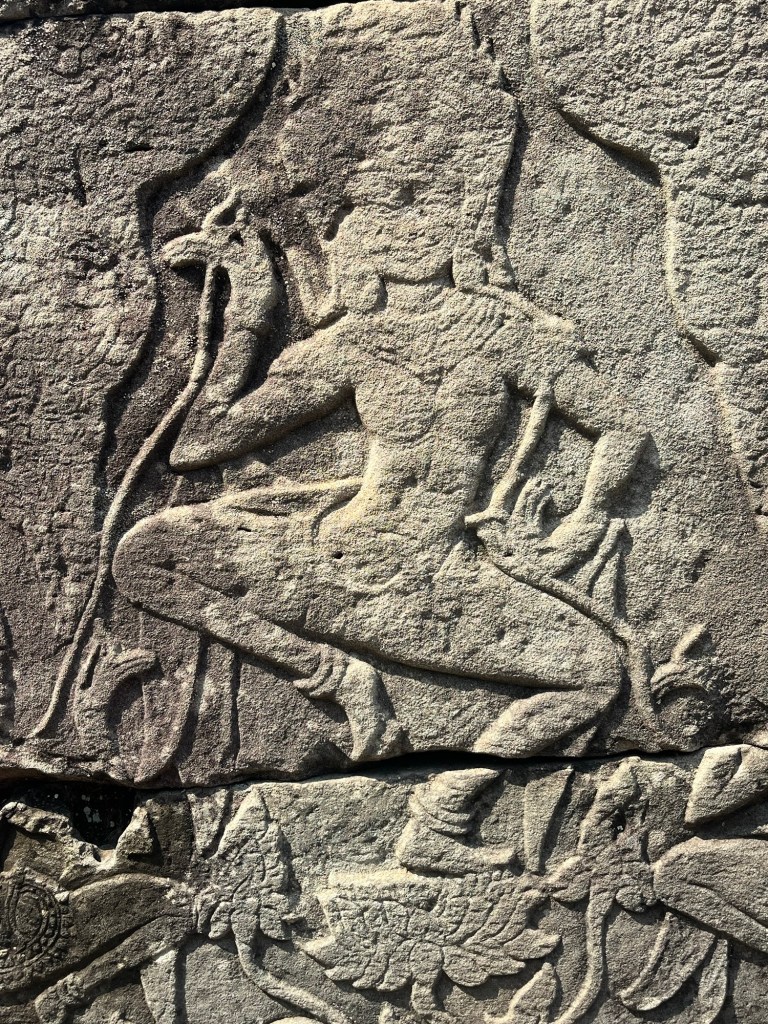
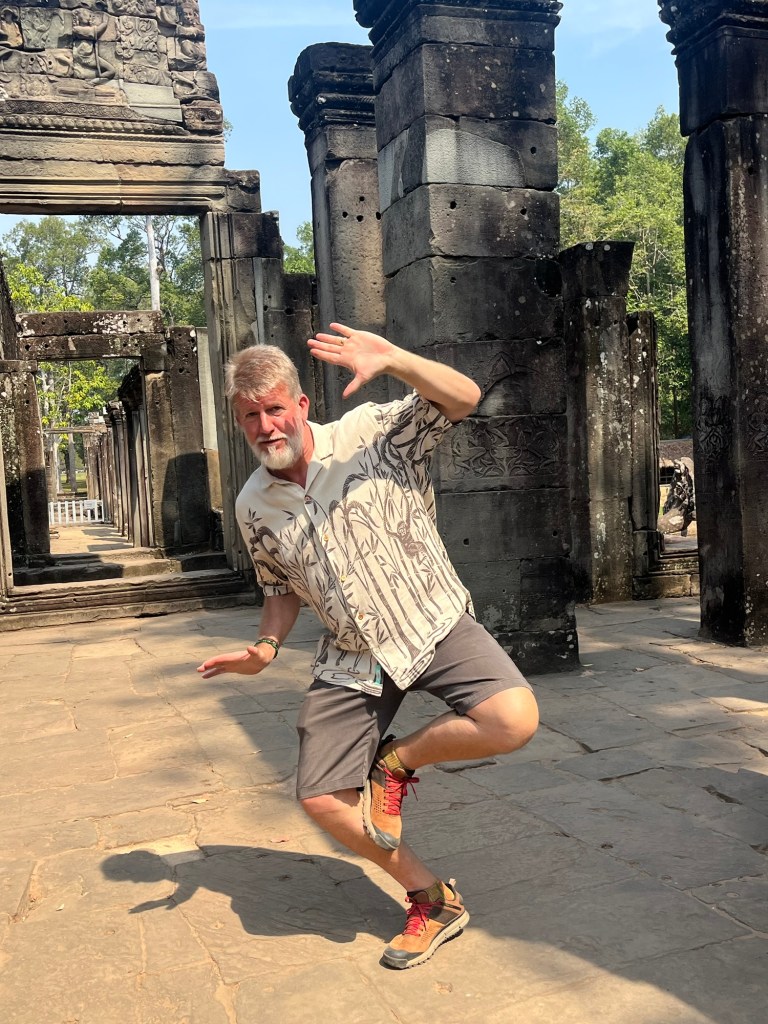
Absara Dancers – The iconic Cambodian image and a dance tradition still practiced today, the Absara are featured everywhere. Their dance, performed for the King is meant to represent the spinning and churning described above.
Absara at Ta KeoAbsara at Angkar WatAbsara Inflexibla
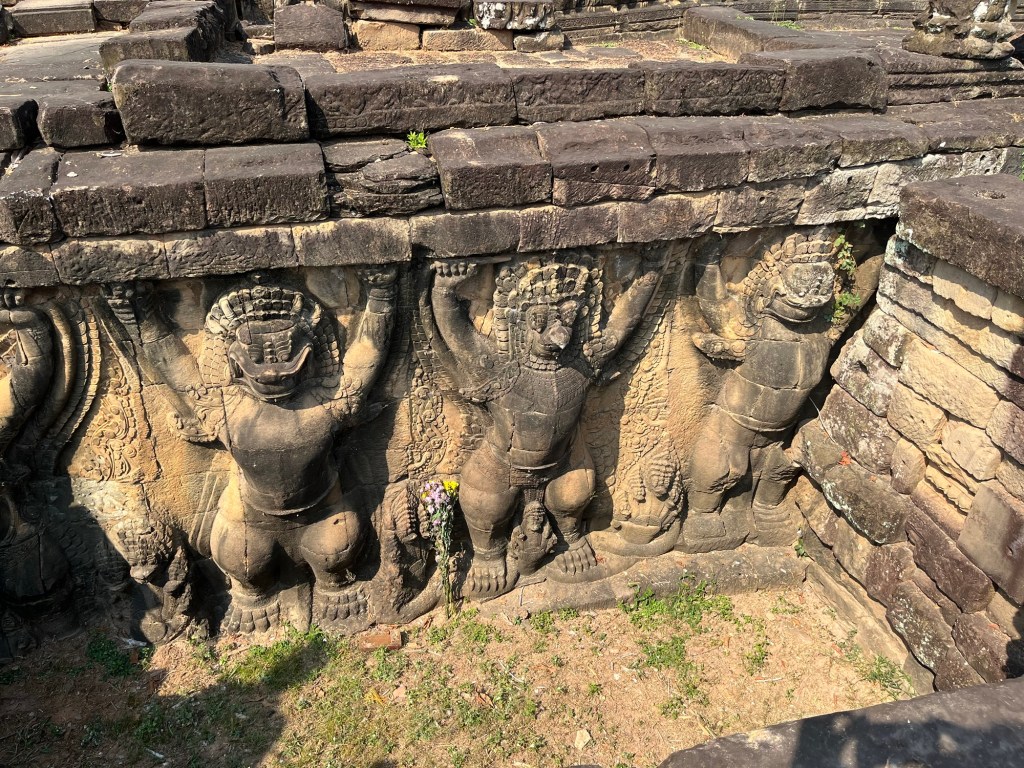
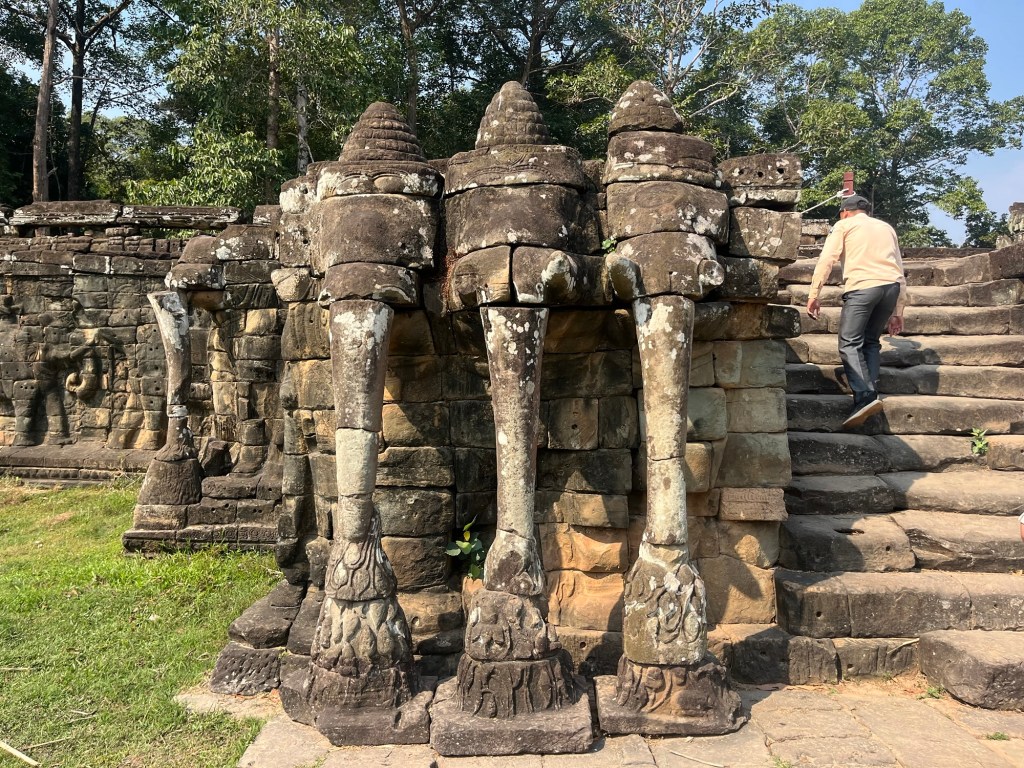
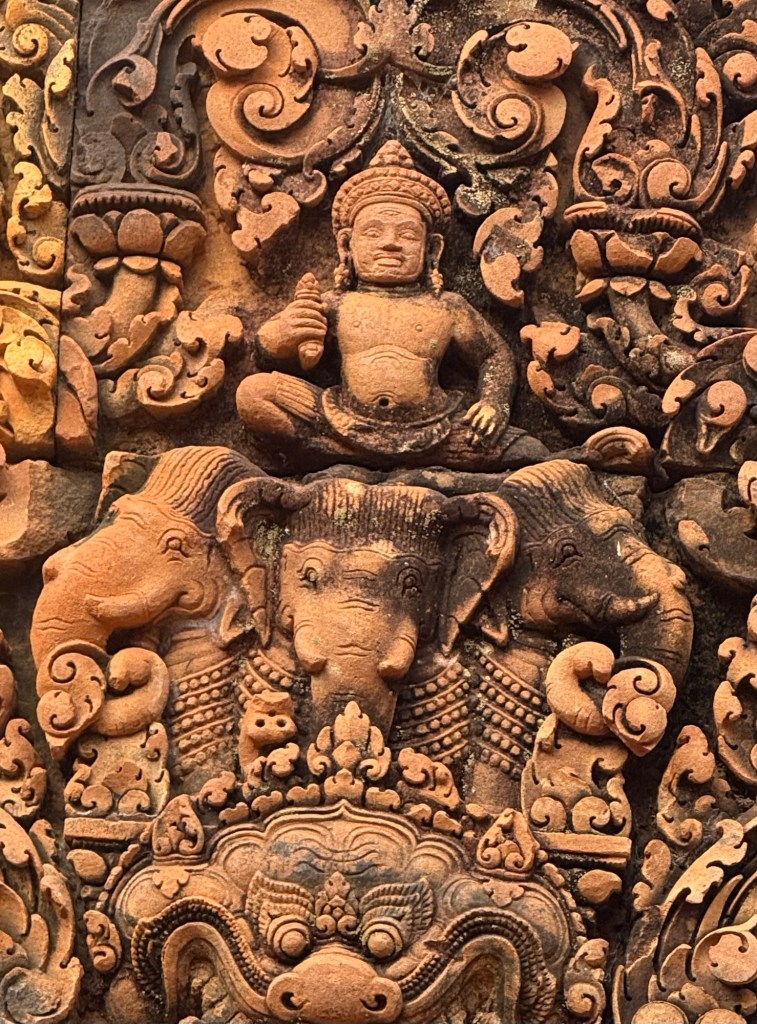
Giant Birds and Three Headed Elephants – Garuda (birds or phoenix) were spun from the froth, as were elephants including the 3 headed Iravanta. These entities serve as foundations and supports in most temples.
GarudaIravantaElephants and Mahouts10th Century Iravanta
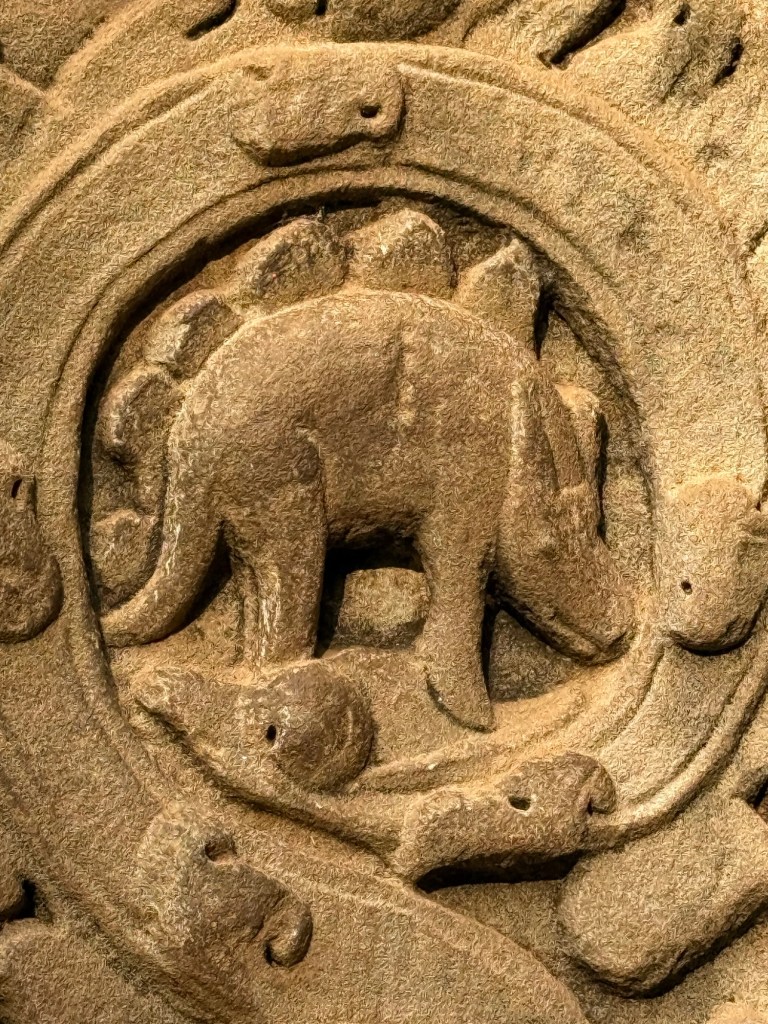
Animals and a Dinosaur (maybe) – Natural motifs, plants and native animals are featured in many carvings. One repeating figure raises a lot of questions among archaeologists. Were there dinosaurs surviving into the 13th century?
Hindu Cow, Transportation for ShivaCambodian Stegosaurus (????)
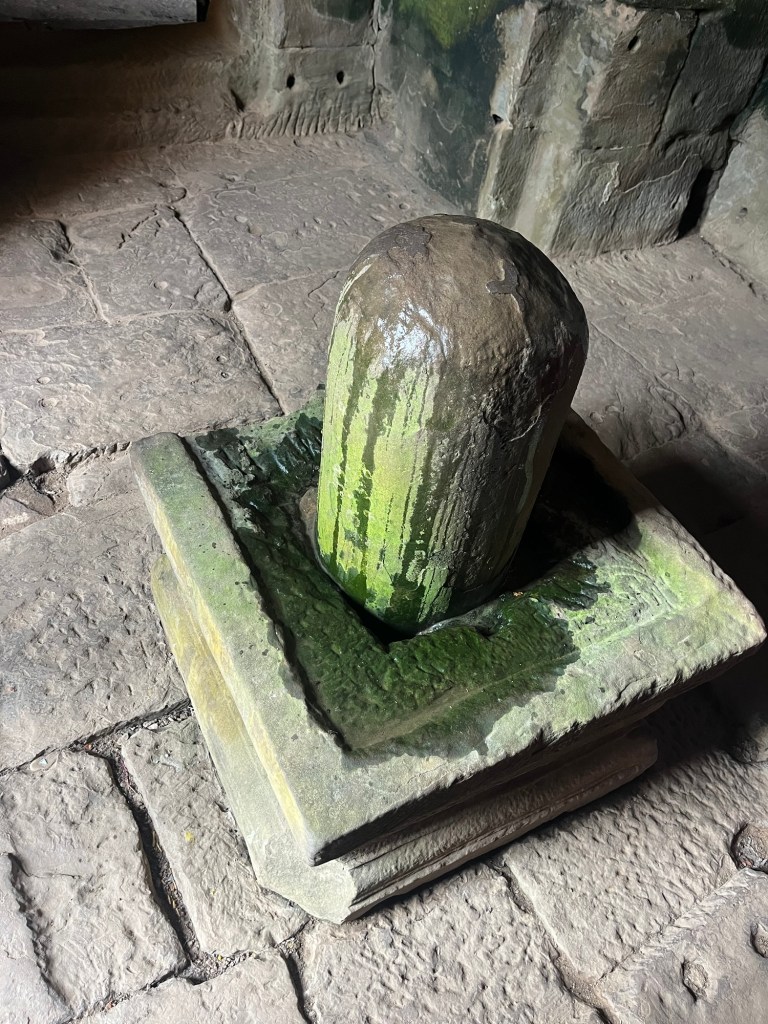
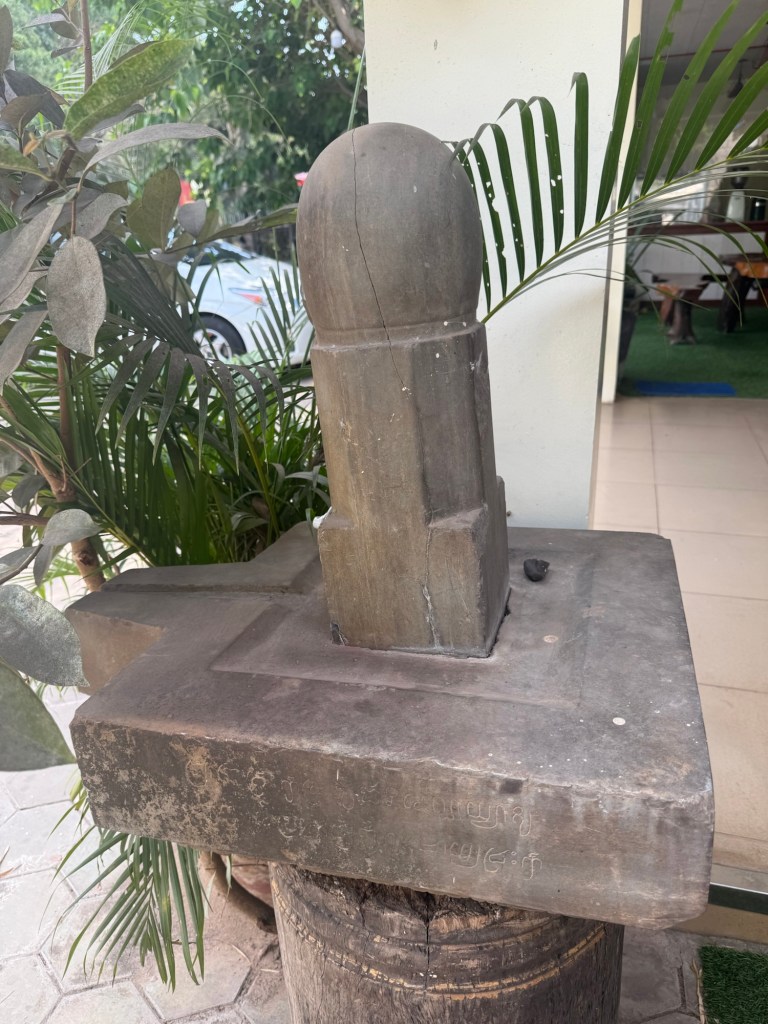
Phallic Symbols – Common in most temples are vertical phallic symbols representing lingam (the shaft) and yoni (the base). These are ancient, sacred, Hindu symbols representing the union of masculine and feminine energies. Visitors to the temple poured grain, died water or coconut milk over the sculptures to entreat the Gods (specifically Lord Shiva and Goddess Shakti) for favor.
Lingam and YoniLingam-Yoni in the hotel lobby
BirdSnake – Jaya 7 introduced a new character found in most later temples combining two natural enemies, the bird and snake. This character places Hindu Garuda inside the mouth of Buddhist Naga and represented the final hybridization of the faiths, and a peace lasting essentially today.
Garuda-Naga
There were many more features and characters but this is getting long.
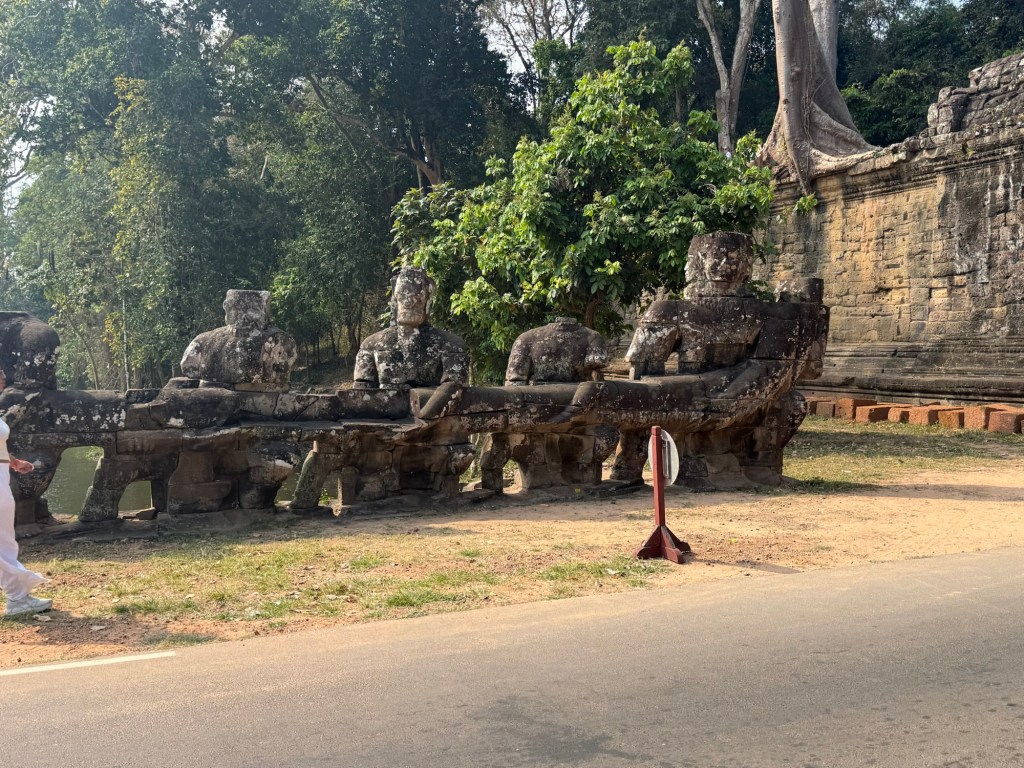
Later in the day we drove between two huge Naga and Nagiana supported by a dozen Demons and a dozen Gods and through the “Victory Gate” and into Angkor Thom.
Entrance to Angkor Thom
Suryavarman II built the royal city 200 years after the reign of Jaya 7. Angkor Thom is surrounded by a huge moat and 40 foot walls. The 4 square mile city includes 12 (relatively) small temples for his 12 kings – each with its own Buddha or guardian God, 4 large royal temples, and 4 small temples for various family members.
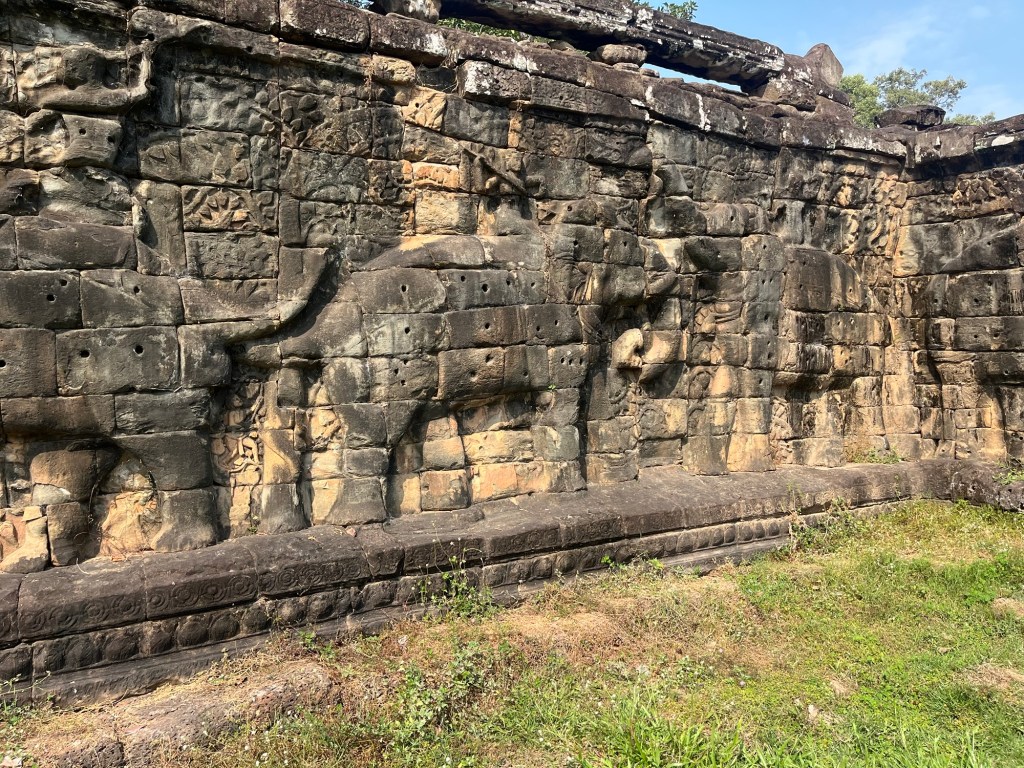
The Terrace of the Elephants, a huge platform 1/4 mile wide and 15 foot high was the royal receiving area from which kings would review their elephant armies, hold sporting events, or receive delegations from subordinate kings.
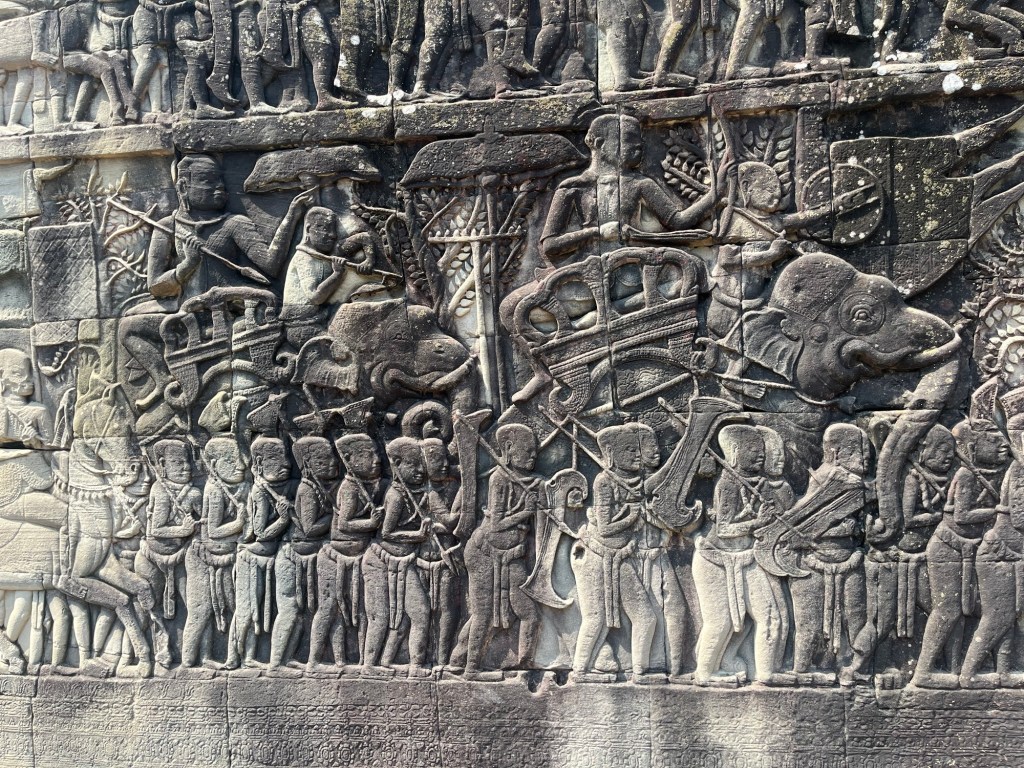
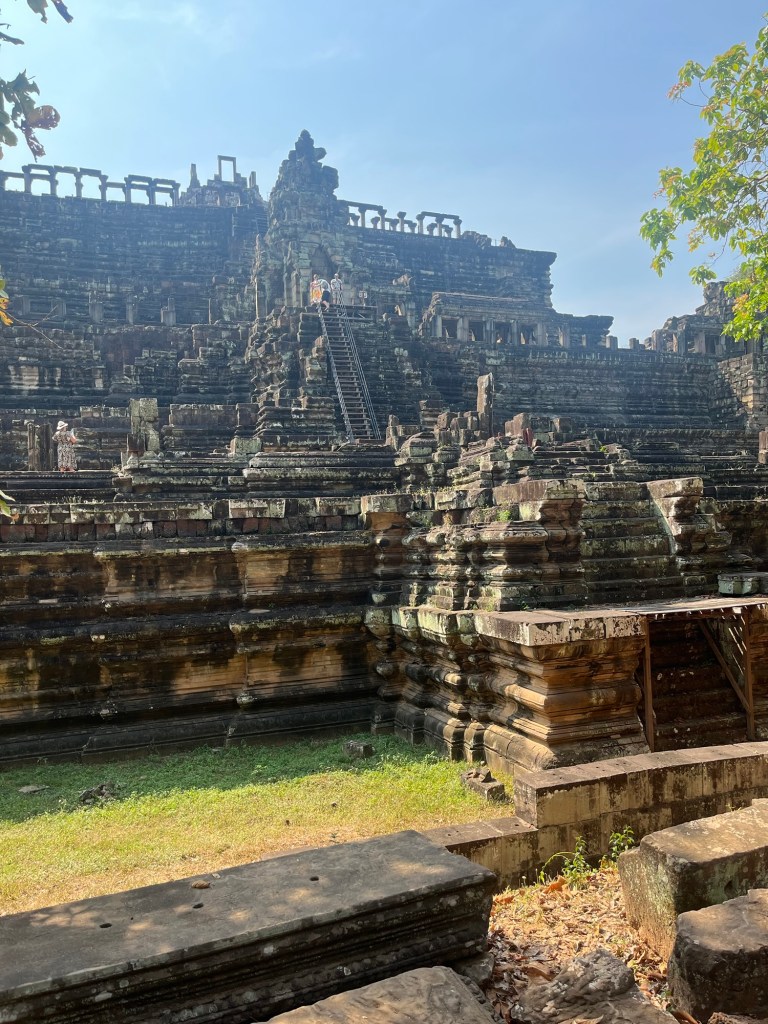
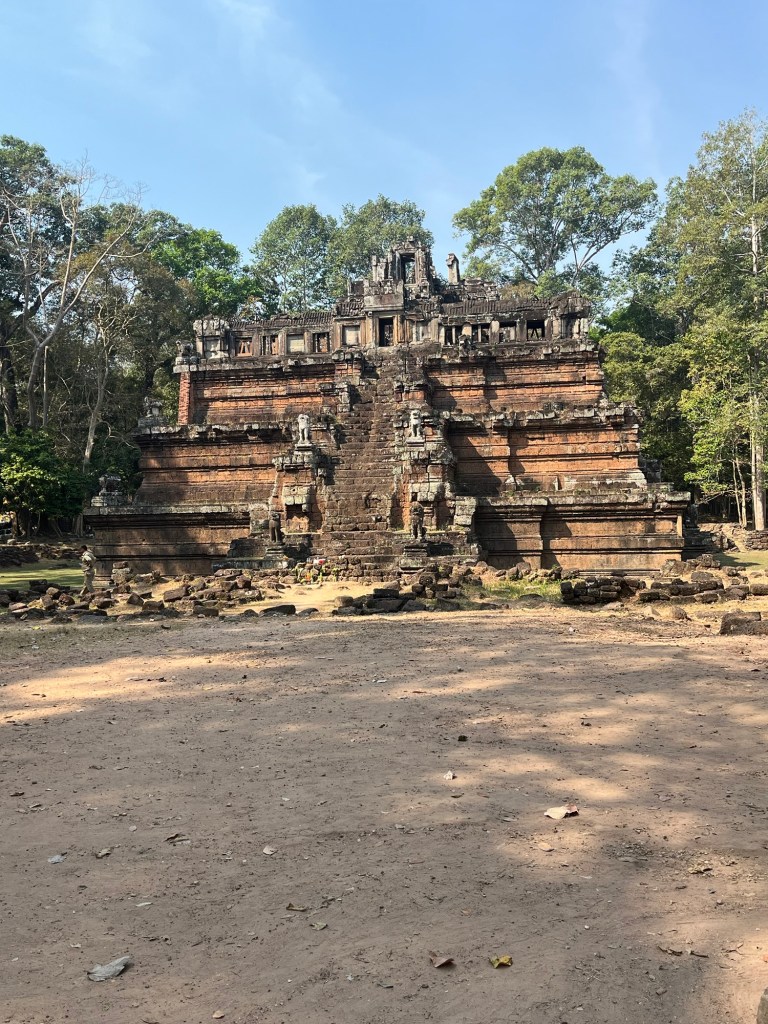
Several huge temples including Bayoun, Baphon and the kings own Phimeanakas Temple were within the city walls. Giant man made pools, separated by male and female, were dotted across the ground. Ponds for fish and ceremonial water offerings were near each temple.
Hays’s Army from BayounThe Temple Baphon
The grounds today feel like a verdant jungle broken up my massive royal structures. But recent LIDAR imaging shows that the city was densely packed with wooden homes. The King’s own palace (wooden) surrounded his temple on all four sides, but only the foundation and broken clay shards from the roof are there today.
Temple BaphonPhimeanakis Temple and Supra
So there you go (and we haven’t even made it to Angkor Wat!)
**Warning** this will be FULL of stereotypes and generalizations.
Vietnam Beautiful
People are complicated. Putting individuals in a box or slapping on labels is simplistic, I know.
However, there have been some common threads that are visible to my eyes as a visitor.
In general, women in Vietnam are self assured, strong, sassy, demanding, hard working, industrious and forthright.
And a few are high maintenance and social media driven. More on that later.
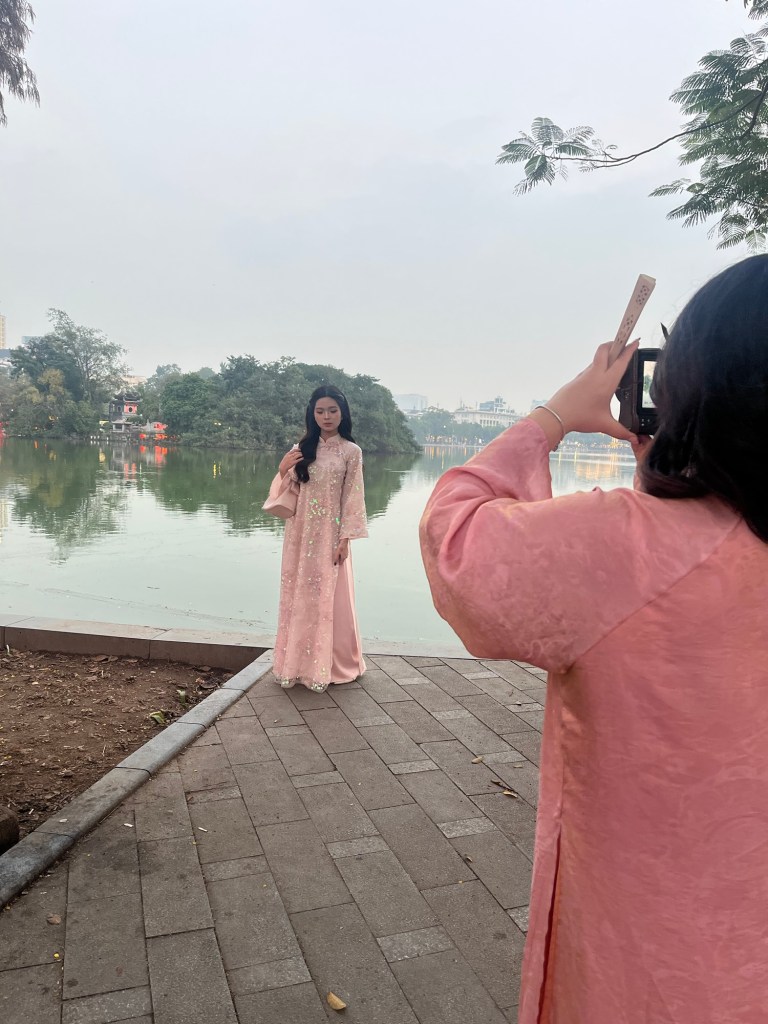
With the coming of the New Year many young women gather at the picturesque lake in the center of town, Hoan Keim Lake. They are elegantly dressed in the traditional ao dai ( pronounced ow zigh.) They pose in practiced positions and look quite demure.
Stole a pose
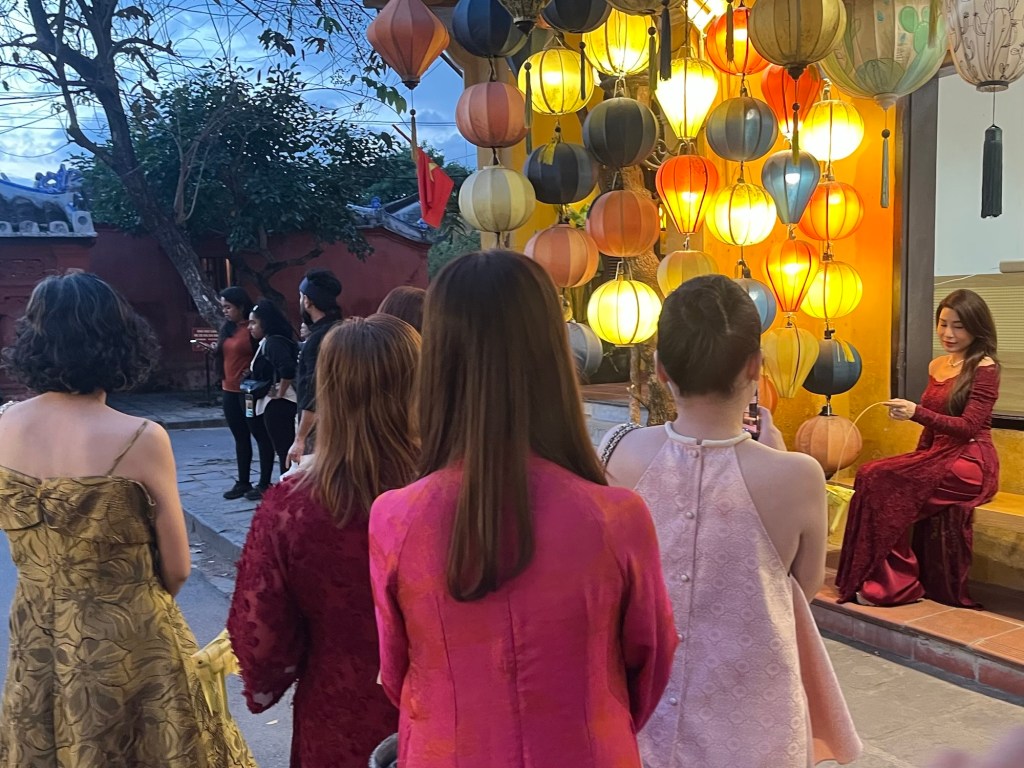
Before moving on to the other women we have encountered, I want to touch on the social media culture. It’s kind of bonkers. Life is a giant photo op here. The constant posing and checking for the just right photo over and over again is like nothing I have ever seen.
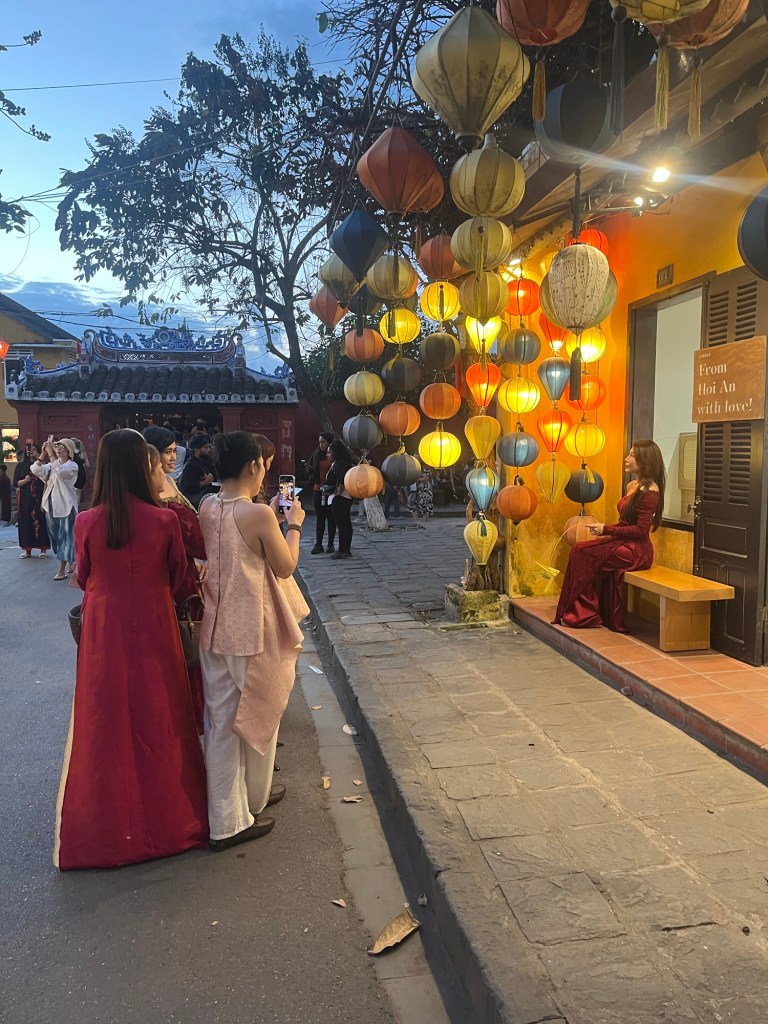
Again forgive the stereotypes, but young women do their hair and makeup, pose demurely, then run to their photographer to choose the perfect picture or to refine their pose or lighting. Our guides both said they will take hundreds of pictures just to get one winner.
Girl with entourage Hoi An
This attention to social media fuels the need to be beautiful. Honestly, the women here are very beautiful. They pay a great deal of attention to skin care routines and do not allow their skin to see sun. We learned that Korean TV dramas influence the current view of beauty. Light skin is the most desirable look.
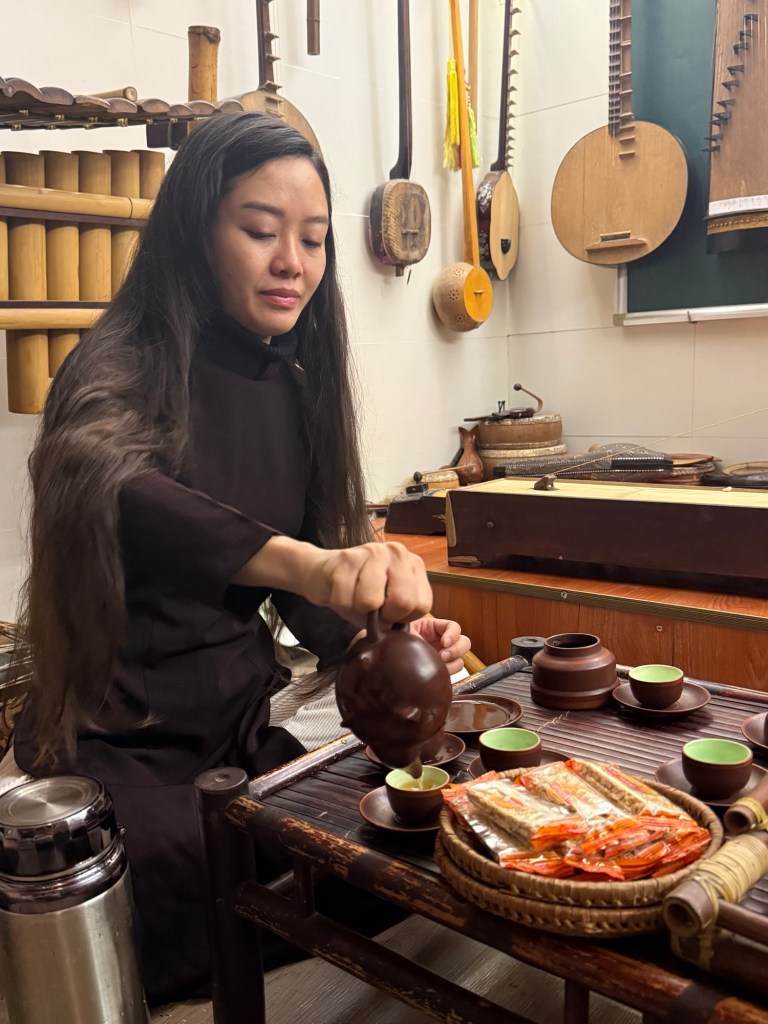
We spent time with a famous musician while in Hanoi. He was accompanied by his student, who is now a teacher as well. She expertly played traditional instruments with elegance and grace. When I tried to pluck a few measly notes she was gentle and encouraging yet firm.
Music and Tea
Our trip to the moonshine brewer’s home in My Chou was such a treat! it was a family operation but it was clear that mom ran the business. Like many of the couples we encountered, the husband took a back seat and allowed her to do most of the communication and hosting. She moved with confidence and had a command of her domain for sure.
Moonshine Mamma
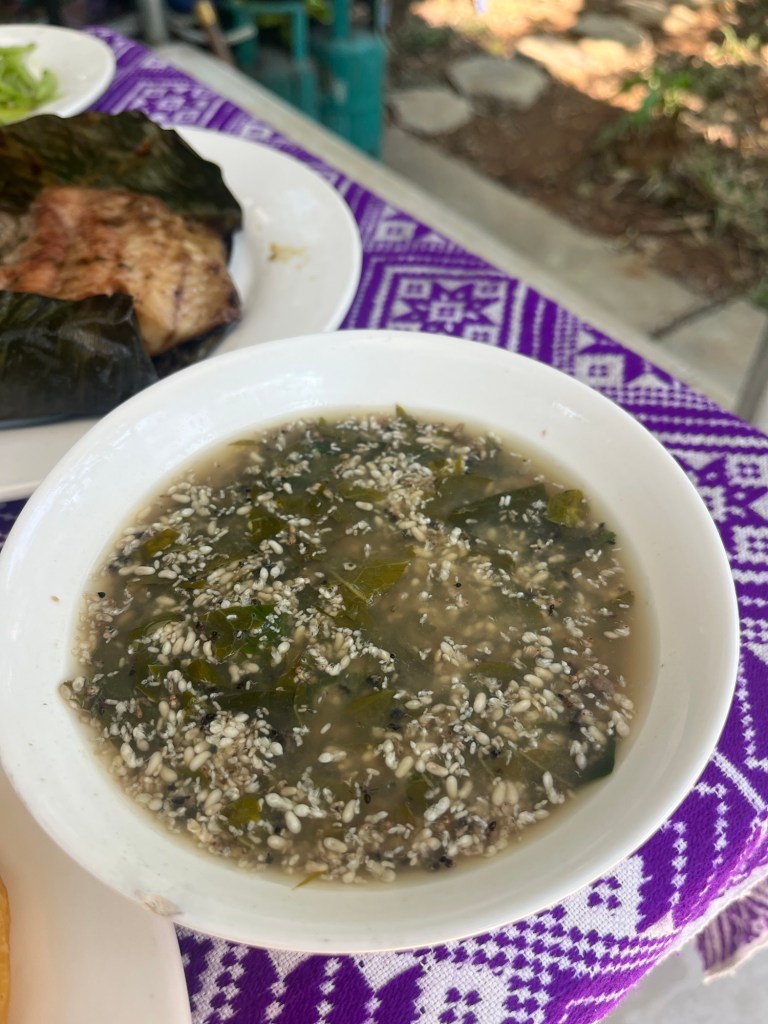
While in My Chou, we met a restaurant owner and her daughter who belonged to the white Thai tribe. They prepared an enormous meal that included ant egg soup. The soup, made at our guide’s request, was expensive and took a great deal of work to make. Evidently the father and daughter gathered the ants and the eggs deep in the mountains that morning. It took quite the effort but I ate a few bites, and it was not my favorite.
Ant egg with crunchy ants soup
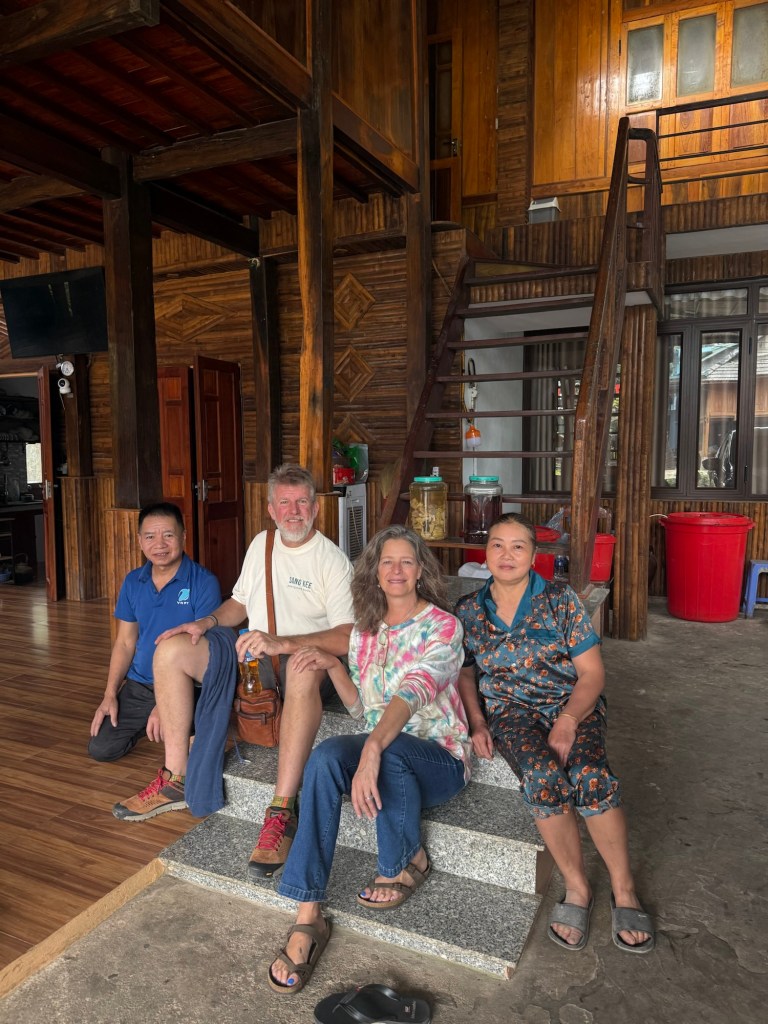
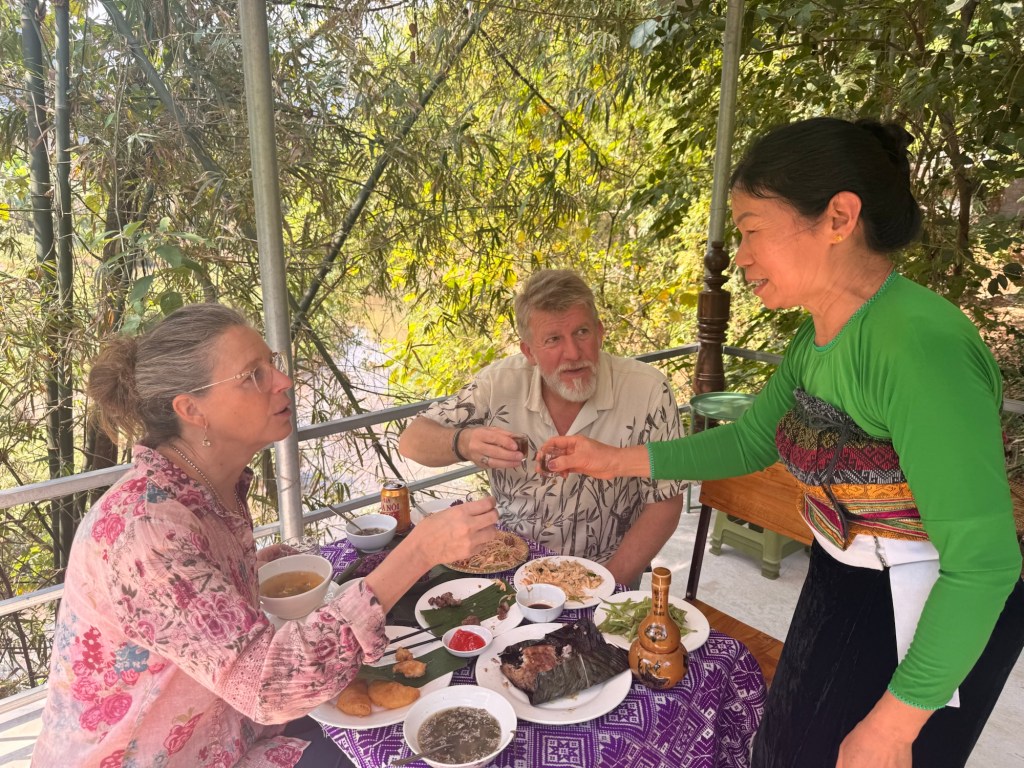
The owner was eager to meet us! She proudly served us home brewed rice wine flavored with banana and did several shots with us. I’m sure she could drink us under the table. She tried to teach us how to toast in Vietnamese- we were pretty terrible. To document the visit she confidently positioned us for a picture in the perfect spot.
một hai ba đồ uống (1,2,3 drink)
Our Driver Hien in Hue and HoiAn
It is highly unusual for women to be drivers for tour companies (<1%.) That makes sense actually in that the drivers accompany tourist through much of their itinerary. They stay alone in home-stays or hostels. Like most of the world, women are expected to raise the children, so being on the road constantly is not conducive with motherhood in the traditional sense. Hien was professional and a very careful driver in an absolutely chaotic driving environment. Hien handled our very heavy luggage with ease and packed the car like a jenga champ.
She also took beautiful photographs of Malcolm and I to document our travels. She took a great deal of care when taking pictures and even helped me pose.
Hien the PhotogNice one!
Hien joined us for many meals (at our insistence). I’m sure there were meals she regretted sitting with us because it turns out she’s a vegetarian! She watched on as we ate platefuls of fish, pork, whole squid and shrimp. I cannot imagine being a vegetarian in Vietnam as the fish sauce is literally in everything.
In Hoi An Ms. Vy is an incredible entrepreneur with 14 restaurants, a cooking school and her own supply chain of farms and fishing boats. At our cooking class we met Chef LuLu, a 40 year old woman that Ms. Vi pulled from poverty at a young age.
LuLu is now running the cooking school and a senior trainer for all Ms. Vi’s restaurants. Her loyalty for Ms. Vi knows no limits. And she commanded the room with both poise and a demand for excellence. We really wanted to impress her!
Pay attention students!JuJu and LuLu
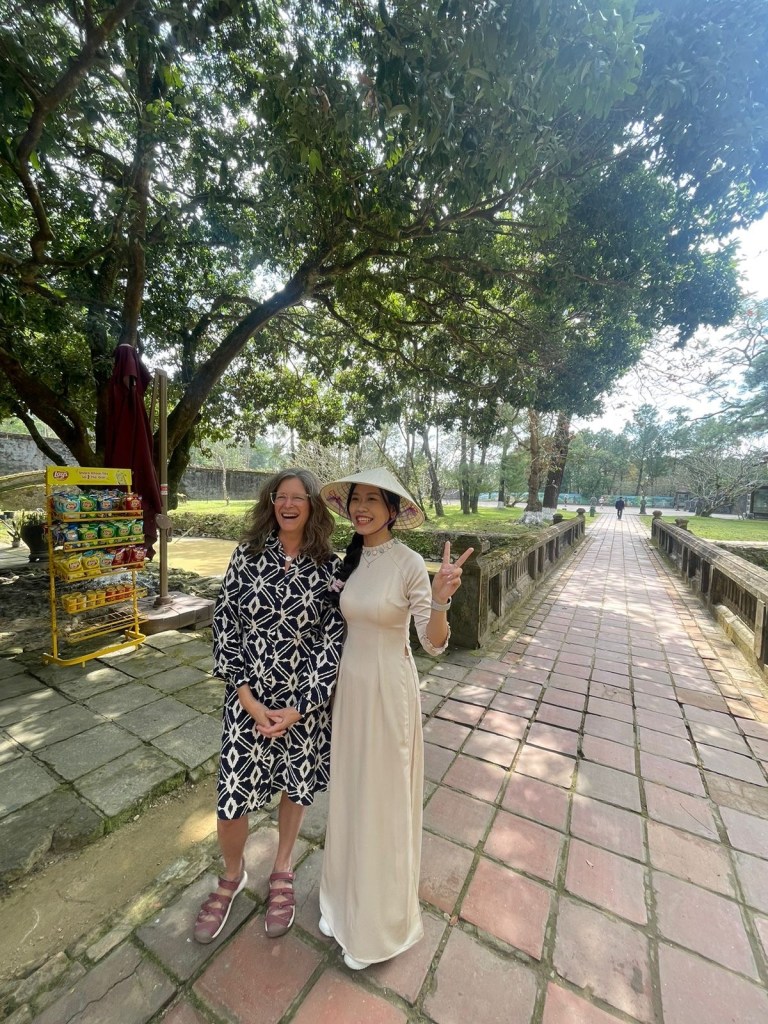
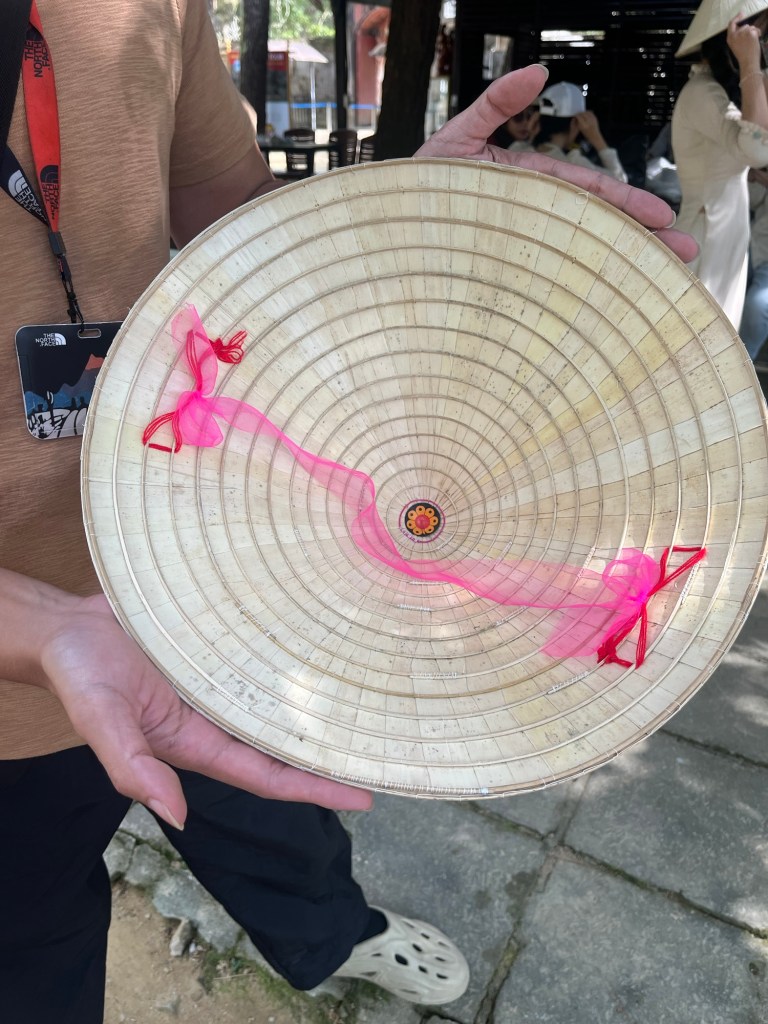
The young women who are in high school typically wear white Áo dài and the straw conical hat (maybe mũ hình nón.) The hats have 16 rings which symbolizes the perfect age. (I strongly call BS! And I happen to be adding this on my 58th birthday.)
Juju wants an Áo dài16 rings…the “perfect” age
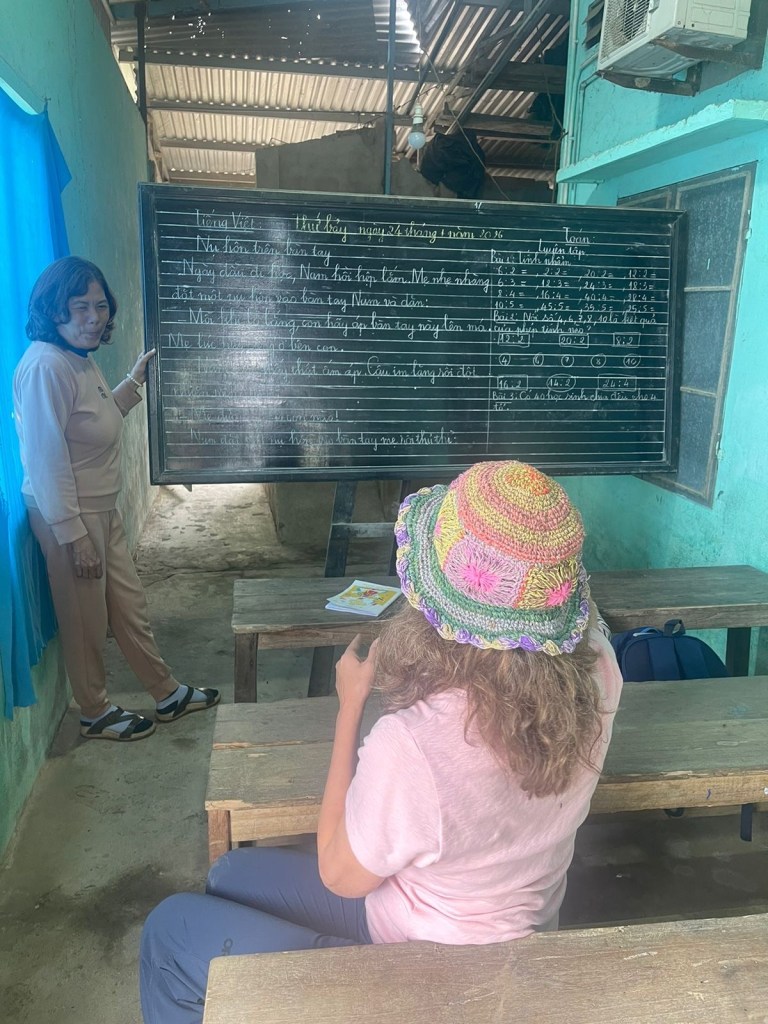
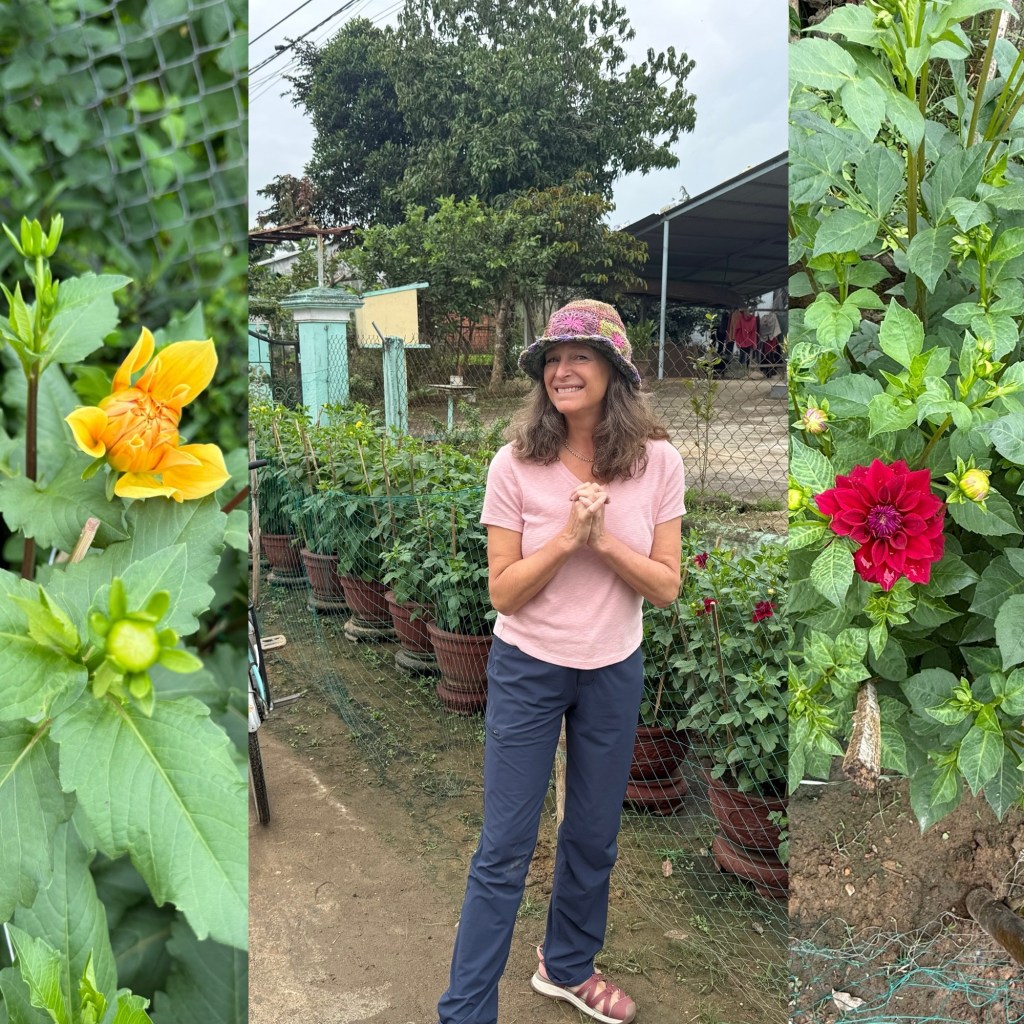
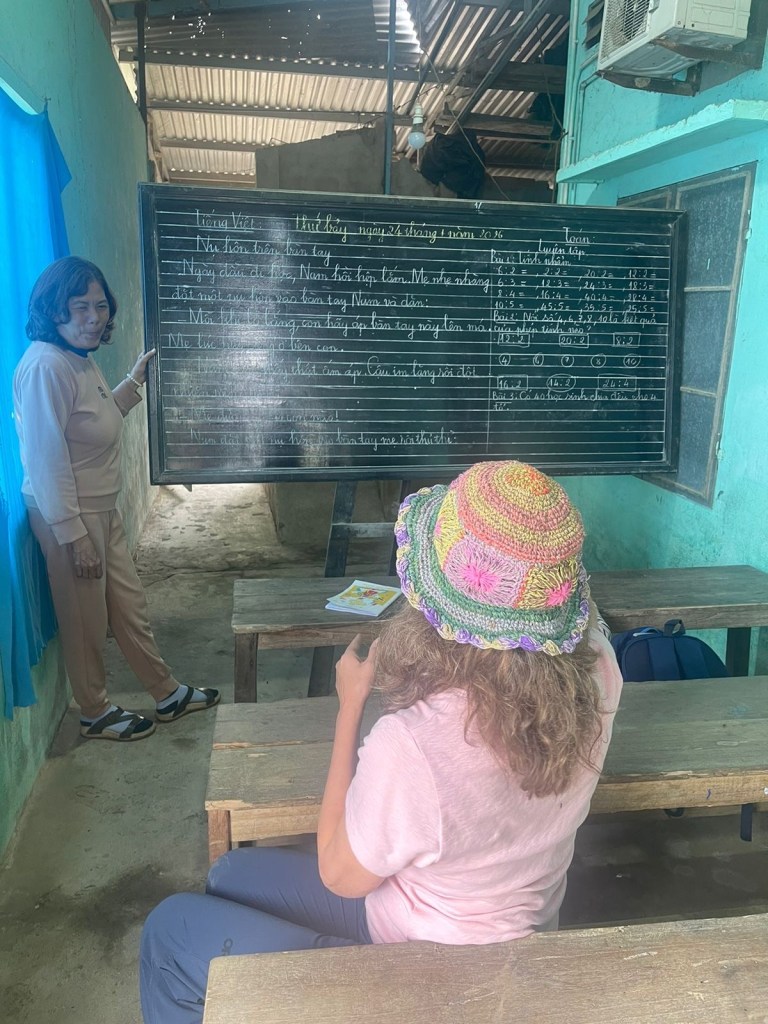
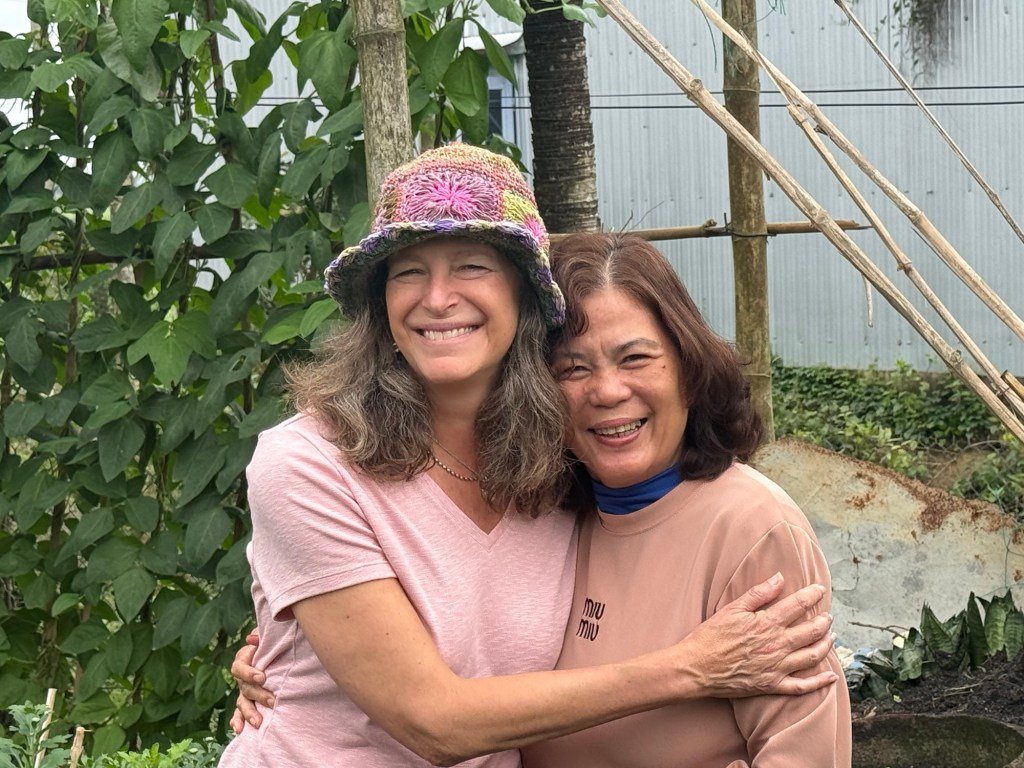
While biking through a small village near Hoi An we accidentally encountered a nursery growing dahlias! The mother of the owner happened to be an elementary language teacher who was tutoring a student. WAIT… dahlias and teaching all at once. I quite literally cried.
Teachers!Grammar Lessons
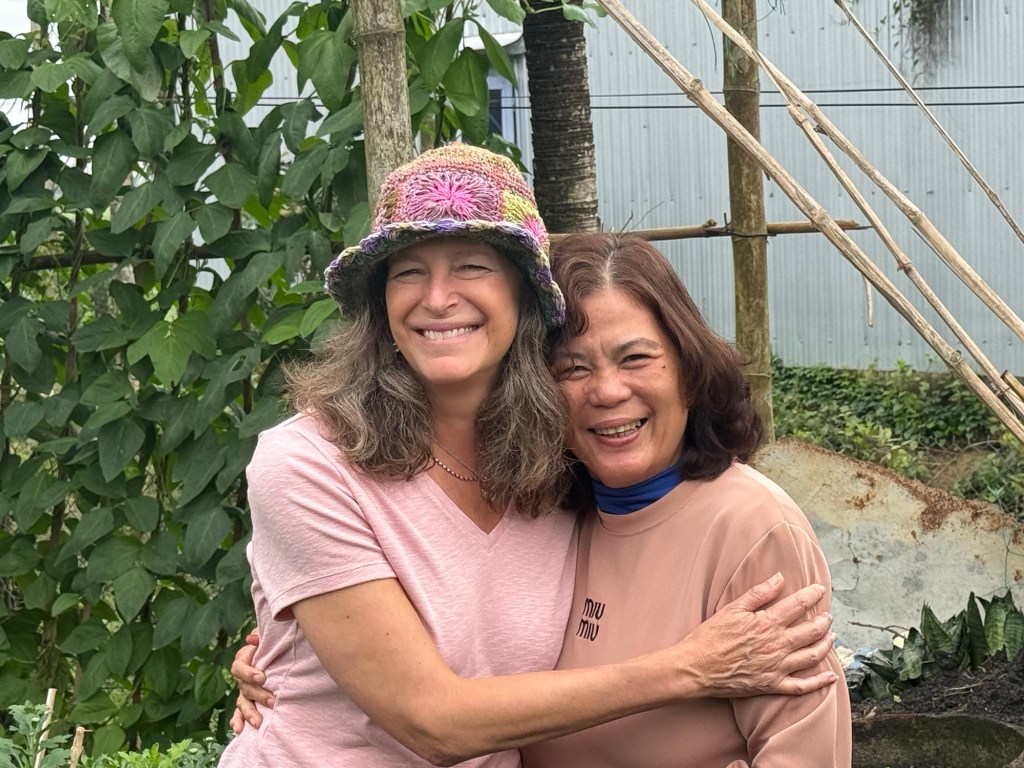
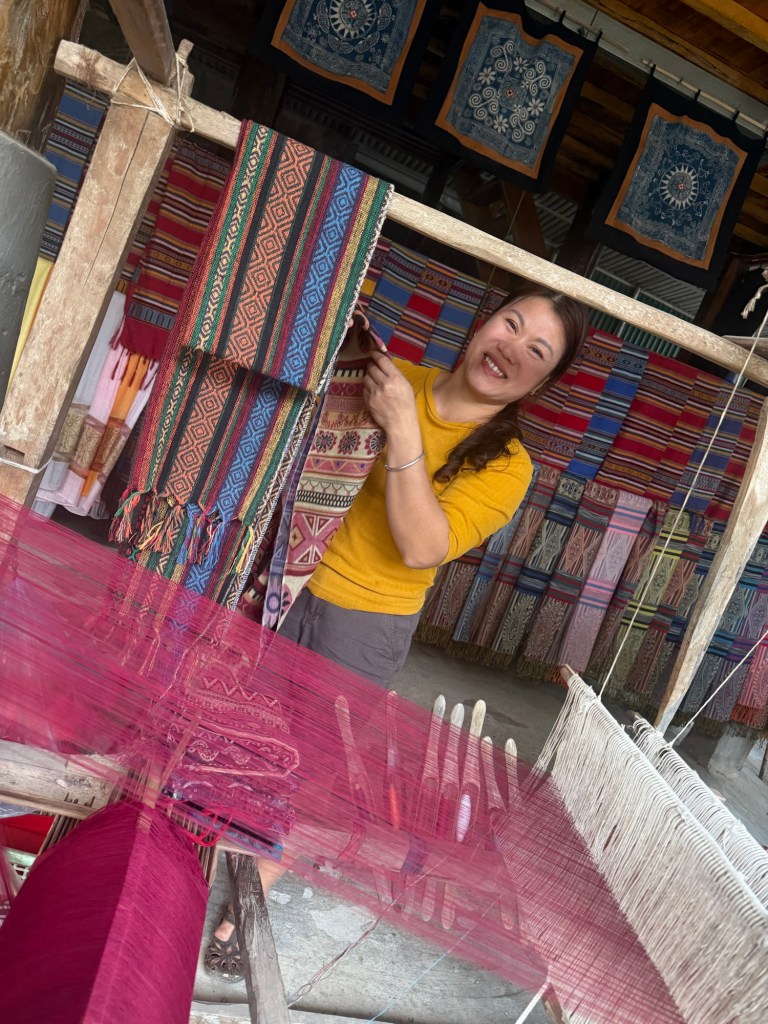
We encountered so many women on our journey. All really strong and confident! Here’s a brief summary in pictures.
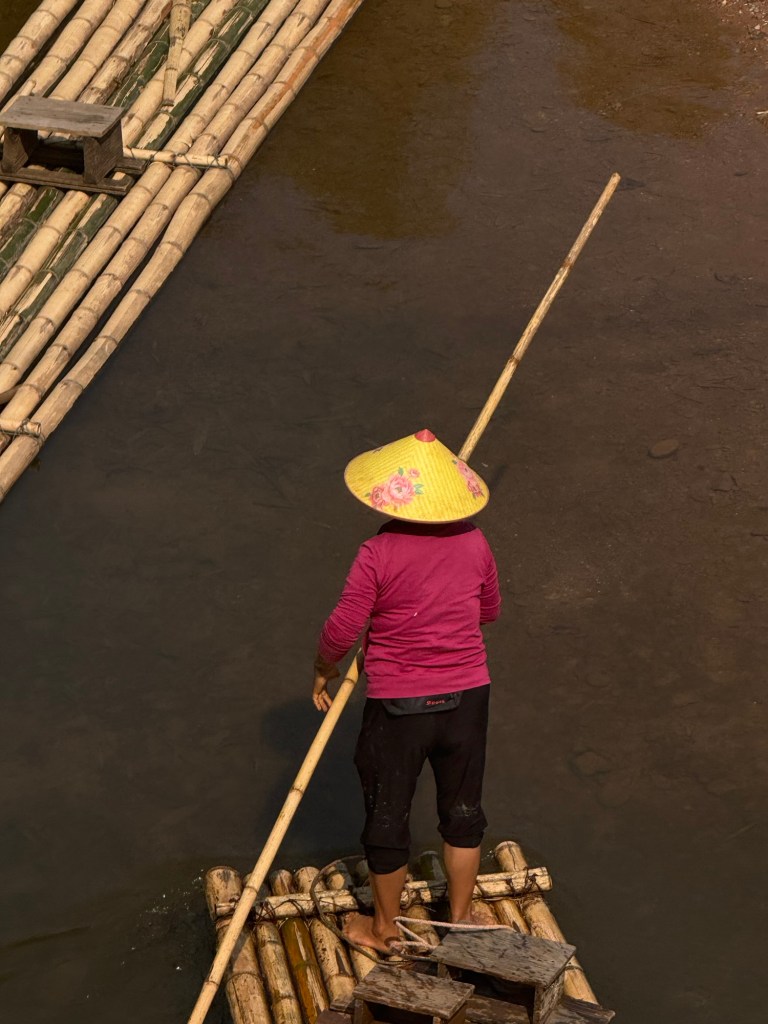
A small shop owner with woven pieces in Mai ChouFull time farmer, rower on a bamboo raft as a side hustle in Mai Chou
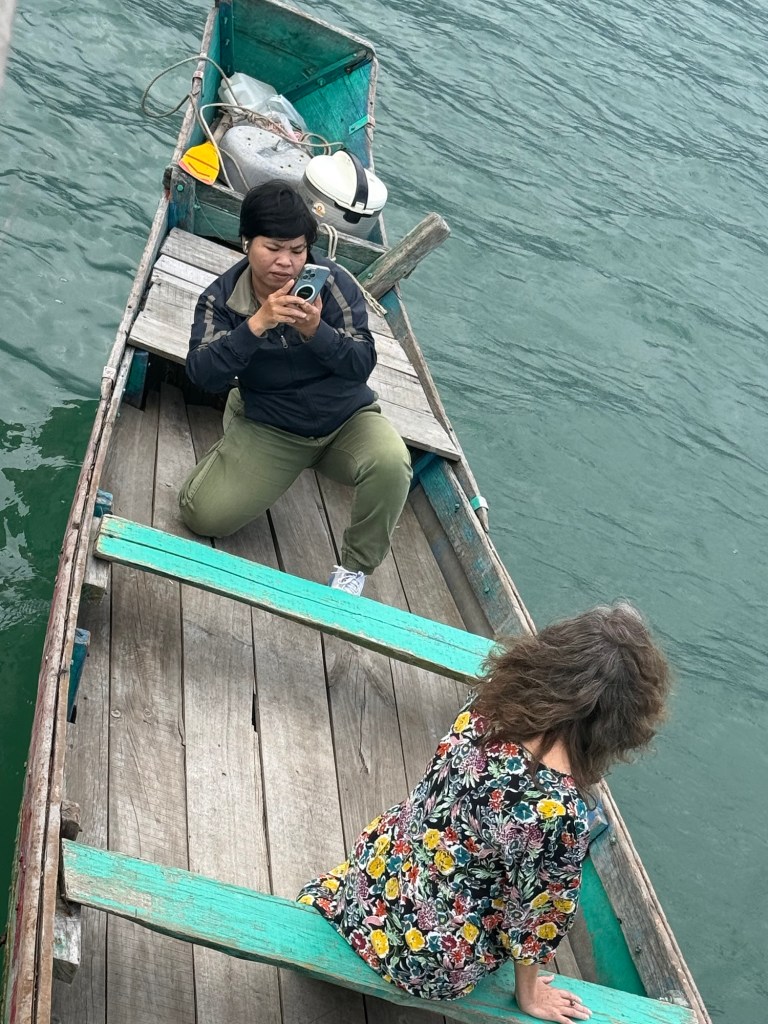
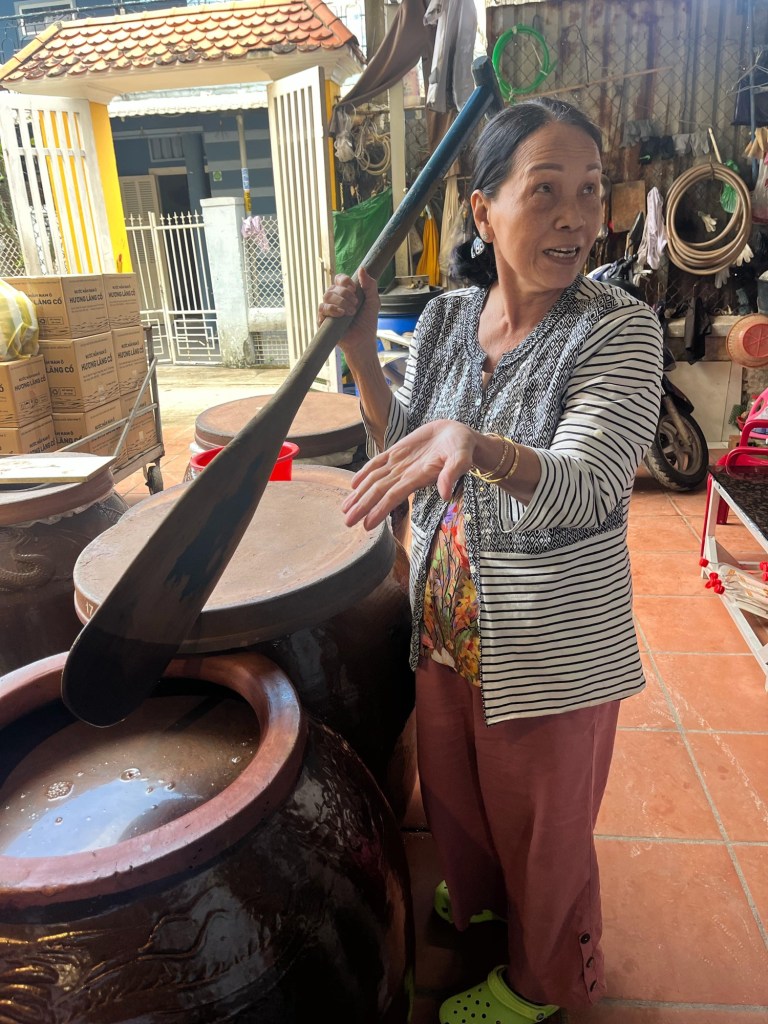
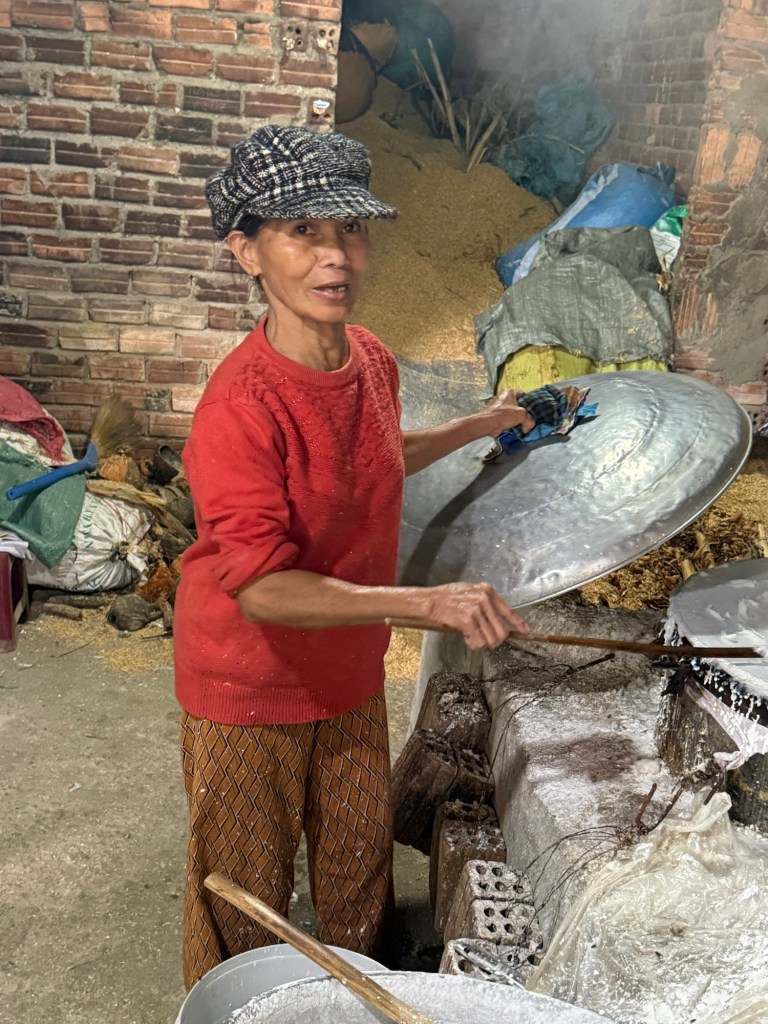
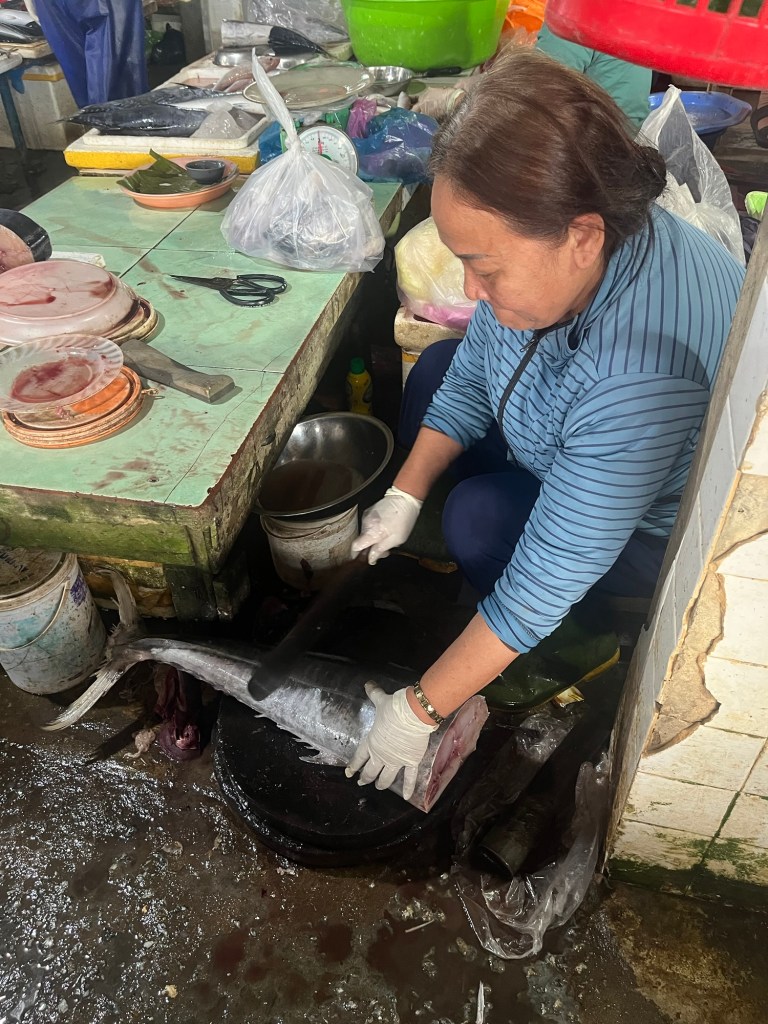
Competent and strong a rower in HaLong Bay fishing villageFish sauce business ownerRice pancakes, small business…very small woman…serious and a bit physicalChopping BreakfastMarket in Hoi An
Women always manage the fish on shore and at market. Apparently it’s believed to be very bad luck to have women aboard a boat.
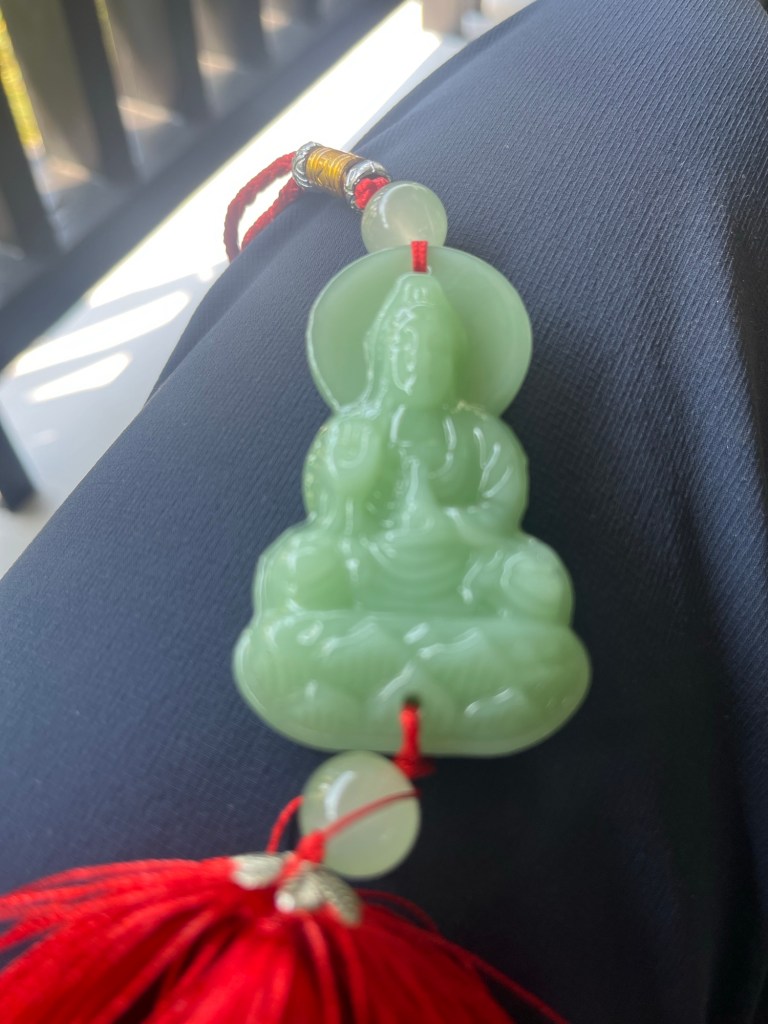
Lastly, Lady Buddha.
Along the central coast, Lady Buddha appears everywhere…temples, mountain sides, gift shops etc. According to our guide, prayers for the softer side of life should be directed her way, as she is compassionate.
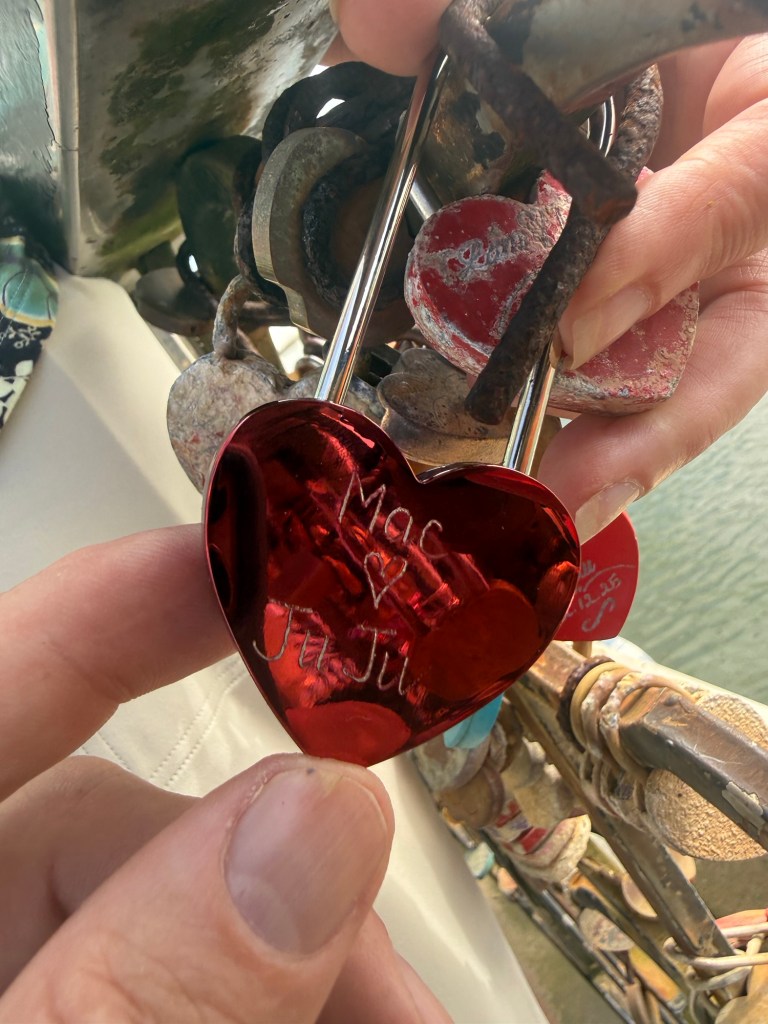
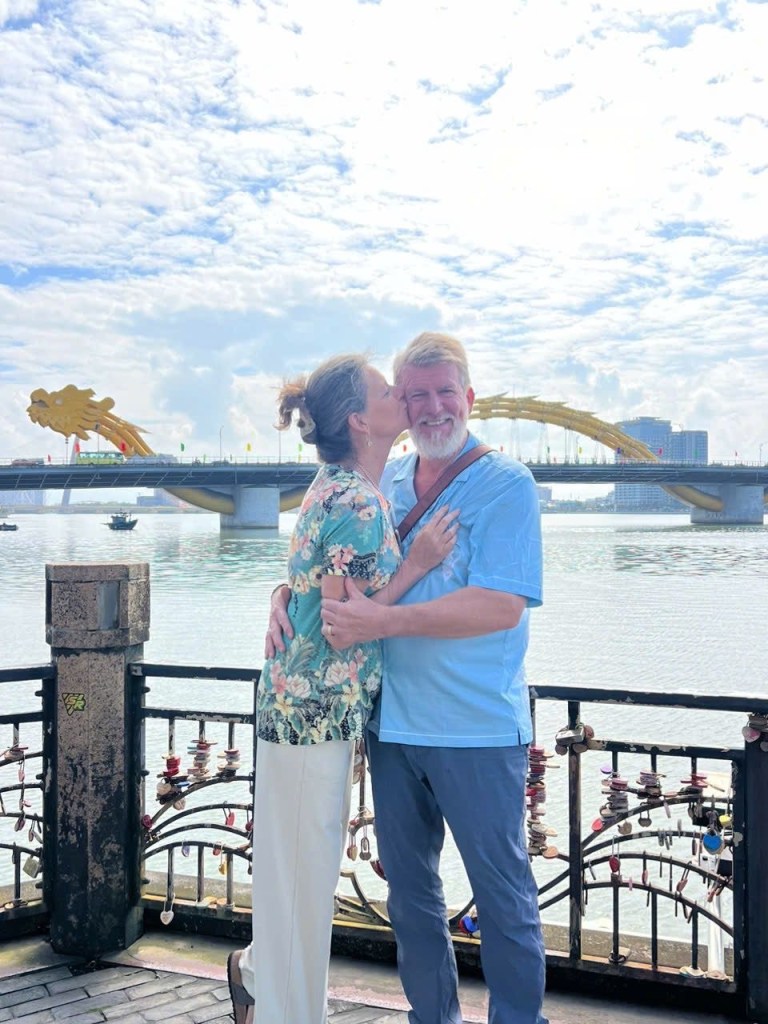
We woke up, went to breakfast, had a red-whiskered bull-bull sighting, picked up JuJu’s Ao Dai (wow!), sat by the pool, hung a love lock on the Da Nang Dragon Bridge, and then flew from Da Nang to Siem Reap, Cambodia .
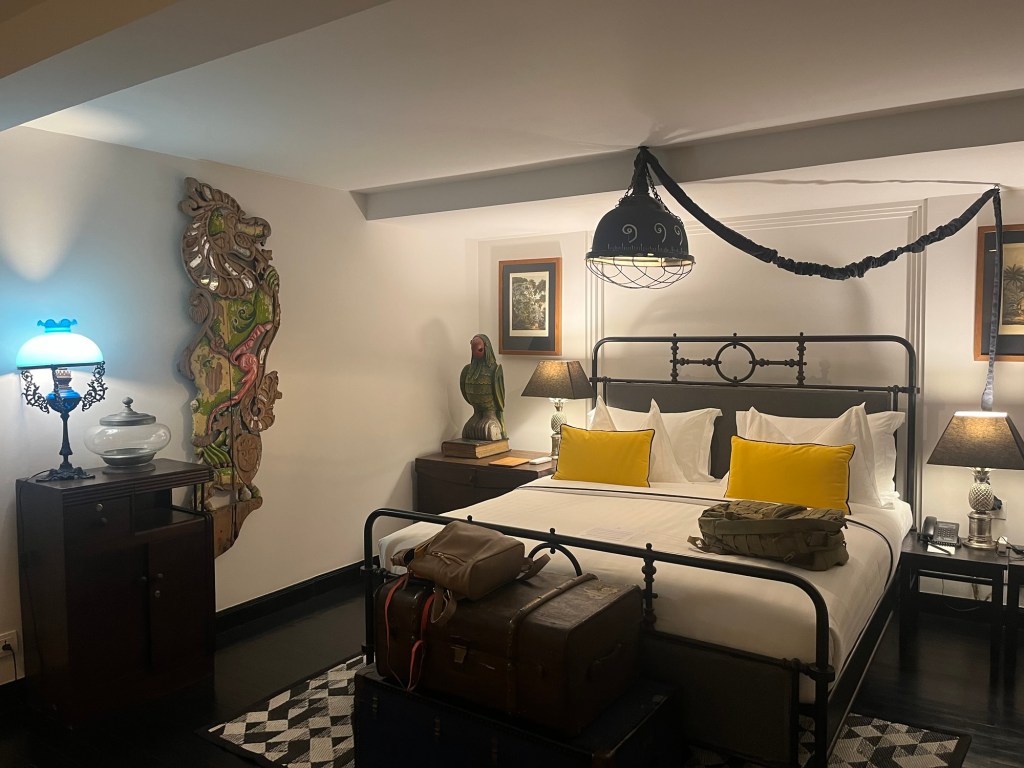
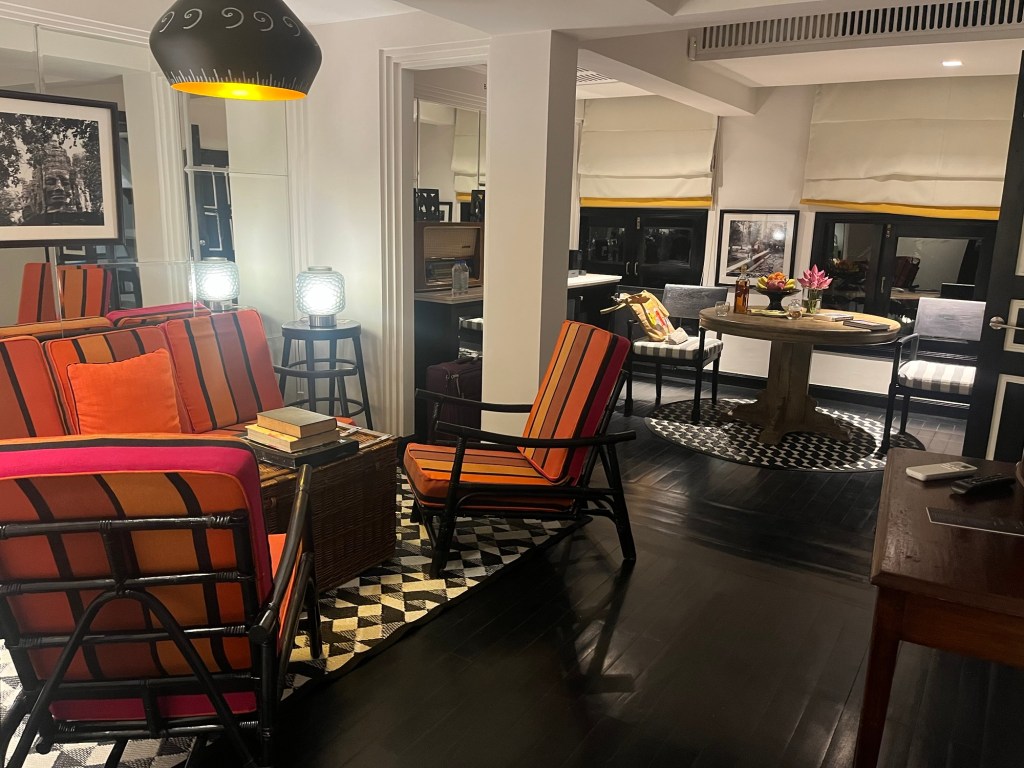
Our new guide, Rom and our new driver Ravuth expedited us through customs and took us to by far the most beautiful hotel and suite we’ve stayed in – ever, the Shinta Mani, Angkor.
Dawn at the Sara Sarong Temple tomorrow, with a 5:20 AM pick up. We had a quick snack at the hotel bar and off to bed.
Storm of the century at home in Pennsylvania. There’s 23″ of snow and single digit temperatures. I’ll just leave this here..-
Simon on the blog. CuzInternational Love Affair (lock on the Dragon Bridge)Dragon Bridge, Danang VNThe Shinta Mani Angkor, Siem ReapNice digs (again)
The tour company arranged a trip to Go Noi Village, a village outside Hoi An and central to an adjacent island. We visited with a farming family and took a biking tour to learn the trade and life of a typical Viet village.
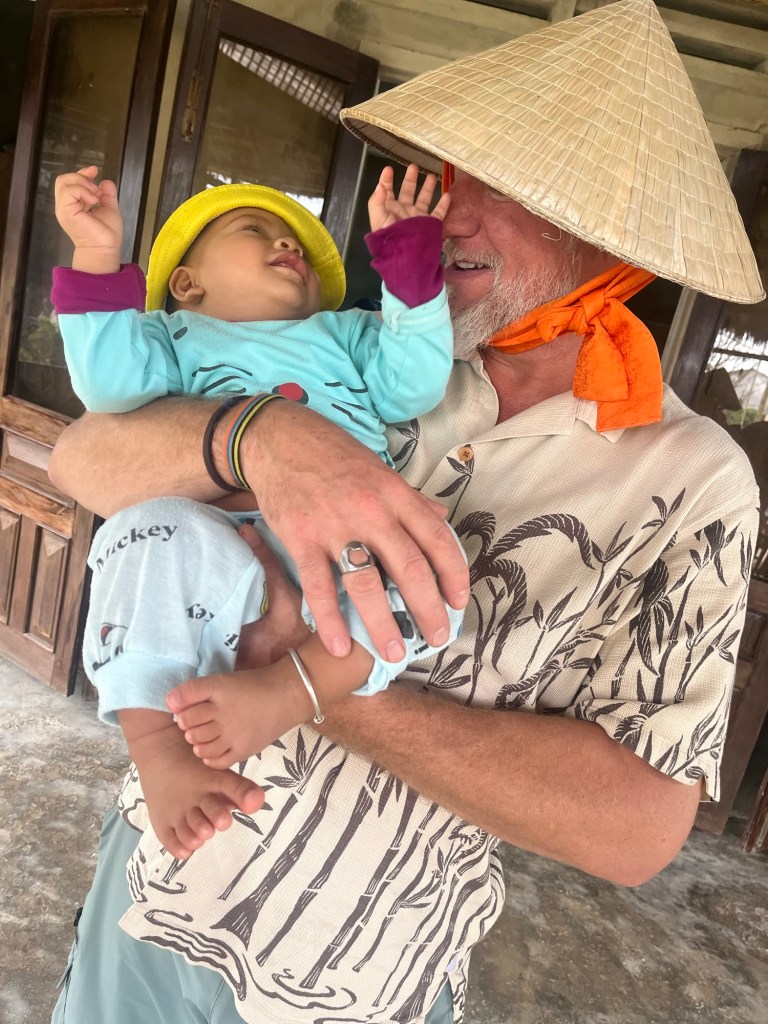
When we arrived we were introduced to the patriarch and matriarch whose names were Bay and Sau (7 and 6 in Viet).
Mac and Bay
They were ~60 , and this was a common naming approach for children born during The American War. Their 5 children were named France, America, Germany, etc.
A tour of the house, revealed some interesting features. It consisted of the two bedrooms, a main room and central shrine, and an outdoor kitchen, and dining rooms. Phap (France) the oldest son and his wife shared a room, and the sister and baby (Tintin) lived in the main room.
Rice Wine (of course)Mac and Hieu (TinTin)
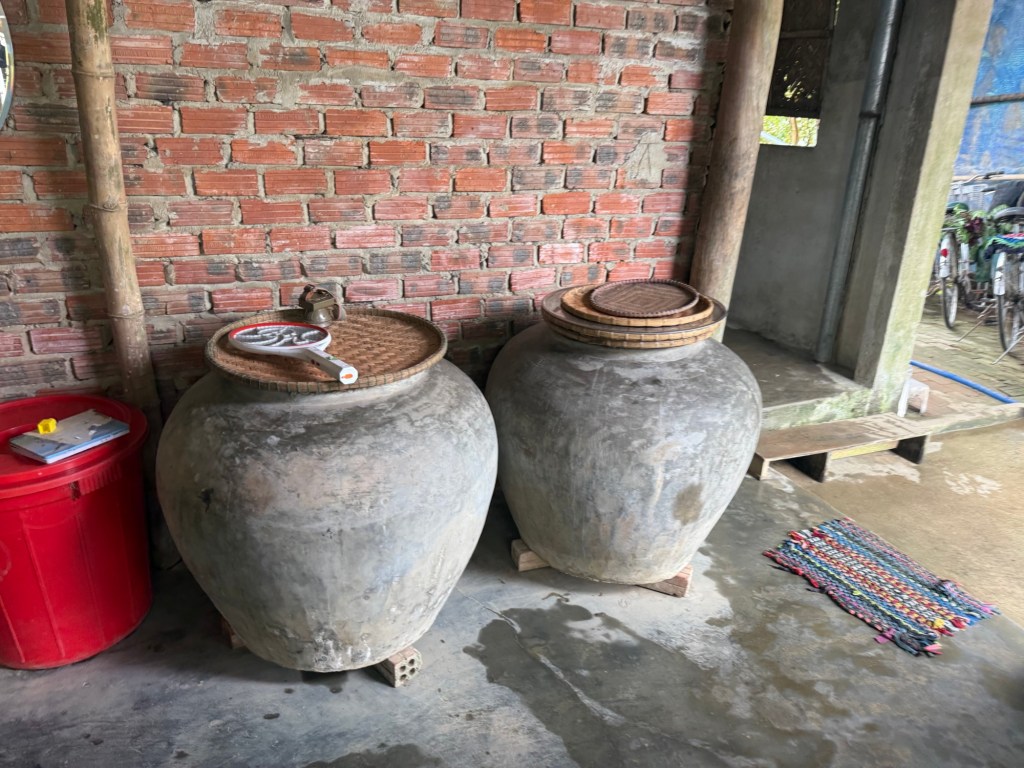
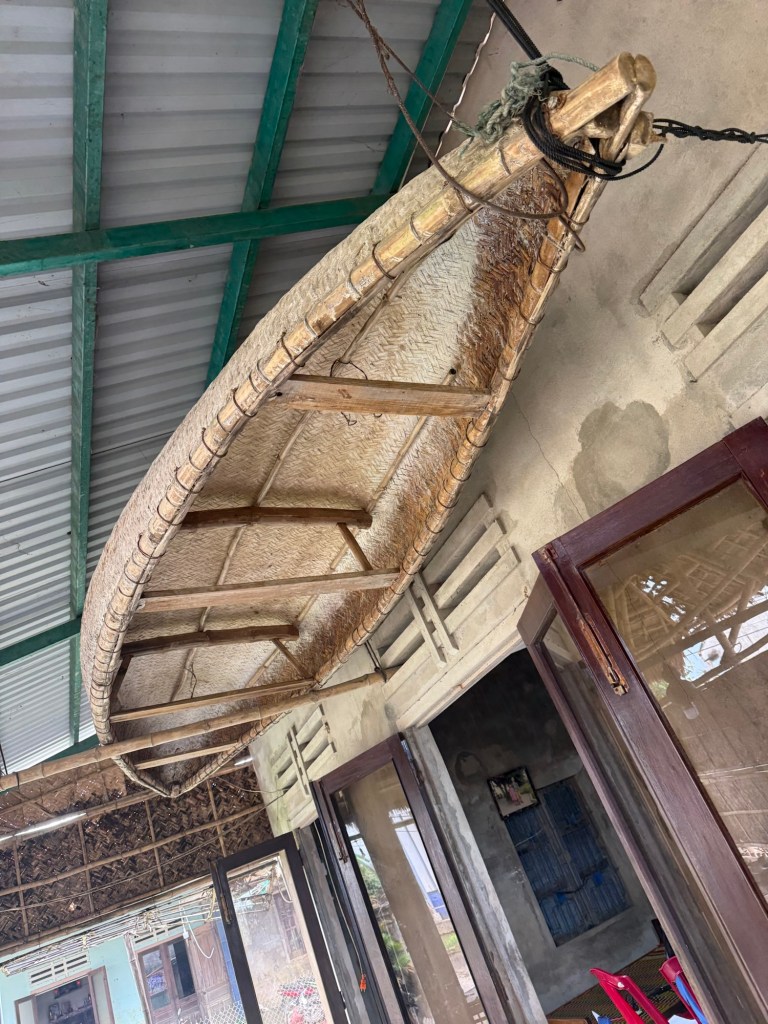
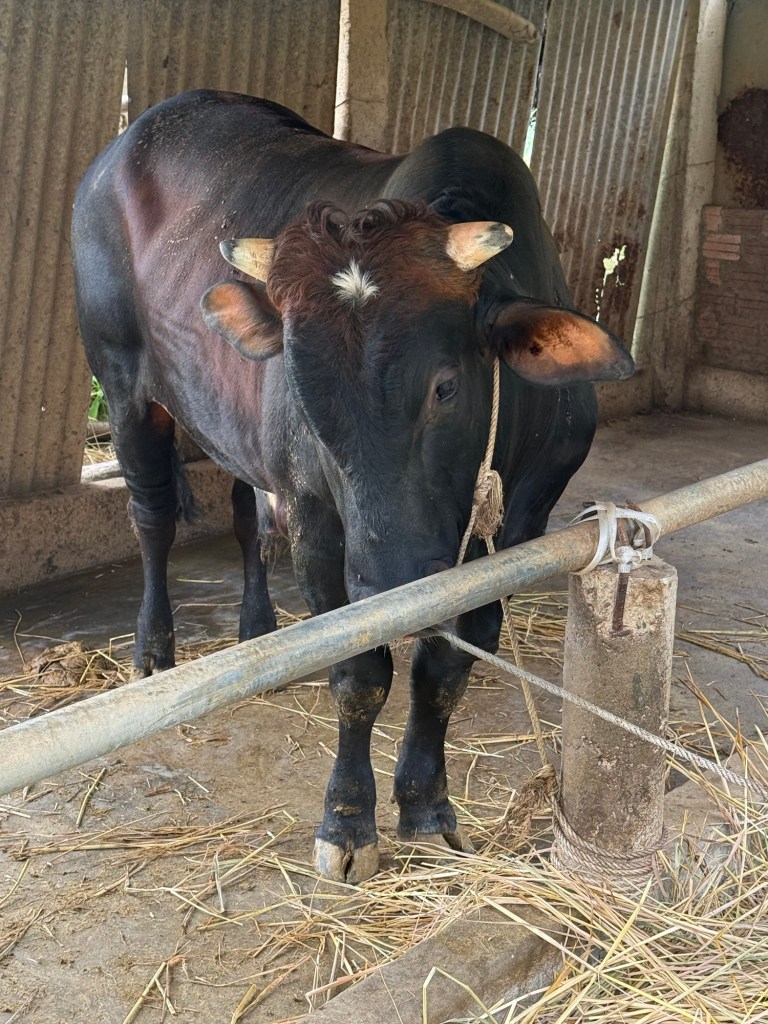
Their home and all the homes in town, included a boat mounted on the ceiling and a flood room, that the family (and the cow) moved into for two months of the year when the water was high. This particular house had a men’s and ladies room, an obvious upgrade to accommodate their tour business.
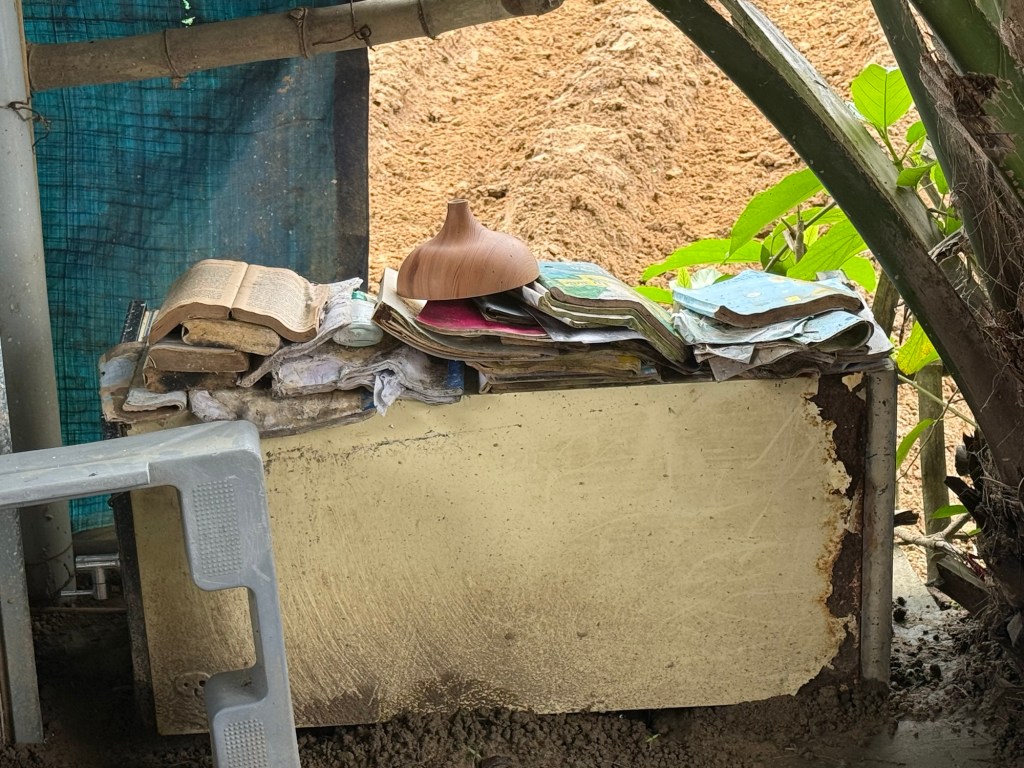
Bamboo Woven Boat (for floods)Records ruined by flood
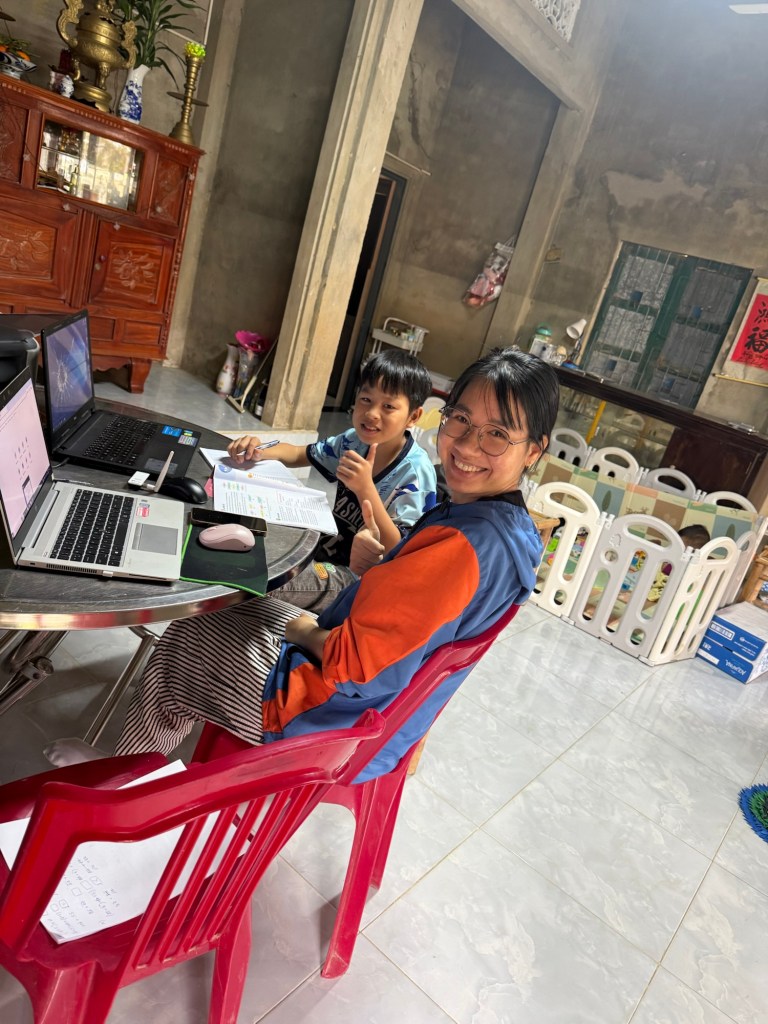
The economics of the household were basically rice farming (including a Party subsidy), a kitchen garden, and a cow. Tien let us know that the tours Phap gave to tourists was also huge part of their living as was the salary for Phap’s wife. She was a teacher, and actively tutoring on a laptop (which seemed wildly out of place) when we arrived. We learned that their other son’s university education cost one cow for two years.
One Year of CollegeSaturday Tutoring…
They treated us like family and Tien like an honored benefactor.
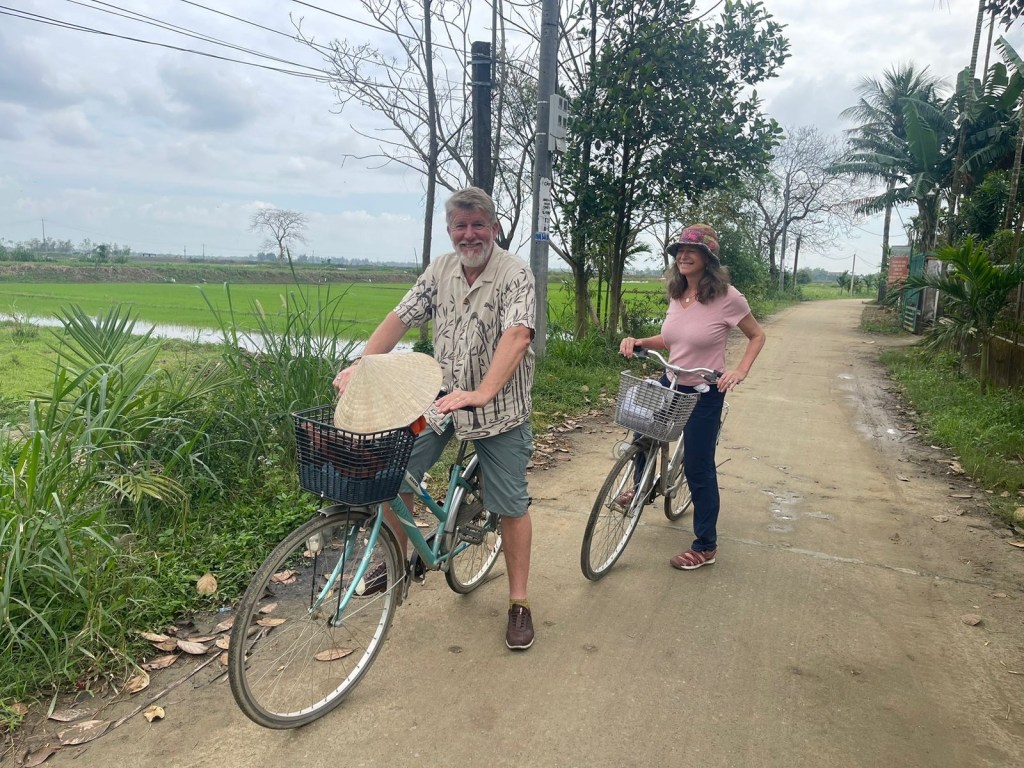
We climbed on rickety bikes and started our tour. It being Saturday, the village was filled with children, following us on their bikes, shouting hello from every house, and giggling at us. It was a pure joy.
Anybody have a wrench I can borrow?
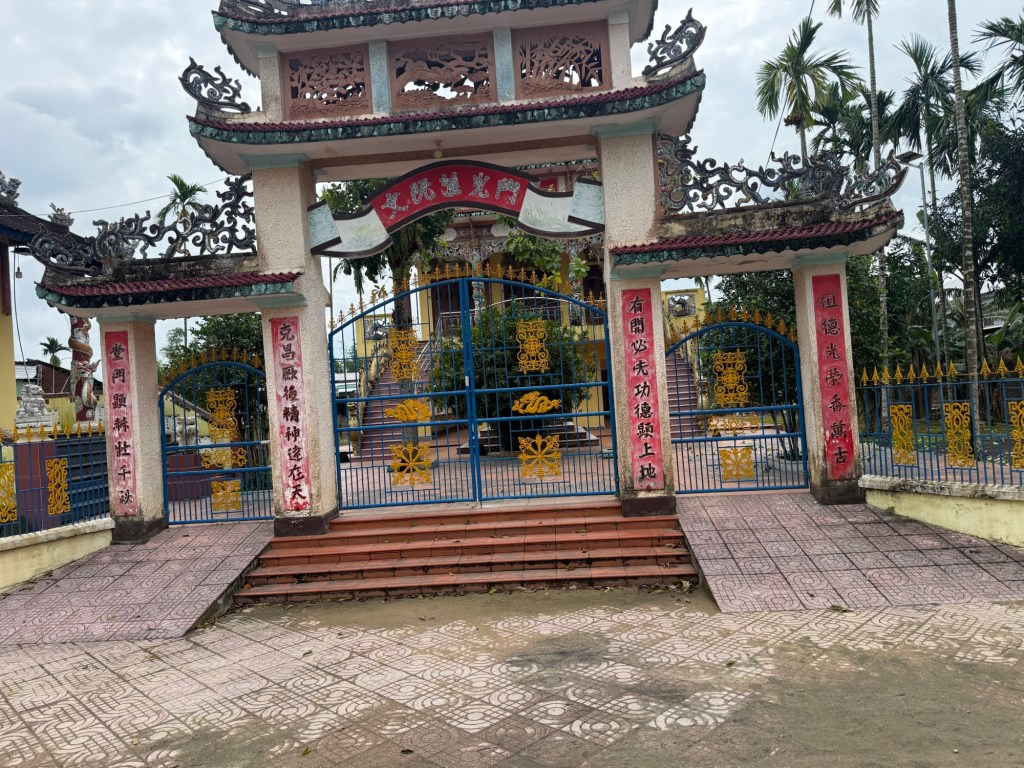
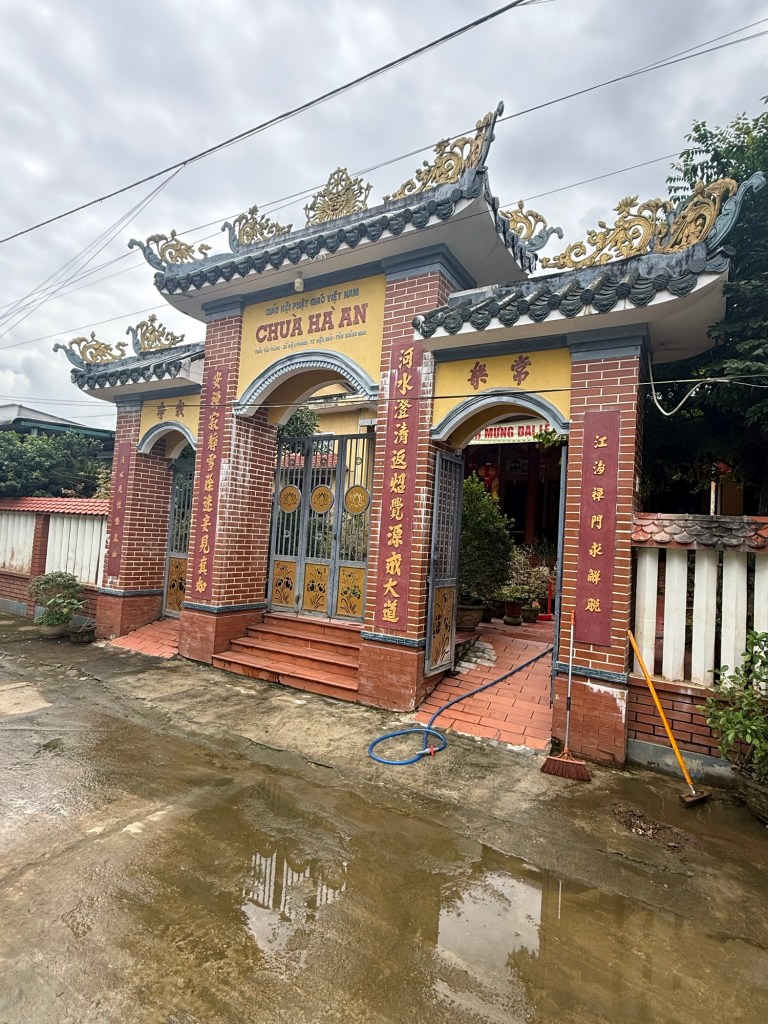
The town was deeply impoverished by western standards with mud roads, homes cobbled together from scrap wood, and trash everywhere. It was disconcerting to see three incredibly wealthy, and ornate temples and two richly appointed monasteries among the modest homes.
Temple in Go NoiBuddhist Monastery for Women Monks
We started a 2 mile ride around the town with Phap working on his English and Tien filling in the gaps. One of the funnier moments was when Tien, a Vietnamese giant at 6’1″ ran into a villager slightly taller than him. A hilarious pissing contest ensued.
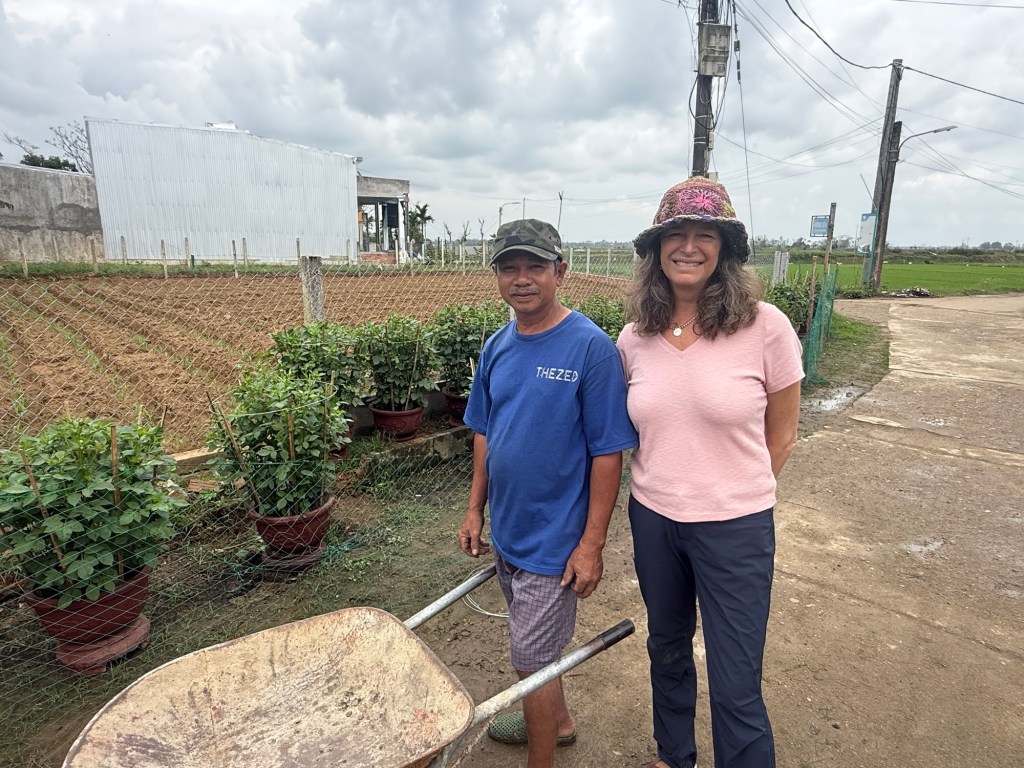
We stumbled onto a Dahlia farm (big tradition in the upcoming Lunar New Year), managed by Hoa, a retired language teacher. Juju geeked out sharing pictures of tubers, Grace’s wedding flowers and getting yet another lesson on VN vowel management.
Dahlia FarmersHating this…LessonsKindred Teachers – JuJu & Hoa (flower)
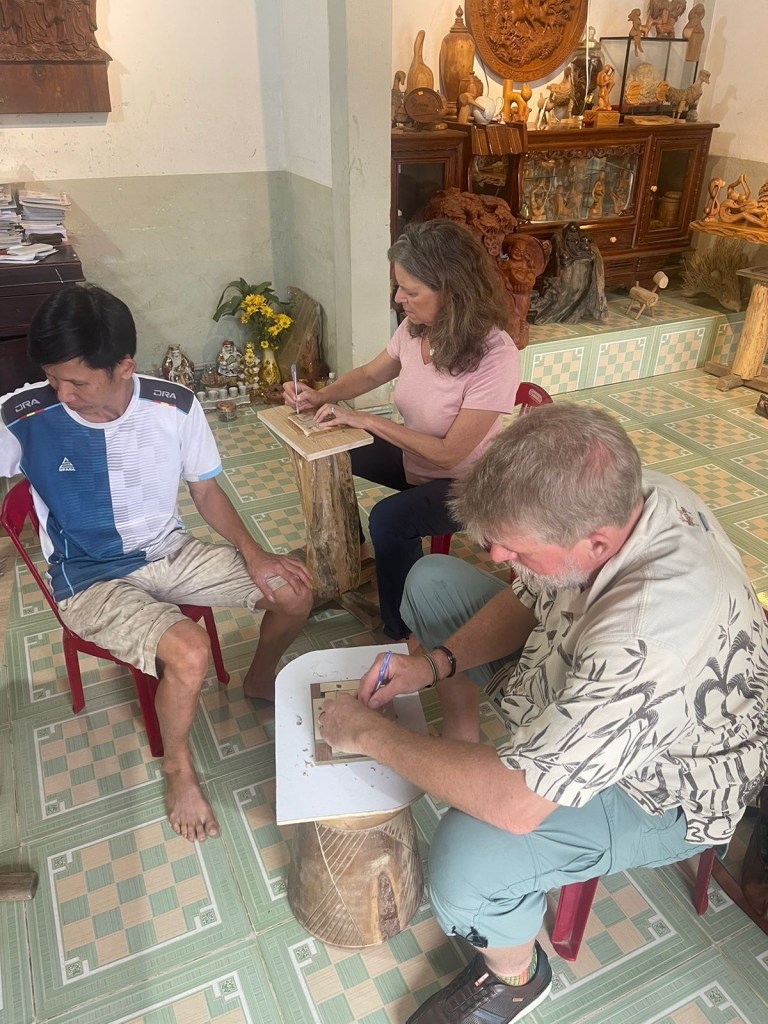
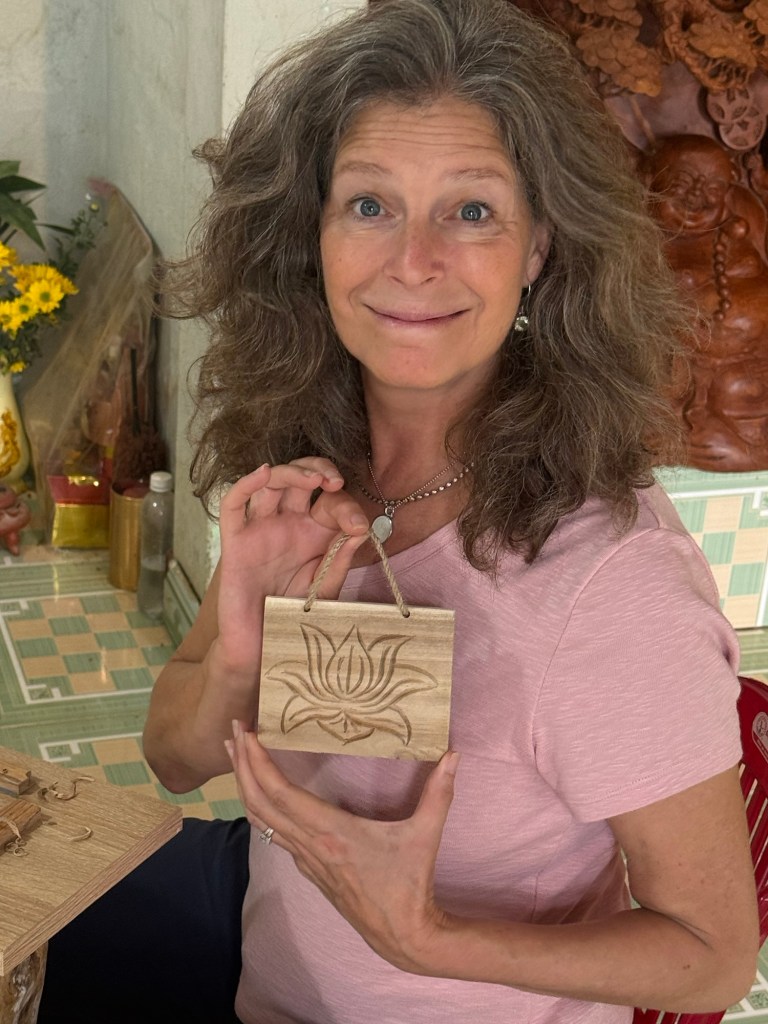
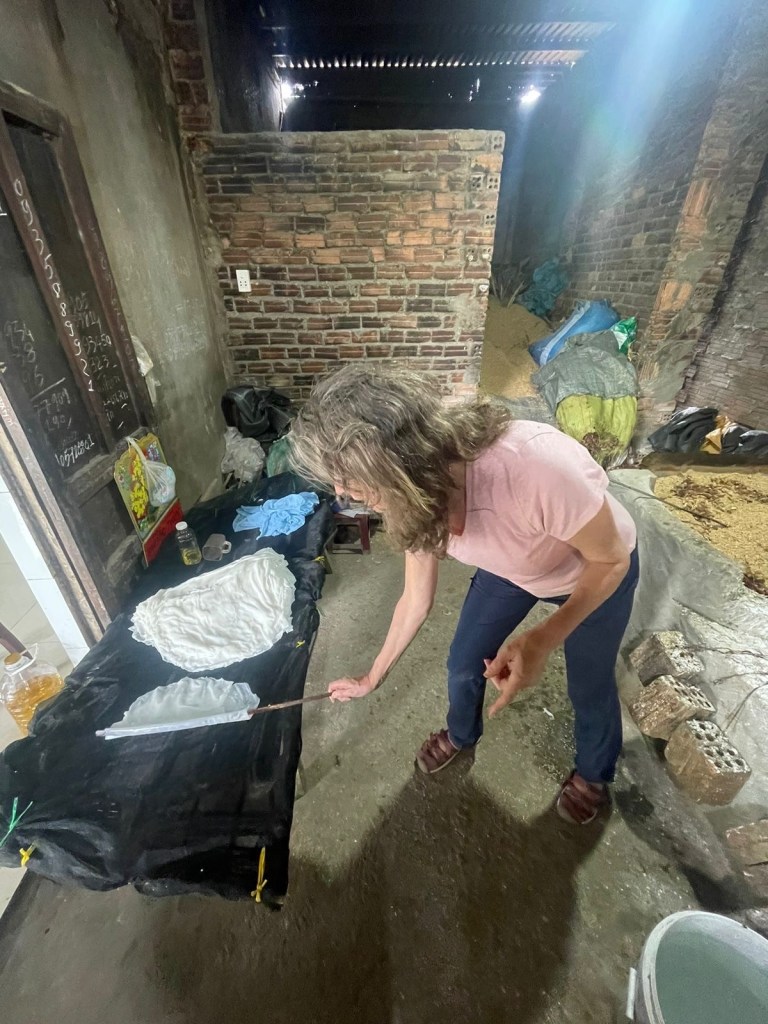
Next we had a few hands on experiences with a wood worker, and a maker of wheat paper/noodles. Really fun.
CraftsmenJuJu’s Lotus Flower
Wheat Paper NoodlesJuju Takes a Turn
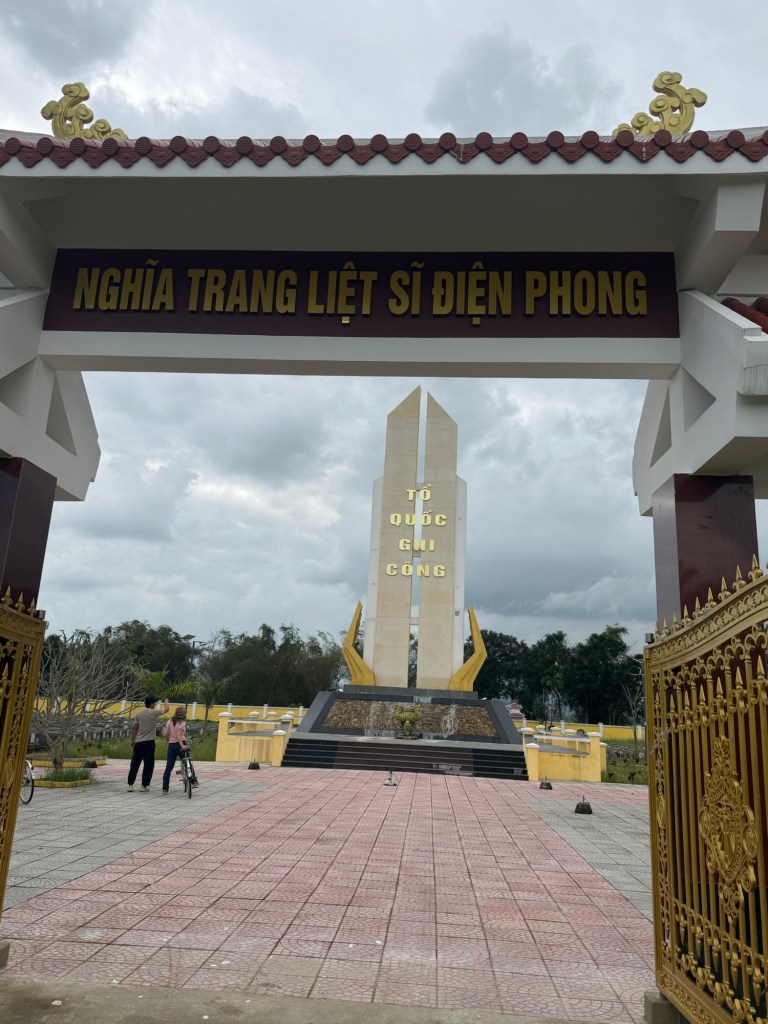
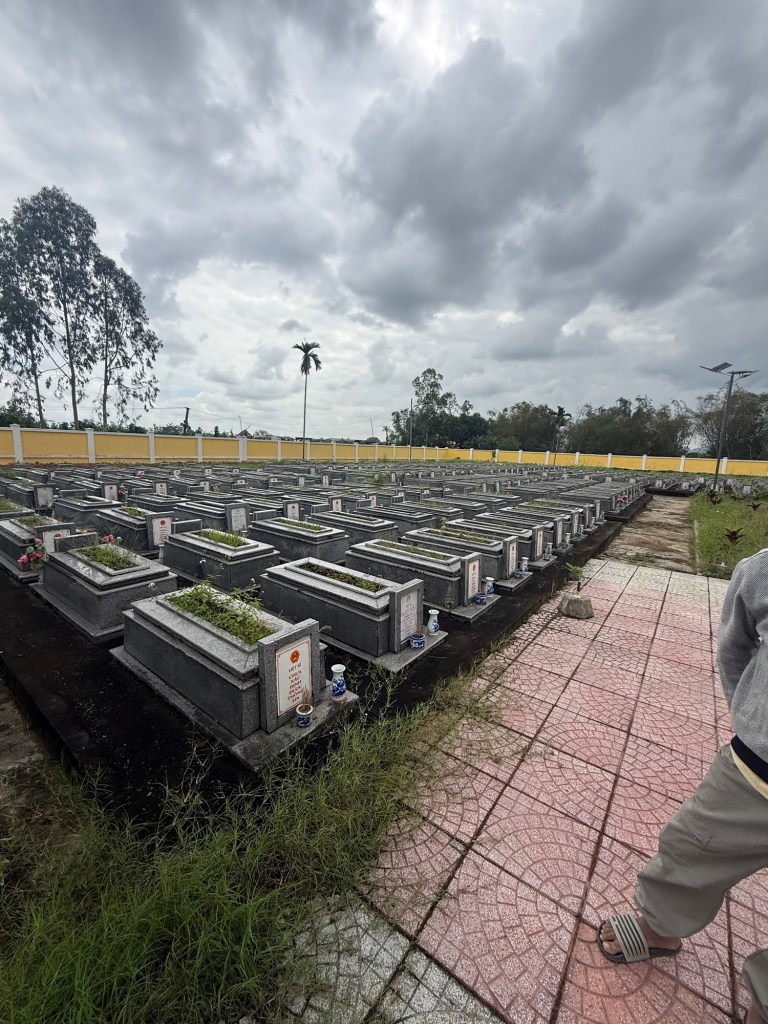
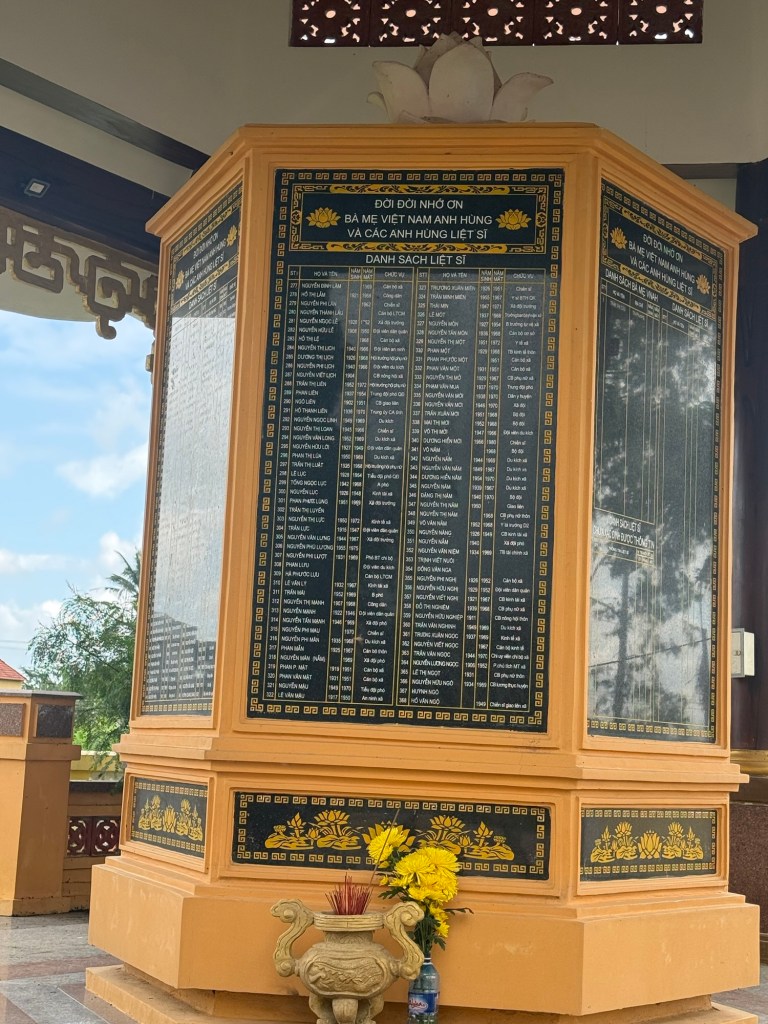
The next stop was not so fun. We visited their American War memorial. The Island was heavily bombed for over a year in 1969. The memorial recognized the 30,000 Viet Cong and citizens that died there.
I mentioned before that our Vietnam War was just one of many bloody conflicts , over a 150 year period. But here it was the one that destroyed their, villages, families and lives. Phap shared several stories about his grandparents (blessedly spared) and their friends and families who were not so fortunate.
“American War” MemorialHonored Viet Cong VeteransList of the Fallen (30,000)
It’s appropriate to remember the disproportionate impact of our war efforts. 282k American and South Vietnamese allies lost their lives. But 628k Viet Cong and over 700k non military were killed, 70% were women and children.
OK. Lunch was a team sport with Hien, our driver, contributing various vegetarian dishes, JuJu and Phap frying crispy pancakes, and Mamma Sau providing an amazing sautéed catfish. I keep saying this, but it was one of the BEST meals ever.
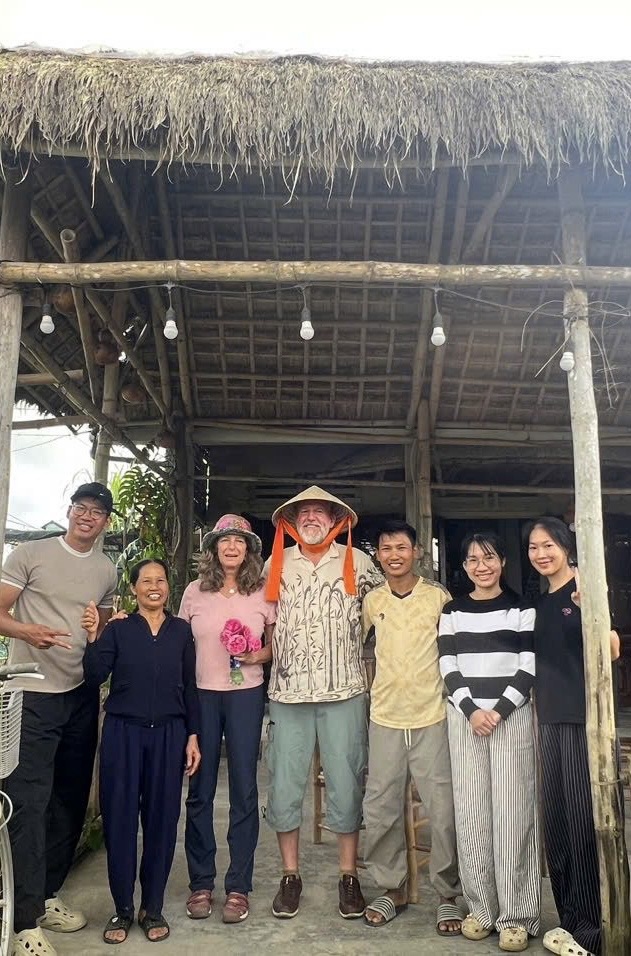
The family helped us record a birthday greeting (chúc mừng sinh nhật) for Grace to wake up to (1/24). And Sau sent JuJu off with a bouquet of roses from her garden.
Go Noi Family
Having a great guide like Tien is invaluable. But it’s also kind of exhausting in terms of activity level and content. It’s difficult to find time to shop and wander, follow your nose, talk to strangers or just chill by the pool.
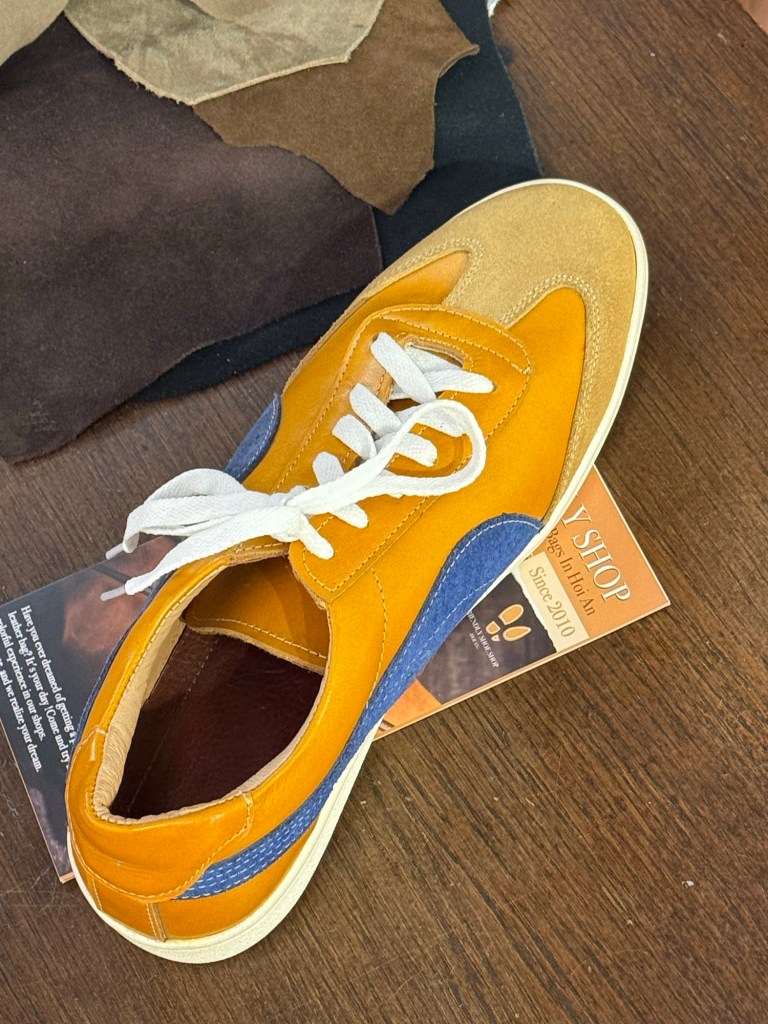
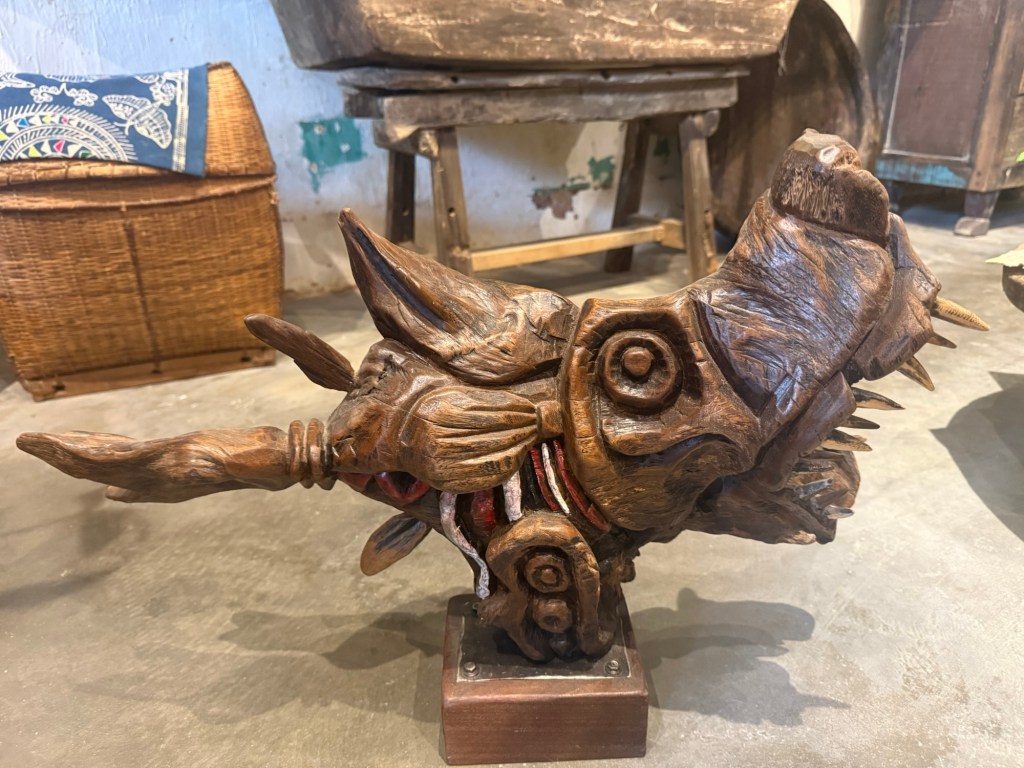
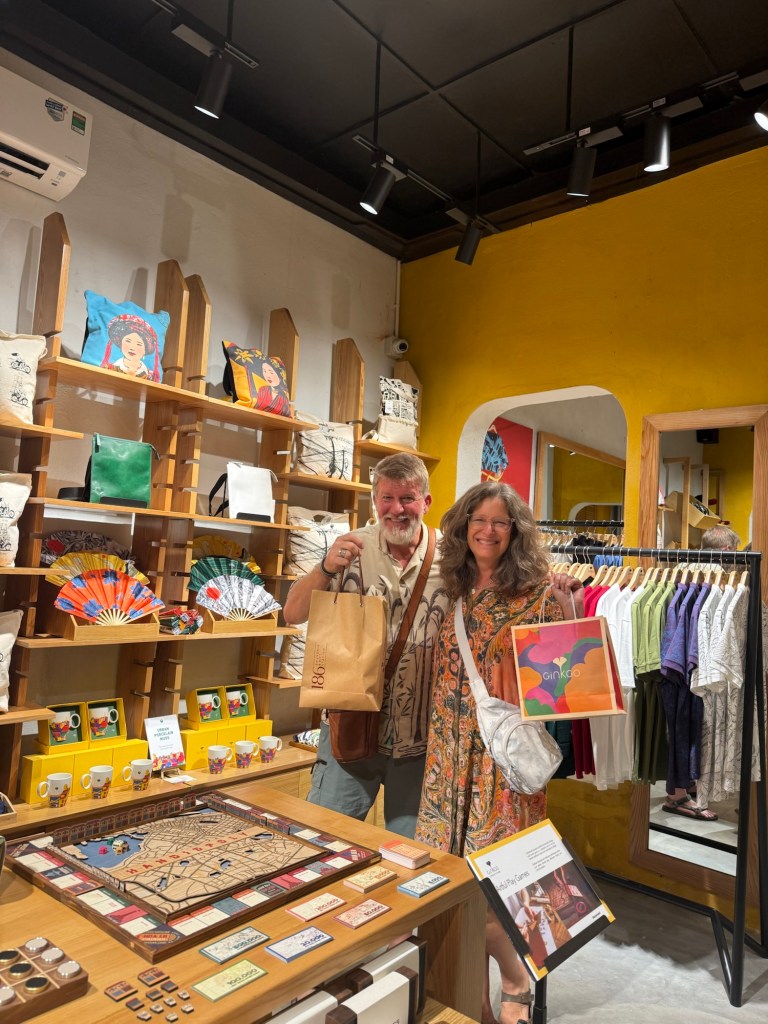
Our last afternoon in Vietnam we cut him loose so we could follow our nose. We bought some gifts for the kids. I picked up my new custom made kicks, and we splurged on some tribal art. We spent some money but I’d guess a fifth of what it would have cost at home.
Custom made knock offsIt’s a fish, really
I finally talked Justine into getting her Ao Dai (pronounced Ow Zigh). This is the traditional, formal dress and trousers of the lady-Vietnamese. Custom made with her fabrics of choice for $35 (and done in 12 hours.)
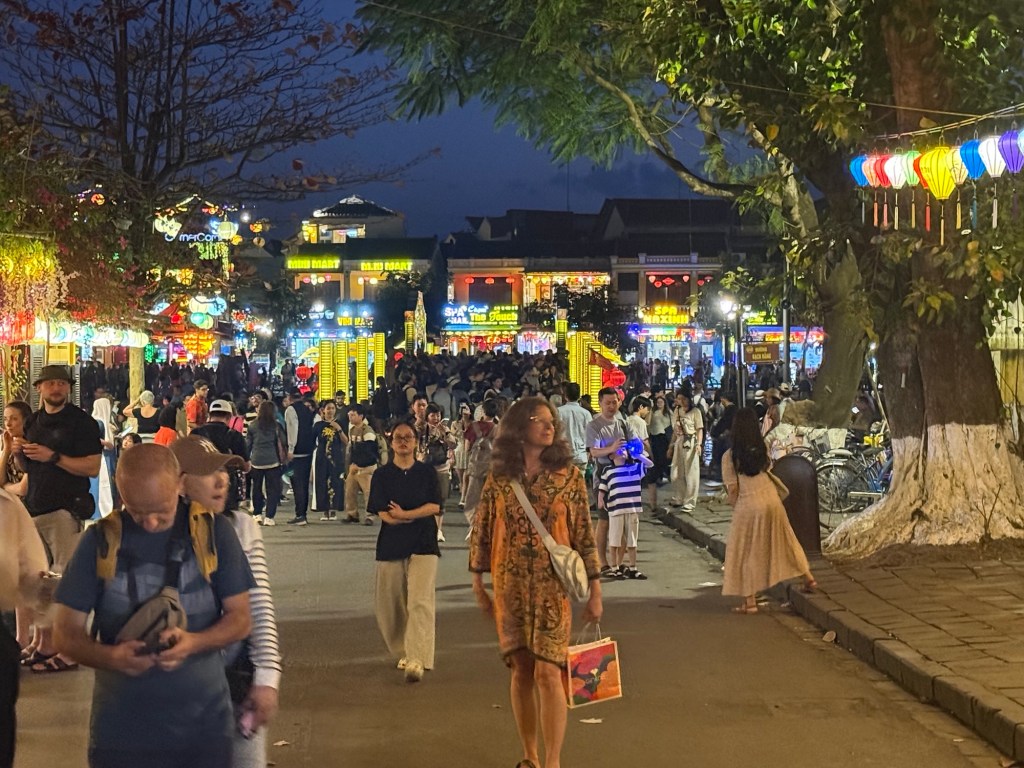
To close out our time in Vietnam we returned to Hoi An’s Old Town. It was mobbed with tourists, selfie-obsessed 20 somethings, and hard drinking Eastern Europeans.
Old TownDemure or ObnoxiousKid Stuff
We popped around the shops, grabbed a sidewalk seat, and settled in for some people watching. Just sitting still for a drink (or three) we met some wonderful people and shared some amazing life experiences.
Tomorrow we pack, pick up JuJu’s Ao Dai, chill some more, and then head to Da Nang for our flight to Siem Reap, Cambodia and the Angkor Wat temple complex.
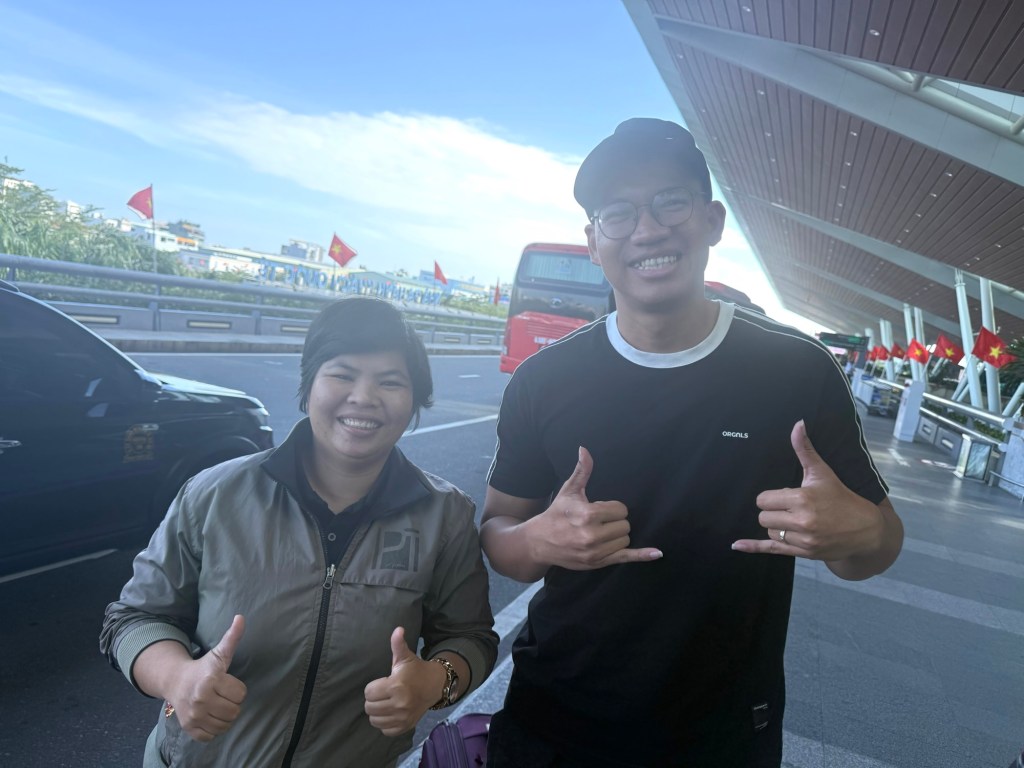
 Mac and Juju explore Southeast Asia